Warm regions near the equator may have offered crocodile relatives a refuge when an asteroid ended the age of non-avian dinosaurs. Their long-standing preference for warmth could have placed surviving populations where suitable climates endured through the catastrophe and its prolonged environmental aftermath. That possibility emerges from research tracing their changing geography across nearly a quarter-billion years.
The study, led by University College London researchers and published in Science Advances, combines fossils with reconstructed climates and evolutionary relationships. Its central finding challenges the familiar image of crocodiles as unchanged survivors. Their ancestors changed enormously in shape and lifestyle, while largely retaining a preference for warm environments.
“The asteroid did not make the whole planet equally hostile to every group,” said lead author Alfio Alessandro Chiarenza of UCL Earth Sciences. His team found that tropical and subtropical climates remained suitable in most simulated impact scenarios. Those results identify a possible survival mechanism, rather than proving precisely where every surviving population lived.
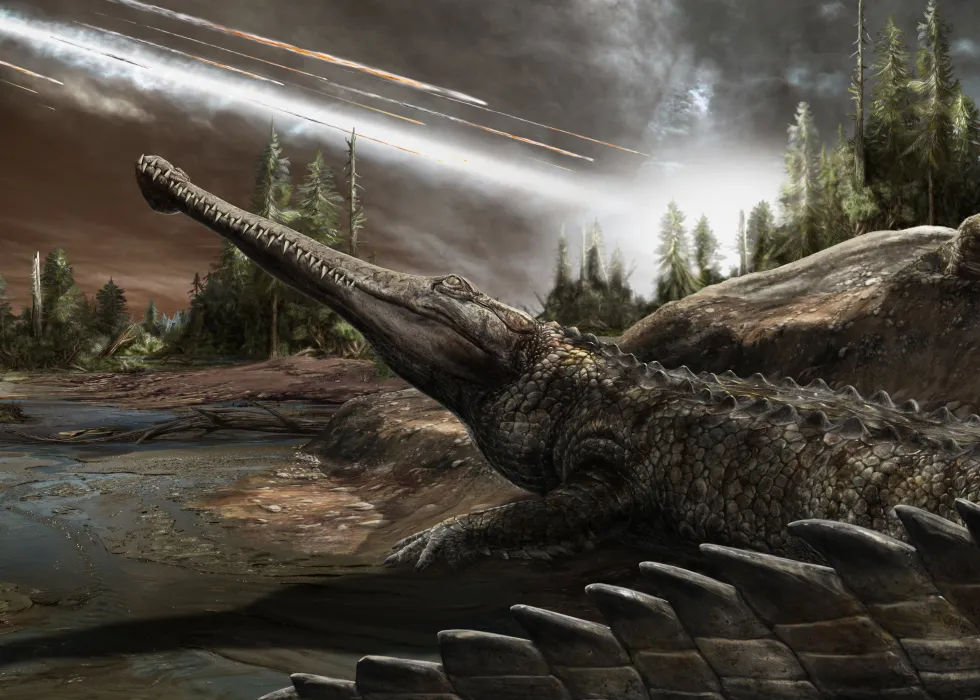
The wider crocodile lineage, called Pseudosuchia, originated about 250 million years ago, near the split from the lineage leading to dinosaurs and birds. Its history includes heavily armored plant eaters, land predators and animals weighing more than a tonne. Living crocodiles, alligators, caimans and gharials represent only a small part of that former diversity. The wider lineage persisted through two of Earth’s five major mass extinctions, despite losing many individual branches.
Across this history, geographical movement appears to have mattered more than repeated adaptation to unfamiliar climates. During warm intervals, suitable environments spread toward the poles, and crocodile relatives expanded with them. Cooling pushed those environments back toward lower latitudes, narrowing the animals’ potential range.
The early Eocene, around 50 million years ago, provides a striking example. Crocodile relatives occupied high-latitude regions of North America, Europe and even Antarctica during that warm interval. Their presence there reflected a different planetary climate, rather than evidence that they could tolerate modern Antarctic conditions.
As Earth cooled over subsequent millions of years, the models show suitable climates contracting toward the tropics. Fossil distributions broadly follow those changes, linking geographical expansion and retreat to the availability of warmth. The pattern suggests that modern crocodilians’ tropical distribution has deep evolutionary roots. It also separates a stable environmental preference from the changing continents and coastlines across which successive generations spread.
The researchers assembled more than 7,000 fossil occurrence records and an evolutionary tree containing over 400 living and extinct species. They also incorporated 130,000 vetted records showing where living crocodilians occur. Their analysis focused on non-marine members of the lineage, excluding fully marine forms.
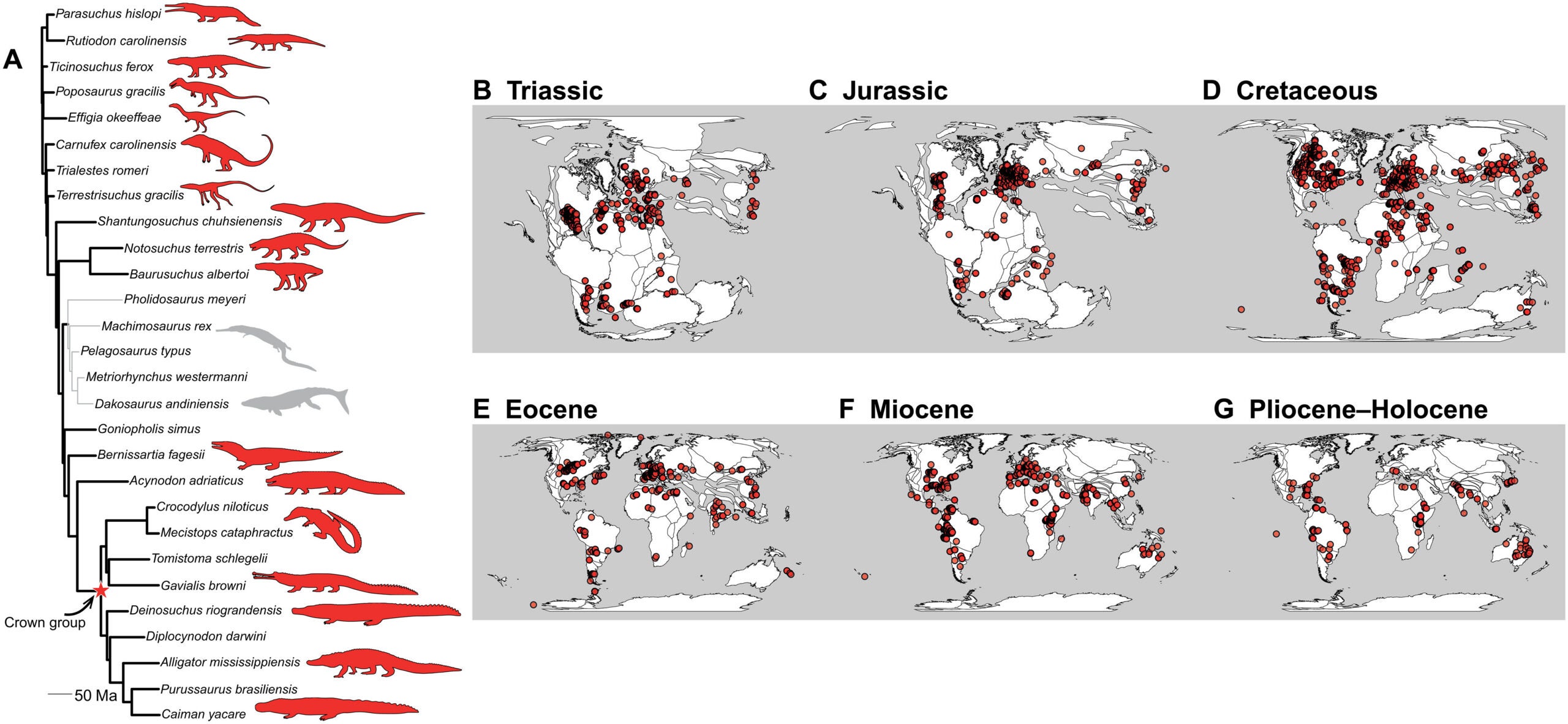
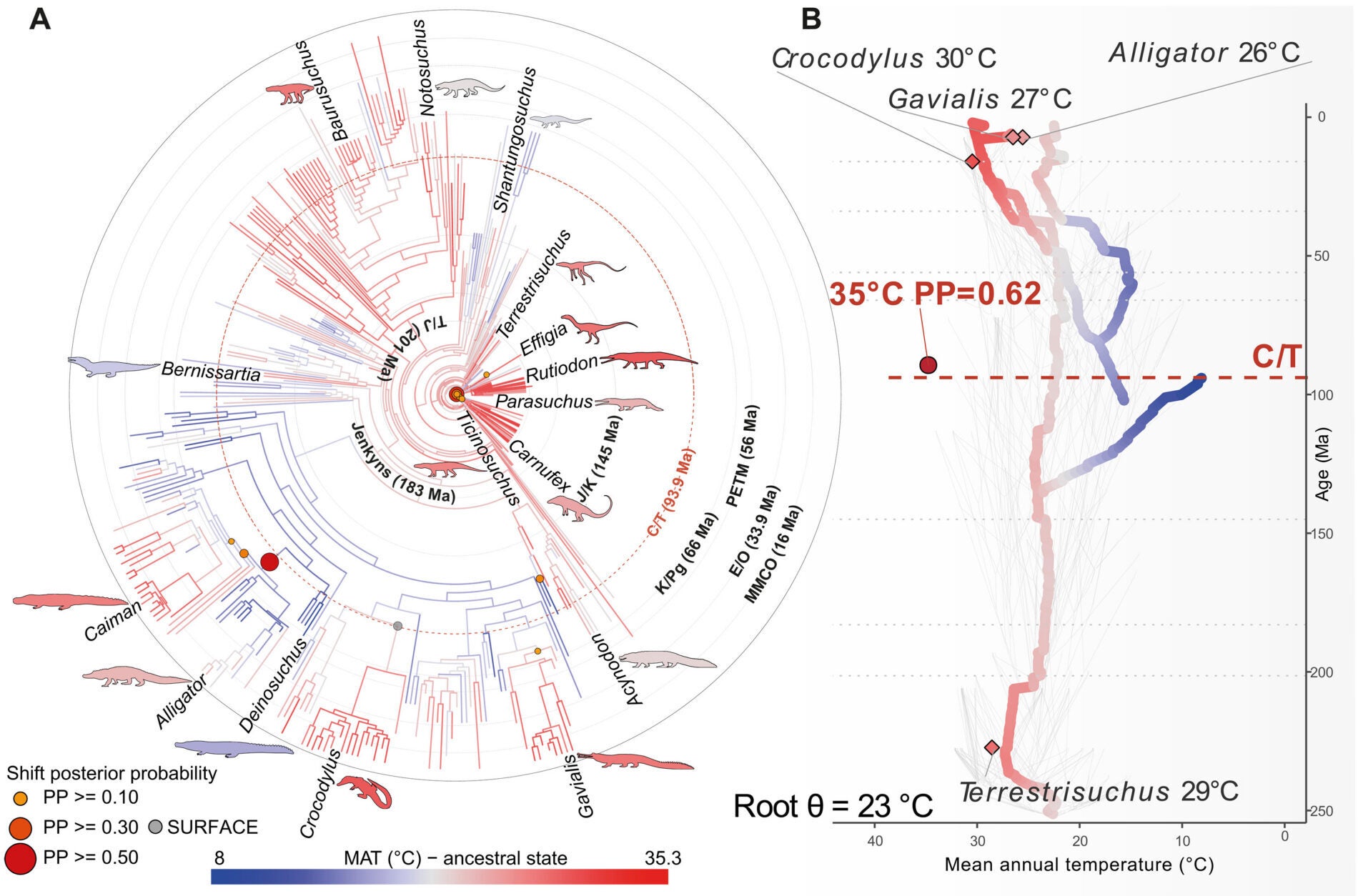
One modeling approach used modern distributions to identify combinations of temperature and rainfall associated with living species. The team projected those relationships onto 52 reconstructions of ancient global climates, spanning about 245 million years. A second approach used evolutionary relationships to reconstruct ancestral climate preferences and map their possible geographical expression.
Agreement between these approaches strengthened the broad picture of animals tracking suitable environments. Both generally recovered poleward expansions during warm phases and retreats toward the equator during cooler ones. The fossil record supplied an additional check on whether the modeled geography resembled documented distributions. Agreement across these different lines of evidence matters because living species alone reveal only the environments occupied by today’s survivors.
These estimates describe climatic suitability, rather than complete reconstructions of ancient habitats or direct measurements of extinct animals’ physiology. Food, waterways, competition and opportunities to disperse could also determine whether a species occupied a suitable region. A favorable climate therefore marks a possible place to live, without establishing that animals actually lived there.
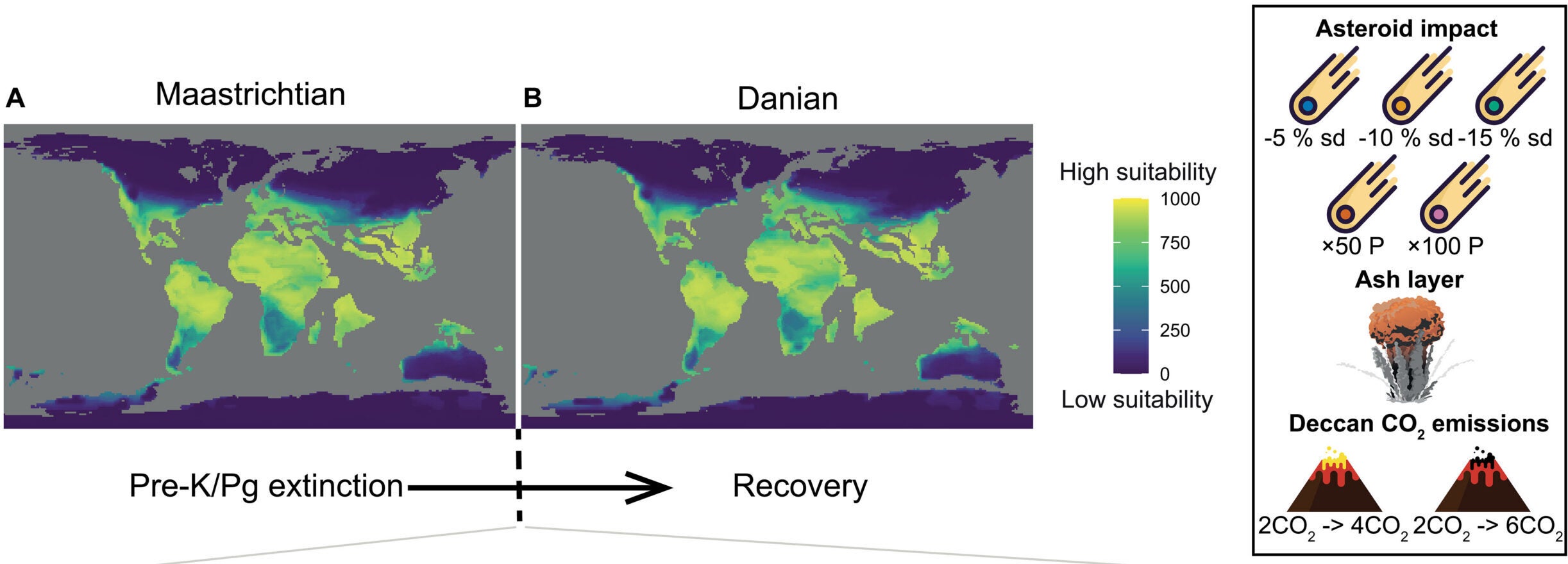
The team separately examined the aftermath of the Chicxulub impact, which struck 66 million years ago. Those simulations explored climate changes over decades to centuries, including reduced sunlight and volcanic carbon dioxide emissions. They asked whether the crocodile lineage’s reconstructed climate preferences left any suitable regions during the disruption.
With sunlight reduced by 5% or 10%, warm areas near the equator remained climatically suitable. Only the most extreme scenario, a sustained 15% reduction, eliminated suitable climates worldwide. The authors describe that prolonged level of dimming as beyond most estimates, rather than their preferred reconstruction of the impact winter.
Volcanic carbon dioxide increased the geographical extent of suitable climates in the simulations. Combined impact and volcanic scenarios also retained suitable regions, allowing a possible route to recovery from low latitudes. Earlier work involving members of the team found much more severe losses of modeled climatic suitability for non-avian dinosaurs.
“Crocodiles’ long-standing preference for warm environments may have placed survivors exactly where suitable climates held up best, like around the equator,” Chiarenza said. “These refuges could have sheltered populations that later recovered and radiated out.” The explanation concerns the survival of particular lineages, rather than suggesting every crocodile relative escaped extinction.
The findings do not mean climate preferences never evolved. Around 94 million years ago, during the Cretaceous Thermal Maximum, one branch shifted toward hotter conditions. Different analytical methods placed that change on somewhat different branches, so its precise evolutionary location remains uncertain.
A separate change occurred around 34 million years ago in an extinct Australasian group known as mekosuchines. These animals shifted toward drier conditions as Australia became more arid. Temperature and rainfall preferences therefore changed at different times, showing that the two environmental relationships could evolve independently.
Those exceptions sit within a broader pattern scientists call climatic niche conservatism: related species tend to retain ancestral environmental preferences. The term describes an evolutionary pattern, without identifying a single underlying cause. Physiological limits, evolutionary trade-offs and selective extinction could all help produce it. Establishing which of those processes mattered most remains a separate question from identifying the geographical pattern itself.
The authors stress that climate cannot fully explain survival through the mass extinction. Smaller bodies, flexible diets, semi-aquatic lifestyles and the low energy demands of ectothermic animals probably also contributed. Aquatic food webs supported by decaying organic material could have helped survivors when the collapse of photosynthesis disrupted other food supplies.
Important uncertainties also remain in the reconstruction itself. Fossil preservation and sampling vary across regions, and the two approaches disagree at some geographical margins. Ancient climates unlike those experienced by living species make projections less reliable, especially in the earliest intervals studied. Better fossil sampling could help test predicted suitable regions where physical evidence is currently sparse.
The deep-time climate maps also use roughly five-million-year intervals, leaving shorter changes unresolved outside the separate impact simulations. Even so, the broad pattern carries a clear conservation implication: persistence depended partly on access to suitable places. As UCL co-author Philip Mannion emphasized, roads, farms and cities can obstruct the movements living species may need as climate changes.
These resources explore ancient climate preferences, crocodile evolution and the environmental disruption following the asteroid impact.
First ‘warm-blooded’ dinosaurs may have emerged 180 million years ago
This institutional account explains evidence for different climate preferences among major dinosaur groups and their possible connection to body-temperature regulation. (University College London, May 2024)
Decoupling speciation and extinction reveals both abiotic and biotic drivers shaped 250 million years of diversity in crocodile-line archosaurs
An evolutionary analysis separates the influences of environmental conditions and biological interactions on the formation and disappearance of species. (Nature Ecology & Evolution, December 2023)
Chicxulub impact winter sustained by fine silicate dust
This modeling study examines how fine dust from the asteroid impact could have prolonged darkness and cooling. (Nature Geoscience, October 2023)
Asteroid impact, not volcanism, caused the end-Cretaceous dinosaur extinction
Climate and habitat simulations compare the potential effects of the asteroid impact and Deccan volcanism on non-avian dinosaurs. (Proceedings of the National Academy of Sciences, June 2020)
Climate constrains the evolutionary history and biodiversity of crocodylians
This earlier study connects crocodilian diversity and geographical distributions with long-term climate changes. (Nature Communications, September 2015)
Research findings are available online in the journal Science Advances.
The original story “Scientists discover how crocodiles survived the asteroid that killed the dinosaurs” is published in The Brighter Side of News.
Like these kind of feel good stories? Get The Brighter Side of News’ newsletter.
The post Scientists discover how crocodiles survived the asteroid that killed the dinosaurs appeared first on The Brighter Side of News.


Leave a comment
You must be logged in to post a comment.