The swirling sky in Vincent van Gogh’s The Starry Night may preserve a recognizable arrangement of celestial objects. A research team proposes that its crescent Moon, Venus and central stars resemble the sky before dawn around July 22, 1889. The suggestion creates a puzzle because the painting is conventionally dated a month earlier.
Published in Scientific Reports, the study was led by Elijah Jeong-hyun Kim, of robotic telescope company SLLAB and Kyung Hee University’s School of Space Research. The researchers argue that astronomical clues deserve closer attention alongside historical documents. Their analysis identifies a possible observational source, rather than establishing the day Van Gogh painted or finished the canvas.
The Museum of Modern Art, which holds the painting, still lists its date as June 1889. Its account already describes a combination of observation and artistic transformation. The new hypothesis therefore concerns which real sky may have informed the composition, rather than whether Van Gogh simply copied nature or invented everything.
Attempts to identify the painting’s sky go back decades. Art historian Albert Boime and astronomer George Abell investigated the question in the 1980s, followed by astronomer Charles Whitney. Their interpretations differed, leaving uncertainty about how the painted objects corresponded to the heavens.
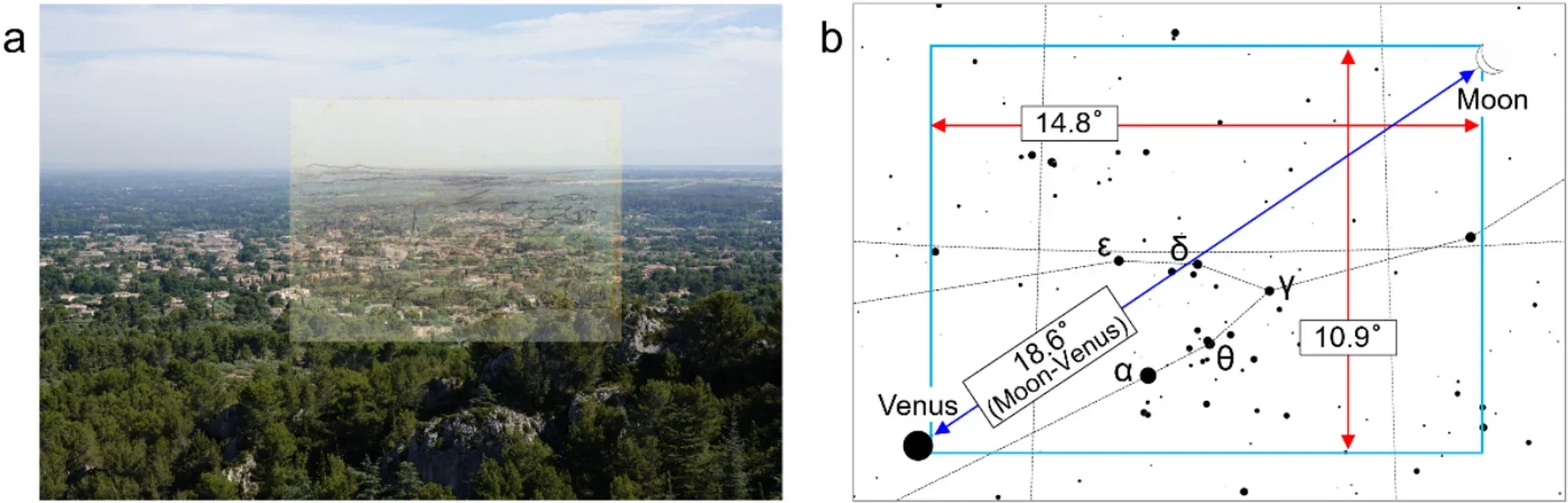
Kim’s team approached the problem by combining several kinds of evidence. Computer simulations reconstructed historical skies above Saint-Rémy-de-Provence, where Van Gogh stayed at Saint-Paul-de-Mausole. Landscape surveys and a related drawing helped the researchers estimate a possible viewing frame.
The drawing suggested a relatively narrow field of view, approximately 18.4 degrees across its diagonal. The researchers applied that frame to candidate skies containing the Moon and Venus. This step depends on the interpretation that the landscape drawing and painted sky share a useful visual scale, rather than a known camera setting.
Under those constraints, the team favored a late-July arrangement that included the Hyades star pattern in Taurus. Venus appeared toward one corner, the Moon toward the opposite corner and the stellar pattern nearer the center. The proposed observing location and viewing geometry remain parts of the reconstruction, not documented measurements by Van Gogh.
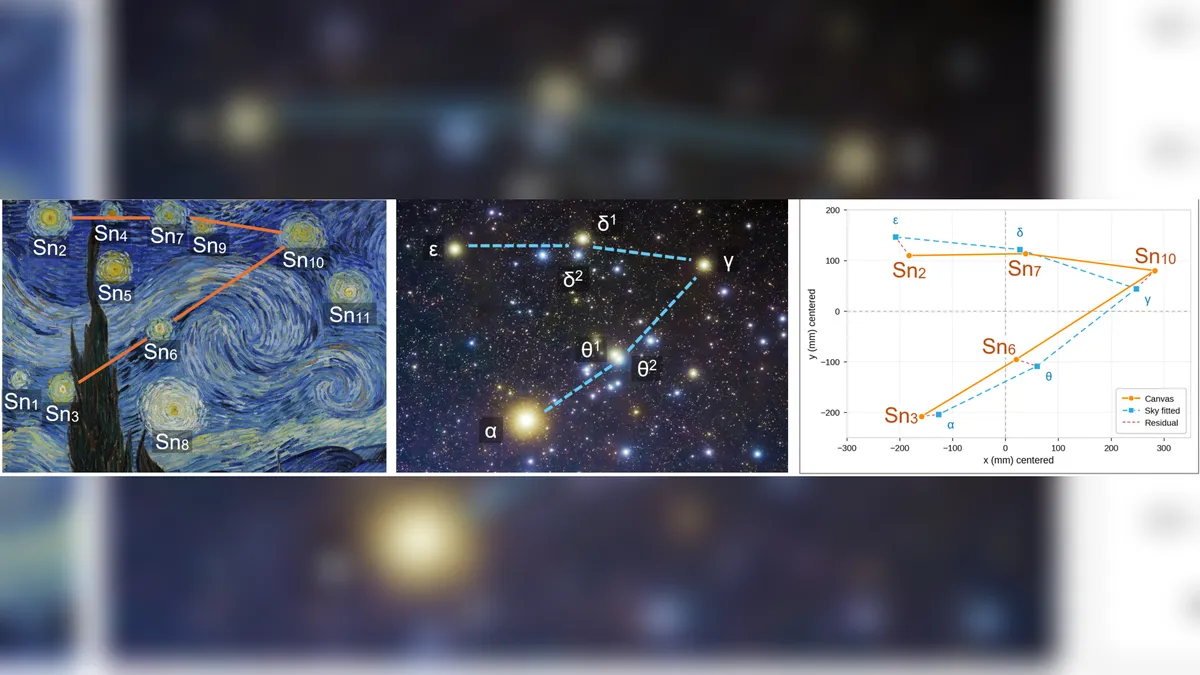
To assess the central stars, the researchers used Procrustes analysis. This technique aligns two sets of points after adjusting their position, rotation and overall size. The remaining differences indicate how closely their shapes resemble one another. Adjusting those features lets researchers compare an enlarged artistic composition with a real star pattern without demanding identical placement on the canvas.
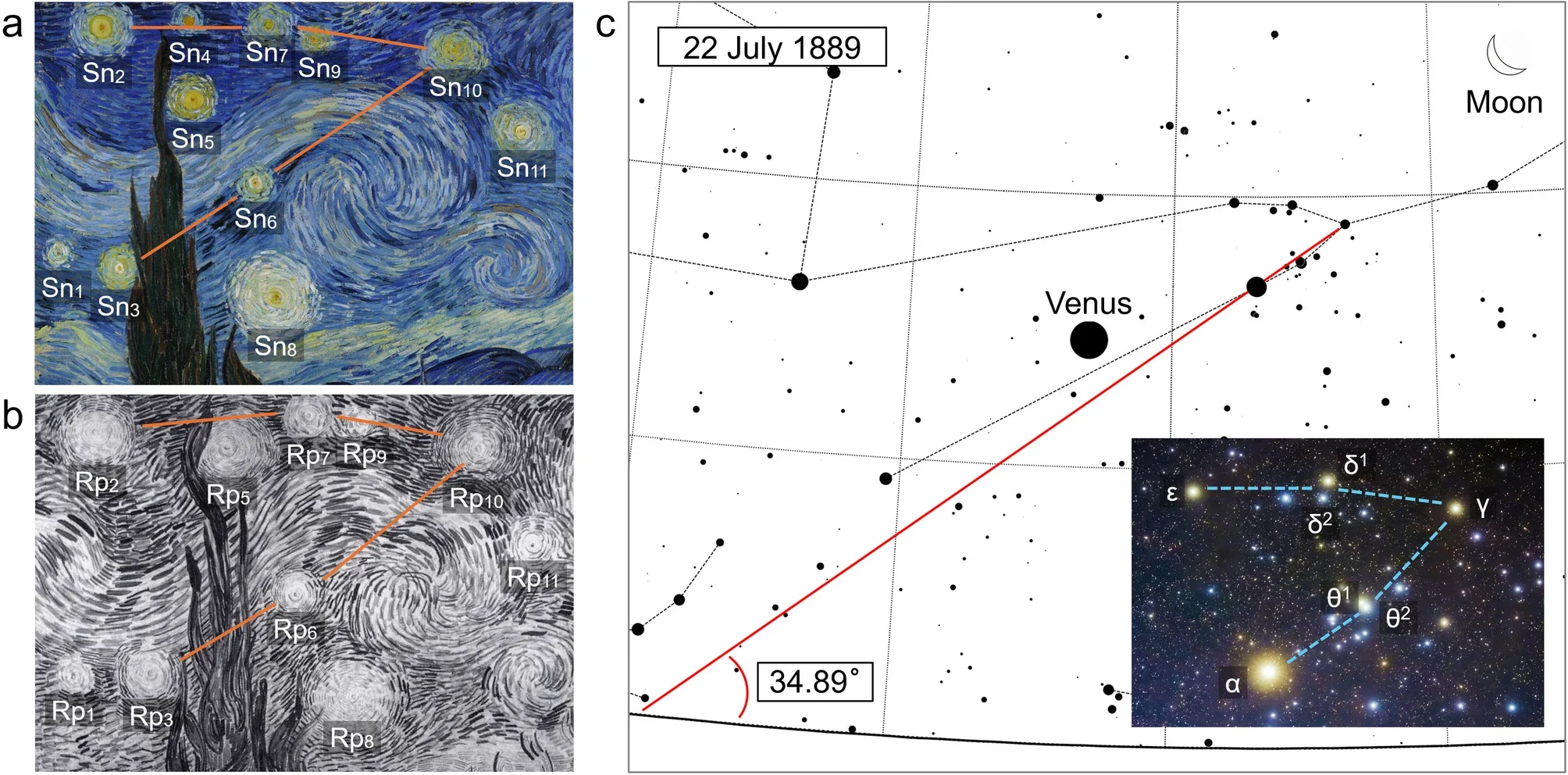
“Because a star cluster on the canvas may be larger or smaller than in reality and slightly tilted, this method was the right fit,” Kim told Space.com. The team compared five selected points in the painting with the proposed celestial pattern. A corresponding analysis examined Van Gogh’s related black-and-white replica drawing. Its stronger resemblance supports the authors’ interpretation of a recognizable pattern, but cannot establish when the original observations were made.
For the painting, the normalized shape discrepancy was 8.17%, with a smaller discrepancy in the drawing. Those values describe a geometric comparison under the researchers’ method. They do not represent the probability that the July date is correct or show that the entire painted sky is an exact reproduction.
The study itself demonstrates why shape matching alone cannot settle the identification. Other constellations produced comparable or smaller discrepancies, especially when fewer points were selected. Researchers rejected those alternatives using additional conditions, including sky direction, stellar brightness, Venus’s identity and the proposed viewing frame. The interpretation consequently rests on the combination of constraints, not on a pattern-fitting score considered separately from its historical setting.
The Moon provides one of the clearest differences between candidate dates. In the team’s simulation for June 19, more than half of its visible disk was illuminated. That shape differs from the pronounced crescent depicted in the painting.
On July 22, the simulated Moon was a waning crescent with about 28% illumination. At 3 a.m. local mean time, its separation from Venus was approximately 18.6 degrees. That configuration closely matched the reconstructed viewing frame, with the Hyades pattern also falling inside.
Neighboring mornings produced different arrangements. The Moon and Venus were farther apart on July 21 and much closer on July 23 and 24. The authors therefore identify the sky around July 22 as their preferred configuration, while allowing that impressions from several nights could have contributed.
Local mean time is important here because it differs from the civil clock conventions visitors use in France today. The reported hour describes the historical simulation’s reference system. The result also does not imply that Van Gogh predicted the alignment or deliberately selected a date in advance.
A letter dated June 18, 1889, refers to a new study of a starry sky. That reference is central to the established chronology. The researchers argue that it documents the work’s existence without conclusively establishing when painting stopped.
They propose that Van Gogh could have begun the composition in June and continued or revised it after observing the July sky. However, an absence of a clear completion statement does not establish that later work occurred. The study explicitly leaves the start date and any subsequent reworking unresolved.
The team also reexamined correspondence about Van Gogh’s illness and compared references to wind with weather observations. These indirect clues were intended to test whether late-July observation was historically possible. The authors acknowledge that no surviving contemporary clinical record fixes the relevant illness onset precisely. Nineteenth-century weather observations also contain gaps and qualitative descriptions that limit how precisely they can reconstruct conditions at Saint-Rémy.
Seasonal references offer similarly qualified evidence. Van Gogh described heat and cicadas when discussing another painting grouped with The Starry Night. July weather better matched the researchers’ interpretation of those descriptions, but a seasonal association between artworks cannot directly date an individual canvas.
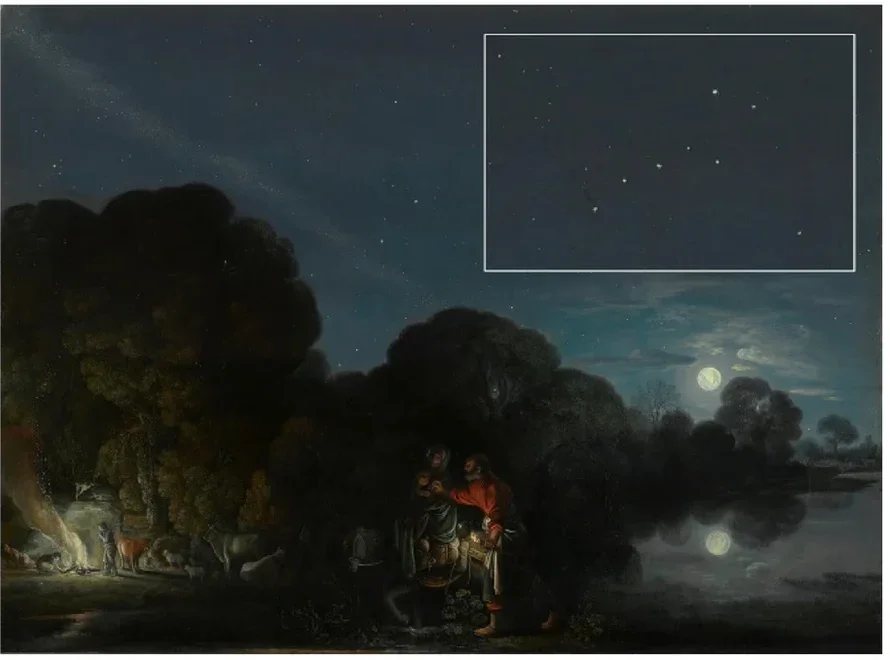
The researchers tested their approach on other night paintings, including Van Gogh’s Starry Night over the Rhône and Café Terrace at Night. Those comparisons suggested that a canvas can combine different viewpoints or observing conditions. Recognizable celestial patterns therefore need not make a painting a literal snapshot.
That principle also fits the broader understanding of The Starry Night. MoMA describes a village assembled from other views and a cypress placed closer than it appeared from Van Gogh’s window. Identifying a possible astronomical reference would add another layer to that constructed landscape.
The remaining challenge is to connect an apparent sky correspondence with the physical and documentary history of the painting. “I think further research in art history and conservation science could shed more light on this question,” Kim told Space.com. Evidence of later changes to the canvas, or clearer historical records, could help determine whether the proposed July sky belongs in its chronology.
These resources explain astronomical reconstruction, the painting’s established history and the interpretation of Van Gogh’s correspondence.
Celestial Sleuth: Using Astronomy to Solve Mysteries in Art, History and Literature
Donald Olson explains how calculations, site visits and historical records can test astronomical clues in art and other sources. (Springer, October 2013)
Vincent van Gogh: The Starry Night
Richard Thomson’s museum publication examines the painting’s artistic context, technique and conventional June chronology. (The Museum of Modern Art, 2008)
The Hyades: distance, structure, dynamics, and age
This astronomical study provides context on the cluster whose visible pattern features in the proposed identification. (Astronomy & Astrophysics, 1998)
Vincent van Gogh. The Starry Night. Saint Rémy, June 1889
MoMA’s collection entry gives the painting’s established date and explains how observation, memory and artistic changes shaped its composition. (The Museum of Modern Art)
Van Gogh’s Letters
The museum explains what the correspondence reveals and how scholars estimate dates for letters that lack explicit dating. (Van Gogh Museum)
Research findings are available online in the journal Scientific Reports.
The original story “Scientists solve a 137-year-old mystery hidden in Van Gogh’s ‘The Starry Night’” is published in The Brighter Side of News.
Like these kind of feel good stories? Get The Brighter Side of News’ newsletter.
The post Scientists solve a 137-year-old mystery hidden in Van Gogh’s ‘The Starry Night’ appeared first on The Brighter Side of News.


Leave a comment
You must be logged in to post a comment.