A laser hit the tiny black cube, and it lurched forward almost at once.
That split-second jump, caught during a zero-gravity arc aboard a parabolic flight, points to a strange and promising idea for space travel. A class of ultralight graphene aerogels, when illuminated under microgravity, can turn light into motion with surprising force. In the experiment, the material accelerated so quickly that the main burst was over in about 30 milliseconds.
“The reaction was fast and furious. Before you could even begin to blink, the graphene aerogels experienced large accelerations. It was all over in 30 milliseconds,” said Marco Braibanti, ESA’s project scientist for the experiment, Light-driven propulsion of graphene aerogels in microgravity.
The work came out of an international team led by researchers at the Université Libre de Bruxelles in Belgium and Khalifa University in the United Arab Emirates. Their findings, published in Advanced Science, suggest that light-driven propulsion in graphene aerogels becomes far more effective when gravity is stripped away.
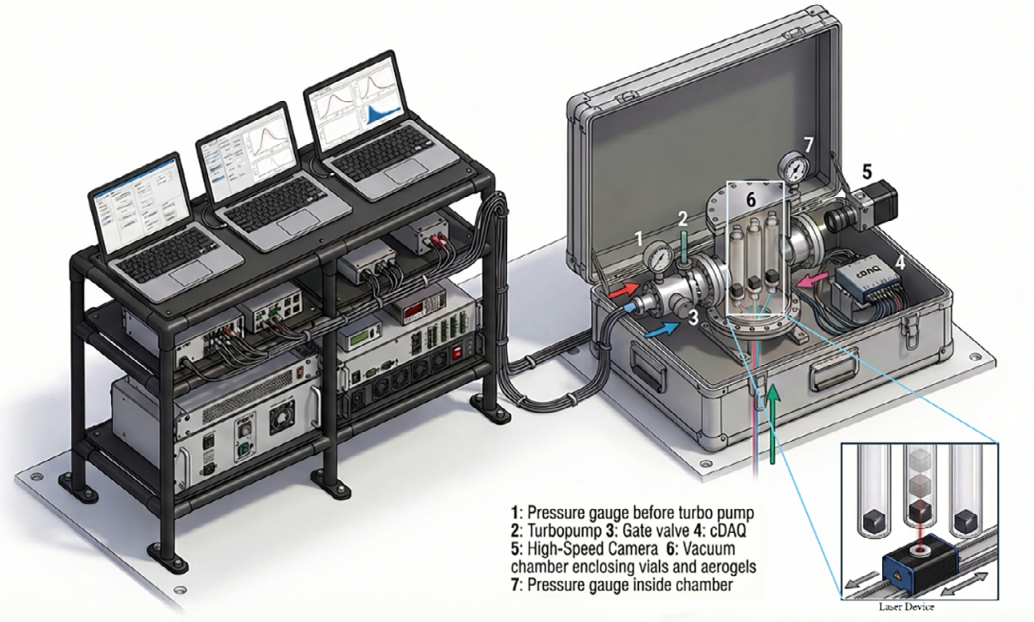
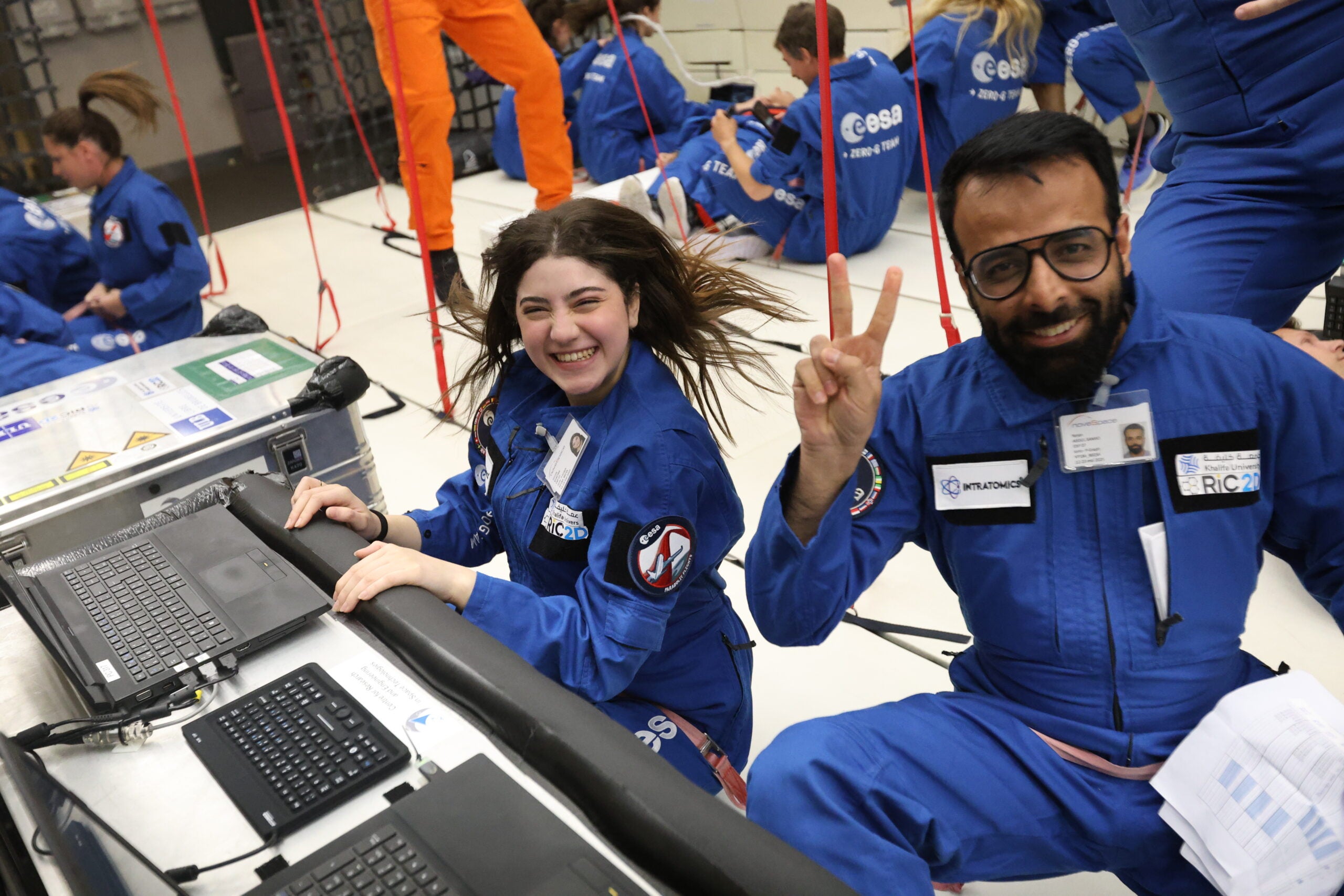
The tests took place during ESA’s 86th parabolic flight campaign in May 2025. Inside the aircraft, the team placed small graphene aerogel samples in a vacuum chamber and hit them with a continuous laser during the short windows of near-weightlessness created by each parabola.
Parabolic flights do not remove gravity itself. They create free-fall conditions that mimic microgravity for short bursts, usually around 20 seconds. During those windows, the aircraft and everything inside it fall together, leaving experiments effectively weightless.
That mattered here.
Under 1 g conditions on the ground, the same aerogels moved only slightly. Under microgravity, they traveled farther, moved faster, and produced much larger thrust. The contrast was stark. In microgravity, displacement reached about 0.05 meters by about 0.05 seconds. Peak velocity climbed to roughly 1.7 meters per second around the same time. Peak thrust reached about 600 micronewtons, or 0.6 millinewtons, within roughly 0.02 to 0.03 seconds.
At 1 g, the response was smaller and slower. Displacement peaked near 0.015 meters at about 0.16 seconds. Velocity reached only about 0.06 meters per second at about 0.12 seconds. Peak thrust was about 11 micronewtons.
That means the microgravity response reached its maximum much sooner, with the paper reporting about a 60 to 75 percent reduction in the time needed to hit peak values.
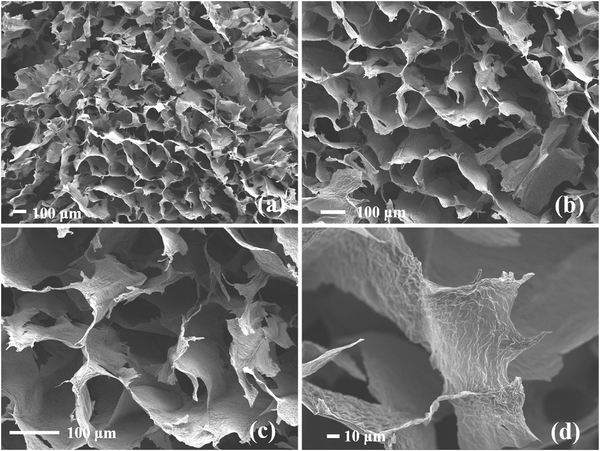
Graphene is a single layer of carbon atoms arranged in a honeycomb pattern. It is known for exceptional strength, conductivity, and heat transport. Graphene aerogels turn that two-dimensional material into a three-dimensional, ultralight, porous network.
Those properties made the material a good candidate for this kind of propulsion test. The aerogels used in the experiment were tiny coupons, each measuring 10 by 10 by 5 millimeters, and they sat inside tapered glass tubes in a vacuum chamber at pressures below about 10⁻⁴ mbar during each parabola.
A 532 nanometer, 5 watt laser illuminated the samples from below. A high-speed camera recorded the motion at 400 frames per second, while a triaxial accelerometer tracked the local g-levels to confirm the microgravity window.
The samples did not all behave in the same way. The team compared three aerogels with slightly different densities, labeled AG-10, AG-15, and AG-20. AG-20 generally produced the largest displacement and velocity. AG-15, though, delivered the highest peak thrust and the strongest acceleration response, reaching about 102 meters per second squared in microgravity at the highest laser power.
That outcome hints that there is no simple rule saying lighter or denser is always better. The paper describes a non-monotonic relationship between density and propulsion. In other words, performance depends on structure, not just mass.
One sentence in the study says a lot: the intermediate-density aerogel appeared to strike the best balance for thrust.
The team also changed laser power to see whether propulsion could be controlled.
It could.
“The stronger the laser, the greater the acceleration. The laser pulse triggers a sharp acceleration peak, after which the aerogels slow down,” Braibanti said.
Across the three aerogels, higher power generally produced larger displacement, faster motion, and stronger thrust pulses. The highest setting, about 99 percent of maximum laser output, gave the strongest performance in most cases. The paper reported no clear sign of saturation at the highest accessible power.
That tunability is one reason the findings stand out. A material that responds predictably to changing light intensity could be useful in systems where precise adjustments matter more than brute force.
Still, the study did not present a perfectly smooth picture. One AG-20 run at 90 percent power had an in-flight acquisition gap and fell outside the high-speed camera’s capture window, leaving the trace incomplete. The authors also noted shot-to-shot variability and occasional spikes at intermediate powers, which they linked to factors such as sample orientation and image-tracking window alignment.
Those caveats matter because they point to a technology still in the experimental stage.
The authors argue that the motion is not best explained by photon pressure alone. Instead, they point to gas-mediated thermal forces, especially Knudsen pumping and photophoretic effects.
Under laser illumination, the front of the aerogel heats quickly while the interior and back remain cooler for tens of milliseconds. That temperature difference can drive gas motion through the porous network and create a pressure imbalance. At the same time, asymmetric heating on the outer surface can produce an external photophoretic force. Together, those effects appear to generate the net thrust.
In microgravity, with weight and normal-force friction largely removed, that thrust can move the samples freely. Under 1 g, the same underlying effect appears to be present but largely masked.
The paper says this line of research remains fundamental science. It also notes that the parabolic flight tests were conducted at a nearly fixed chamber pressure, so the parametric work focused mainly on aerogel density and laser power, not pressure. Another limitation is that thrust estimates were restricted to the first 10 to 30 milliseconds after the laser pulse, before contact with the tube walls and friction could distort the readings.
Even with those limits, ESA researchers see a longer path ahead.
“We are opening the path to a propellant-free propulsion future. Ultralight graphene aerogels are the perfect example of an innovative material created in the lab that could save us large amounts of fuel and hardware in space,” said Ugo Lafont, ESA’s materials’ physics and chemistry engineer.
This work points to a possible way of moving or adjusting spacecraft hardware without carrying as much fuel. The clearest near-term ideas in the paper are solar sail propulsion and attitude control for small satellites. If light-responsive graphene structures can be refined, they could help spacecraft make fine position changes, preserve propellant, and free up mass for instruments or other onboard systems.
The study also gives engineers something more practical than a broad concept. It suggests that both material design and laser power matter, and that an intermediate architecture may outperform simpler lighter-versus-heavier assumptions.
For future space systems, that means performance may depend as much on pore structure and thermal behavior as on the raw properties of graphene itself.
Research findings are available online in the journal Advanced Science.
The original story “Scientists develop laser-powered graphene propulsion for next-generation space travel” is published in The Brighter Side of News.
Like these kind of feel good stories? Get The Brighter Side of News’ newsletter.
The post Scientists develop laser-powered graphene propulsion for next-generation space travel appeared first on The Brighter Side of News.


Leave a comment
You must be logged in to post a comment.