Something has been lurking in empty space, and for the first time, physicists may have caught it leaving fingerprints.
Quantum theory has long predicted that the vacuum seethes with virtual particles, pairs that flicker in and out of existence too briefly to observe directly. But a new experiment at Brookhaven National Laboratory suggests those fleeting pairs are not entirely invisible. Under the right conditions, they can be jolted into reality, and when they are, they carry a memory of what they were before, written in the language of spin.
The findings, from a collaboration between Brookhaven and Stony Brook University using the STAR detector at the Relativistic Heavy Ion Collider, offer the first direct experimental evidence that virtual quark-antiquark pairs in the quantum vacuum leave a measurable imprint on the real particles that emerge from high-energy proton collisions.
Most people learn that space is empty. That turns out to be a useful simplification, not a description of reality.
Quantum chromodynamics, the theory that governs quarks and the strong force that binds them, predicts that the vacuum has structure. It contains a condensate of virtual quark-antiquark pairs, pairs that exist momentarily in a kind of quantum suspension. Because of constraints imposed by the quantum numbers of the vacuum itself, these pairs are expected to have their spins aligned in parallel, a configuration called a spin-triplet state.
That prediction has been difficult to test, because virtual particles cannot be measured. They vanish before any detector can register them.
The key insight behind this experiment was that high-energy proton collisions might change that. Smash protons together hard enough, and the collision energy could reach into the vacuum and liberate those virtual pairs, turning them into real, detectable particles. If the spin alignment survived that violent transition, it would show up in the particles left behind.
The team accelerated protons to 99.996 percent of the speed of light and recorded roughly 600 million collision events. Their focus was on strange quarks and strange antiquarks, a particular pairing expected to emerge from the vacuum condensate with spins aligned.
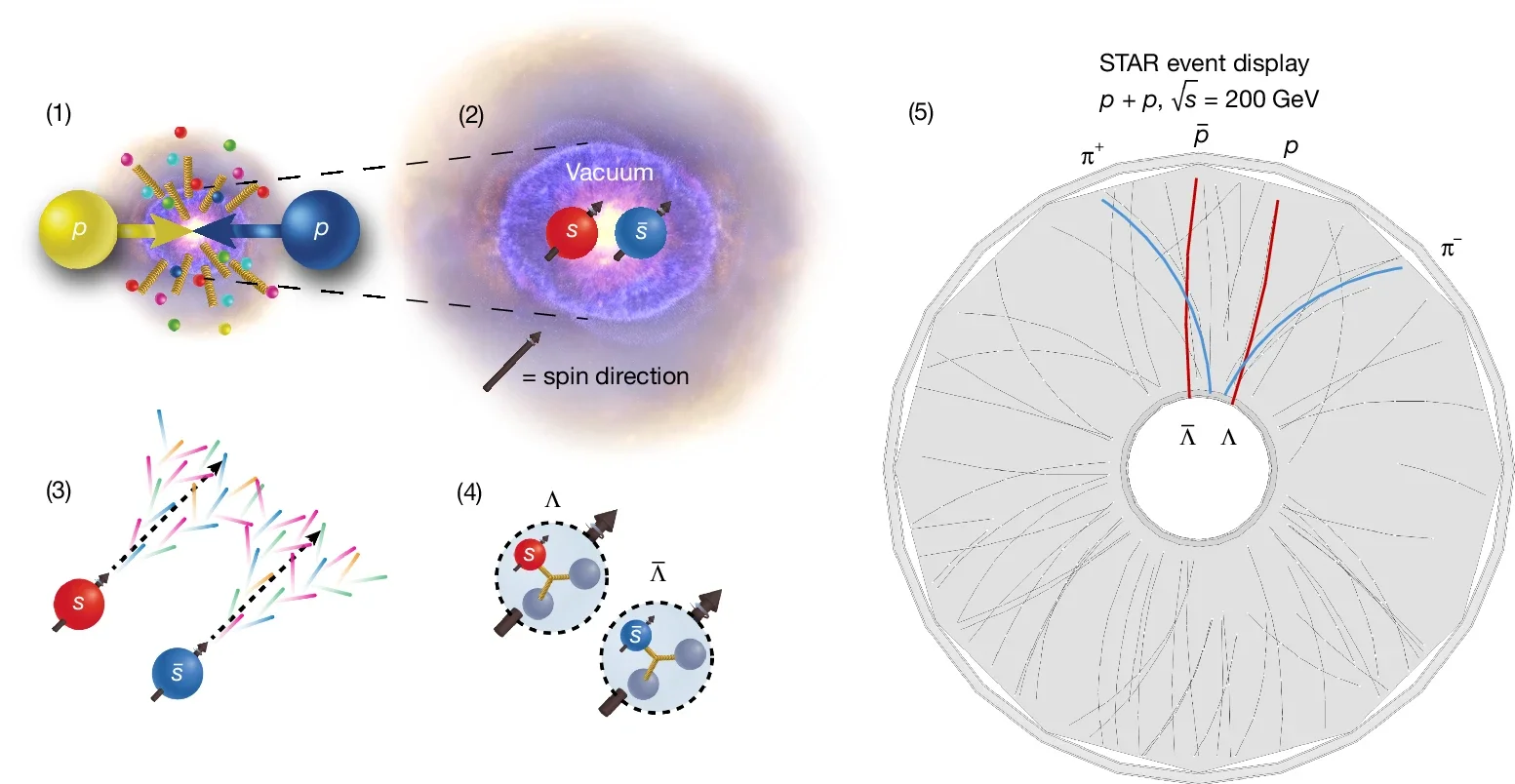
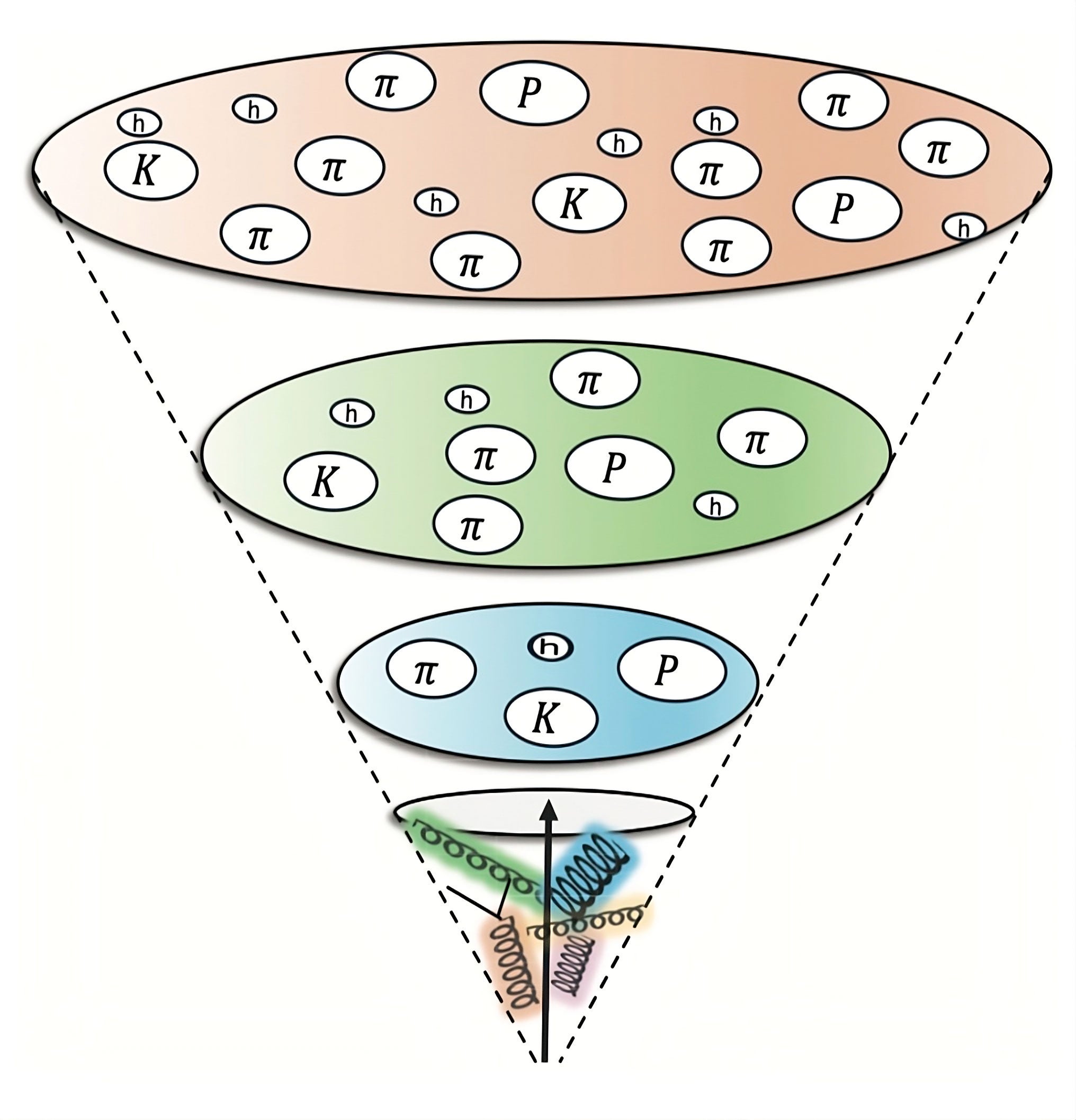
Once liberated, quarks cannot remain free for long. The strong force quickly pulls them into composite particles in a process called hadronization. In this case, some strange quarks and antiquarks became lambda hyperons and anti-lambda hyperons, short-lived neutral particles that decay in about one ten-billionth of a second.
That decay is what makes the measurement possible. Lambda hyperons fall apart into daughter particles whose trajectories encode the spin orientation of the parent. By tracing those decay products in the STAR detector, researchers could reconstruct the spin of each hyperon and ask whether a lambda and an anti-lambda, emerging close together, showed correlated spins.
The answer, for close pairs, was clearly yes.
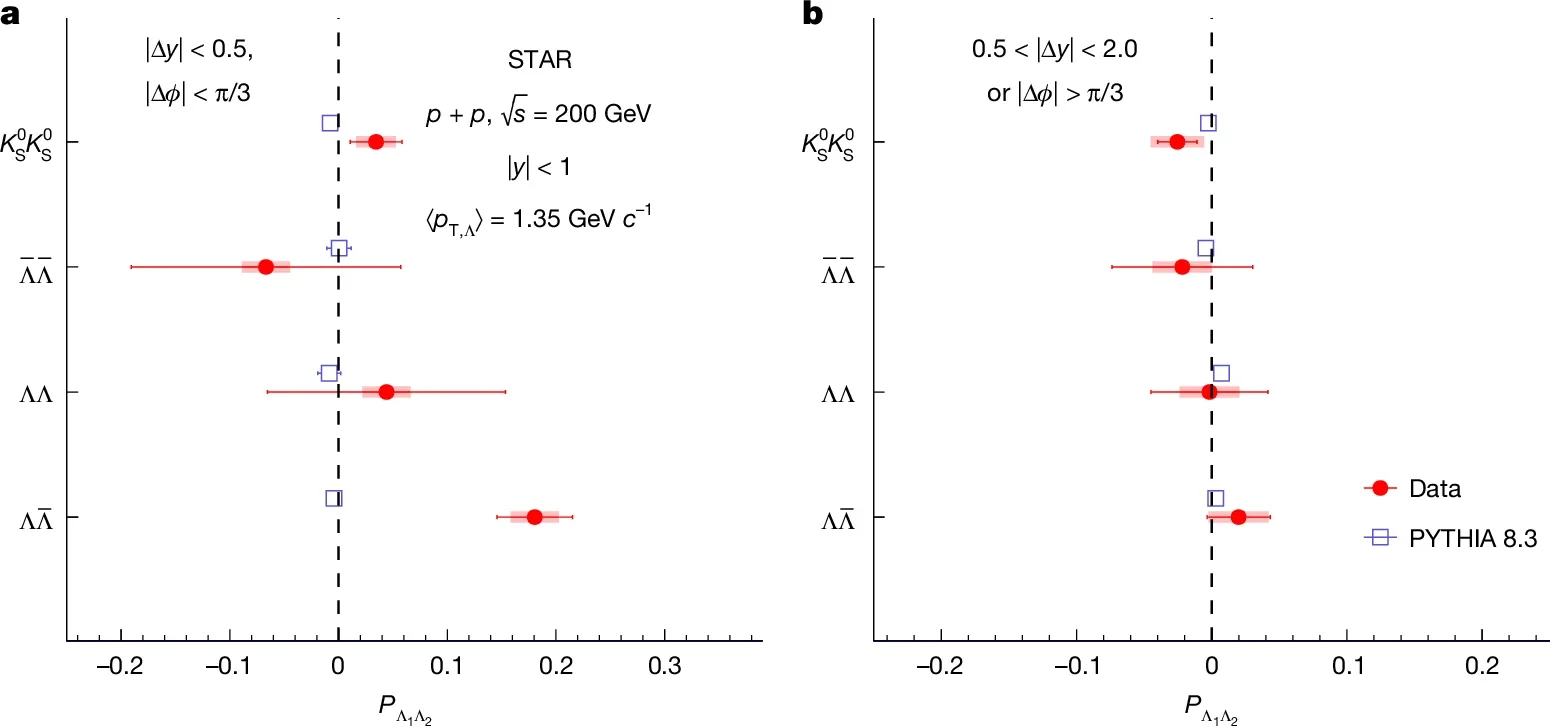
Short-range lambda and anti-lambda pairs showed a positive spin correlation of 0.388, with a statistical significance of 4.4 standard deviations above zero. That result held up against multiple checks.
Lambda-lambda and anti-lambda-anti-lambda pairs, by contrast, showed no spin correlation. Neither did pairs separated by larger distances in angle or rapidity. Measurements involving kaon pairs and simulations using the PYTHIA 8.3 Monte Carlo model, both used as baseline references, also showed no correlation.
The pattern matched what the vacuum-condensate picture predicted. Close pairs of lambda and anti-lambda hyperons behaved as though their strange quarks had started out as a correlated pair in the vacuum, with their original spin alignment largely intact after hadronization. A competing model, known as the Burkardt-Jaffe model, predicted a weaker polarization and was disfavored by the data.
“The vacuum is now understood to have a rich and complex structure, characterized by fluctuating energy fields and a condensate of virtual quark-antiquark pairs,” said physicist Zhoudunming Tu. “High-energy proton-proton collisions could liberate virtual quark-antiquark pairs from the vacuum that subsequently form hadrons.”
One of the more telling details in the data is what happens as the two hyperons move farther apart. The spin correlation was strongest when the lambda and anti-lambda were close together in both angle and rapidity. As their separation grew, the correlation weakened and eventually became indistinguishable from zero.
The researchers interpret this as a sign of quantum decoherence, the gradual loss of quantum information as particles interact with their surrounding environment during hadronization. Multiple initial quark pairs becoming entangled with the process may also play a role. Either way, the spin signal fades the more the two particles have had to interact with the rest of the collision’s aftermath before being detected.
That fading is itself informative. It offers a new way to study how quantum coherence is lost during the chaotic transition from free quarks to bound hadrons, a process that first-principles calculations have struggled to describe.
The clearest near-term value is a new experimental tool for probing quark confinement, one of the most stubborn unsolved problems in physics. Understanding why quarks cannot exist alone, and how their binding generates most of the mass of ordinary matter, has resisted complete theoretical description for decades. Measuring spin correlations through the hadronization process gives researchers a new way to track what happens during that transition, not just after it.
The findings also have implications for the so-called proton spin crisis. Experiments have shown that the quarks inside a proton account for only about 35 percent of its total spin, far below what older models expected. The new result, which favors a model in which the strange quark carries essentially all of the lambda hyperon’s spin, suggests that different hadrons may organize their spin contributions differently. That distinction will matter for future experiments aimed at understanding how spin is distributed inside composite particles.
Longer term, the methodology opens a path toward studying chiral symmetry restoration, a phase transition expected to occur in the quark-gluon plasma produced in heavy-ion collisions. Observing spin correlations in that environment could provide direct evidence for whether the vacuum condensate disappears at high temperatures, a question that experimental measurements have not yet resolved.
Research findings are available online in the journal Nature.
The original story “Scientists achieve the impossible by creating matter from empty space” is published in The Brighter Side of News.
Like these kind of feel good stories? Get The Brighter Side of News’ newsletter.
Like these kind of feel good stories? Get The Brighter Side of News’ newsletter.
The post Scientists achieve the impossible by creating matter from empty space appeared first on The Brighter Side of News.


Leave a comment
You must be logged in to post a comment.