A satellite carrying a nuclear weapon would not just menace rival spacecraft. It could scramble parts of modern life on Earth.
That is the threat behind a new proposal from MIT professor Areg Danagoulian, who has outlined a way to inspect a suspicious satellite in orbit and test whether it may contain a thermonuclear device. The idea, published in Nature, aims at a problem that has hung over the 1967 Outer Space Treaty for decades. The treaty bans nuclear weapons in space, but there is no accepted way to verify what another country has actually launched.
The urgency of that gap sharpened after Russia launched Kosmos 2553 on Feb. 2, 2022, into an orbit about 2,000 kilometers above Earth. Russia says the craft is part of its Neitron radar system for surveillance and remote sensing. However, U.S. officials have raised concerns that it could be a test platform connected to a future anti-satellite weapon carrying a nuclear charge.
Danagoulian’s study does not claim to prove what that Russian satellite contains. Instead, it argues that a practical inspection system may be scientifically possible.
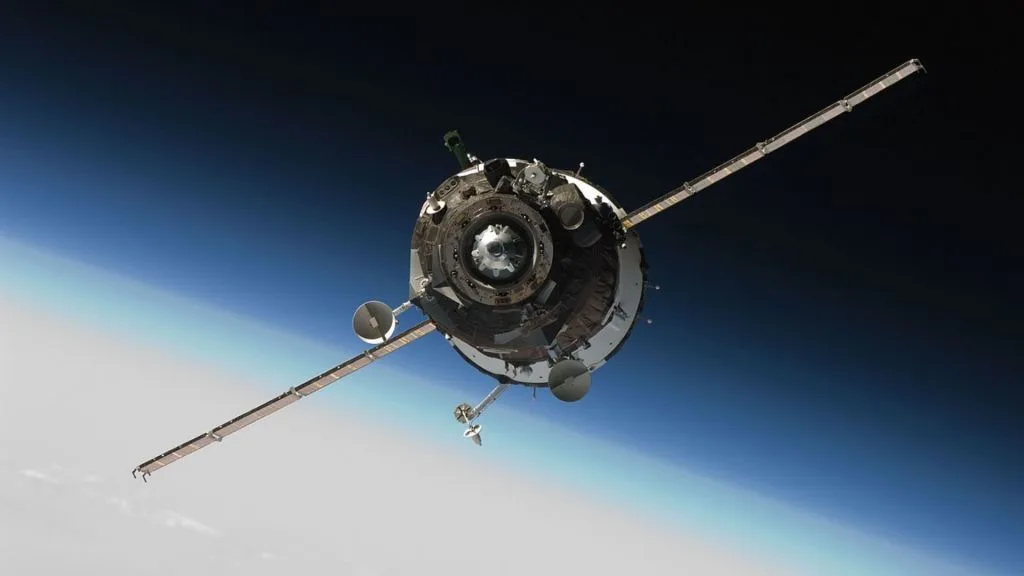
The fear is rooted in an old lesson. In 1962, the United States detonated the 1.4-megaton Starfish Prime thermonuclear warhead in space. The blast injected vast numbers of energetic electrons into the inner Van Allen radiation belt and destroyed many early satellites.
“When you have a nuclear detonation in outer space, basically the whole body of the bomb becomes ionized, and nearly every single electron in the weapon’s mass becomes free,” Danagoulian explains.
Those electrons do not simply vanish. He said they can become trapped in Earth’s magnetic field, where they continue striking satellites that pass through the region. Furthermore, as you go further out into space, you create these thick belts around Earth populated by highly energetic protons and electrons.
A weapon detonated in low-Earth orbit could therefore do far more than destroy one target. It could damage or disable large numbers of satellites used for communications, reconnaissance, GPS and internet service.
That risk is one reason the Outer Space Treaty called space the “province of all mankind” and barred countries from placing nuclear weapons in orbit or elsewhere in outer space. The treaty has been signed by 118 countries, including the United States, China and Russia.
Yet a ban without inspection leaves room for doubt.
Danagoulian’s approach turns the harshness of orbit into an advantage.
His proposed system would place an inspector satellite near a suspect one. Instead of actively probing the target, the detector would wait for naturally present high-energy protons in the inner Van Allen belt to strike any high-atomic-number radioactive material inside the suspicious craft.
If those protons hit uranium or plutonium, they can trigger a process called spallation, knocking out large numbers of neutrons.
“When an energetic proton slams into elements with a high atomic number, like uranium and plutonium, each proton may knock out something like 40 neutrons,” he explains. “That’s a ridiculously large number.”
The key question, he said, is whether enough of those neutrons could be measured from nearby.
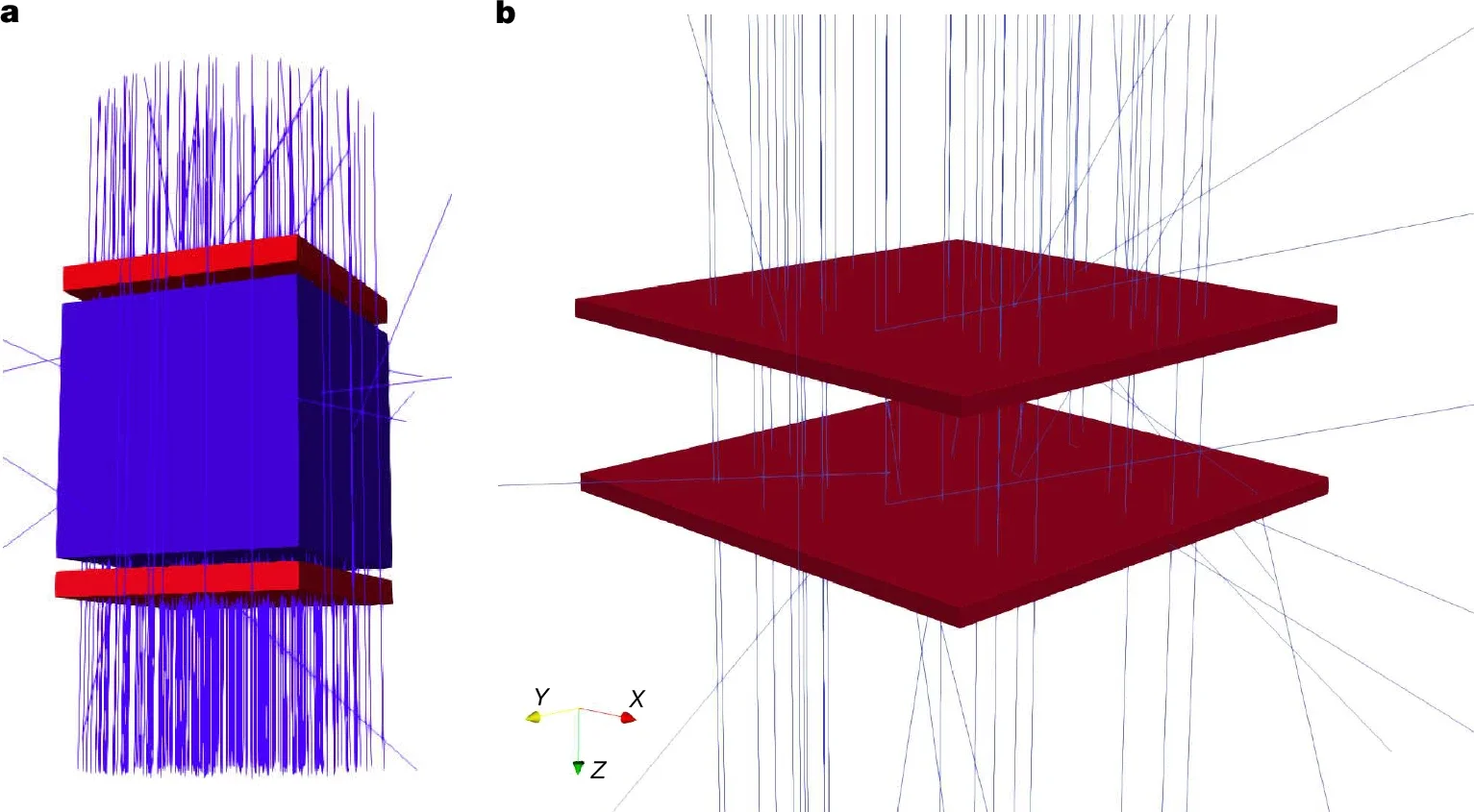
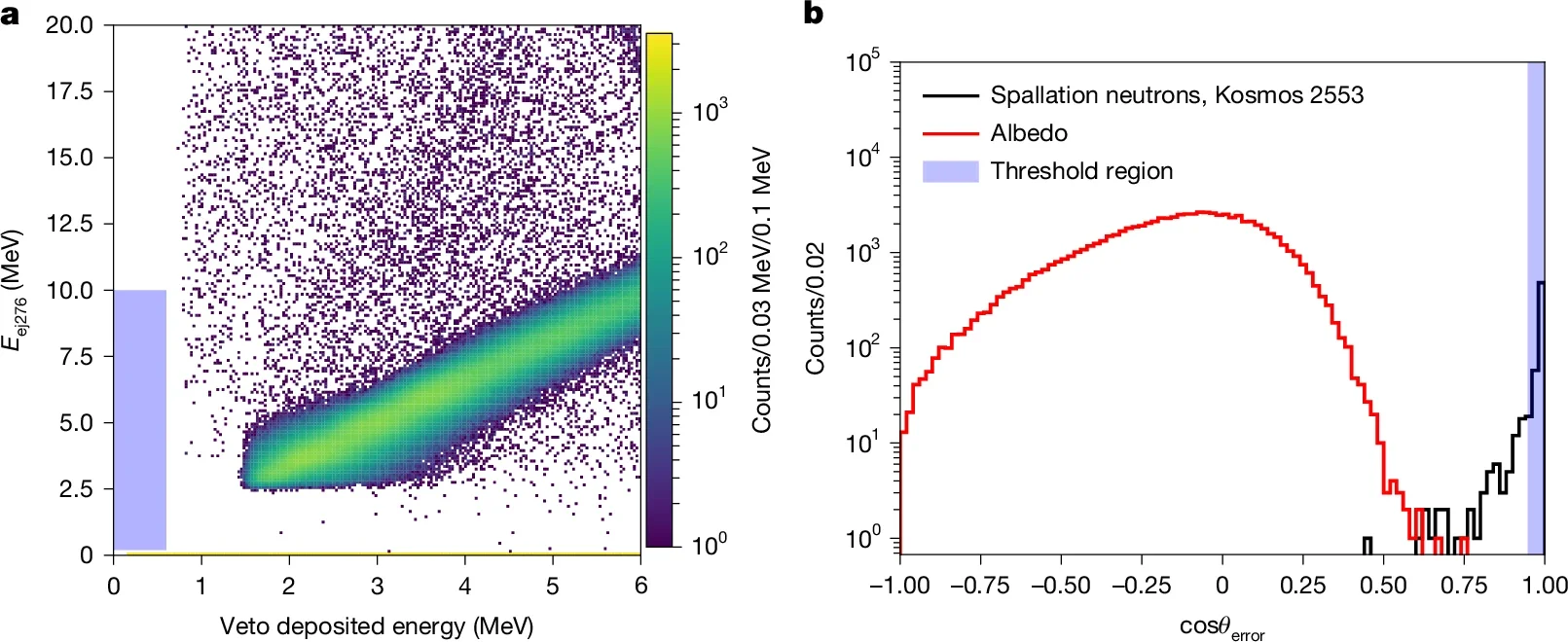
His answer is a compact detector package roughly the size of a 9U CubeSat, or about a large encyclopedia in volume. The design uses two planes of neutron-sensitive scintillator pixels. Also, it is paired with synthetic diamond detectors that act as a veto system. That matters because orbit is full of charged particles, especially protons and electrons. Those particles could easily swamp an ordinary detector with false signals.
“Most neutron detectors are very sensitive to protons, so you have to come up with some smart ways to reject protons but keep neutrons,” Danagoulian says. “You also have to tell the difference between naturally occurring neutrons and neutron spallation from the satellite.”
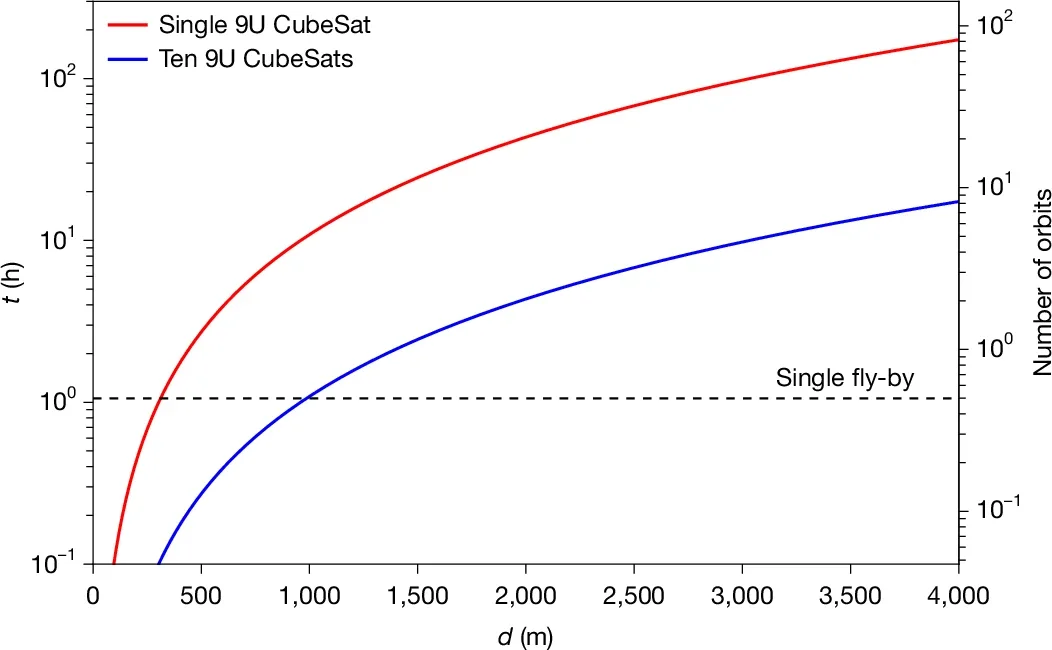
The paper models a hypothetical thermonuclear device aboard a satellite in an orbit like Kosmos 2553’s. Using Geant4 simulations, radiation-belt models and empirical spallation estimates, Danagoulian calculated how long an inspector would need to stay nearby to detect a neutron signal strong enough to matter.
For a single 9U inspector at a distance of 4,000 meters, the study estimates a better than 99% chance of detection in about 7.2 days.
Move closer, and the timing changes sharply. At 1,000 meters, the same basic system could reach that threshold in about one hour. A constellation of 10 similar inspector satellites could also cut the time. At 4,000 meters, the paper estimates about 15 hours.
The study also found a very low expected false count during a 7.2-day observation for the modeled 9U system. The upper false-positive estimate is below 1.1%.
Those numbers come with important caveats. The work assumes an unshielded weapon. It also assumes the inspector can hold a favorable position relative to the suspect satellite. This allows it to separate neutrons coming from above from background neutrons rising from Earth’s atmosphere or generated elsewhere in the spacecraft.
Danagoulian calls the work a feasibility study, not a finished blueprint.
“I say in the paper this isn’t a completely proven system,” he says. “The purpose of the paper is to show the scientific community that it’s scientifically possible to do this. But there are many more practical considerations to be made to actually build these detectors.”
Those practical questions are not minor. The detector would have to work in a punishing radiation environment, handle high hit rates, survive heating and cooling cycles, and cope with issues such as shielding, outgassing and the behavior of onboard electronics.
The paper also notes a limit that matters politically as much as technically. High-Z materials such as lead and tungsten can also produce neutron spallation. The method is designed to distinguish a likely thermonuclear device from ordinary satellites built mostly from aluminum and hydrogen-rich materials. However, it is not designed to identify every detail of what is inside a spacecraft.
Even so, Danagoulian argues that a credible inspection method could change behavior.
“If we eventually have some verification mechanisms for the Outer Space Treaty, that will put pressure on countries to respect the treaty or disclose what they are doing, because they know if they try to violate it, we will find out,” he says.
He said the immediate goal is not deployment but attention from national labs and policymakers who could test the concept further and decide whether it belongs in future monitoring systems.
In the end, the idea rests on an old nonproliferation truth: intelligence claims can be disputed, but measured physical signals are harder to wave away. As Danagoulian put it, “You can fake intelligence, but you can’t fake physics.”
If this concept holds up in follow-up engineering studies, it could give governments a new way to check whether a suspicious satellite carries materials associated with a thermonuclear weapon. This approach does not rely only on secret intelligence assessments.
That would not solve every legal or diplomatic dispute in orbit, and it would not prove treaty compliance on its own.
But it could create a firmer technical basis for inspections, deterrence and arms-control talks at a time when more countries and private companies depend on crowded low-Earth orbit.
Research findings are available online in the journal Nature.
The original story “MIT scientist reveals a new method to detect nuclear weapons in space” is published in The Brighter Side of News.
Like these kind of feel good stories? Get The Brighter Side of News’ newsletter.
The post MIT scientist reveals a new method to detect nuclear weapons in space appeared first on The Brighter Side of News.


Leave a comment
You must be logged in to post a comment.