A potentially large addition to the solar system’s dwarf planet family has emerged from a crowded field of stars. Astronomers identified the icy object, provisionally designated 2026 ED138, in images collected by the Simonyi Survey Telescope at NSF–DOE Vera C. Rubin Observatory. It currently lies about 46 times farther from the Sun than Earth does.
The discovery was announced October 27 through the International Astronomical Union’s Minor Planet Center and presented at a planetary science meeting in Spokane, Washington. Matthew Holman, a senior astrophysicist at the Center for Astrophysics | Harvard & Smithsonian, first identified the object. University of Washington astronomy professor Mario Jurić, who leads Rubin’s solar system team, helped uncover additional observations.
ED138 is a candidate, rather than a confirmed sixth member of the officially recognized dwarf planet group. Initial estimates place its diameter between 600 and 1,500 kilometers, a range broad enough to leave important questions unanswered. Infrared observations are needed to narrow that estimate and help establish its nature.
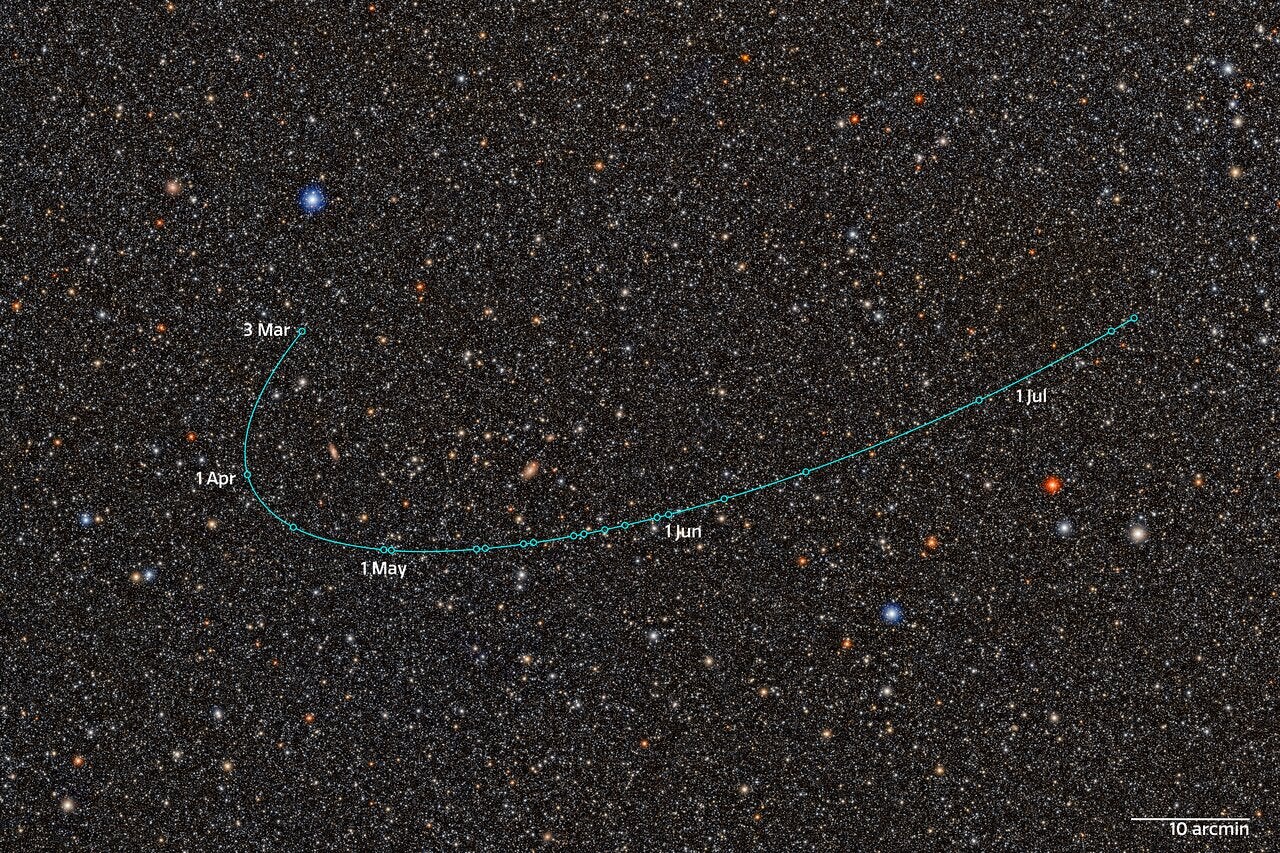
Holman found ED138 on the evening of October 13 while examining Rubin data collected earlier in 2026. He used search software developed with colleague Kevin Napier to connect separate detections of moving objects. The program searches billions of recorded detections for observations that belong to the same body.
That task involves identifying a consistent moving target among enormous numbers of points of light. For ED138, its brightness and distance suggested something unusually large. Those clues immediately prompted Holman to check the result before accepting it as a discovery.
“My first reaction was one of excited disbelief,” Holman said. “Objects like this are very rare, so I immediately started checking whether I or the code had done something wrong.” Further searches then strengthened the evidence that the detections represented a real object.
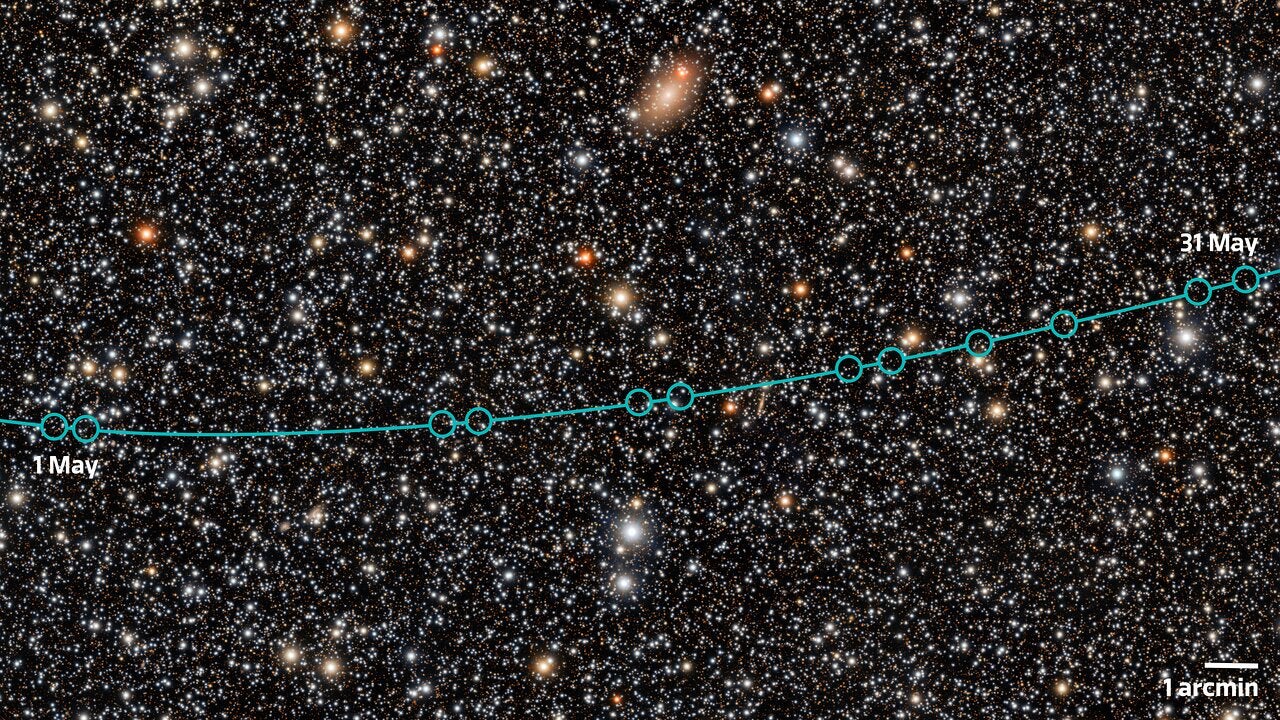
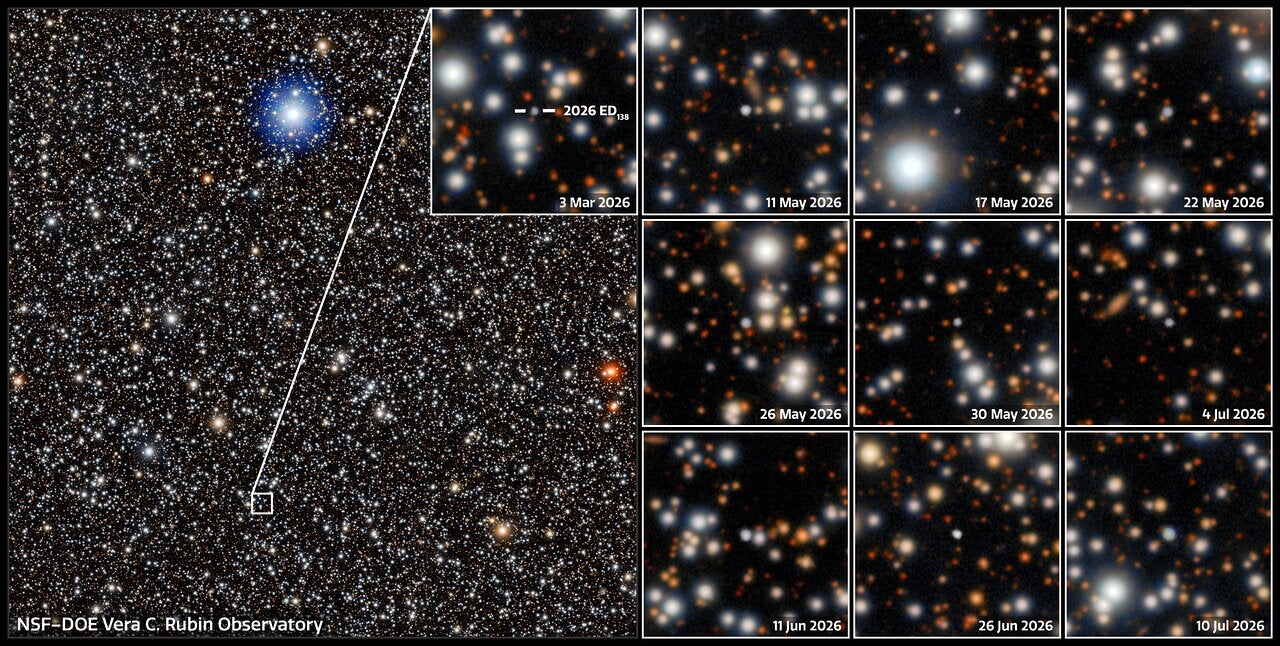
Jurić found 20 additional observations in Rubin’s catalogs and images. Altogether, the telescope recorded ED138 30 times on 20 nights between March 4 and July 11. Those repeated sightings gave the team a firmer basis for reconstructing its motion.
The investigation did not end with Rubin’s observations. Archival images from the Dark Energy Camera, mounted on the Victor M. Blanco 4-meter Telescope in Chile, contained earlier appearances. The Asteroid Institute’s ADAM Precovery service helped uncover records extending back to 2016.
Astronomers call this process “precovery,” finding an object in images taken before anyone recognized it. In this case, it extended the observational record across more than 10 years. That longer record allowed the team to trace ED138’s orbit well beyond the few months covered by Rubin’s images.
A discovery date therefore does not necessarily mark the first time a telescope photographed an object. Earlier observations can remain unrecognized until a later discovery provides a reason to search for them. For ED138, modern searches connected scattered appearances into a much longer history.
This combination makes new observations and old archives complementary tools. Rubin supplied the detections that brought ED138 to attention, while earlier images extended its known trajectory. Together, they turned a newly identified moving point into an object with a decade-spanning orbital record.
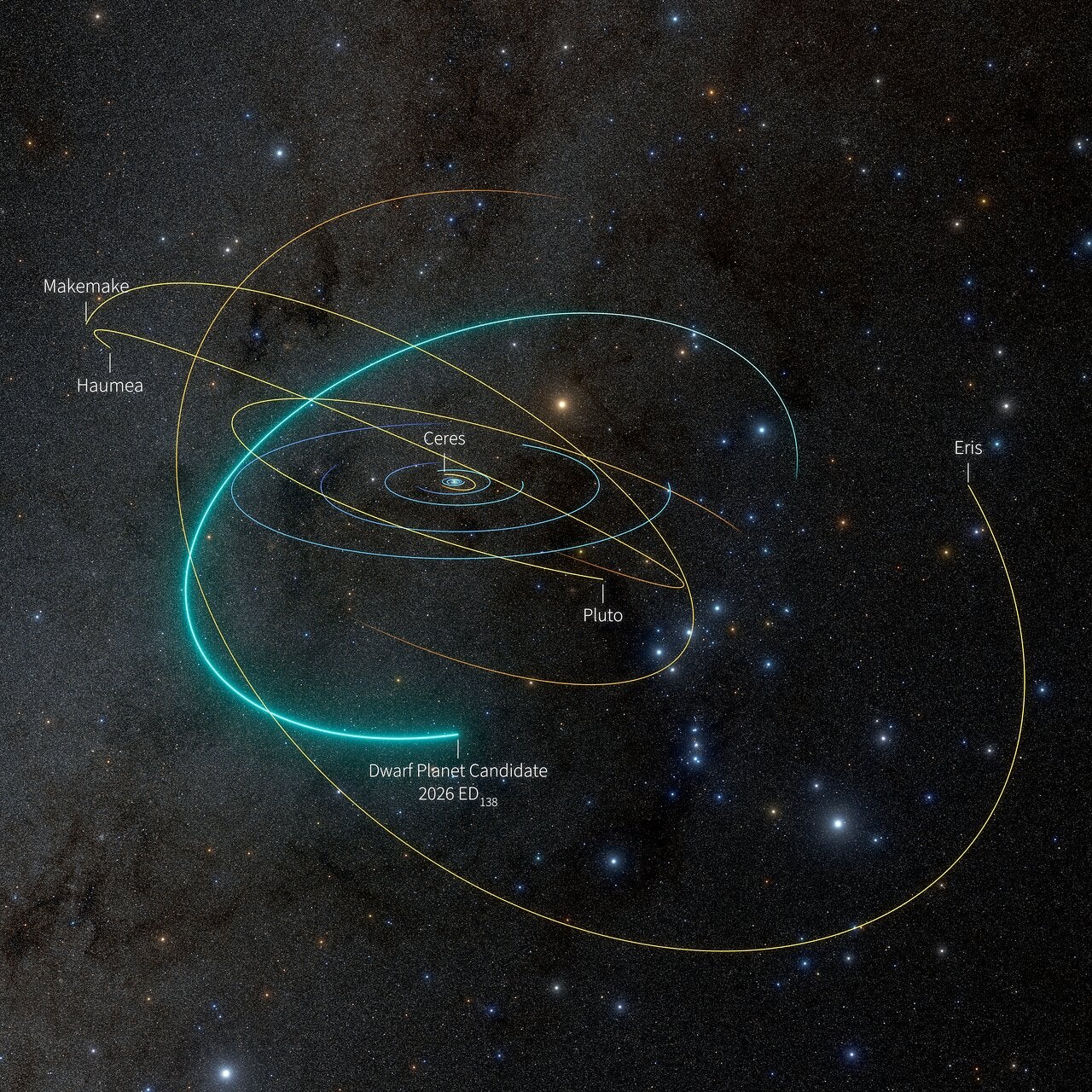
The International Astronomical Union currently recognizes five dwarf planets: Ceres, Pluto, Eris, Haumea and Makemake. Under its definition, a dwarf planet orbits the Sun, is not a moon and has enough gravity to become nearly round. It also has not gravitationally cleared its orbital neighborhood, a distinction separating it from the eight planets.
ED138’s estimated size makes it a plausible candidate because icy bodies that large are expected to become rounded by their own gravity. However, the team has not measured its diameter precisely. Its current size estimate depends on its distance, brightness and assumed surface reflectivity, also called albedo.
A brighter surface reflects more sunlight than a darker one of the same size. Consequently, brightness alone cannot tell astronomers exactly how large a distant object is. Different assumptions about reflectivity help explain the wide range in ED138’s estimated diameter.
The distinction matters when comparing ED138 with other distant worlds. Describing it as roughly 1,000 kilometers across conveys the general scale, but does not replace the full uncertainty range. Follow-up measurements must establish whether that preliminary estimate accurately represents the object.
At about 46 astronomical units from the Sun, ED138 belongs to the population known as trans-Neptunian objects. An astronomical unit is the average distance between Earth and the Sun. For comparison, Pluto’s average distance is about 40 astronomical units, although that average and ED138’s current distance describe different measurements.
ED138’s orbit tilts almost 25 degrees relative to the solar system’s main orbital plane. Astronomers classify it as a hot-classical trans-Neptunian object. Here, “hot” refers to its dynamically excited orbit, rather than a warm surface.
The tilted trajectory suggests that gravitational interactions with Neptune disturbed ED138 from its original orbit. That interpretation links its motion to broader questions about the giant planets’ past movements. It does not provide a complete reconstruction of the object’s individual history.
Astronomers study distant objects’ sizes, compositions and orbits to investigate how the solar system developed. Different trajectories preserve evidence about how smaller bodies were scattered as the giant planets evolved. ED138 adds another target for testing those ideas once its properties become better constrained.
ED138 appeared near the Milky Way’s plane, where millions of background stars crowd the view. That location likely helped it escape earlier discovery despite its apparent size. Rubin’s repeated imaging, combined with software that identifies moving objects, made it possible to distinguish the target within that field.
The discovery follows a much larger haul from Rubin’s early observations. In April, its solar system team submitted observations of more than 11,000 new asteroids to the Minor Planet Center. That dataset also included roughly 380 trans-Neptunian objects, demonstrating how quickly the observatory could expand the known inventory.
Rubin’s Legacy Survey of Space and Time began in June 2026 and is designed to repeatedly image the southern sky over 10 years. ED138 emerged from observations taken during the run-up to that survey. The combination of repeated coverage and archival searches could reveal other large objects missed by earlier efforts.
The public can explore ED138’s modeled orbit through Orbitviewer, an interactive application that displays solar system objects in three dimensions. Scientists with Rubin data rights can examine its images through the Rubin Science Platform. Those resources serve different purposes: public exploration on one hand, and access to observations for further research on the other.
For now, ED138 gives astronomers a specific follow-up target rather than a completed addition to the dwarf planet roster. Its orbital record is already substantial, but its physical dimensions remain uncertain. The next priority is measuring its size more closely and determining whether this distant world meets the dwarf planet criteria.
These resources explain outer solar system discoveries, icy surfaces and the criteria used to classify dwarf planets.
Early Data from NSF–DOE Vera C. Rubin Observatory Reveals Over 11,000 New Asteroids
Rubin’s earlier discovery announcement explains how repeated observations and software identify asteroids and distant objects before follow-up investigations. (Rubin Observatory, April 2026)
Discovery and dynamics of a Sedna-like object with a perihelion of 66 au
This study of the distant object nicknamed Ammonite shows how unusual orbits help researchers investigate the solar system’s early history. (Nature Astronomy, July 2025)
NASA’s Webb Reveals the Ancient Surfaces of Trans-Neptunian Objects
Researchers describe how infrared spectra reveal distinct groups of icy surfaces among objects beyond Neptune. (NASA, February 2025)
The original story “Rubin Observatory finds new dwarf planet candidate in our solar system” is published in The Brighter Side of News.
Like these kind of feel good stories? Get The Brighter Side of News’ newsletter.
The post Rubin Observatory finds new dwarf planet candidate in our solar system appeared first on The Brighter Side of News.


Leave a comment
You must be logged in to post a comment.