Small amounts of molten rock lie beneath large stretches of Earth’s moving plates, yet they may contribute surprisingly little to making those plates mobile. A global seismic analysis found evidence for a partly melted mantle layer without the strong weakening scientists might expect. The finding separates two questions often treated together: where rock melts and why Earth’s interior can slowly flow.
The research, published in Nature Geoscience, brought together scientists from Brown University, the University of Texas at Austin and Cornell University. Junlin Hua began the work as a Brown doctoral student and led it while a postdoctoral researcher at UT Austin. His team used earthquake signals to investigate a region inaccessible to direct inspection.
Earth’s tectonic plates consist of the crust and the rigid uppermost mantle, together called the lithosphere. Beneath them lies the asthenosphere, a weaker mantle region that accommodates movement between the plates and deeper rock. Although predominantly solid, this material can deform over geological timescales.
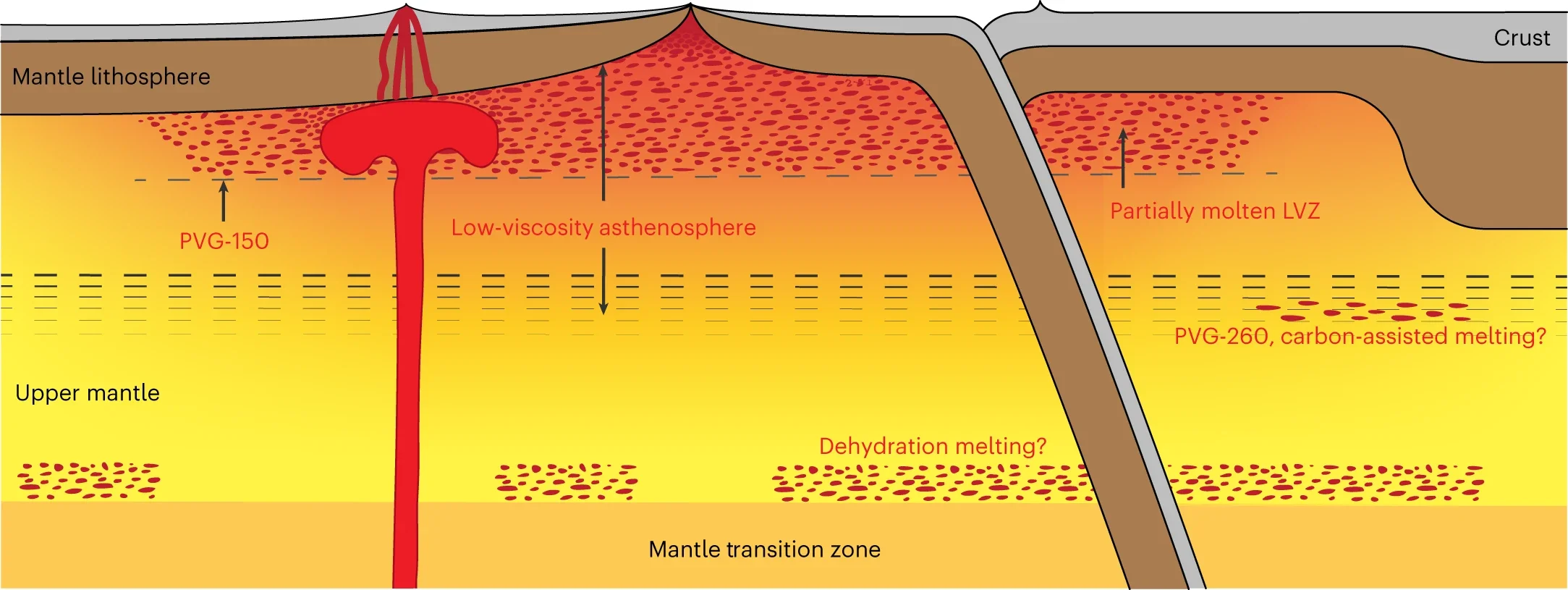
Its weakness depends on viscosity, a measure of resistance to flow. A rock can transmit earthquake vibrations while also changing shape slowly under sustained stress. Explaining that slow deformation is essential to understanding how relatively rigid plates move across Earth’s surface.
Partial melting seemed a plausible contributor because liquid between solid mineral grains can change a rock’s behavior. Earlier research had supported the presence of melt, but its extent and mechanical importance remained disputed. Detecting a seismic signature of melting would therefore answer only part of the problem.
The team focused on the lower boundary of a region where seismic waves travel relatively slowly. Previous studies had identified its upper boundary in many places. Its lower edge was harder to resolve, leaving uncertainty about how this low-velocity region related to melting deeper underground.
The researchers assembled recordings from 716 permanent seismic stations worldwide. After quality checks, their analysis retained 184,340 measurements called receiver functions, which isolate signals produced when seismic waves encounter changes inside Earth. Combining many measurements helped reveal structures that would be difficult to distinguish in individual recordings.
Their approach examined S waves that converted into P waves at underground boundaries. These wave types deform rock differently, so their conversions carry information about changes in material properties. The timing and strength of those signals helped the team estimate a boundary’s depth and the associated change in wave speed.
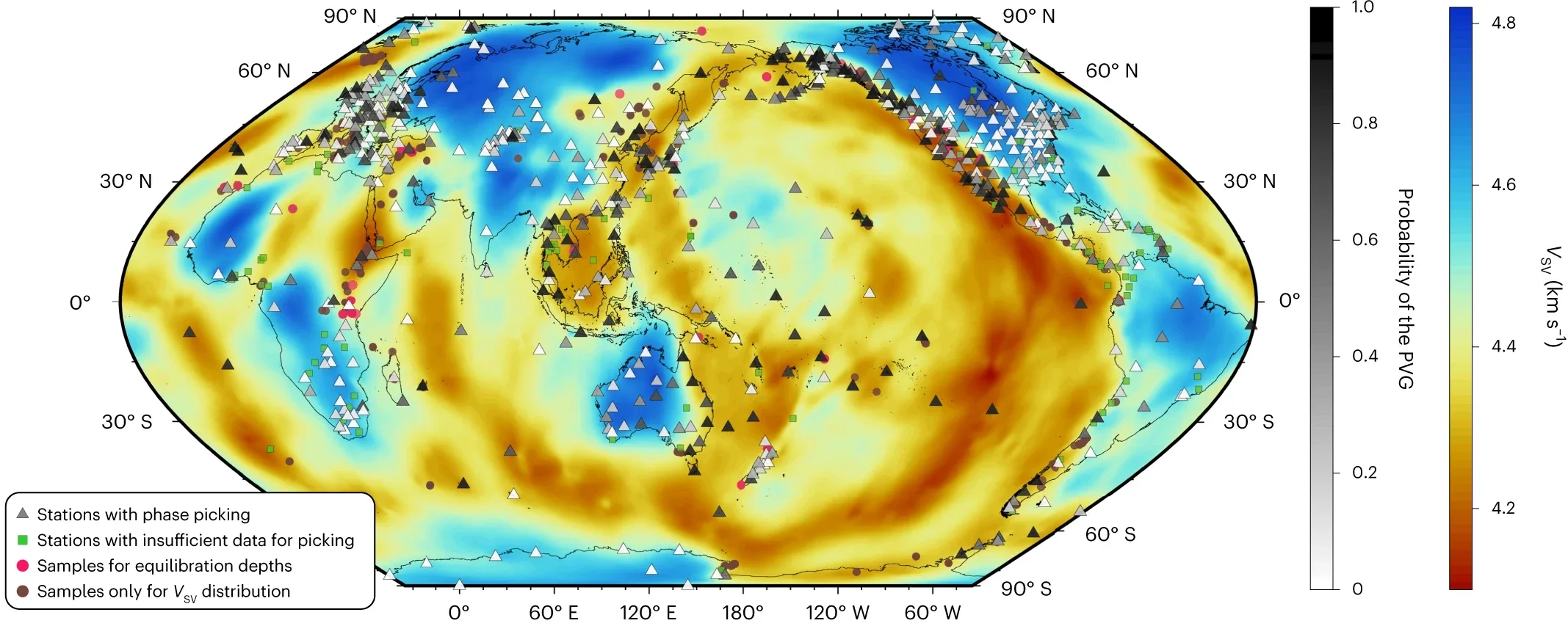
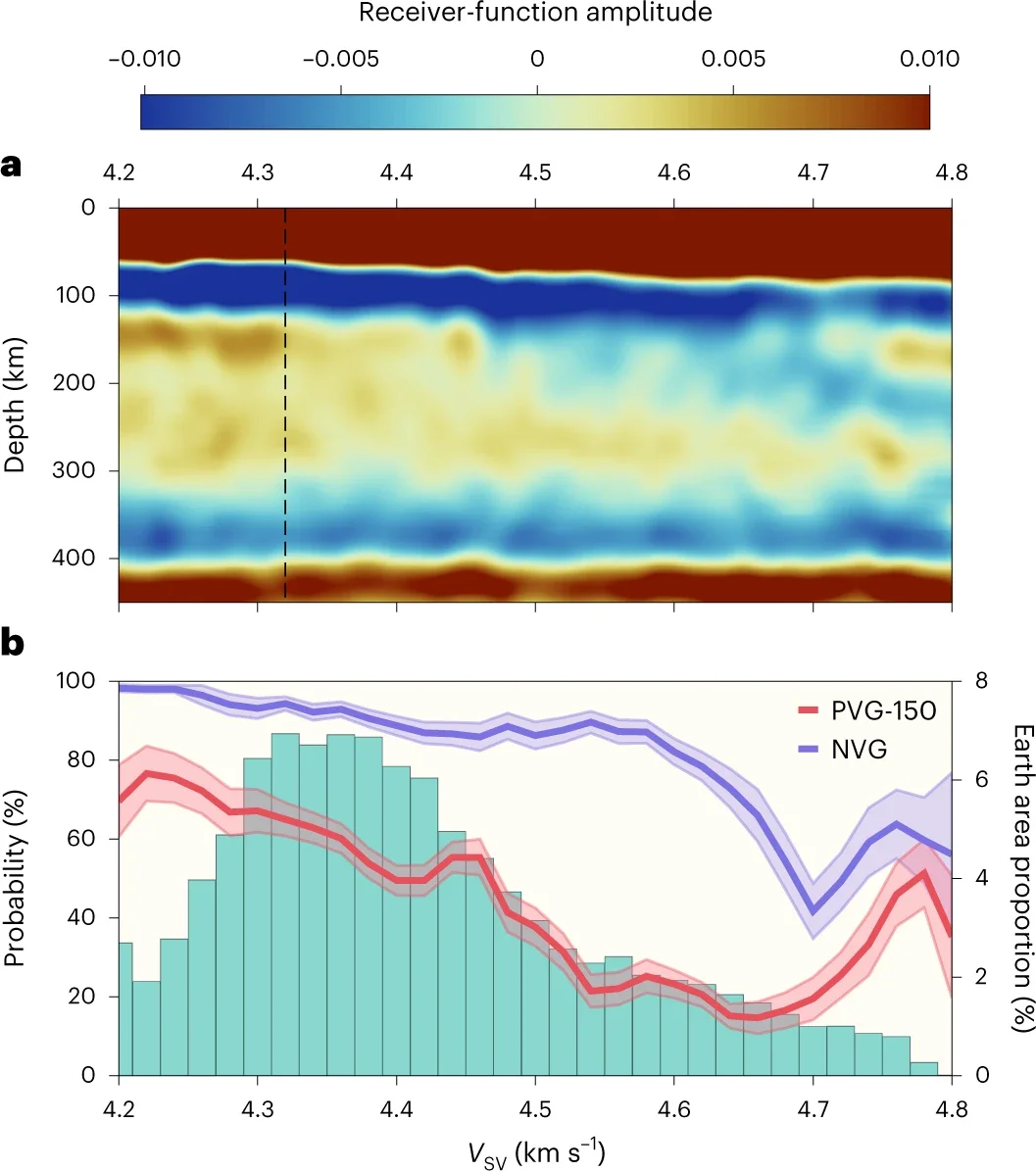
A clear signal appeared near 150 kilometers, about 93 miles, beneath many stations. It marked an increase in seismic velocity with depth, consistent with waves leaving a slower layer above. Where both boundaries were detected, the low-velocity layer had a median thickness of roughly 65 kilometers.
The results did not identify that boundary everywhere. The team found strong evidence at 160 stations and little evidence at another 240, while other locations remained less certain. This distribution matters because the study supports widespread partial melting, rather than an uninterrupted liquid shell surrounding the planet.
The detected boundary should not be confused with the bottom of the entire asthenosphere. It marks the lower edge of the particularly slow, melt-bearing region in the team’s interpretation. Weaker mantle can continue below it without displaying the same sharp change in seismic velocity.
The boundary occurred most often where other seismic models indicated relatively hot upper mantle. It appeared beneath both oceans and continents and extended beyond regions associated with volcanic hotspots. That pattern suggested a process more widespread than melting confined to a few unusually hot locations.
To test possible explanations, the team calculated how seismic waves should behave under different temperatures, mineral compositions and water contents. Models including partial melt reproduced key features of the observations. The analysis favored melt-bearing rock above the boundary, with small melt fractions around 1% or less, depending on the model.
The team checked whether the pattern depended on including stations near descending tectonic slabs. Removing those stations left the main relationship between the boundary and slow mantle velocities largely intact. Separate analyses of oceanic and continental stations also produced broadly similar patterns.
The researchers also examined basalt samples erupted around the world. Their chemistry allowed estimates of the temperatures and depths where the original magmas had equilibrated. Those estimates were consistent with melting beginning near the depth of the seismic boundary, adding a separate line of support.
Extrapolating the station results to areas with comparable mantle velocities suggested that the boundary could underlie about 44% of Earth’s surface area. This was a model-based estimate, not direct detection beneath every part of that area. Most stations were on continents, and the team noted that limited ocean coverage could affect the estimate.
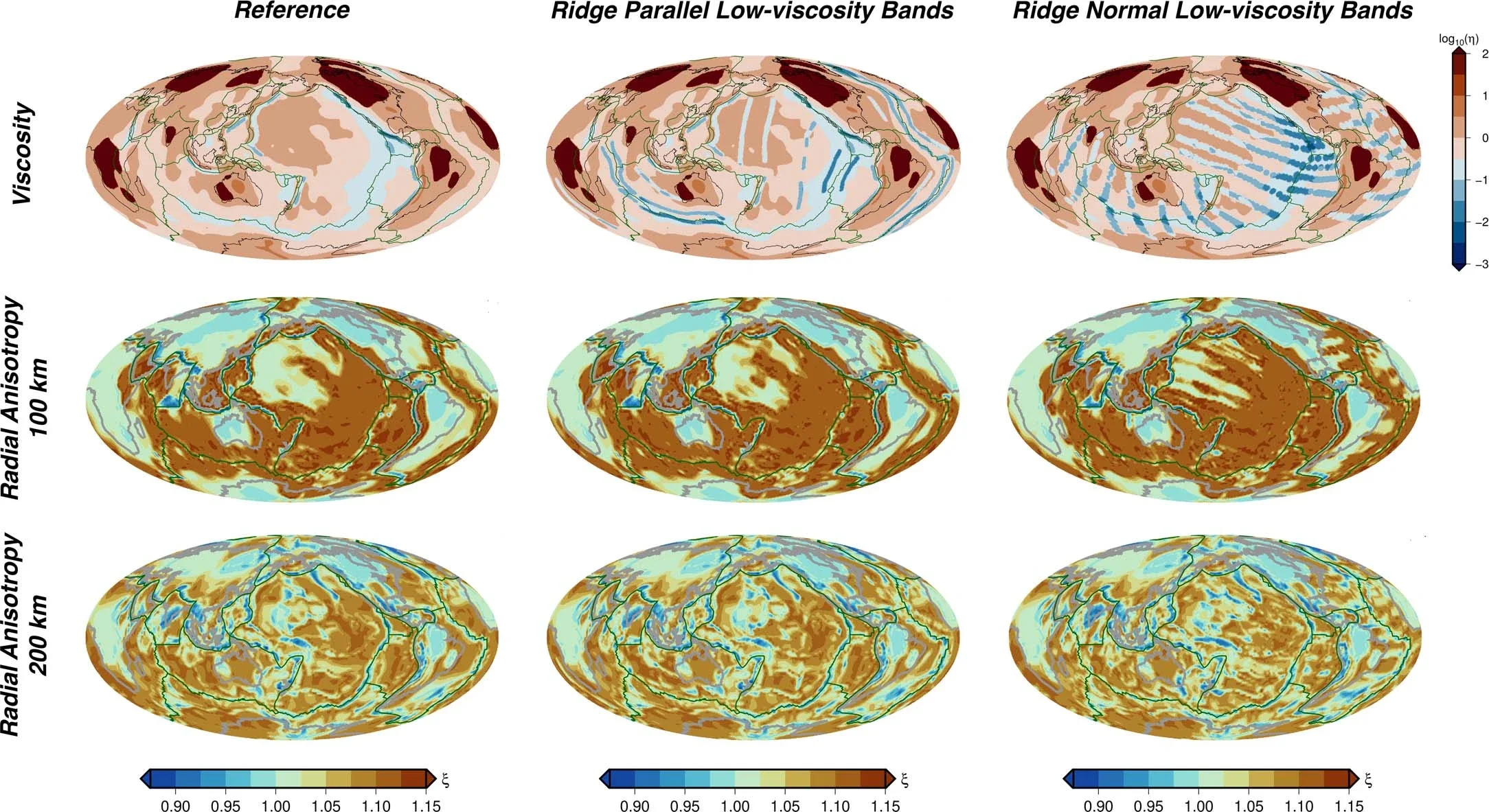
The decisive question concerned what the inferred melt did to the surrounding rock. The researchers compared areas with and without the boundary using seismic anisotropy, variations in wave speed with direction. These patterns can reflect the alignment of mineral crystals as mantle rock deforms.
If melting created a strongly weakened layer, deformation should become concentrated differently with depth. The team tested that expectation using one-dimensional and three-dimensional mantle-flow models. Strong reductions in viscosity produced changes in predicted anisotropy that should distinguish melt-bearing regions from surrounding mantle.
The observations did not show the expected differences. Regions with the boundary had lower seismic velocities, but their anisotropy profiles were not significantly different from regions without it. That mismatch argued against the inferred melt producing a large reduction in long-term viscosity.
The distinction involves timescale as well as material composition. Earthquake waves probe how rock responds over seconds, while plate movement involves deformation accumulated over much longer periods. Melt can change the rapid response enough to slow a wave without becoming the main control on slow mantle flow.
The findings point toward gradual variations in temperature and pressure as primary controls on asthenospheric weakness. Brown geophysicist Karen Fischer, a co-author and Hua’s doctoral adviser, emphasized the importance of understanding those controls. Establishing why the layer is weak helps explain the conditions that allow plate tectonics to operate.
However, the study does not establish that melt is mechanically irrelevant in every setting. UT Austin co-author Thorsten Becker noted that local effects could still matter. The global comparisons instead challenge the idea that widespread partial melting supplies a major additional weakening mechanism across the asthenosphere.
The work also leaves the timing of plate tectonics unresolved. Mapping present-day mantle properties cannot by itself establish when Earth first developed moving plates. Nor does identifying melt directly measure its influence on every region, since the mechanical conclusions depend on seismic interpretation and flow models.
For models of Earth’s interior, the result offers a useful distinction between detecting melt and assigning it a mechanical role. A low seismic velocity cannot automatically be translated into exceptionally low viscosity. The remaining challenge is to explain the asthenosphere’s weakness while respecting the different behavior recorded by earthquake waves and long-term deformation.
These studies explain the evidence for mantle melting and the competing ideas about what makes the asthenosphere weak.
Seismic evidence for partial melt below tectonic plates
This earlier global analysis linked partial melting with mantle deformation, providing a contrasting interpretation of melt’s mechanical importance. (Nature, October 2020)
Olivine anisotropy suggests Gutenberg discontinuity is not the base of the lithosphere
Laboratory measurements and flow modeling explain how mineral alignment can produce seismic boundaries that differ from the plate’s mechanical base. (Proceedings of the National Academy of Sciences, September 2016)
Experimental evidence supports mantle partial melting in the asthenosphere
Experiments under mantle-like conditions investigate how small amounts of melt affect seismic velocities, complementing evidence from earthquake recordings. (Science Advances, May 2016)
On the origin of the asthenosphere
This review evaluates proposed explanations for the asthenosphere’s properties using mineral physics, melting relationships and thermal models. (Earth and Planetary Science Letters, March 2012)
Water, Melting, and the Deep Earth H2O Cycle
This review examines how water moves through Earth’s mantle and influences where partial melting can occur. (Annual Review of Earth and Planetary Sciences, January 2006)
Research findings are available online in the journal Nature Geoscience.
The original story “Scientists discover a hidden layer of molten rock beneath Earth’s surface” is published in The Brighter Side of News.
Like these kind of feel good stories? Get The Brighter Side of News’ newsletter.
The post Scientists discover a hidden layer of molten rock beneath Earth’s surface appeared first on The Brighter Side of News.


Leave a comment
You must be logged in to post a comment.