DNA regions separated by millions of genetic letters can become neighbors when a chromosome folds. In octopus, squid and cuttlefish, those contacts offer clues to how ancient genome reshuffling may have altered gene regulation.
A University of Vienna-led study in Nature Communications compared this 3D architecture across three cephalopod species. First author Thea Rogers and colleagues combined contact maps with gene activity and evolutionary comparisons, then tested one candidate regulatory region in squid embryos.
The findings suggest that genome organization can preserve essential connections while allowing others to change. They also point to a possible contribution to cephalopods’ elaborate nervous systems. The work does not demonstrate that DNA folding alone produced problem-solving abilities or rapid camouflage.
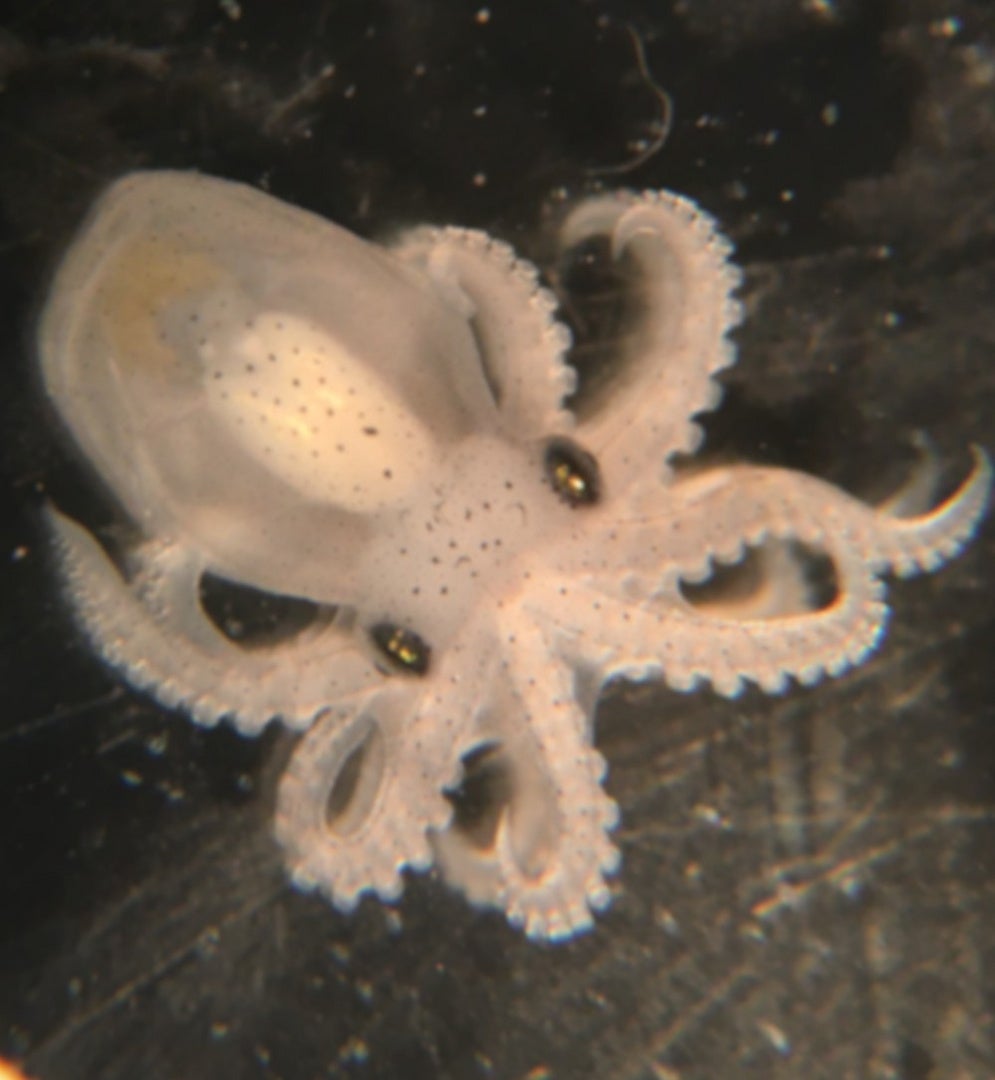
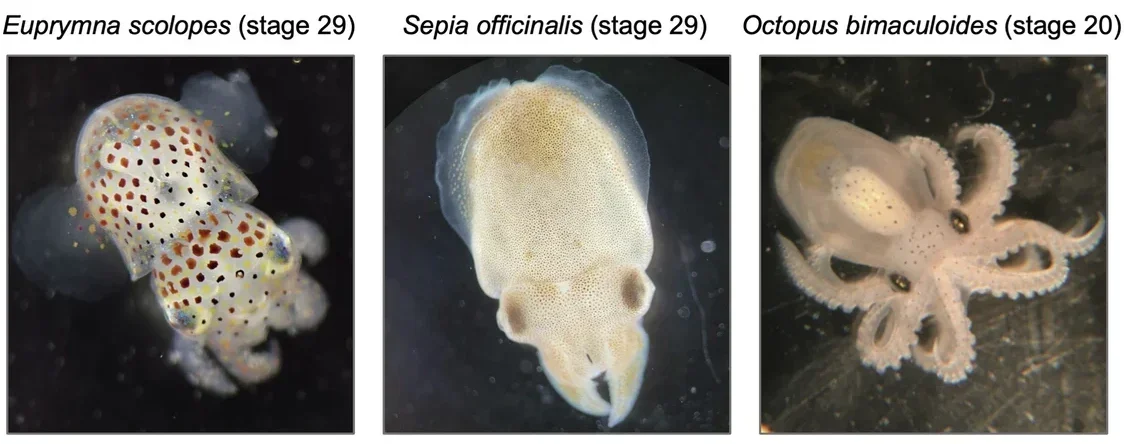
The main comparison included the Hawaiian bobtail squid, Euprymna scolopes, common cuttlefish, Sepia officinalis, and California two-spot octopus, Octopus bimaculoides. These species represent two major branches of coleoid cephalopods. Squid and cuttlefish belong to one branch, while octopuses belong to the other.
Their ancestors underwent extensive chromosome reorganization hundreds of millions of years ago. DNA regions changed positions within chromosomes and moved between them. The descendants also experienced genome expansion, with different histories in the squid-cuttlefish and octopus branches.
The researchers used Micro-C, a technique that measures contacts between DNA regions inside cells. They combined those maps with measurements of accessible DNA and RNA, which provided information about potential regulatory sites and gene activity. Samples covered embryos, developmental stages and adult tissues.
Comparisons with the great scallop, Pecten maximus, helped reconstruct older gene arrangements. The scallop retains much of the ancestral molluscan chromosome organization. It therefore supplied a reference for distinguishing inherited connections from those associated with cephalopod reshuffling.
Chromatin is DNA packaged with proteins. Its folded structure includes domains, regions with relatively frequent internal contacts and boundaries that separate them from neighboring regions. Loops provide more localized connections between distant stretches of DNA.
The distinction proved important. Larger chromatin-domain structures were generally conserved across the species, despite their extensive evolutionary changes. Loops were much less stable across species and varied among tissues and developmental stages.
The analysis identified 1,592 gene pairs that interacted in all three cephalopods. Another 952 pairs interacted only in the squid-cuttlefish comparison, while 3,634 interacted only in the octopus. These categories describe detected contacts, rather than proving that every pair shares a regulatory mechanism.
Gene pairs with contacts conserved across all three species showed the strongest correlation in activity across 19 squid tissues. They also tended to have broader expression and associations with essential cellular functions. Those patterns suggest that some spatial connections face stronger evolutionary constraints than others.
Conservation was much rarer among gene-associated loops. Under the study’s criteria, only three were shared across all three species. This contrast supports a hierarchy in which broad organization persists while many finer connections change.
Loop endpoints were enriched in conserved non-coding sequences, potential regulatory elements that do not encode proteins. The authors suggest that changing loops can repurpose older sequences, creating new regulatory arrangements without requiring entirely new genes.
The researchers call the proposed accumulation of interconnected dependencies “regulatory entanglement.” A rearrangement can place previously separated genes and regulatory elements near one another. Over time, new contacts may become integrated into networks that are increasingly difficult to reorganize without consequences.
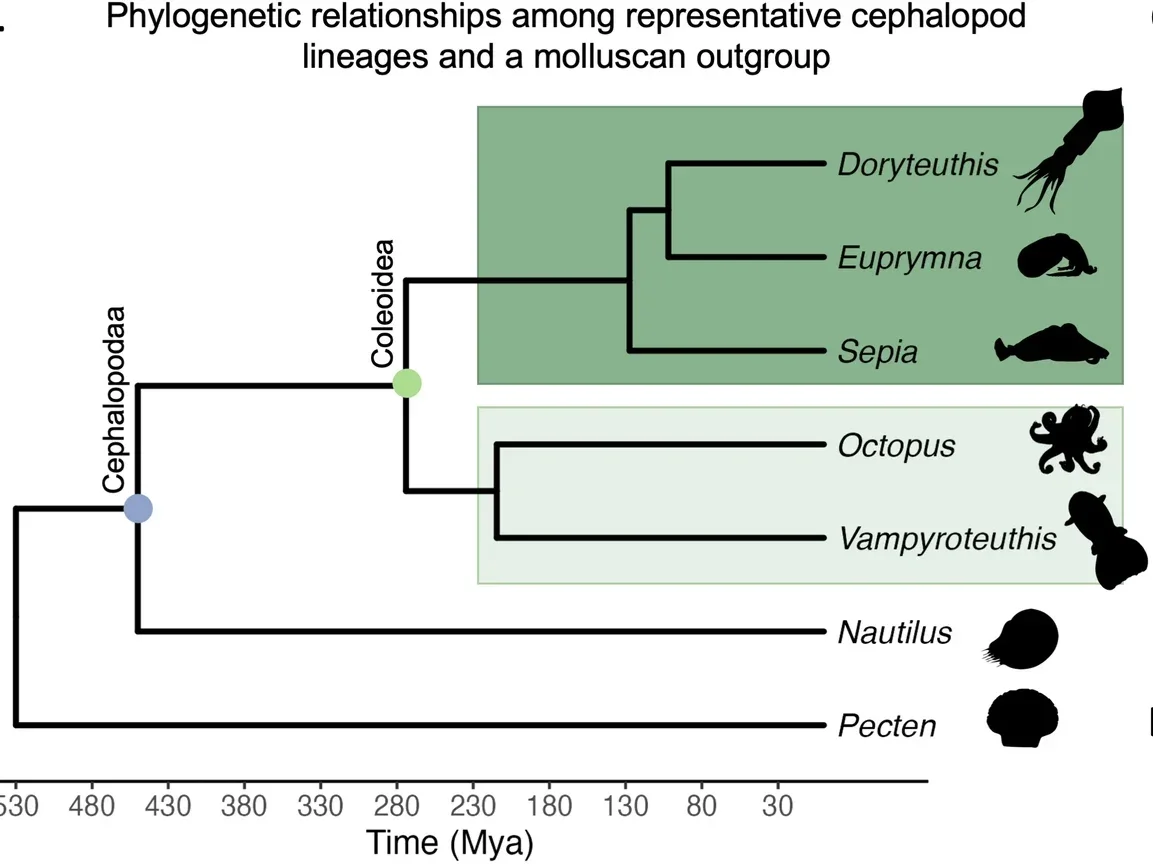
This is an evolutionary interpretation built from present-day comparisons. The study did not observe ancient chromosomes rearranging or track new dependencies over millions of years. Instead, it reconstructed their likely history using gene positions, shared sequences and physical contacts.
The octopus showed a particularly mixed pattern, consistent with additional chromosome fusions and rearrangements in its lineage. Although its genome was smaller than those of the other two species, its gene-associated loops were generally larger. Their median span was 2.9 million DNA base pairs, compared with 1.6 million in squid and 1.3 million in cuttlefish.
That result suggests loop size cannot be explained simply by total genome expansion. The authors propose that chromosome fusion brought together regions requiring longer-range connections. Such rearrangements could create opportunities for new regulation while eventually imposing new constraints.
Genes associated with conserved loops were strongly expressed in squid neural tissues. They were also active in the white body, an organ involved in blood-cell production and immunity. The connections therefore extended beyond nervous-system biology.
Loop patterns differed within each species as well. Octopus neural tissues had similar loop counts, while internal organs had roughly one-third as many. In cuttlefish, the eyes had the highest number, followed by the optic lobes.
Development introduced further variation. One squid loop appeared during early organ formation but weakened at later stages. Its presence coincided with accessible DNA and elevated activity in a group of genes involved in cellular development.
These associations do not mean every loop switches nearby genes on together. Some loop-associated genes increased activity, others decreased, and mixed patterns were common. The contacts appear to provide regulatory settings whose effects depend on the particular elements and developmental context.
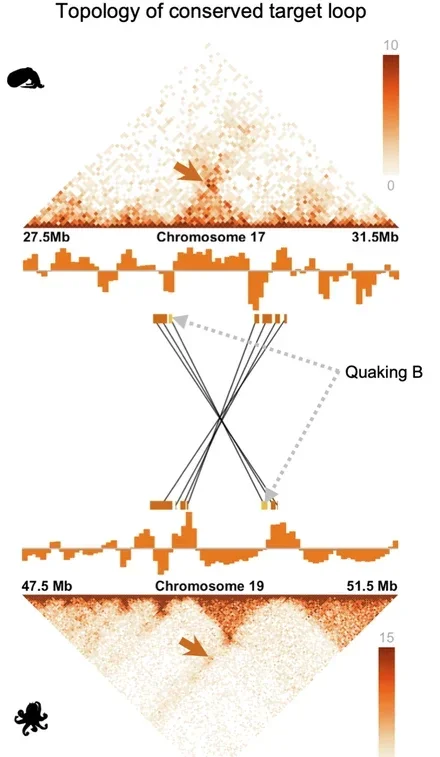
To move beyond comparisons, the team deleted approximately 1,000 base pairs from a candidate regulatory region in another bobtail squid, Euprymna berryi. The sequence lies within an intron of Quaking B, a gene inside a conserved chromatin loop. An intron is a segment removed during RNA processing.
All 25 examined late-stage injected embryos showed developmental delay. Five had clearly reduced brain size, particularly in the optic lobes, and five were severely malformed. Six were smaller with shorter arms, while nine lacked an overt morphological abnormality despite the delay.
The strongest statistically supported gene-activity changes occurred outside the conserved loop. One downregulated gene lay 14.5 million base pairs upstream of the target in this squid. Other affected genes were several million base pairs downstream.
Those results support a functional role for the deleted region and are consistent with long-range regulatory connections. They do not establish every proposed contact mechanism. Activity changes within the conserved loop itself were not statistically significant after correction for multiple comparisons.
The broader evolutionary explanation remains a model for further testing. Conserved domains, flexible loops and the deletion experiment together show how physical genome organization can matter for development. Whether particular rearrangements helped produce specific cephalopod behaviors requires additional evidence linking DNA architecture, neural development and function.
These resources explore cephalopod nervous systems, chromosome reorganization and the evolution of spatial gene regulation.
Emergence of novel cephalopod gene regulation and expression through large-scale genome reorganization: Investigates earlier evidence connecting cephalopod chromosome reshuffling with new gene-regulatory arrangements. (Nature Communications, 2022)
Genome and transcriptome mechanisms driving cephalopod evolution: Compares cephalopod genomes and gene activity to examine mechanisms behind their distinctive evolutionary history. (Nature Communications, 2022)
Chromatin loops are an ancestral hallmark of the animal regulatory genome: Traces the evolutionary history of DNA looping and spatial regulation across animals and their unicellular relatives. (Nature, 2025)
Evolution and function of chromatin domains across the tree of life: Reviews how chromatin domains form, function and differ among evolutionary lineages. (Nature Structural & Molecular Biology, 2024)
Evolution of cephalopod nervous systems: Reviews the origins and distinctive organization of cephalopod brains and distributed nervous systems. (Current Biology, 2023)
Research findings are available online in the journal Nature Communications.
The original story “New DNA findings may explain how octopuses evolved complex brains” is published in The Brighter Side of News.
Like these kind of feel good stories? Get The Brighter Side of News’ newsletter.
The post New DNA findings may explain how octopuses evolved complex brains appeared first on The Brighter Side of News.


Leave a comment
You must be logged in to post a comment.