A sixteen-minute train delay once appeared to mark the first recorded collision between space weather and human technology. There was one problem: the railway did not exist on the date given for the incident.
An archival investigation published in Space Weather concludes that the Exeter episode most likely happened on October 18, 1848. A widely cited account in Nature had placed it exactly seven years earlier.
James Wild of Lancaster University led the international study with collaborators including Baylor University space weather historian William B. “Trey” Cade III. Researchers from the British Geological Survey, Natural Resources Canada, RMIT University and RAL Space also contributed. Their evidence combined transport records with measurements and sightings of solar-driven disturbances.
The disputed story appeared in an anonymous article in Nature on October 5, 1871. It described an intense magnetic disturbance on October 18, 1841, affecting the South Devon Railway’s needle telegraph instruments. Those instruments allowed railway staff to communicate whether a section of track was clear or occupied.
According to the account, operators could not establish whether the line near Starcross was clear. The 10:05 p.m. express therefore remained at Exeter for sixteen minutes. The superintendent reportedly believed “some one was playing tricks with the instruments.”
Cade rediscovered the passage and discussed it in a 2013 paper. If the date were accurate, it would precede other known accounts of geomagnetic activity disrupting electrical infrastructure. The episode consequently acquired significance beyond an ordinary late departure.
But the historical chronology made the reported year impossible. Parliament approved the Exeter-to-Plymouth railway in July 1844. The first section, between Exeter and Teignmouth and including Starcross, opened on May 30, 1846.
The line reached Newton Abbot later that year. Whatever caused the reported delay, it could not have affected that railway in 1841. The construction records established the investigation’s clearest finding before any solar observations were examined.
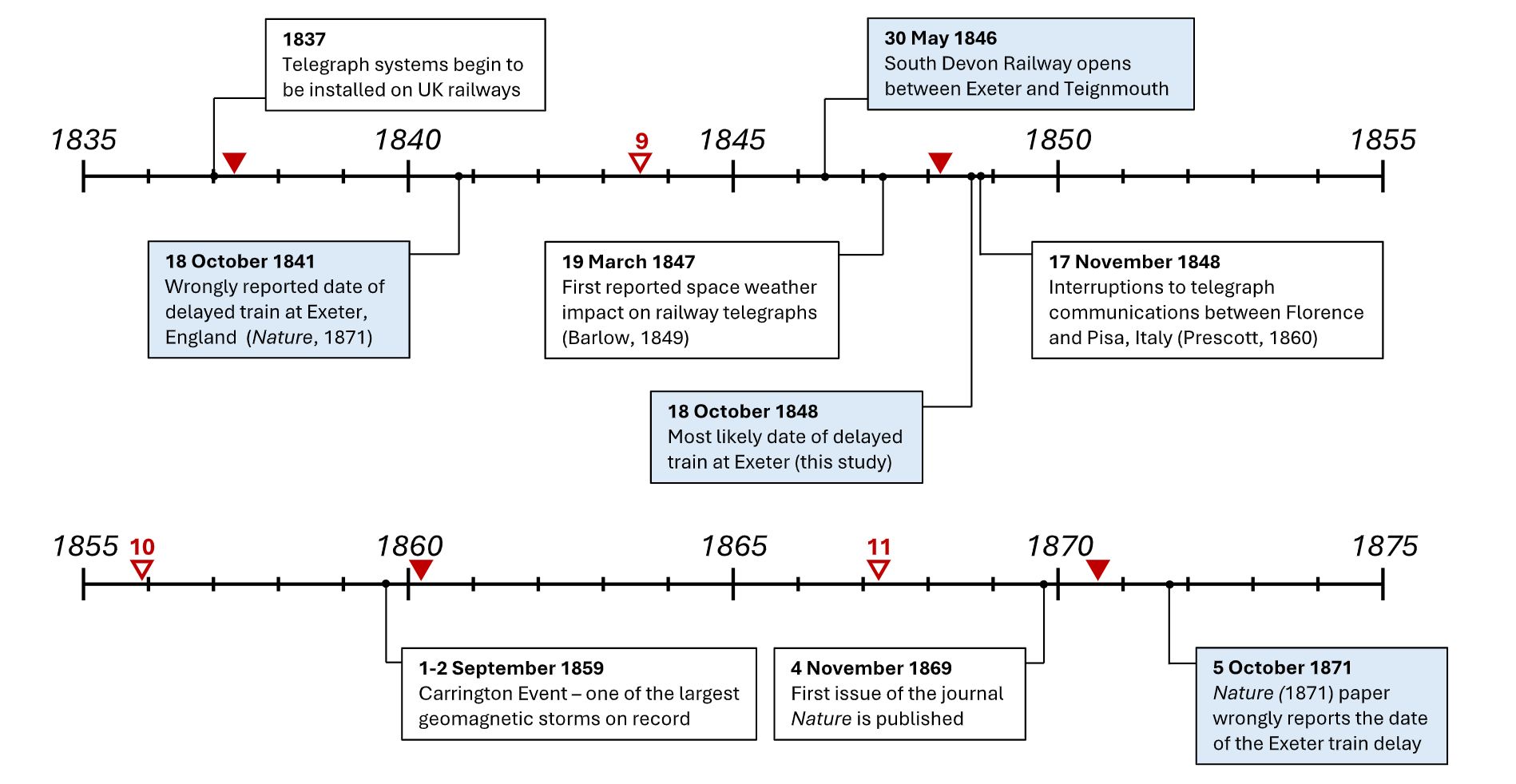
The researchers next treated the train’s scheduled departure as a historical clue. Local newspapers routinely printed railway timetables, offering a way to check when a 10:05 p.m. service actually operated. The surviving schedules identified a window from March 11, 1848, to July 26, 1849.
A timetable in Trewman’s Exeter Flying Post dated October 12, 1848, included the relevant weekday departure. Its notation, “10 5,” matched the time quoted in the later scientific account. That supported looking for a disturbance during the timetable’s documented operating period.
October 18, 1848, became a particularly promising candidate because it preserved the reported day and month. The researchers then checked whether independent evidence showed disturbed space conditions on that evening. This avoided relying on the railway anecdote to establish the storm itself.
The alternative year also addressed another difficulty. Greenwich records contained no unusual magnetic activity noted for October 18, 1841. An aurora catalogue listed a sighting in Prague that day, but no corresponding reports from England.
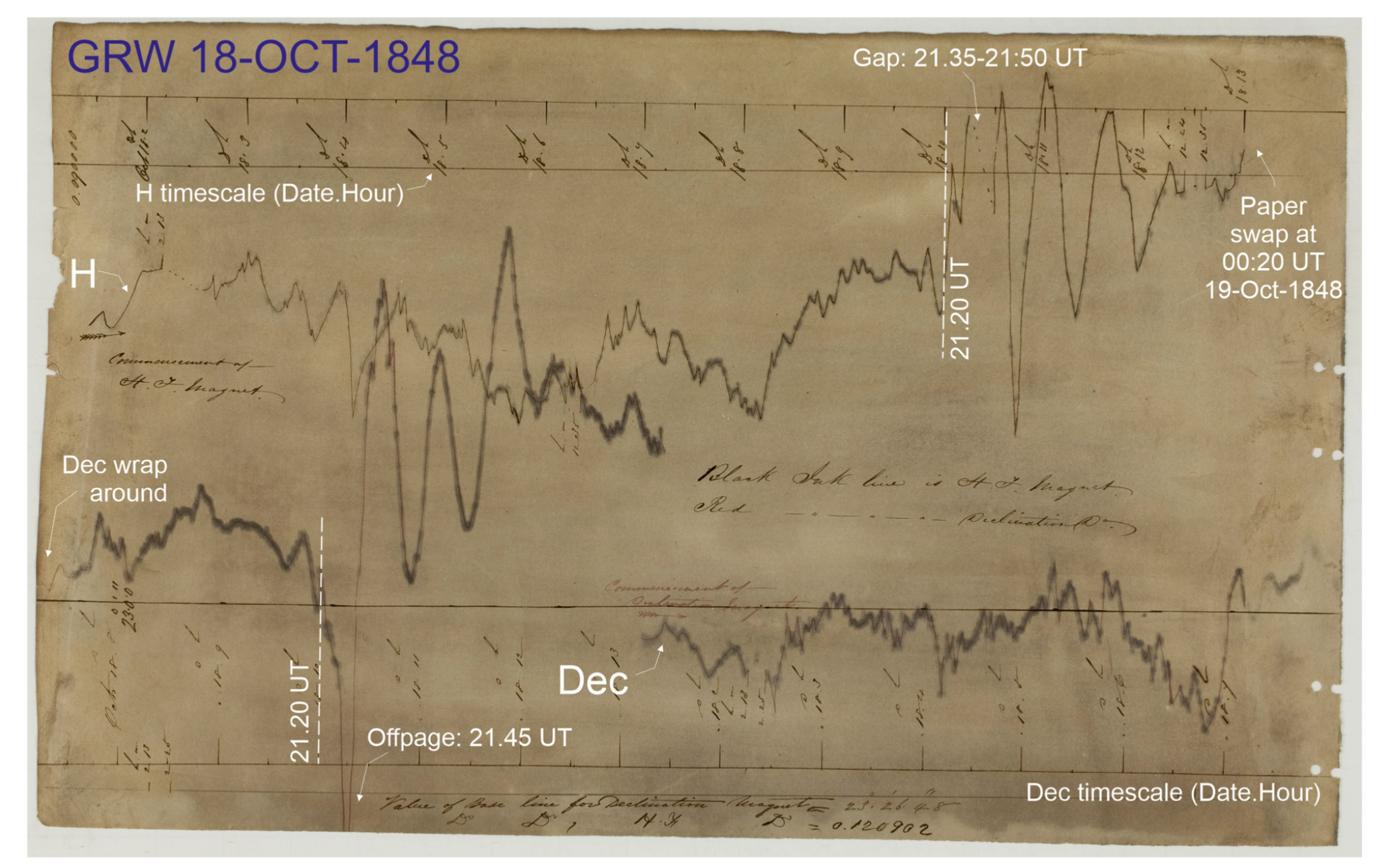
Greenwich Observatory’s magnetic records revealed powerful disturbances on the evening of October 18, 1848. One recorded change in horizontal magnetic-field strength was approximately 310 nanoteslas over about twenty minutes. Another trace showed a roughly 1.3-degree change in magnetic direction over twenty-two minutes.
The original charts used astronomical time, with noon as the starting point. Interpreting them required accounting for that convention and offsets between the recorded traces.
Rapid magnetic changes can induce electric fields at Earth’s surface. Those fields can drive unwanted currents through long conductors, including telegraph lines. The researchers judged the recorded changes sufficient to produce interference in southern England, assuming Exeter experienced variations similar to Greenwich.
That qualification matters because the magnetic measurements came from London, not the railway’s instruments. The records establish a strong regional disturbance. They do not directly measure the electrical current that passed through the Exeter telegraph.
Newspapers supplied another independent strand. An observer near Leeds described an unusually extensive auroral display on a Wednesday night, probably October 18. Reports from Exeter also described northern lights during the following days.
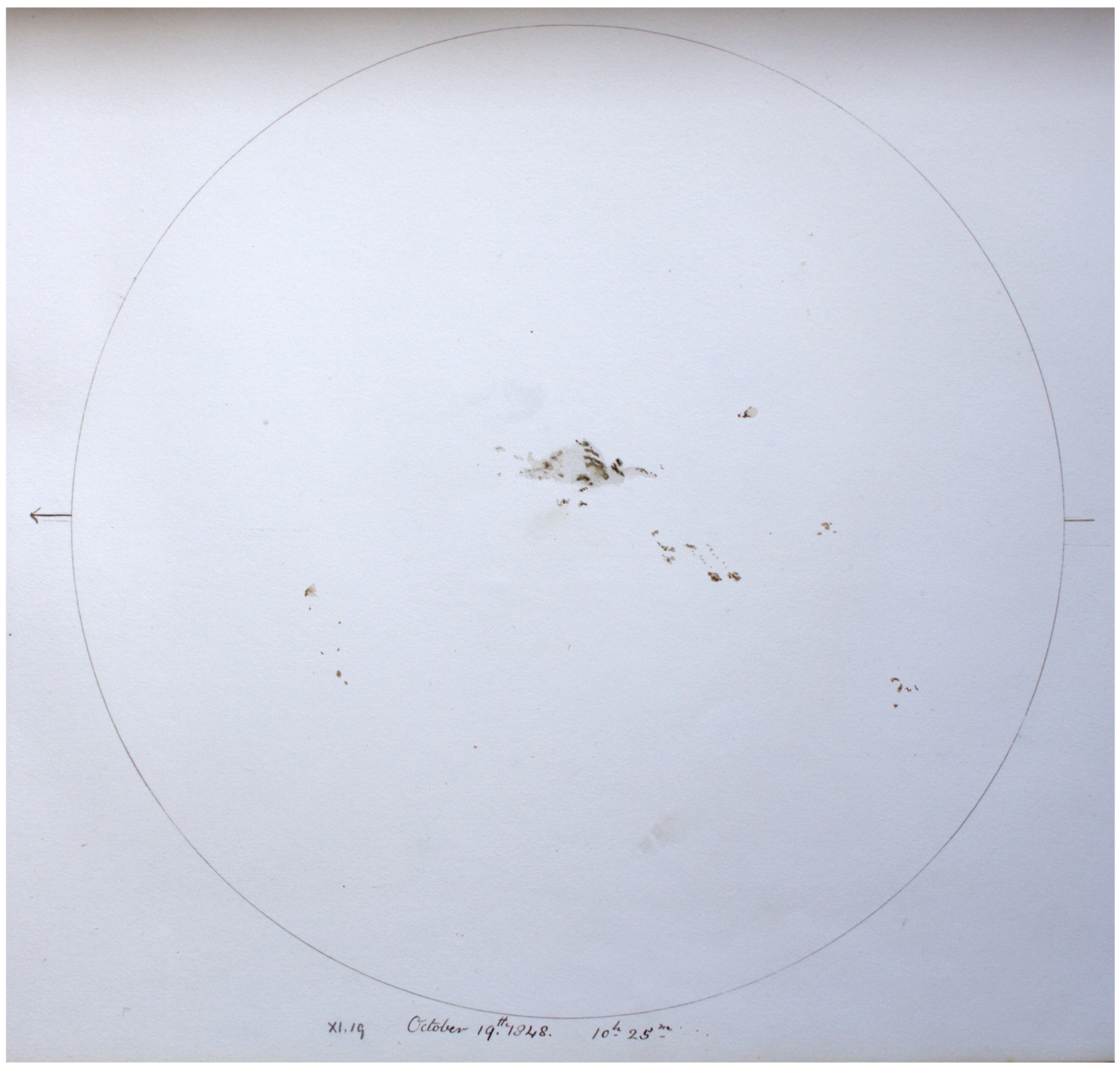
Solar observations added context for the disturbed period. An Exeter observer reported a large sunspot group on October 19, 1848. A drawing made that morning by astronomer Temple Chevallier at Durham also showed a substantial group near the Sun’s central, Earth-facing meridian.
Together, the timetable, magnetic disturbance, auroras and sunspots make 1848 a strong fit. The authors conclude that “1848” was most likely printed as “1841” in the 1871 account. They describe the evidence as compelling but circumstantial.
The original manuscript has not survived in the archives consulted. Neither has directly relevant correspondence that would establish how the date entered the article. Researchers also could not locate a contemporary report containing the superintendent’s complaint about interference with the instruments.
A handwritten annotation on the publisher’s copy suggests the author may have been electrical engineer Nathaniel John Holmes. His interest in telegraph systems and astronomy makes that identification plausible. It does not prove authorship or explain the date error.
The episode therefore has two different levels of certainty. The railway chronology decisively excludes 1841. The proposed replacement date and printing-error explanation rest on mutually supporting records rather than a recovered correction from the original author.
Moving the Exeter incident to 1848 removes its claim to be the earliest credible technological disruption. The authors instead identify March 19, 1847, when magnetic disturbances affected Midland Railway telegraph equipment near Derby. Engineer William Henry Barlow described spontaneous electrical currents during a brilliant auroral display.
That account was presented to the Royal Society in May 1848 and published in 1849. Both it and the probable Exeter event preceded the widely remembered Carrington storm of 1859. Telegraph vulnerability was apparent before that later episode produced widespread disruption.
The study links these early problems to the expansion of electrical communication during the 1840s. As solar activity increased, operators encountered disturbances their instruments were not designed to accommodate. The historical record captures an emerging technology meeting an unfamiliar environmental hazard.
Modern vulnerabilities extend to railway signaling, power supplies, navigation and communications. The specific equipment has changed, but solar activity can still interfere with electrical and radio-dependent systems. The Exeter investigation shows why documenting that history requires both scientific observations and careful checks of the infrastructure supposedly affected.
These resources explore historical magnetic storms, modern railway vulnerabilities and the wider effects of solar activity.
Digitized Continuous Magnetic Recordings for the August/September 1859 Storms From London, UK: Reconstructs historical magnetic measurements from the Carrington-era storms, illustrating the value of surviving observatory records. (Space Weather, 2024)
Modeling “Wrong Side” Failures Caused by Geomagnetically Induced Currents in Electrified Railway Signaling Systems in the UK: Models how solar-driven electrical currents could affect modern railway signaling. (Space Weather, 2023)
The super storms of August/September 1859 and their effects on the telegraph system: Examines telegraph disruptions during the storms that made the technological consequences of space weather especially conspicuous. (Advances in Space Research, 2006)
The Origin of “Space Weather”: Traces the terminology and historical development of understanding connected solar and terrestrial disturbances. (Space Weather, 2015)
What NASA Is Learning from the Biggest Geomagnetic Storm in 20 Years: Describes observations of the May 2024 storm and its effects across Earth’s space environment and technology. (NASA, 2025)
Research findings are available online in the journal Space Weather.
The original story “A delayed Victorian train reveals a 185 year-old error in space weather history” is published in The Brighter Side of News.
Like these kind of feel good stories? Get The Brighter Side of News’ newsletter.
The post A delayed Victorian train reveals a 185 year-old error in space weather history appeared first on The Brighter Side of News.


Leave a comment
You must be logged in to post a comment.