A nearby world has weather that astronomers can now follow in unusual detail. Over eleven hours, the James Webb Space Telescope watched its infrared light change, revealing separate clues about shifting clouds and gases rising from deeper layers.
The object, WISE 0855, floats through space without a host star. Roughly Jupiter-sized and about 7.5 light-years away, it is the coldest known brown dwarf. Its atmosphere offers a rare opportunity to investigate planet-like weather beyond the solar system.
Brittany Miles of the University of Arizona‘s Steward Observatory led the international team. The study, accepted by The Astronomical Journal and available on arXiv, presents evidence that patchy water clouds change thickness while a separate chemical signal varies underneath.
That interpretation comes from comparing spectra with atmospheric models. Webb did not photograph individual clouds or directly watch parcels of gas rise. Its measurements instead reveal how different parts of the atmosphere affect escaping light.
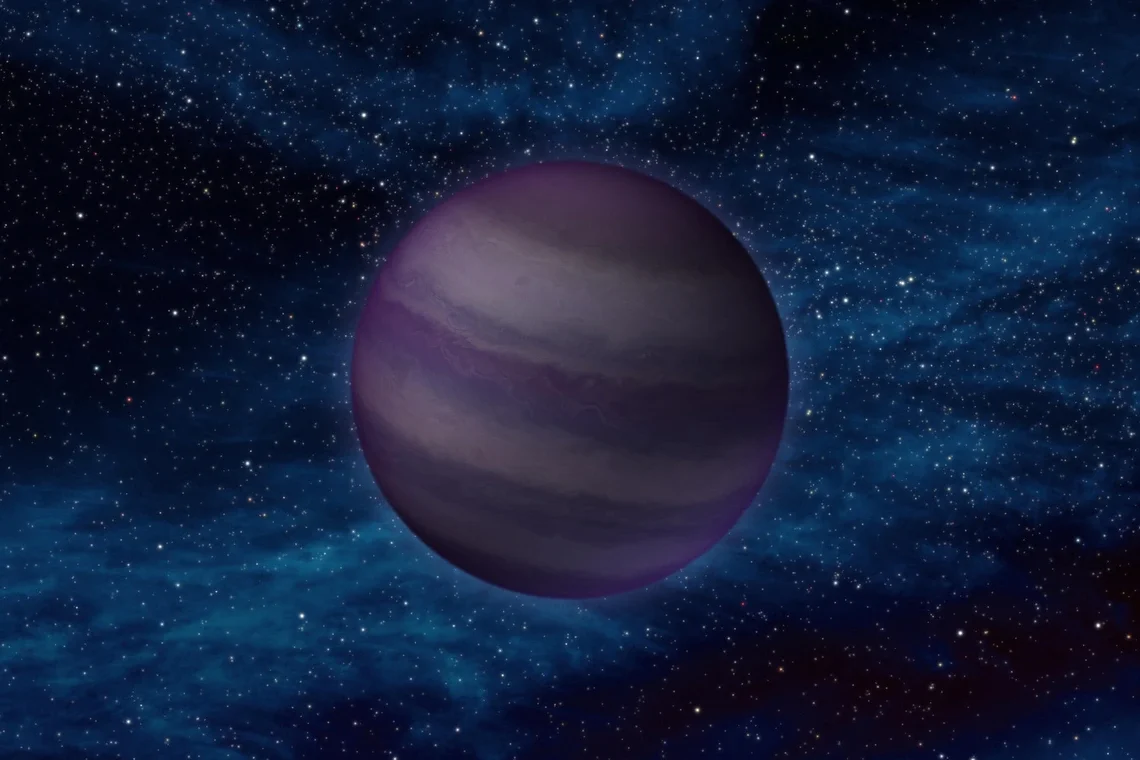
Brown dwarfs lack the sustained hydrogen fusion that powers ordinary stars. They radiate heat left over from their formation, allowing astronomers to study them even without illumination from a nearby sun.
WISE 0855 sits at the unusually cold end of that population. Its effective temperature is approximately 265 kelvin, or minus eight degrees Celsius. That temperature describes its overall thermal emission, rather than a solid surface like Earth’s.
The object therefore provides an atmospheric comparison with giant planets, despite its different surroundings. Clouds, convection and chemical reactions can operate on a free-floating world as they do on planets orbiting stars.
Co-author Mark Marley, director of Arizona’s Lunar and Planetary Laboratory, compares the atmosphere to a screen door. Escaping photons carry information about deeper layers, but the material they pass through changes what observers receive.
“We’re learning about the world on either side of the screen,” Marley said. Understanding that intervening atmosphere is essential to interpreting the light.
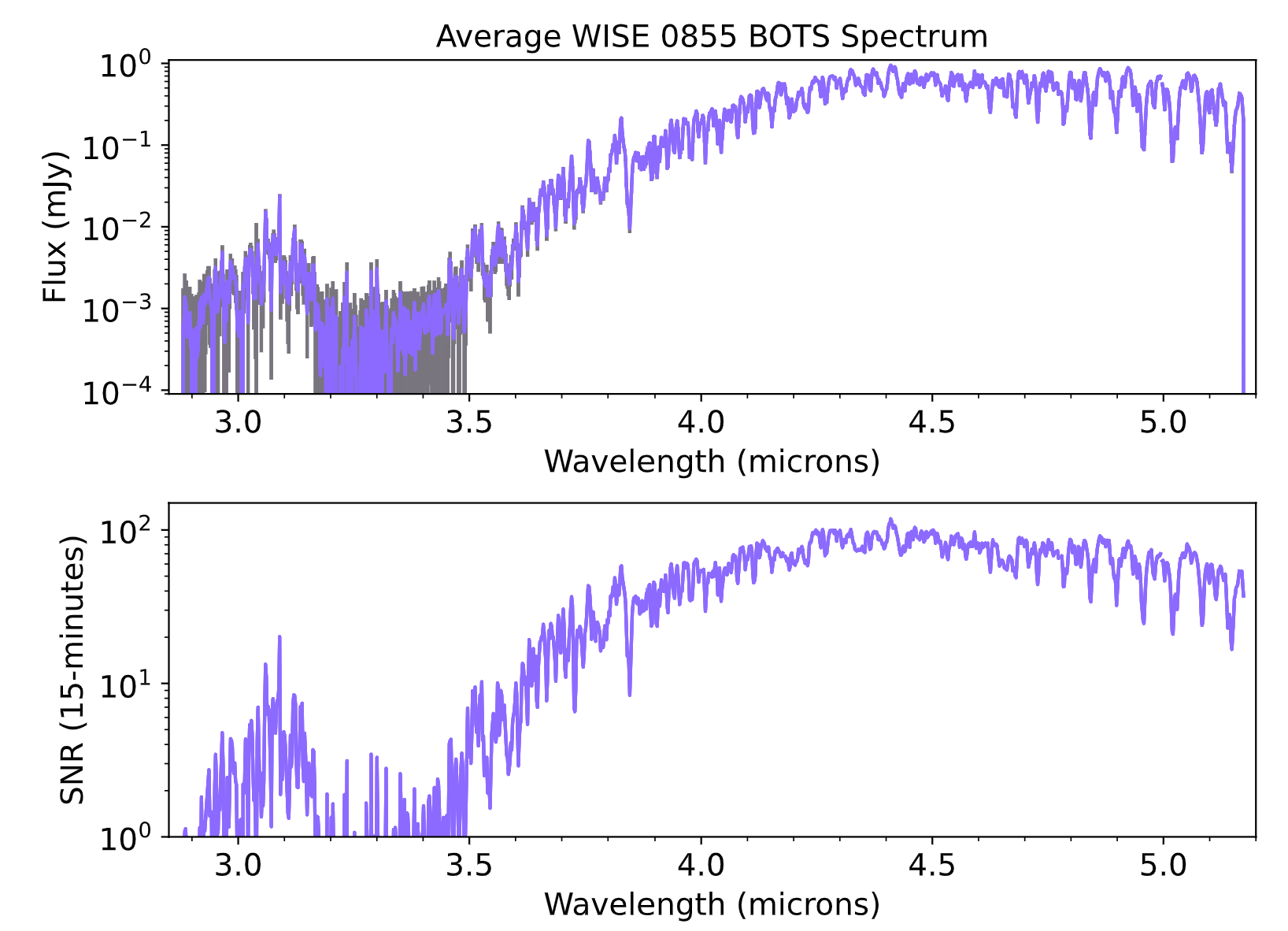
Webb observed WISE 0855 on December 2, 2023, using its Near-Infrared Spectrograph. The team collected forty-four spectra, each representing fifteen minutes, across approximately eleven hours.
The observations covered wavelengths from 2.87 to 5.27 micrometers. Within that range, different molecules absorb light at characteristic wavelengths. Those features let researchers investigate chemistry alongside changes in the overall brightness.
This matters because a single brightness measurement can combine several effects. A warmer region may emit more light. Thicker clouds may obscure deeper layers, while a changing gas abundance can alter particular absorption features.
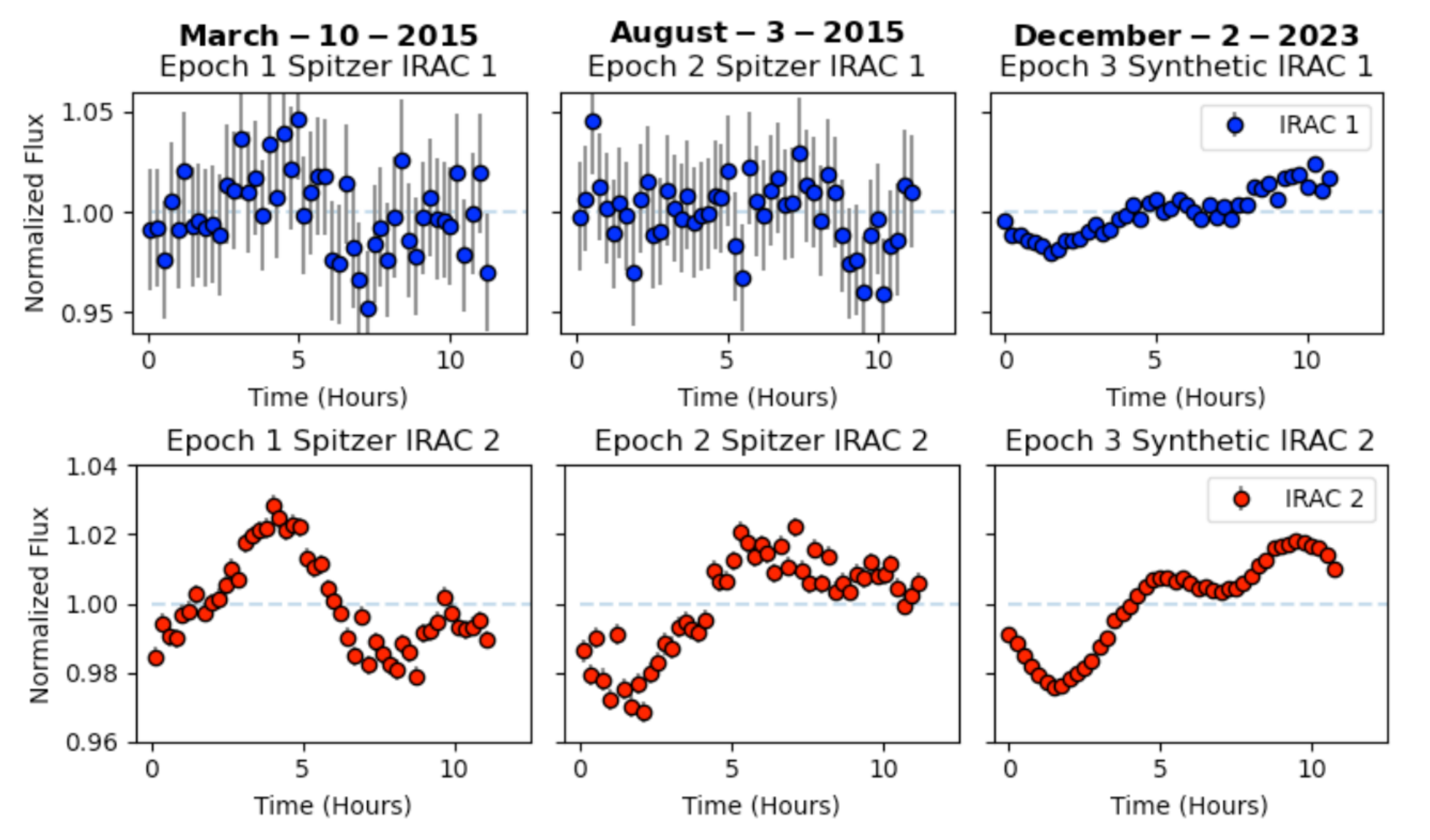
Earlier observations had already revealed important pieces of WISE 0855’s atmosphere. A ground-based spectrum reported in 2016 provided evidence for water vapor and clouds. Spitzer monitoring also showed that its brightness varied.
The new advance is following a detailed spectrum repeatedly. Instead of watching only a blended brightness signal, astronomers can compare how individual molecular features change through time.
Different wavelengths effectively sample different atmospheric depths because gases and clouds block light unevenly. Watching those wavelengths together helps researchers distinguish processes that would otherwise look similar. It is a way to investigate vertical structure without resolving the world into a visible disk.
The researchers tested several families of atmospheric models, including clear and cloudy versions. Models containing water clouds fitted the average spectrum better than their corresponding clear models.
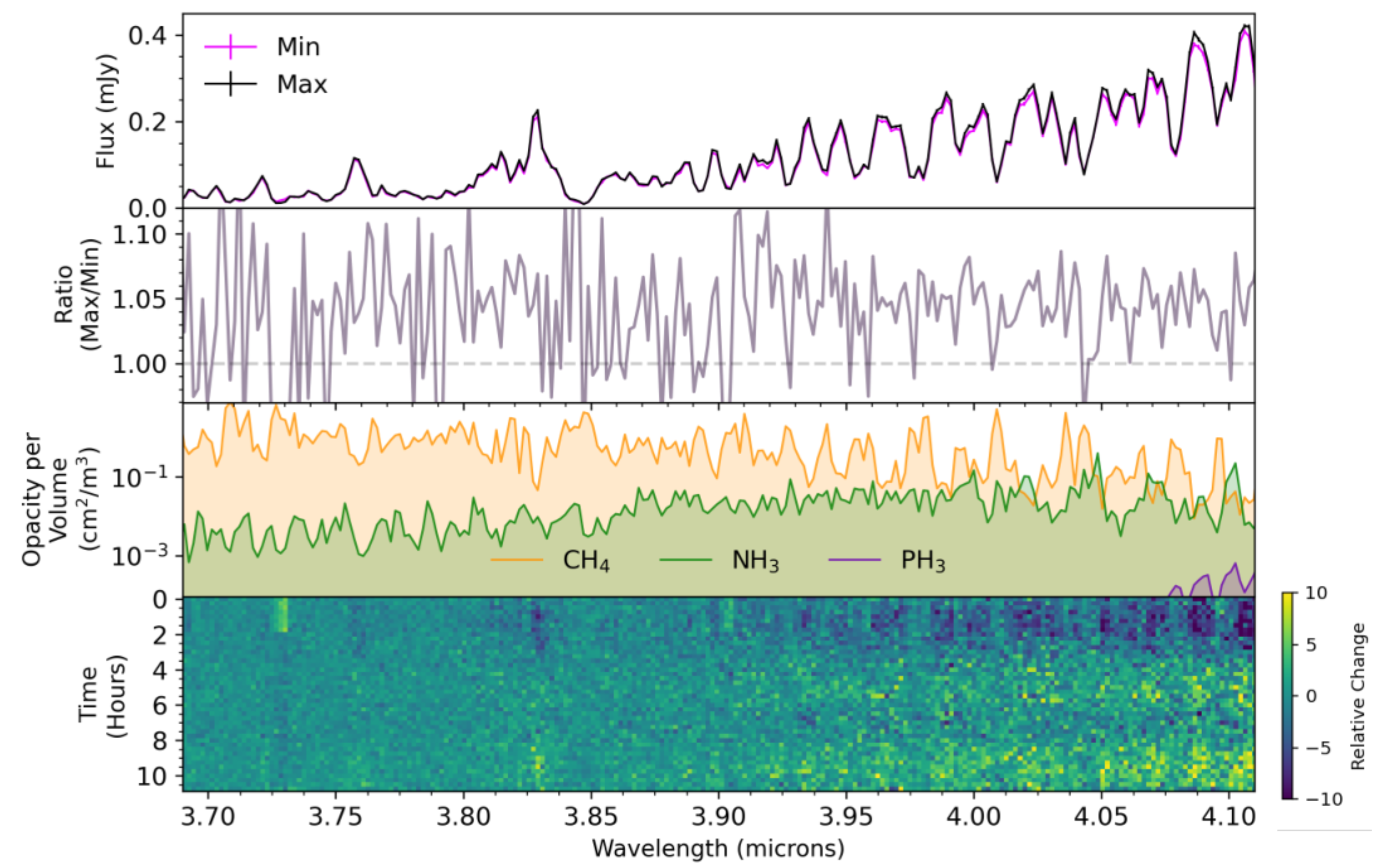
The changing spectra supplied additional clues. Variations across broad wavelength ranges resembled the effects expected from temperature differences or changing cloud thickness. Water absorption features varied relatively little, which helped constrain those explanations.
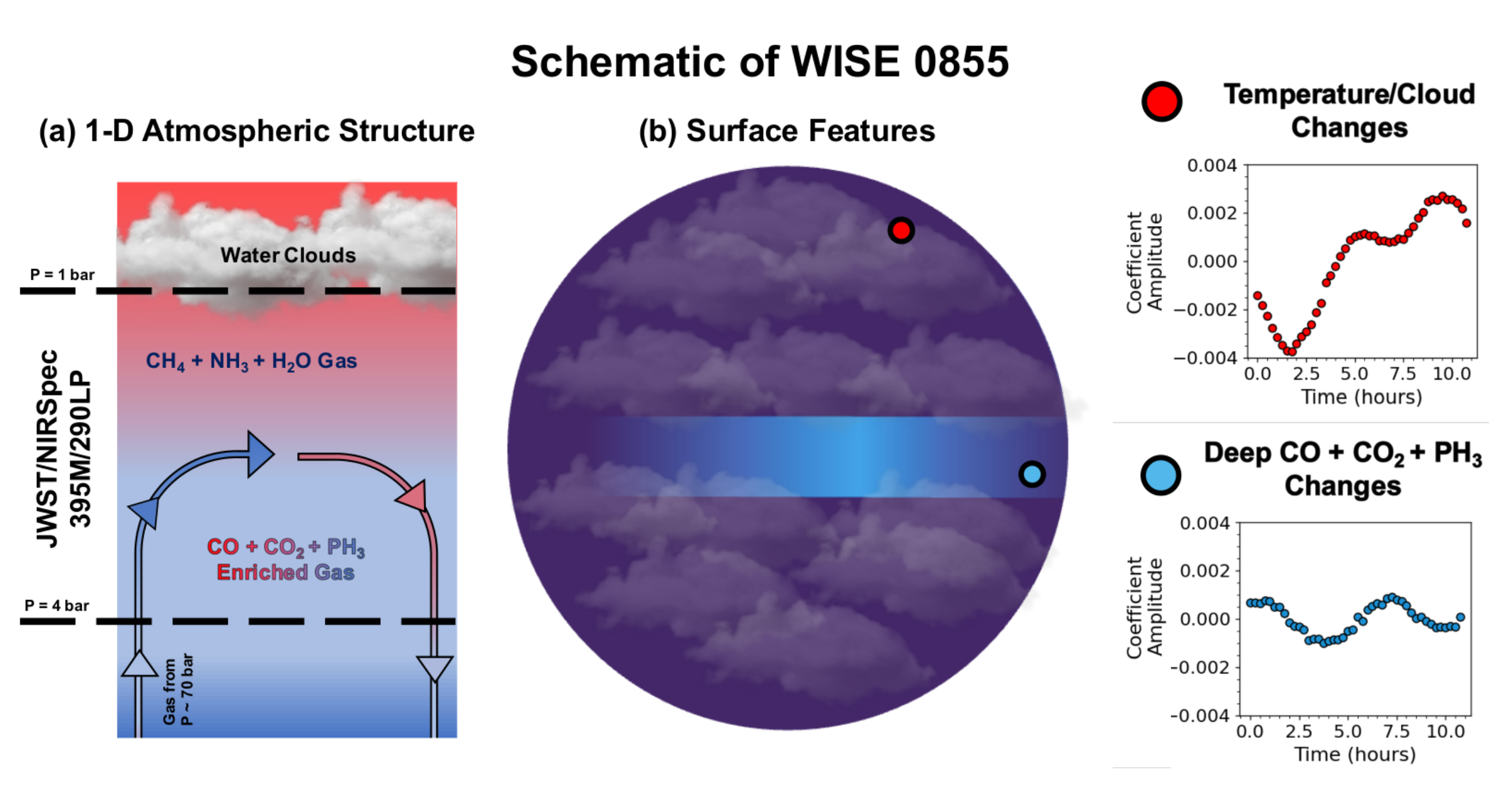
Taken together, the comparisons support patchy water clouds whose thickness changes across the atmosphere. As the object turns, regions with different cloud cover and temperatures contribute different amounts of light.
The inferred temperature differences can be small, around one kelvin. Webb’s sensitivity makes such subtle changes detectable in the spectrum, even though the object remains an unresolved point of light.
“We can actually watch them change in real time,” Miles said of the atmospheric signals. The evidence is strongest when the time variations and model comparisons are considered together.
The models still have limitations. A better fit does not uniquely establish every atmospheric property, and cloud thickness can interact with temperature in shaping the observed light.
The team therefore compared multiple modeling approaches rather than relying on one reconstruction. Agreement across cloudy models strengthens the interpretation, while differences between predictions and measurements identify questions for further work. The resulting picture is an atmospheric explanation constrained by observations, with details still open to revision.
Carbon monoxide produced the strongest variable spectroscopic feature. At some wavelengths, the peak-to-peak changes reached approximately ten percent. That figure describes particular spectral channels, rather than a ten-percent change in the world’s entire output.
Phosphine varied in step with carbon monoxide. Their linked behavior pointed to another atmospheric process, separate from the higher-altitude cloud variations.
Both gases help trace mixing from deeper, hotter layers. In a cold atmosphere, chemical reactions would favor a different balance of molecules if everything reached local equilibrium. Upward transport can preserve gases associated with warmer conditions below.
Scientists call this disequilibrium chemistry. Material moves faster than some reactions can adjust its composition, leaving an observable chemical record of conditions elsewhere in the atmosphere.
Jupiter provides a familiar comparison. Its internal heat drives mixing that carries deep atmospheric gases upward. The WISE 0855 analysis suggests related physics, with changing chemical signatures that Webb can now distinguish through time.
Some chemistry remains difficult to explain. Phosphine appears much less abundant than certain models predict. Improving the treatment of mixing and chemical reactions will be necessary to reconcile the different molecular measurements.
The observations also contain hints about rotation. A signal around 5.4 to 5.6 hours appears in the Webb data, but longer periods remain possible. Comparisons with earlier Spitzer observations do not yield one consistent rotation period.
Consequently, eleven hours of observing cannot establish a definitive length for this world’s day. Atmospheric evolution can also complicate attempts to separate rotation from changes in the clouds themselves.
Longer observations and repeat visits would help resolve those uncertainties. They could show which patterns persist, how the atmosphere evolves and whether a stable rotational rhythm emerges.
The result already strengthens WISE 0855’s value as a test of atmospheric physics. Its spectra connect cloud behavior with deep chemistry while exposing shortcomings in current models. Those lessons can inform studies of giant exoplanets, without implying that every cold world shares the same weather.
These studies trace the discovery of WISE 0855 and the observations that built today’s picture of its atmosphere.
Discovery of a ∼250 K Brown Dwarf at 2 pc from the Sun: The discovery paper established this exceptionally cold object as one of the Sun’s nearby neighbors. (The Astrophysical Journal Letters, 2014)
The First Spectrum of the Coldest Brown Dwarf: Ground-based infrared spectroscopy revealed water absorption and evidence for clouds, providing a foundation for later Webb measurements. (The Astrophysical Journal Letters, 2016)
Photometric Monitoring of the Coldest Known Brown Dwarf with the Spitzer Space Telescope: Two observing campaigns documented brightness variability and explored possible atmospheric inhomogeneities. (The Astrophysical Journal, 2016)
Protosolar D-to-H Abundance and One Part per Billion PH₃ in the Coldest Brown Dwarf: Webb measurements investigated deuterium and phosphine, adding constraints on this world’s atmospheric chemistry. (The Astrophysical Journal Letters, 2024)
Water depletion and ¹⁵NH₃ in the atmosphere of the coldest brown dwarf observed with JWST/MIRI: Mid-infrared observations examined water depletion and an ammonia isotope in WISE 0855’s atmosphere. (Astronomy & Astrophysics, 2025)
Research findings are available online in The Astrophysical Journal.
The original story “JWST discovers the first shifting water clouds on a planet outside of our solar system” is published in The Brighter Side of News.
Like these kind of feel good stories? Get The Brighter Side of News’ newsletter.
The post JWST discovers the first shifting water clouds on a planet outside of our solar system appeared first on The Brighter Side of News.


Leave a comment
You must be logged in to post a comment.