A giant planet orbiting one of the galaxy’s smaller stars is becoming even more difficult to explain.
HATS-6 b is roughly Jupiter-sized but only about one-third of Jupiter’s mass. It races around a cool M-dwarf every 3.3 days, despite theories suggesting such small stars should struggle to assemble enormous gas planets in the first place.
Now, James Webb Space Telescope observations have revealed another surprise. The planet’s atmosphere contains water, methane and rarely detected ammonia, while its apparent atmospheric temperature is substantially lower than expected from its close orbit.
The University of Maryland-led study, published in The Astronomical Journal, is part of the Giant Exoplanets around M-dwarf Stars, or GEMS, JWST survey. The program is examining seven unusual giant planets to determine whether they formed and evolved differently from giants orbiting Sun-like stars.
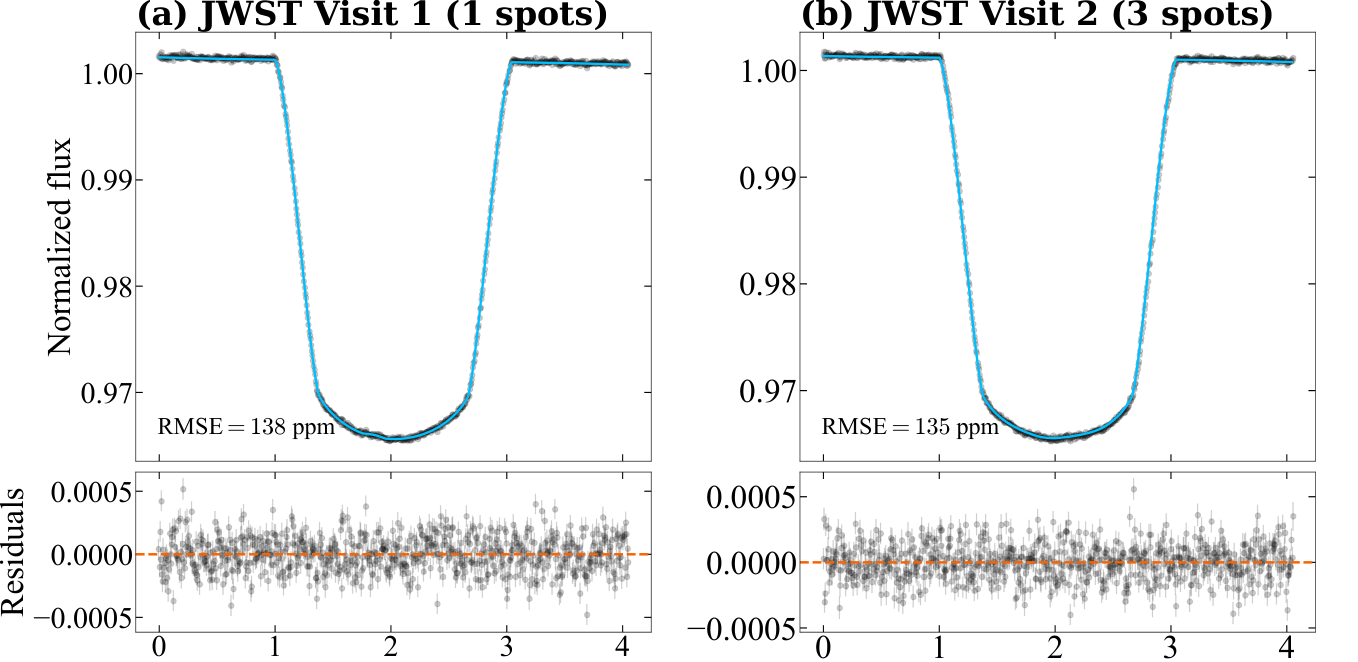
HATS-6 b sits about 500 light-years away and regularly passes in front of its star as viewed from Earth. During these transits, a small amount of starlight passes through the planet’s atmosphere before reaching JWST.
Different molecules absorb characteristic wavelengths from that light. By measuring those missing wavelengths, astronomers can reconstruct part of the planet’s chemical composition through transmission spectroscopy.
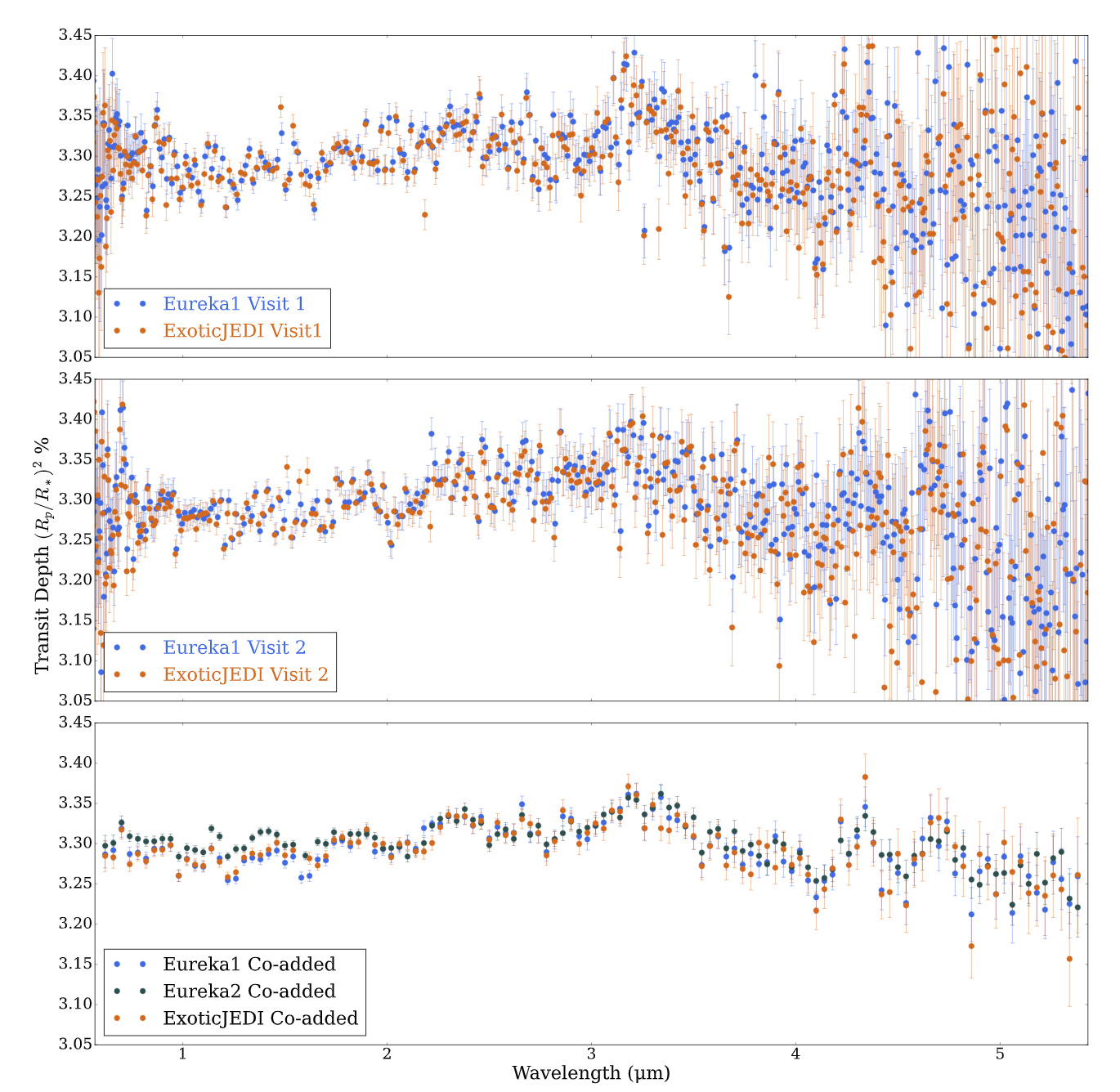
The team observed two transits with JWST’s Near Infrared Spectrograph, covering wavelengths from 0.6 to 5.3 micrometers. Researchers then processed the measurements through multiple independent analysis pipelines and atmospheric models to test whether the chemical signatures survived different assumptions.
They found particularly strong evidence for water and methane, along with a statistically significant ammonia signal. Carbon dioxide also improved the atmospheric fit, although the evidence for it was weaker than for the other three molecules.
“Carbon, hydrogen and oxygen are all things that have been previously found in atmospheres of giant planets outside our solar system, but ammonia is something almost never detected before,” lead author Giannina Guzmán Caloca said. “It’s an entirely new molecule to think about.”
Ammonia is important because atmospheric chemistry changes dramatically as giant planets cool.
On extremely hot giant planets, nitrogen tends to appear in other chemical forms. At temperatures below roughly 1,000 kelvins, ammonia can become increasingly important, just as methane becomes more favorable than carbon monoxide as a major carbon-bearing molecule.
That makes HATS-6 b useful for studying a cooler population of giant exoplanets that has only recently become accessible to detailed atmospheric measurements.
The planet belongs to a rare class known as GEMS. M-dwarfs are the most common stars in the Milky Way, yet giant planets around them appear uncommon. Astronomers currently know only a few dozen examples.
Standard core-accretion models help explain why. Smaller stars generally form with less massive disks of gas and dust, giving planets less solid material from which to build the roughly Earth-mass cores needed to trigger rapid gas accumulation.
“Every one of these planets is a challenge to formation theory,” Guzmán Caloca said.
Chemistry was not the only puzzle hidden in the JWST spectrum.
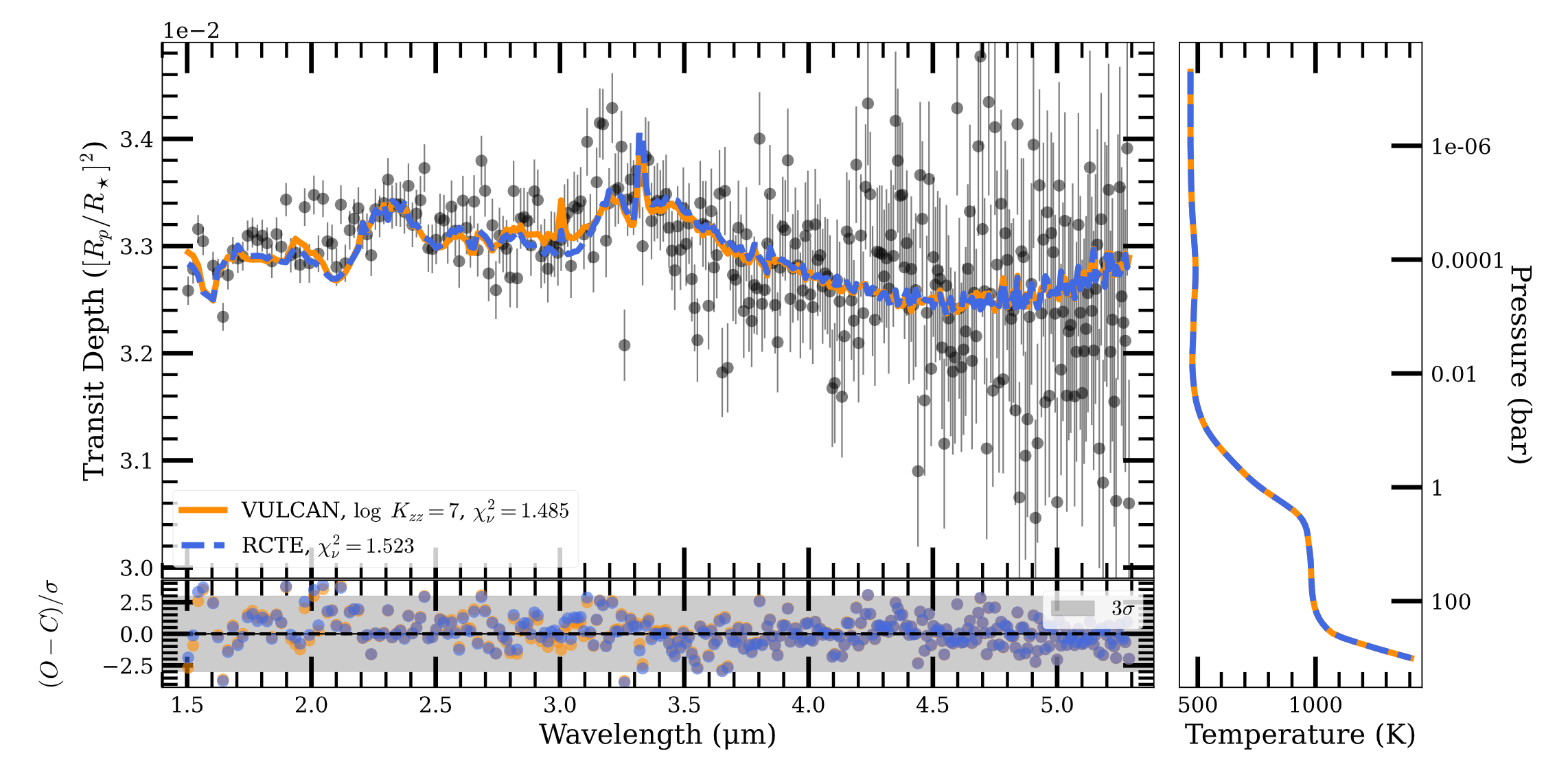
Earlier calculations placed HATS-6 b’s equilibrium temperature near 713 kelvins, or about 824 degrees Fahrenheit. That estimate assumes the planet absorbs incoming stellar energy with essentially no reflection and redistributes heat efficiently.
The researchers’ final atmospheric retrieval instead produced a temperature near 514 kelvins, or roughly 466 degrees Fahrenheit. The result remained low across different data reductions, observing visits and atmospheric retrieval programs.
If that temperature represents the planet accurately, HATS-6 b would need to reflect a surprisingly large fraction of its star’s energy. Under one simplified assumption about heat redistribution, the implied Bond albedo would be about 0.71, approaching Venus’s highly reflective value.
Clouds and haze offer one possible explanation. Reflective material high in the atmosphere could send substantial starlight back into space before it heats deeper atmospheric layers.
The researchers caution, however, that transmission spectroscopy alone cannot prove this explanation. Stellar activity, modeling limitations and differences between the planet’s morning and evening atmospheric edges could also influence the retrieved temperature.
Another mystery appears near a wavelength of 3 micrometers.
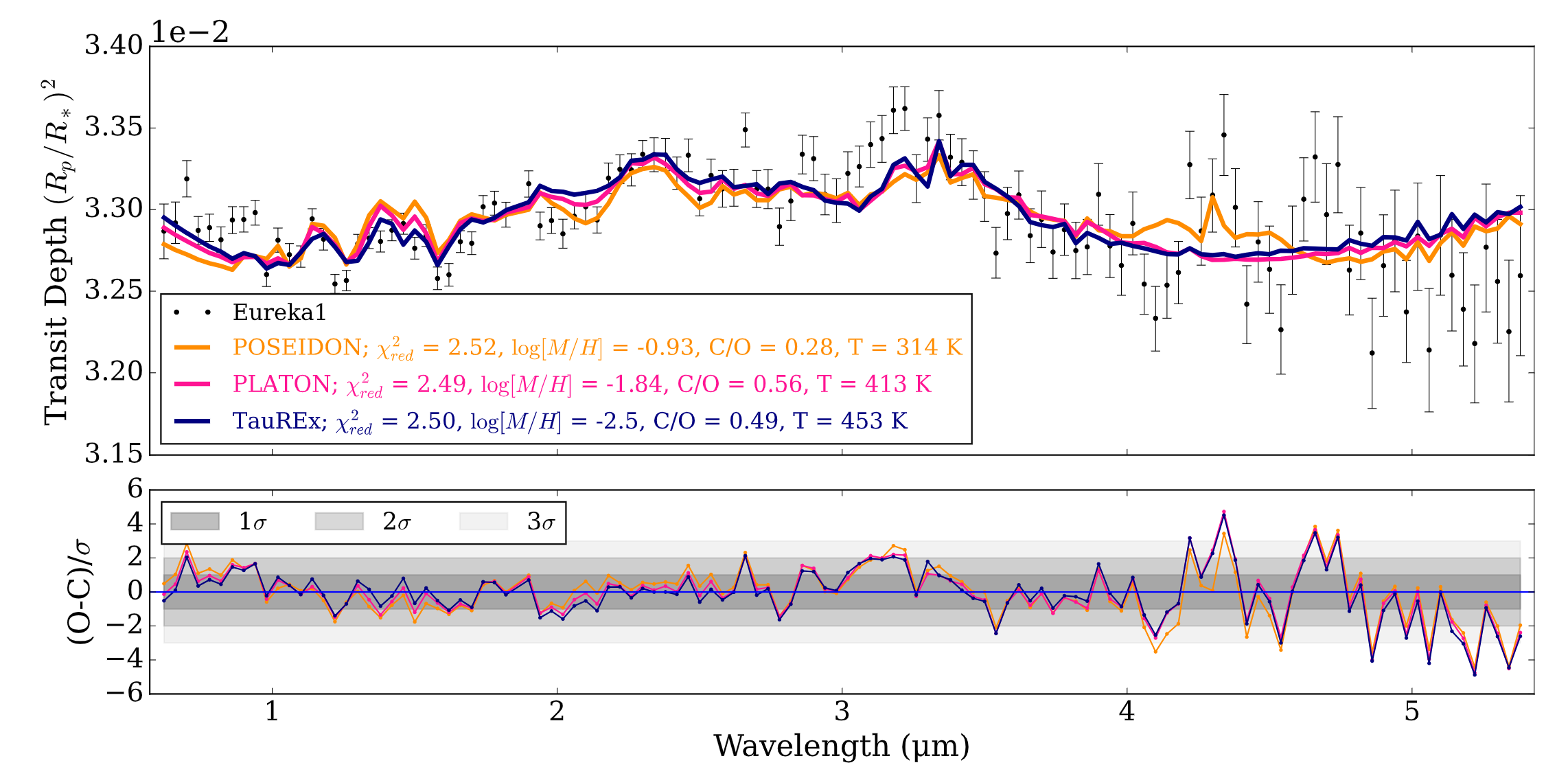
The spectrum contains additional absorption that methane alone could not fully reproduce. Some models matched it using ethene, while others improved the fit by adding hydrogen cyanide.
Neither explanation was convincing enough for the researchers to claim a detection. The inferred ethene abundance was difficult to reconcile with chemical models, and several hydrocarbons absorb light in the same crowded wavelength region.
The feature also differed between the two observing visits, raising the possibility that changes on the star could be involved.
Future observations at longer infrared wavelengths could help. JWST’s Mid-Infrared Instrument may distinguish competing hydrocarbon signatures and test predictions for mineral clouds that become more obvious beyond the wavelength range already observed.
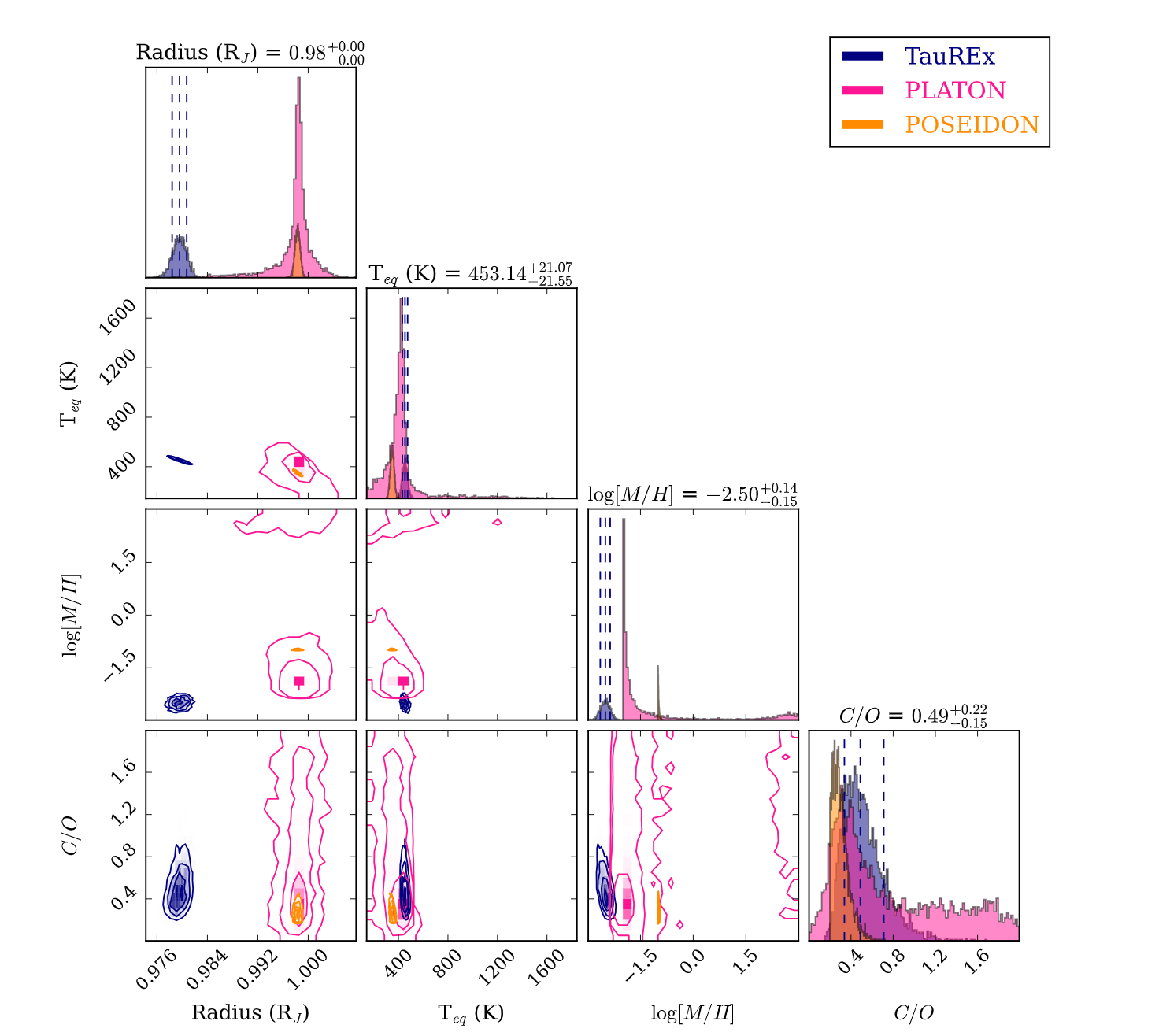
The team also derived an unusually low atmospheric metallicity. In astronomy, metallicity describes the abundance of elements heavier than hydrogen and helium rather than metals alone.
Their preferred retrieval gave an atmospheric metallicity around two orders of magnitude below solar. Interior models, however, suggested the planet’s total heavy-element abundance could be roughly three orders of magnitude higher than the value inferred for its visible atmosphere.
That discrepancy could mean HATS-6 b is not chemically well mixed from its deep interior to its observable atmosphere. Its inflated radius also cannot be reproduced easily by standard cooling models without an additional internal energy source.
Those results remain model-dependent, but together they make HATS-6 b especially valuable. Its formation, atmosphere, temperature and interior all resist simple explanations.
As JWST adds more GEMS to the comparison, astronomers should learn whether HATS-6 b is an extreme individual case or part of a broader population of giant planets assembled through pathways that current theories have yet to fully capture.
These studies provide useful context on HATS-6 b, warm giant atmospheres and why giant planets around M-dwarfs challenge existing formation models.
Warm Jupiters around M dwarfs are great opportunities for extensive chemical, cloud, and haze characterisation with JWST: Three-dimensional climate modeling predicts strong prospects for detecting methane, ammonia, clouds and hazes in warm giants orbiting M-dwarfs. (Astronomy & Astrophysics, 2024)
A warm Neptune’s methane reveals core mass and vigorous atmospheric mixing: JWST measurements of WASP-107 b show how methane and other molecules can constrain both atmospheric mixing and the hidden interior of a cool giant planet. (Nature, 2024)
Methane throughout the atmosphere of the warm exoplanet WASP-80b: JWST detected methane in both transmission and emission from a warm Jupiter, demonstrating the changing carbon chemistry expected in cooler giant atmospheres. (Nature, 2023)
HATS-6b: A Warm Saturn Transiting an Early M Dwarf Star, and a Set of Empirical Relations for Characterizing K and M Dwarf Planet Hosts: The original discovery study established HATS-6 b as a roughly Saturn-mass planet with a Jupiter-sized radius orbiting a low-mass M-dwarf. (The Astronomical Journal, 2015)
Looking at Giant Exoplanets around M-dwarfs (GEMS) with JWST: A Comprehensive Study on the Atmosphere of TOI-3714b: This GEMS program report describes JWST observations of another Jupiter-sized planet around an M-dwarf and the survey’s effort to compare this rare population systematically. (American Astronomical Society, 2025)
Research findings are available online in The Astronomical Journal.
The original story “JWST uncovers a surprisingly cold atmosphere on the giant planet HATS-6 b” is published in The Brighter Side of News.
Like these kind of feel good stories? Get The Brighter Side of News’ newsletter.
The post JWST uncovers a surprisingly cold atmosphere on the giant planet HATS-6 b appeared first on The Brighter Side of News.


Leave a comment
You must be logged in to post a comment.