One of astronomy’s oldest suspected planetary systems has just undergone its most sensitive search yet, and the biggest planets scientists might have expected to find are not there.
Astronomers led by the University of Michigan studied 70 Ophiuchi AB, a pair of nearby K-type stars about 16 light-years from Earth. By combining more than a century of observations with new high-precision measurements, they found no statistically convincing evidence for giant planets around either star.
The absence is scientifically useful. Researchers can now rule out Jupiter-mass planets across much of the inner system while leaving open the possibility of smaller worlds, including planets occupying potentially habitable orbits.
Published in The Astrophysical Journal, the study also demonstrates how easily activity on a star’s surface can imitate the gravitational wobble produced by a planet.
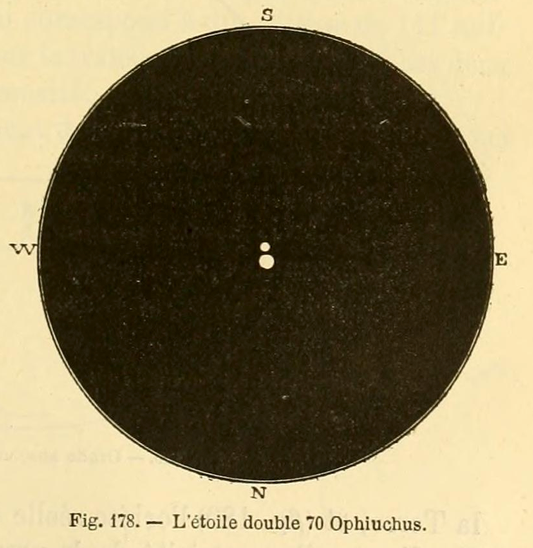
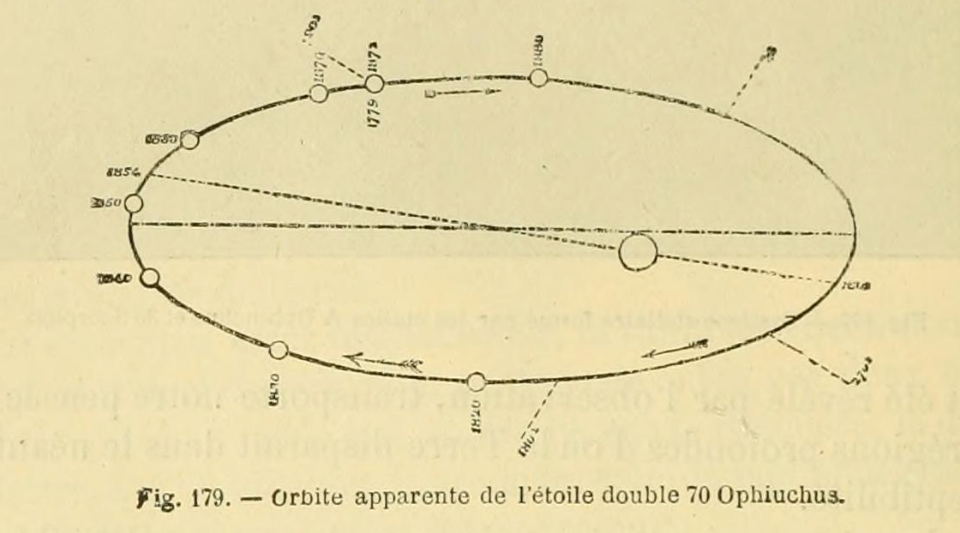
70 Ophiuchi has occupied an unusual place in exoplanet history for more than 170 years. In 1855, British astronomer William Jacob reported irregularities in the stars’ motion and proposed an unseen planetary companion, making the system home to one of the earliest formal exoplanet claims.
That interpretation did not survive later observations. Yet the possibility of planets remained because increasingly precise measurements still showed small velocity changes that could potentially have been caused by orbiting worlds.
The system is especially attractive because it is one of the nearest binaries to Earth. Its two stars complete an orbit in roughly 88 years, giving astronomers an unusually long observational record with which to refine their motion.
Nearly half of Sun-like stars belong to binary or multiple systems. Understanding whether planets can form and survive around them therefore matters for estimating how common potentially habitable worlds may be throughout the galaxy.
“It’s a mix of disappointment and excitement,” lead author Yiting Li said. “We’re finding out that there isn’t a Jupiter-sized planet, but we’re also opening the latest chapter on this historic system.”
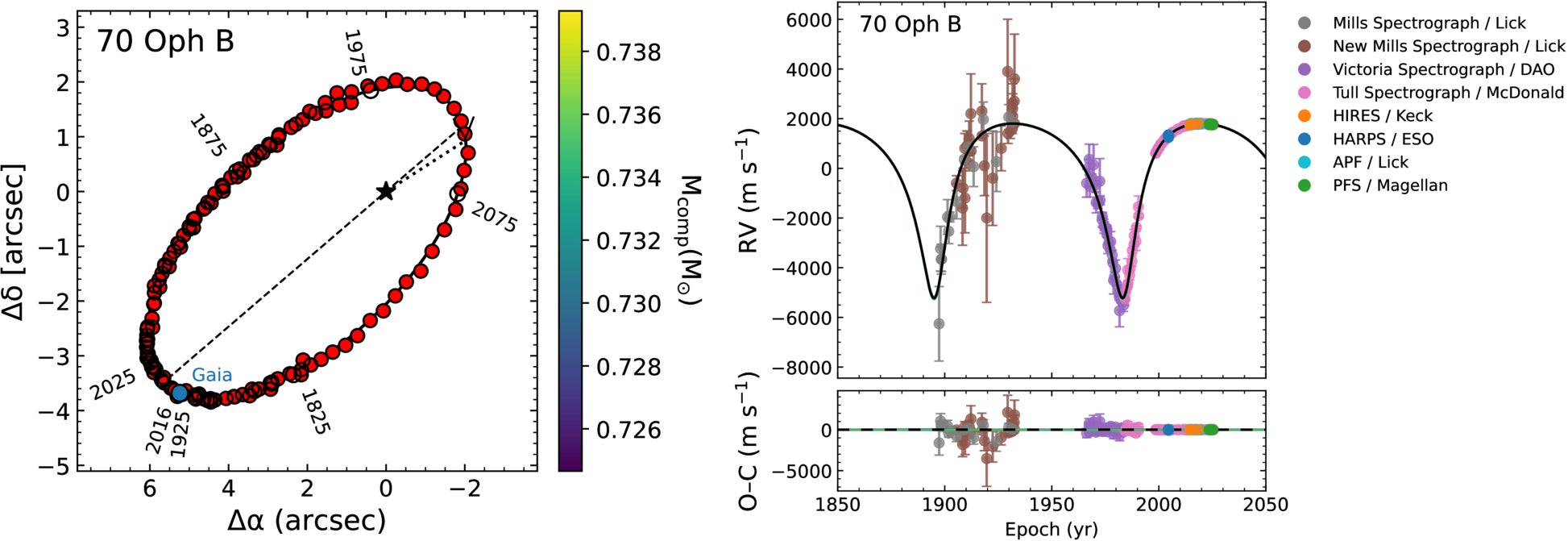
The team combined historical measurements with modern radial-velocity and astrometric data. Radial velocity detects small changes in a star’s motion toward or away from Earth as an orbiting companion pulls gravitationally on it.
New observations came from the Planet Finder Spectrograph on the 6.5-meter Magellan Clay Telescope in Chile and measurements from McDonald Observatory in Texas. The researchers also incorporated data from multiple earlier instruments, along with positional measurements from Hipparcos, Gaia and historical visual observations.
The result was an exceptionally precise reconstruction of the binary itself. The team measured the orbital period at roughly 88.13 years and determined the stellar masses with uncertainties below 1%.
That accuracy matters because a poorly understood binary orbit can disguise or mimic the much smaller gravitational effects produced by planets. Removing the binary signal allowed the researchers to examine the remaining stellar motions for additional periodic patterns.
What initially looked promising turned out to be something else.
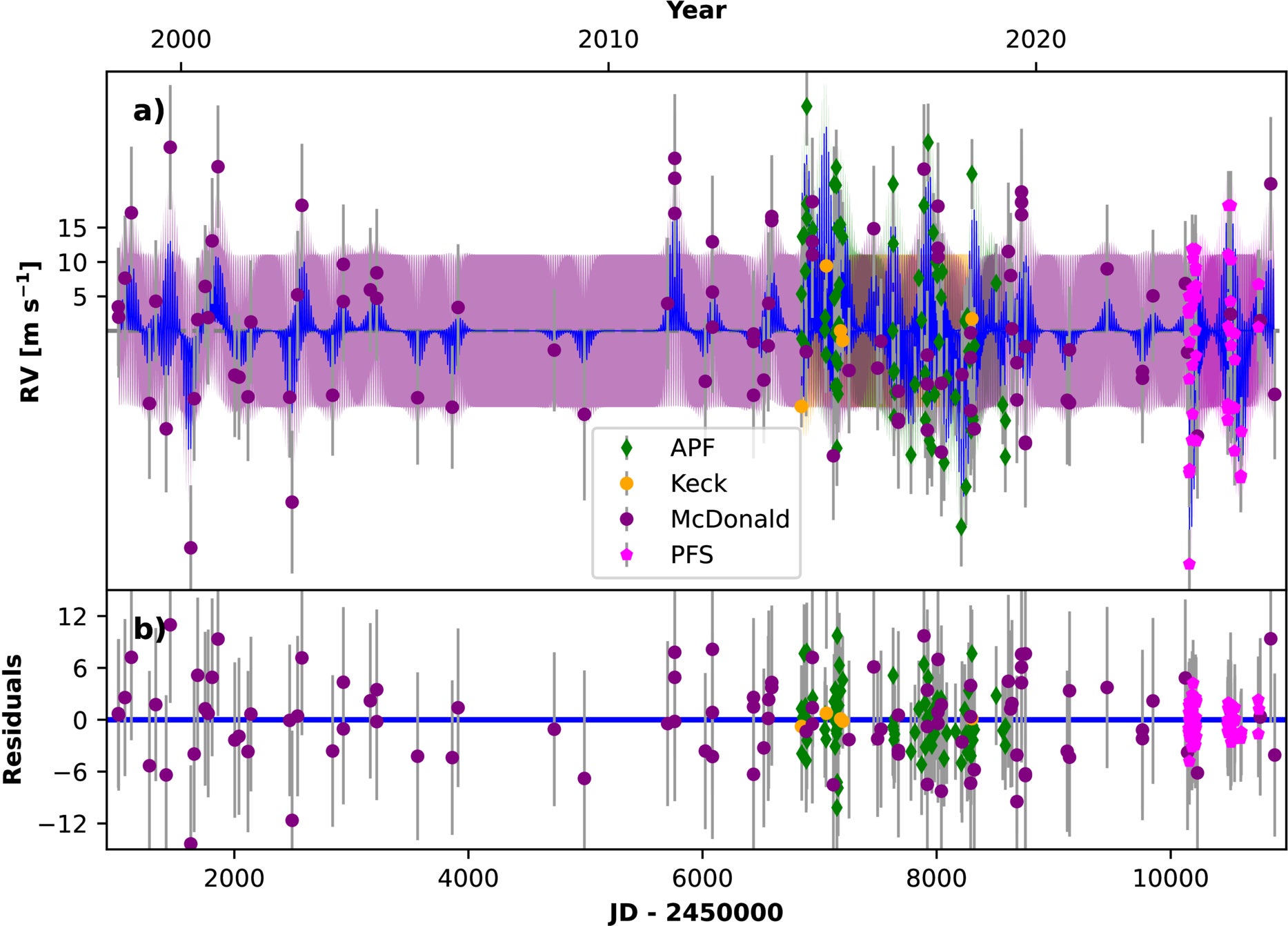
70 Ophiuchi A showed repeating radial-velocity signals near 20 days and at shorter related periods. A planet could produce such a periodic wobble if the signal remained stable over time.
Instead, the pattern closely followed the star’s approximately 20-day rotation period and its mathematical harmonics. Computer models designed to account for changing stellar activity explained the measurements better than models containing planets.
Starspots and bright magnetic regions can distort the spectral lines astronomers use to measure radial velocity. As the star rotates, those features move across its visible surface and create apparent shifts resembling the pull of an orbiting planet.
“Yiting assembled an absolutely huge amount of data from all over the world and carefully explored all possibilities,” University of Michigan astronomer Michael Meyer said. “It’s a cautionary tale about how stellar activity can mimic planet signals using the radial velocity.”
The second star, 70 Ophiuchi B, likewise showed no significant planetary signal.
A nondetection does not mean 70 Ophiuchi has no planets. It determines which kinds of planets should have been visible if they existed.
The new analysis strongly excludes Jupiter-sized companions through much of the system’s inner regions. Around 70 Ophiuchi A, Jupiter-mass planets within roughly 5 astronomical units can largely be ruled out. For 70 Ophiuchi B, the strongest constraints currently extend to about half an astronomical unit.
Sensitivity improves at smaller orbital distances. Around the primary star, planets more massive than roughly 0.3 Jupiter masses at 1 astronomical unit and about 0.5 Jupiter masses at 2 astronomical units fall within the study’s detection range.
Rocky planets are much harder to detect. Their gravitational pull produces radial-velocity changes small enough to become buried beneath the several-meter-per-second variability generated by stellar activity.
That leaves considerable unexplored territory below the mass of Saturn and Neptune, especially for terrestrial planets.
“The study sets an upper limit, not a ban, on planets,” Li said.
Computer simulations also addressed whether planets could remain stable while orbiting one member of this gravitationally complicated pair.
Around 70 Ophiuchi A, planetary orbits remained stable across roughly the inner 2.5 to 2.9 astronomical units when aligned reasonably well with the binary’s orbital plane. That comfortably includes the star’s modeled habitable zone.
A separate 2026 numerical study similarly concluded that both stars in 70 Ophiuchi could maintain planets in permanently habitable regions under favorable orbital arrangements. Strongly tilted planetary systems were less stable because the companion star can drive large changes in orbital eccentricity.
None of those calculations show that habitable planets actually exist there. They demonstrate that the binary does not automatically eliminate the environments where such planets could survive.
That distinction makes the new null result especially valuable. Removing massive planets from the likely architecture simplifies the search space for future instruments designed to reach smaller worlds.
70 Ophiuchi is already being considered for future missions capable of finding planets through direct imaging or extremely precise astrometry.
The proposed SHERA mission would measure tiny changes in stellar position caused by orbiting planets. NASA’s planned Habitable Worlds Observatory is being developed specifically to image Earth-sized planets around nearby stars and analyze their atmospheres for evidence of habitability.
At only about 5.1 parsecs away, the habitable zone around 70 Ophiuchi A appears widely separated enough on the sky to make the system particularly interesting for direct imaging. An Earth-mass planet there would generate an astrometric signal far smaller than current radial-velocity measurements can reliably uncover.
Recent observations of another nearby binary reinforce the opportunity. In 2025, JWST detected evidence for a possible giant planet around Alpha Centauri A, demonstrating that modern telescopes can directly investigate planets within extremely nearby multiple-star systems.
For 70 Ophiuchi, astronomers now know more clearly what is absent and where future searches should concentrate. One of the oldest planet mysteries in astronomy remains unresolved, but the possible worlds still hiding there have become smaller and considerably more interesting.
These studies and resources explore the stability, detectability and future search strategies for planets in nearby binary systems.
Assessing Planetary Stability and Long-Term Habitability in Nearby Stellar Binaries: 70 Oph, 36 Oph, γ Leo: Numerical simulations show that 70 Ophiuchi can support long-lived planets in its habitable regions when their orbits are favorably aligned with the binary. (arXiv, 2026)
HWO Target Stars and Systems: A Prioritized Community List of Potential Stellar Targets for the Habitable Worlds Observatory’s ExoEarth Survey: This community-developed catalog identifies nearby stars suitable for future direct searches for Earth-sized habitable-zone planets. (Publications of the Astronomical Society of the Pacific, 2025)
Worlds Next Door: A Candidate Giant Planet Imaged in the Habitable Zone of α Centauri A. I. Observations, Orbital and Physical Properties, and Exozodi Upper Limits: JWST observations revealed a candidate giant planet in the nearest Sun-like binary, demonstrating the growing power of direct imaging around neighboring stars. (The Astrophysical Journal Letters, 2025)
Worlds Next Door: A Candidate Giant Planet Imaged in the Habitable Zone of α Centauri A. II. Binary Star Modeling, Planet and Exozodi Search, and Sensitivity Analysis: This companion analysis examines the technical challenges of finding planets when light from two bright neighboring stars must be modeled simultaneously. (The Astrophysical Journal Letters, 2025)
Stability of planetary orbits in binary systems: This foundational study established widely used numerical criteria for determining where planets can maintain stable orbits around stars in binary systems. (The Astronomical Journal, 1999)
Research findings are available online in The Astrophysical Journal.
The original story “170-year-old search narrows the hunt for planets around nearby binary system 70 Ophiuchi” is published in The Brighter Side of News.
Like these kind of feel good stories? Get The Brighter Side of News’ newsletter.
The post 170-year-old search narrows the hunt for planets around nearby binary system 70 Ophiuchi appeared first on The Brighter Side of News.


Leave a comment
You must be logged in to post a comment.