Goblin sharks have spent years in public imagination as something half-seen, half-legendary, a pale, long-snouted predator usually known from carcasses, fishing lines, and brief encounters near death. Now they have finally been seen alive where they actually live, deep in the ocean. As a result, that changes more than a shark checklist.
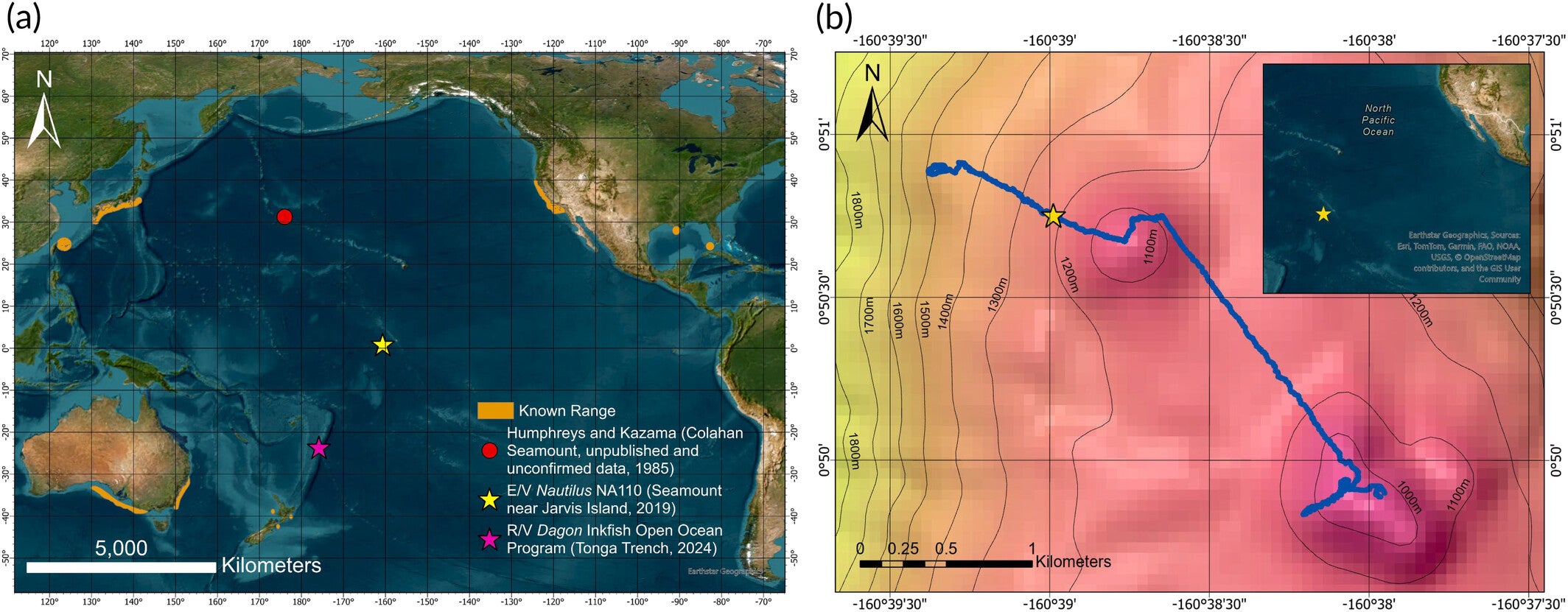
A University of Hawaiʻi at Mānoa-led team has reported the first published live observations of goblin sharks, Mitsukurina owstoni, in their natural deep-sea habitat. The paper, published in the Journal of Fish Biology, describes two separate sightings. One was near Jarvis Island in 2019, and another was on the slope of the Tonga Trench in 2024.
For a species often called a “living fossil,” the footage fills in a major blank. Goblin sharks are the only living members of their family, a shark lineage dating back nearly 125 million years.
Lead author Aaron Judah, a doctoral candidate in the Deep-Sea Fish Ecology Lab and the Deep-Sea Animal Research Center in the Department of Oceanography at the University of Hawaiʻi at Mānoa, said the moment stood out immediately.
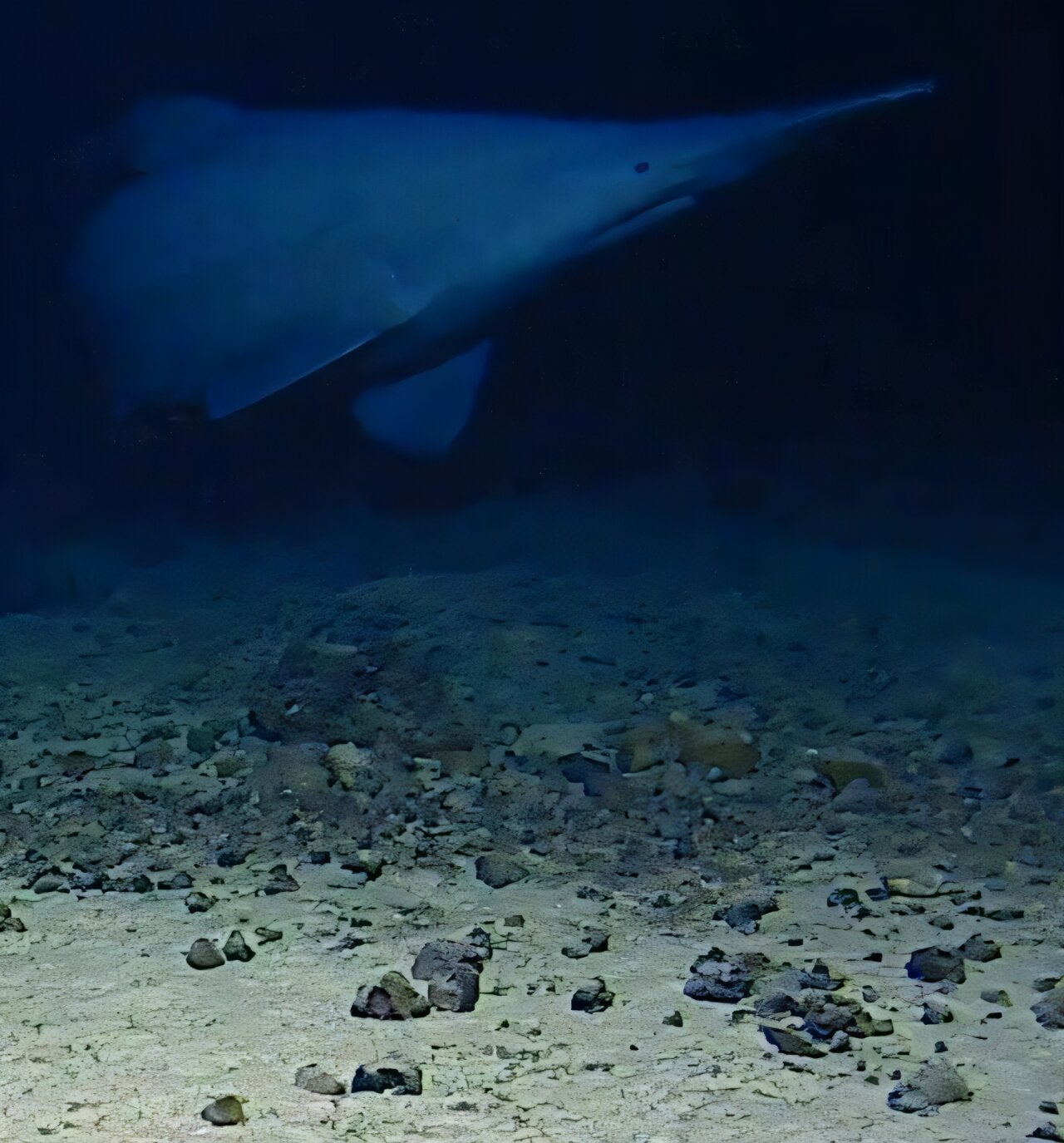
“Seeing the most iconic of all the deep-sea sharks alive and looking healthy in its natural habitat is a unique honor,” Judah said. “I was also very surprised about how deep this species was found. The observation from the slope of the Tonga Trench is nearly 700 meters deeper than this species was known to live.”
Before these observations, goblin sharks were known from scattered records in narrow areas off the western United States, Australia and Japan in the Pacific, along with patchy records in the Atlantic and Indian oceans. The new sightings extend that known range into the central Pacific and the southwestern Pacific.
The first sighting came from old footage, not a new dive.
In 2025, Judah learned from colleagues at the Deep-Sea Animal Research Center that a possible goblin shark might have appeared during a 2019 Ocean Exploration Trust expedition aboard the E/V Nautilus. That expedition explored deep-sea ecosystems near Kingman Reef, Palmyra Atoll and Jarvis Island within the Pacific Remote Islands Marine National Monument.
“I was shocked to hear this because this species was not known to be in the Central Pacific,” Judah said.
Judah then searched the publicly archived video, which had been captured by the remotely operated vehicle Hercules and later annotated by colleagues at UH Mānoa. In that archive, he found what the team says was indeed a goblin shark. It was recorded during a livestreamed dive on an unnamed seamount northwest of Jarvis Island.
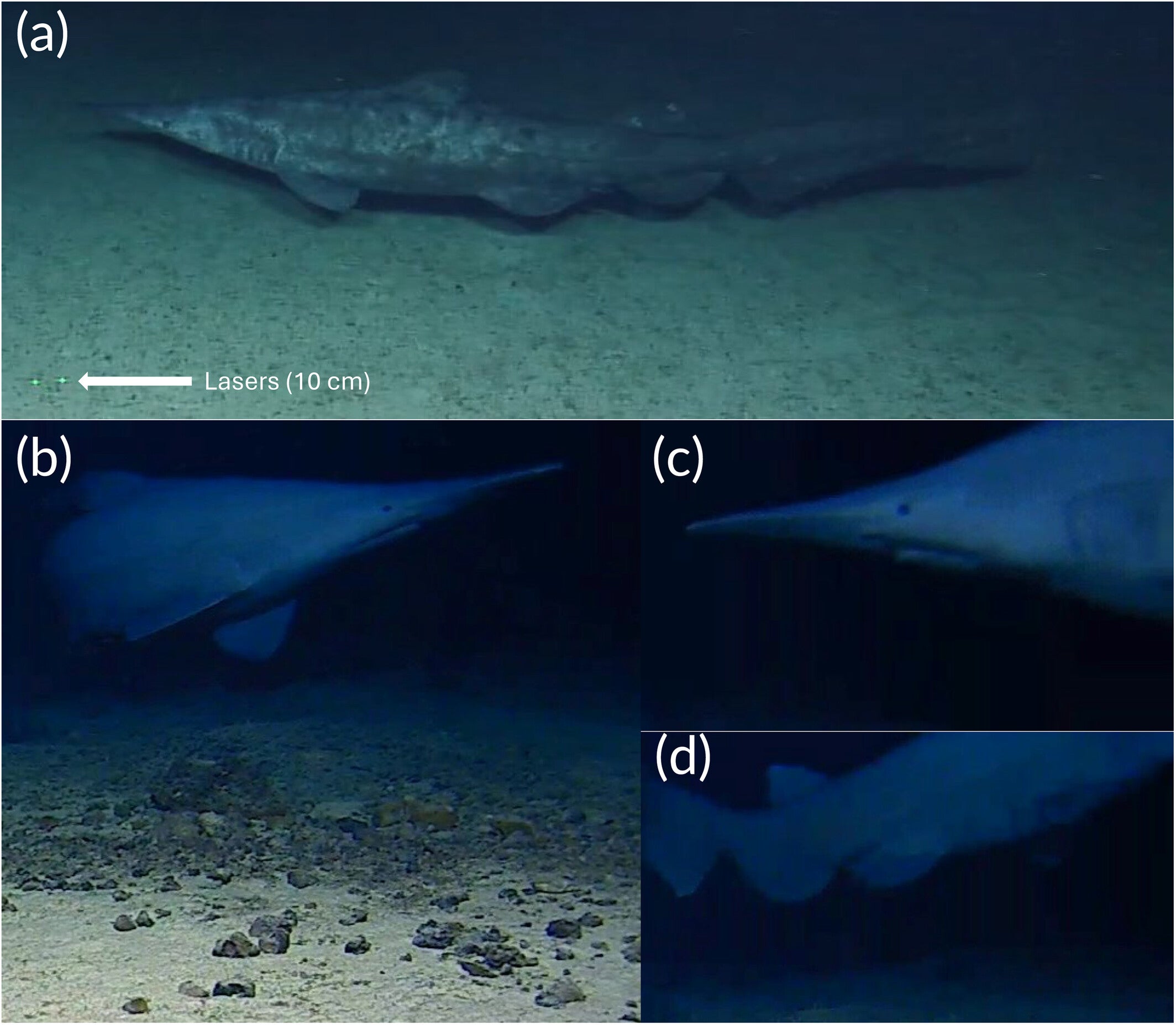
That shark was seen on July 4, 2019, at a depth of 1,237 meters. It was a large solitary male in water measuring 3.9 degrees Celsius, with salinity of 34.55‰ and oxygen concentration of 1.329 mL/L. The surrounding habitat was soft sediment with sparse sea pens. Using the ROV’s scaling lasers, placed 10 centimeters apart, the team estimated the shark’s length at about 343 centimeters.
The paper notes that, based on growth estimates from earlier work, the animal may have been about 51.5 years old. However, the authors stress that this is highly speculative.
The second observation came five years later and much farther down.
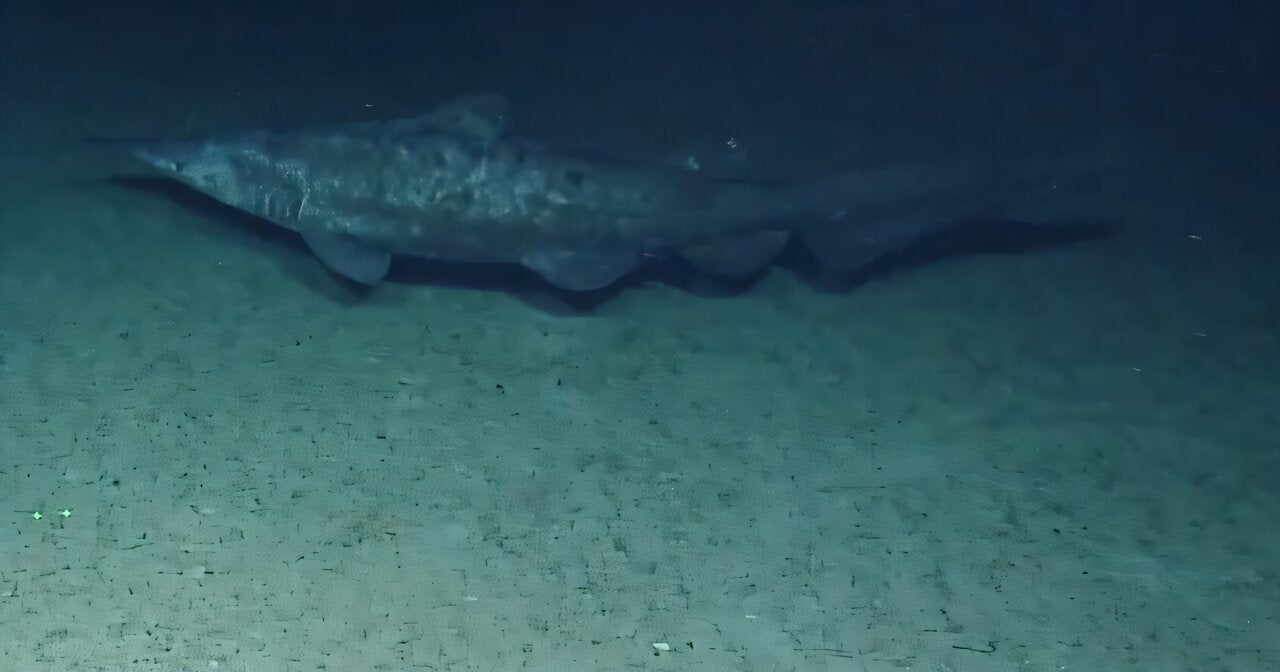
During a 2024 expedition to the Tonga Trench aboard the R/V Dagon, part of the Inkfish Open Ocean Program, a baited camera on a bottom lander recorded another goblin shark at a seafloor depth of 1,997 meters on the trench’s northern slope. The lander had been on the seafloor for about nine hours when the shark first entered view for 50 seconds. It returned about 10 minutes later and remained visible for 101 seconds as it moved across the far edge of the frame.
The shark did not approach the bait closely and did not feed. Based on the lack of visible claspers, the researchers said it was presumably female. Yet the imagery made that difficult to determine with certainty.
The depth matters. The Tonga Trench sighting extends the goblin shark’s known depth range by 697 meters, from the previous maximum of 1,300 meters to 1,997 meters. Judah said that also pushes the record for the entire order Lamniformes, the mackerel sharks, deeper than previously known.
That group includes white sharks, basking sharks and mako sharks. According to the paper, the new depth exceeds previously reported depths for species such as the basking shark, crocodile shark, long-fin mako and pelagic thresher.
Study co-author Alan Jamieson, professor and founding director at the Minderoo-UWA Deep-Sea Research Center, helped document the 2024 sighting.
“The Goblin Shark is one of these deep-sea charismatic animals that I never thought we’d see alive, and then to do so was amazing, but to then learn that colleagues in Hawai’i also saw one was just incredible,” Jamieson said.
No specimen was collected during either expedition, so the team could not do genetic testing. Still, the authors argue the species is distinctive enough to identify from subsea imagery.
They point to several visible traits in both animals: the very long snout, a tail lacking a lower lobe, large pelvic and anal fins with smooth edges, and the pale white coloration typical of the species. The morphometric measurements taken from the Jarvis footage also aligned broadly with published descriptions. Nevertheless, the authors caution that video-based measurements come with substantial uncertainty.
The observations also provide direct evidence that goblin sharks use seamount and slope habitats in situ. The Jarvis animal appeared over a seamount far from continents and surrounded by much deeper abyssal water. The Tonga shark appeared on a slope near a trench, a setting not previously recorded for the species.
That matters because goblin sharks have often been treated as patchily distributed, with records associated mainly with outer continental shelves, upper slopes and seamounts. The new observations suggest that pattern may be less limited than once thought.
The paper also points to recent evidence that goblin sharks show very limited genetic diversity worldwide, a sign that populations in distant places may be more connected than their sparse records suggest. Because the species can also use midwater habitats, the authors say it may be able to disperse farther from continental margins than expected.
Judah said the broader lesson reaches past one shark.
“It is really important that we still perform natural history work,” Judah emphasized. “New discoveries like this demonstrate that there is still so much to explore in our deep-ocean home. Given the newly expanded geographic range of the goblin shark, this species can be included in regional management and a nation’s biodiversity list, whereas beforehand we didn’t know it was even there.”
The findings sharpen the map of where goblin sharks live and how deep they can occur. This is basic information conservation planners need before they can protect a species effectively.
By extending the shark’s range into the central and southwestern Pacific, the study gives regional managers a stronger basis for including the species in biodiversity records. In addition, this helps with management planning.
It also highlights seamounts and trench-adjacent slopes as habitats worth closer attention, especially as deep-sea ecosystems face growing human pressure.
More broadly, the work shows that continued exploration and careful review of archived footage can still produce major discoveries about large, vulnerable ocean animals. These species remain poorly documented.
Research findings are available online in the Journal of Fish Biology.
The original story “Deep-ocean cameras capture first-ever images of live Goblin shark” is published in The Brighter Side of News.
Like these kind of feel good stories? Get The Brighter Side of News’ newsletter.
The post Deep-ocean cameras capture first-ever images of live Goblin shark appeared first on The Brighter Side of News.


Leave a comment
You must be logged in to post a comment.