A handful of dark grains returned from asteroid Bennu may be rewriting where scientists think some of the Solar System’s most primitive material formed. Researchers at ETH Zurich analyzed titanium, chromium and iron isotopes in samples brought back by NASA’s OSIRIS-REx mission and found that Bennu shares a distinctive isotopic fingerprint with asteroid Ryugu and rare CI carbonaceous chondrites.
That relationship matters because all three preserve chemistry unusually close to the average composition of the Solar System. Yet the new results suggest their parent bodies may not have formed far beyond Jupiter, as some earlier models proposed. Instead, the researchers argue that Bennu-like material probably assembled just outside the young Solar System’s water-ice line, in a transition zone where fine dust from inner and outer regions could mix.
The study, published in Science Advances, also gives Jupiter a central role in the story. The giant planet may have acted as a size-selective filter, trapping larger particles while allowing smaller dust grains and fragments to drift across its orbit and become incorporated into the material that eventually formed Bennu-like bodies.
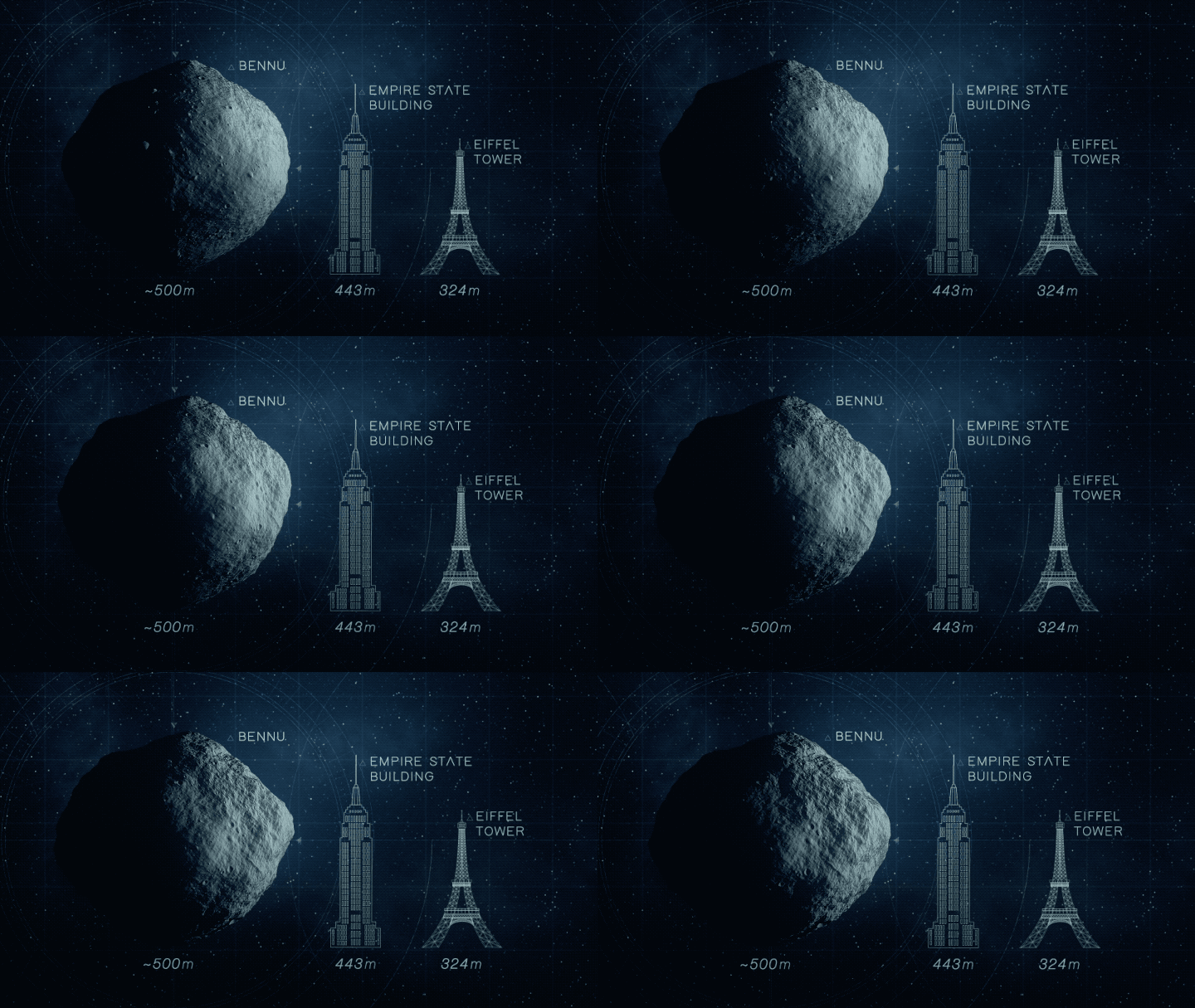
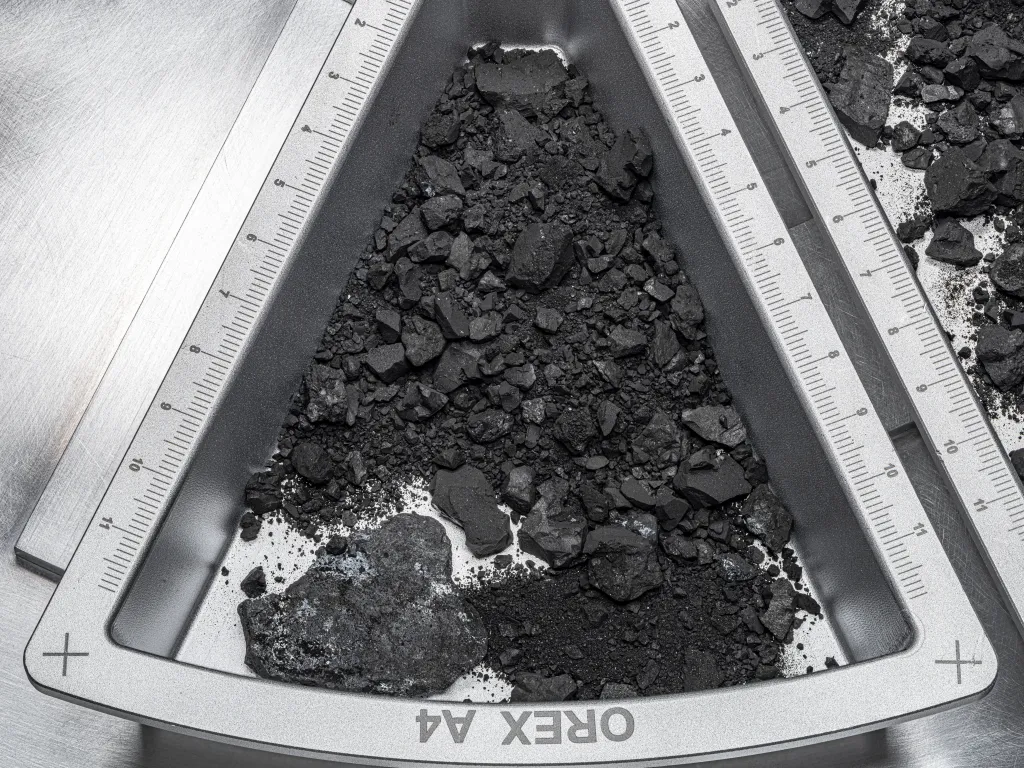
OSIRIS-REx returned roughly 120 grams of Bennu material to Earth in September 2023. ETH Zurich received a small portion for detailed laboratory analysis, and the team measured several isotopes of titanium, chromium and iron in five Bennu sample portions representing different particle types and sample masses.
Isotopes are versions of the same element that contain different numbers of neutrons. Their relative abundances can act as fingerprints because different regions of the early Solar System inherited different mixtures of ancient stellar material. By comparing these signatures across asteroids and meteorites, scientists can reconstruct relationships that are not obvious from appearance alone.
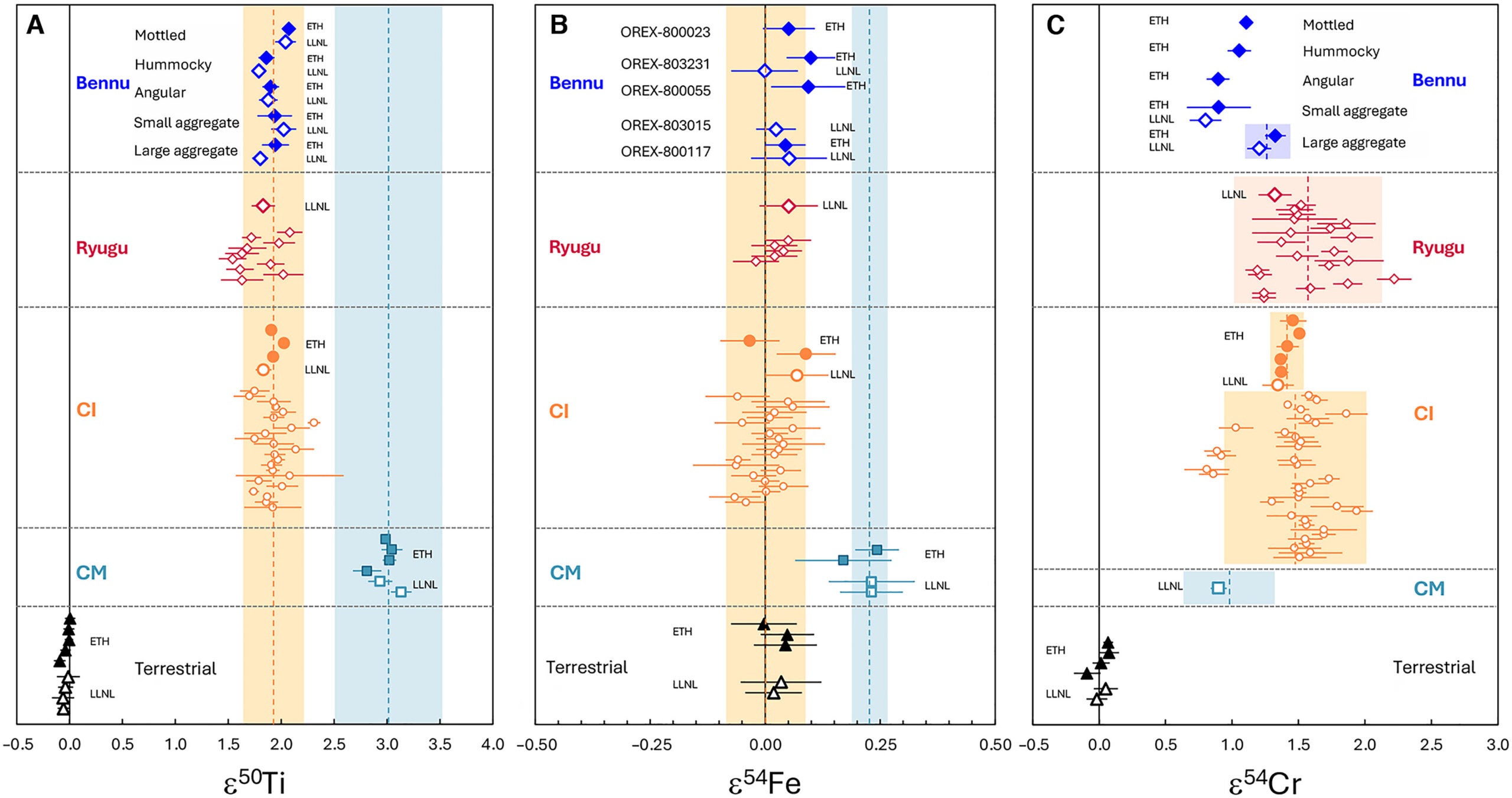
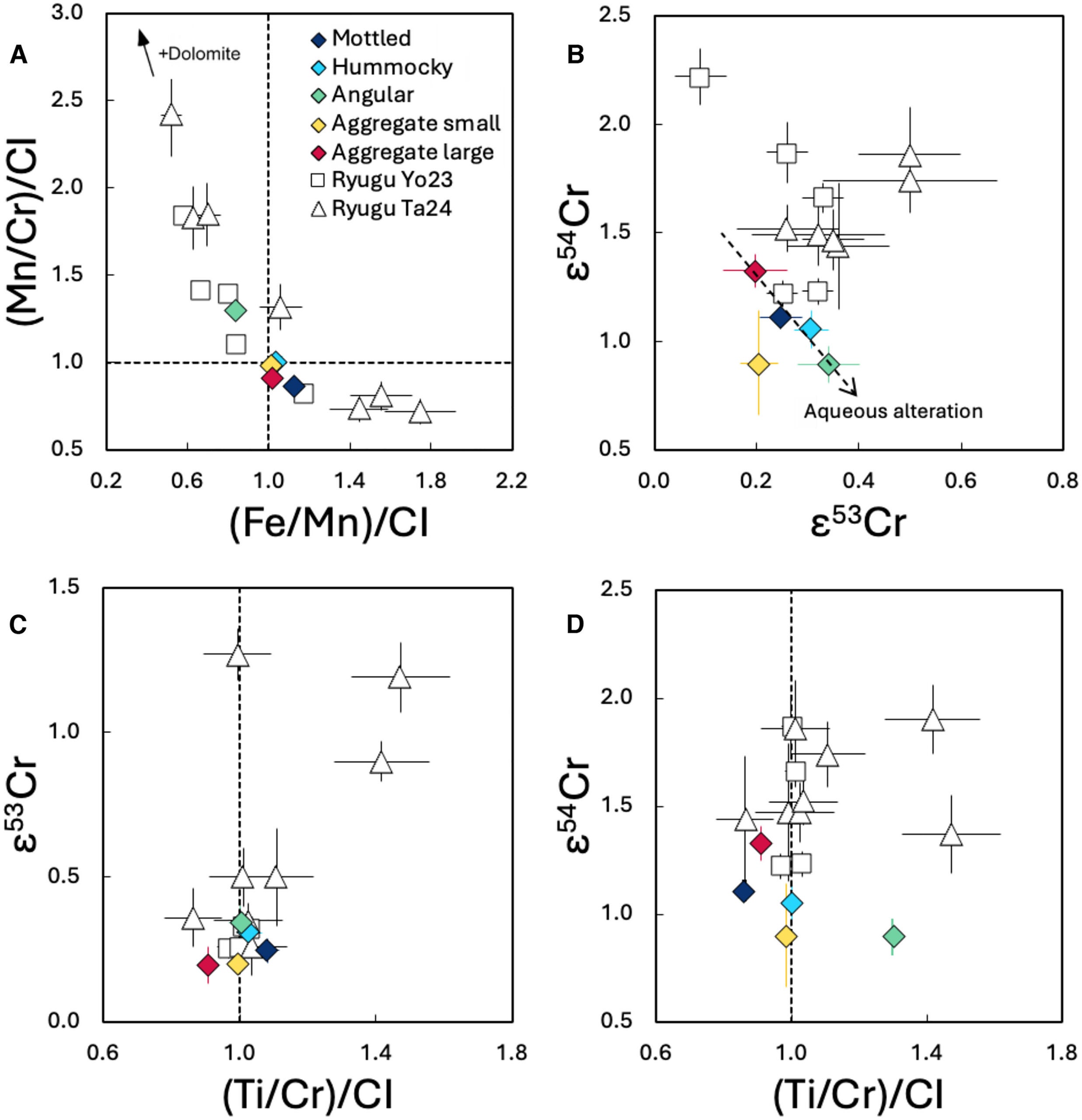
The titanium and iron isotope compositions were remarkably consistent among the Bennu samples. Chromium showed somewhat more variability, which the researchers link at least partly to later alteration by liquid water inside Bennu’s parent body. Even with those differences, Bennu overlaps strongly with Ryugu and CI meteorites, indicating that all three incorporated a similar reservoir of early Solar System material.
That similarity may mean the bodies formed in the same broad region of the protoplanetary disk, or possibly that they trace back to related parent bodies. What the isotope data show most clearly is that Bennu belongs to a chemically distinctive family that differs from most other known meteorite groups and asteroids.
Most primitive meteorites fall broadly into two isotopic families. Noncarbonaceous materials are generally associated with the inner Solar System, while carbonaceous materials are linked with more distant regions. Bennu is rich in carbon and water-altered minerals, which places it naturally among carbonaceous bodies, but its detailed isotope pattern complicates that simple division.
Bennu, Ryugu and CI chondrites have iron isotope compositions that overlap more closely with inner Solar System material than many other carbonaceous meteorites do. Other isotope systems show similar intermediate behavior, producing a combination that does not fit neatly into either reservoir.
“Bennu is a hybrid: the material does not clearly match either the inner or the outer Solar System,” ETH Zurich isotope geochemist Maria Schönbächler said. The material instead carries characteristics associated with both regions, pointing toward a location where dust from different parts of the disk could meet and mix.
That mixed signature is one reason the team questions models that place Bennu’s parent body in the same distant environment where comets formed. The new measurements favor a formation zone that was still cold and volatile-rich, but closer to the young Sun than those remote outer regions.
The researchers identify the water-ice line as a particularly plausible location. Early in Solar System history, temperature changed with distance from the Sun. Inside this boundary, water existed mainly as vapor, while farther out it could freeze onto dust grains and survive as ice.
That transition could have promoted planetesimal formation. Water vapor moving outward could recondense onto grains just beyond the ice line, increasing their ability to stick and helping raise the local concentration of solids. The process could eventually trigger the rapid assembly of larger bodies.
This setting also helps explain why Bennu, Ryugu and CI material contain substantial evidence for water. Their parent bodies appear to have incorporated water ice before internal heating melted it and drove extensive aqueous alteration.
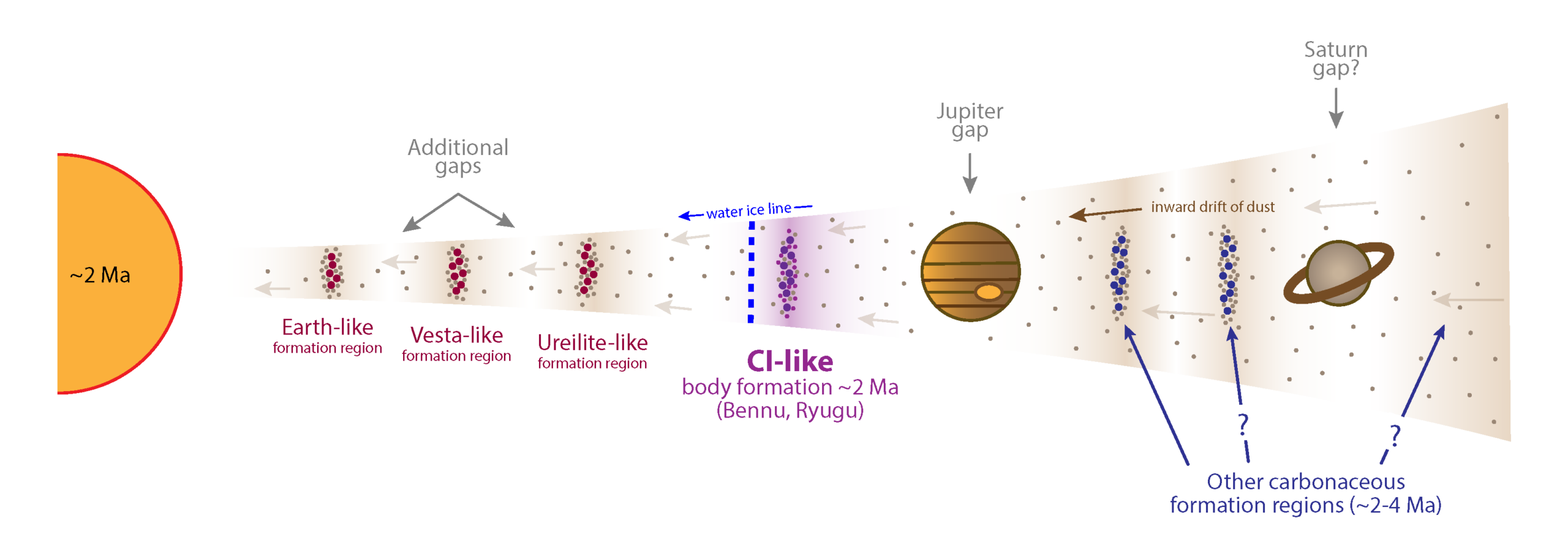
The researchers argue that CI-like parent bodies could have formed there only about 2 million years after the earliest Solar System solids appeared. That relatively early timing is difficult to reconcile with some models that place their formation much farther out, where planetesimal growth may have occurred later.
Jupiter provides the other major piece of the proposed scenario. The gas giant probably began forming very early and became massive enough to open a gap in the surrounding disk of gas and dust. That gap would not have affected every solid particle equally.
Larger particles were more easily trapped near pressure maxima around Jupiter. Fine dust, however, remained strongly coupled to the surrounding gas and could continue drifting through the gap. Fragments created by collisions could also join this mobile fine-grained population.
This size-selective filtering could explain why Bennu-like material contains a thoroughly mixed fine-grained component but relatively few intact coarse objects such as chondrules and calcium-aluminum-rich inclusions. Fragments of those objects still occur in Bennu, showing that some material crossed the barrier, but mostly in smaller pieces.
The result would have been a dust reservoir containing ingredients from a wide range of Solar System regions. Fine particles could move across large distances and become chemically well mixed, while larger objects remained more strongly sorted by Jupiter and other pressure structures in the disk.
That mechanism offers a way to explain why Bennu has a composition that is both chemically primitive and isotopically intermediate between established inner and outer Solar System reservoirs.
The Sun contains more than 99% of the Solar System’s mass, so its elemental composition provides the best estimate of the system’s overall chemical inventory. CI-like materials are unusual because, aside from highly volatile elements, their bulk elemental abundances closely mirror those of the Sun.
“Bennu may offer our best glimpse of the original mix of chemical elements from which the terrestrial planets were ultimately built,” Schönbächler said. The asteroid therefore gives researchers more than a record of one small body. It may preserve a representative sample of the fine dust that circulated widely while planets were assembling.
Bennu is not completely pristine. Its parent body experienced extensive interaction with liquid water, producing abundant clay minerals, carbonates and other secondary phases. It was later broken apart and reassembled into the rubble-pile asteroid seen today.
Yet the titanium and iron isotope signatures appear to have survived those events with little measurable change. Chromium shows somewhat more evidence of modification, but the overall link with Ryugu and CI chondrites remains strong.
That preservation allows scientists to use Bennu as a probe of the dust reservoir that existed before many later geological processes altered the surfaces and interiors of planets.
The study does not establish Bennu’s exact birthplace. The position of the water-ice line changed as the young Sun and protoplanetary disk evolved, and models of Jupiter’s early growth still carry significant uncertainty.
Researchers also cannot yet determine whether Bennu, Ryugu and CI meteorites came from one original parent body or several bodies formed from the same material reservoir. More returned samples and isotope measurements from other primitive asteroids will be needed to answer that question.
What the new work does show is that Bennu does not fit comfortably into a simple inner-versus-outer Solar System picture. Its chemistry instead points toward a transition zone where fine dust crossed planetary barriers, water ice helped particles accumulate and Jupiter reshaped which materials could travel inward.
That makes Bennu more than a primitive asteroid. Its returned grains may preserve part of the mixing process that helped assemble the rocky worlds of the inner Solar System, including Earth.
These resources explore Bennu’s composition, its relationship with Ryugu and CI meteorites, and what returned asteroid samples reveal about planet formation.
Asteroid (101955) Bennu in the laboratory: Properties of the sample collected by OSIRIS-REx: This initial analysis describes the physical, chemical and mineralogical properties of the material returned from Bennu. (Meteoritics & Planetary Science, 2024)
The variety and origin of materials accreted by Bennu’s parent asteroid: Researchers identified presolar grains, organics and high-temperature minerals that reveal the diverse sources contributing to Bennu’s parent body. (Nature Astronomy, 2025)
Mineralogical evidence for hydrothermal alteration of Bennu samples: This study reconstructs how liquid water altered Bennu’s parent asteroid and transformed much of its original mineralogy. (Nature Geoscience, 2025)
Samples returned from the asteroid Ryugu are similar to Ivuna-type carbonaceous meteorites: Laboratory analyses established Ryugu’s close mineralogical and chemical relationship with primitive CI meteorites. (Science, 2022)
Ryugu’s nucleosynthetic heritage from the outskirts of the Solar System: Iron isotope measurements helped establish the unusual nucleosynthetic character of Ryugu and provided earlier constraints on where CI-like material formed. (Science Advances, 2022)
Research findings are available online in the journal Science Advances.
The original story “Asteroid Bennu may have formed much closer to the Sun than scientists thought” is published in The Brighter Side of News.
Like these kind of feel good stories? Get The Brighter Side of News’ newsletter.
The post Asteroid Bennu may have formed much closer to the Sun than scientists thought appeared first on The Brighter Side of News.


Leave a comment
You must be logged in to post a comment.