Only a few hundred million years after the Big Bang, some young galaxies were already spilling newly forged elements into the space around them.
Astronomers using NASA’s James Webb Space Telescope detected carbon, oxygen and silicon in gas associated with three galaxies observed at redshifts between about 7.3 and 9.3. The most distant appears as it existed roughly 500 million years after the Big Bang.
The findings challenge a simple picture in which gas outside the earliest galaxies remained largely pristine for an extended period. Instead, stars had already manufactured heavier elements and galaxies had begun redistributing them through their surroundings.
The University of Arizona-led study, published in Nature Astronomy, provides direct evidence that an important process known as baryon cycling was underway remarkably early in cosmic history.
“We observed that heavy elements escaped from galaxies very, very early in cosmic time,” first author Yongda Zhu said. “Not only were the galaxies producing these elements, but they were also dispersing them, possibly seeding other galaxies.”
The universe that emerged from the Big Bang contained overwhelmingly hydrogen and helium, along with traces of a few other light elements. Carbon, oxygen, silicon, iron and most of the periodic table had yet to exist in significant quantities.
Stars changed that chemistry. Nuclear reactions inside them produced heavier elements, while stellar winds and explosive stellar deaths returned some of that material to space. Later generations of stars incorporated those ingredients, gradually increasing the chemical complexity of galaxies.
Understanding when metals began moving beyond their host galaxies is therefore important for reconstructing cosmic evolution. Those elements eventually became raw materials for rocky planets and the chemistry associated with life.
Astronomers already knew that very early galaxies could contain metals internally. What remained difficult to establish was how quickly enriched material began spreading into gas associated with and surrounding those galaxies.
JWST offered a new way to investigate the question.
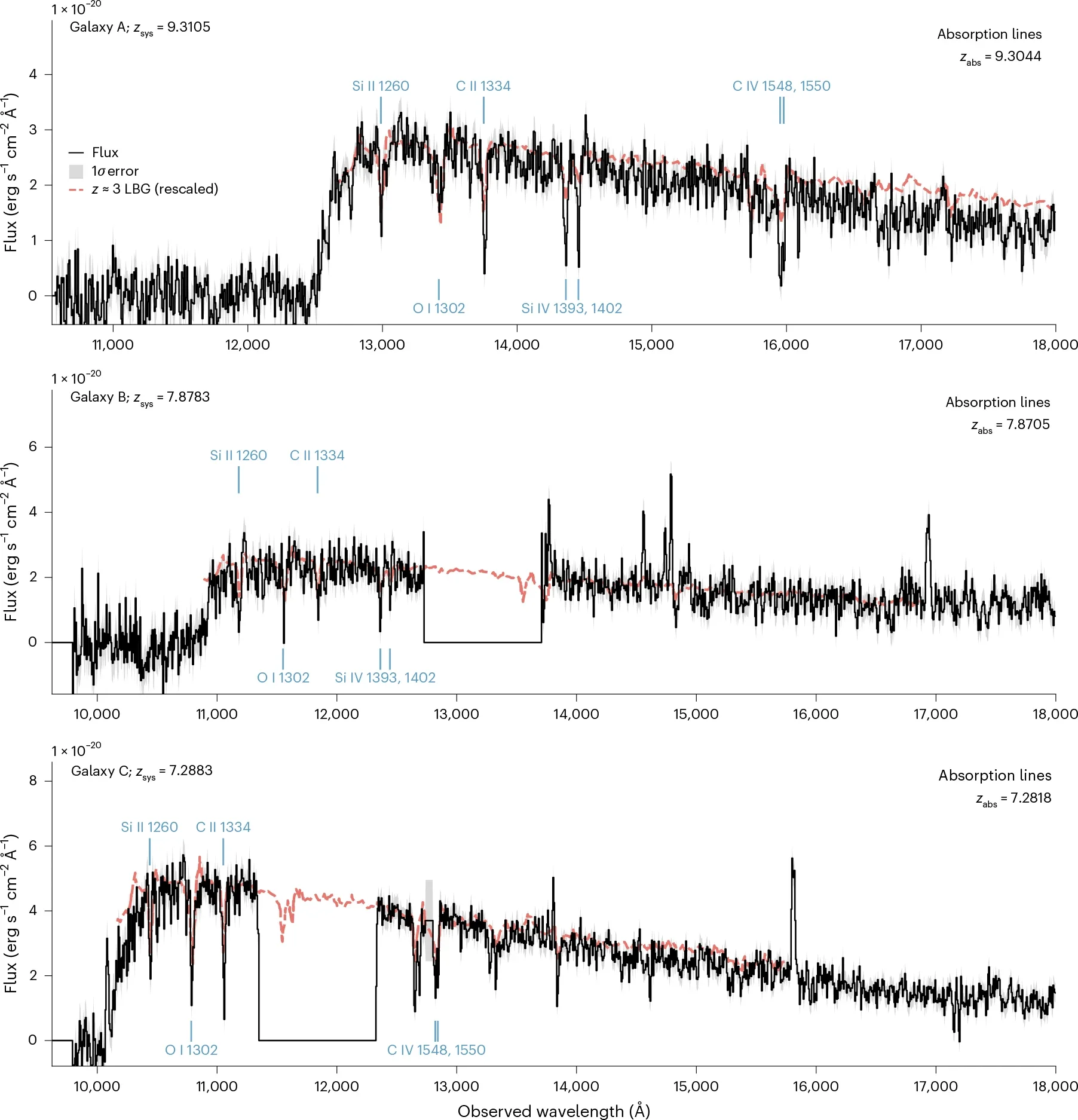
Zhu examined publicly available observations from the SPectroscopic Ultra-deep Reionization-era Survey, or SPURS, taken with JWST’s NIRSpec instrument.
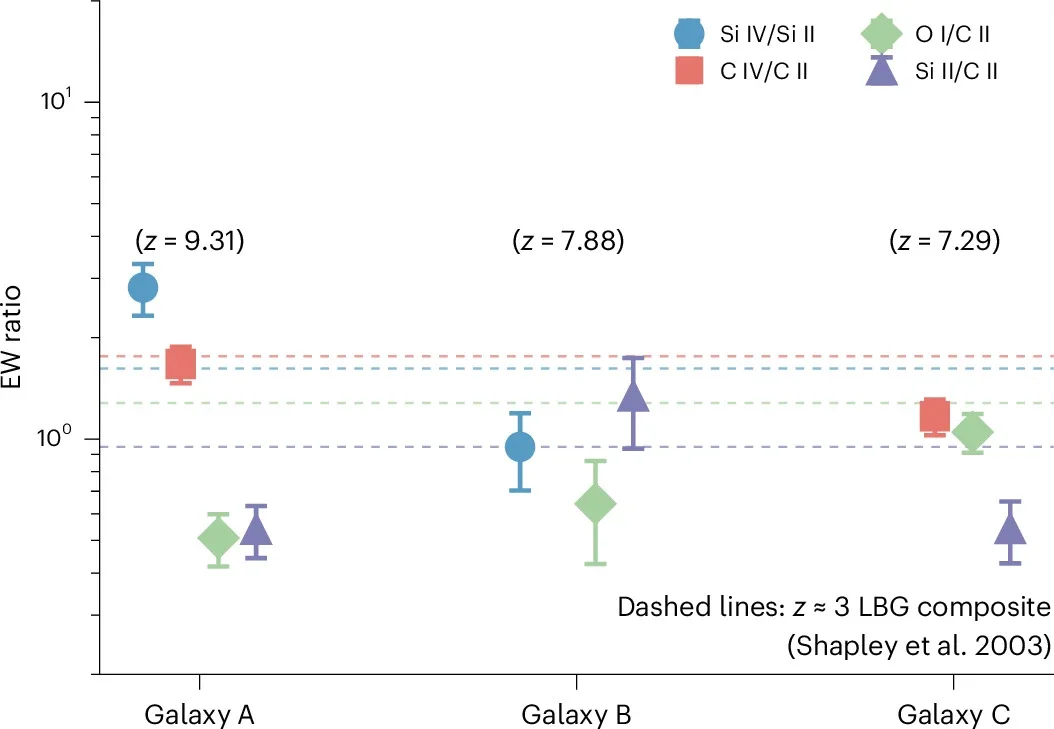
The team focused on three exceptionally ultraviolet-bright galaxies at redshifts of 9.3105, 7.8783 and 7.2883. Their brightness allowed NIRSpec to obtain unusually sensitive spectra of their ultraviolet continua.
Instead of observing glowing gas directly, astronomers used each galaxy’s own starlight as a background source. As that light traveled through gas associated with the galaxy, atoms and ions absorbed particular wavelengths.
Those missing wavelengths act as chemical fingerprints.
The spectra contained absorption from neutral oxygen, singly ionized silicon and carbon, along with more highly ionized silicon and carbon. Finding all of these species revealed chemically enriched gas spanning several ionization states.
The observations required deep exposures approaching 30 hours, illustrating why measurements like these were nearly impossible before JWST.
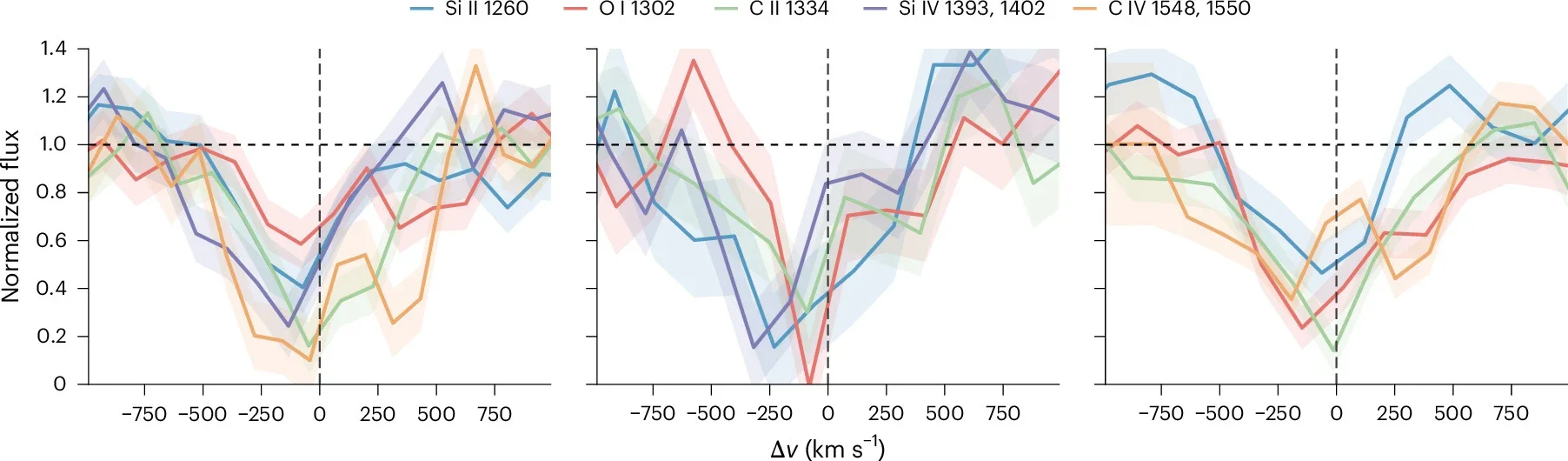
The wavelengths carried another crucial piece of information.
Absorption from the metals was blueshifted by roughly 50 to 250 kilometers per second relative to each galaxy’s systemic velocity. A blueshift indicates material moving toward the observer relative to the galaxy itself.
That pattern is consistent with gas moving outward from the galaxy on the side facing Earth, although the authors are careful not to claim that every absorption component must represent a simple galactic wind.
Neutral, low-ionization and high-ionization species also occupied broadly overlapping velocity ranges. This indicates a multiphase environment in which chemically enriched gas exists under several different physical and ionization conditions while sharing similar overall motion.
Highly ionized material may have been moving faster than lower-ionization gas in some cases, but higher-resolution observations will be needed to establish that pattern.
The data also cannot determine exactly where the absorbing material sits. It could include gas leaving the interstellar medium, material closer to the inner circumgalactic environment or a combination of both.
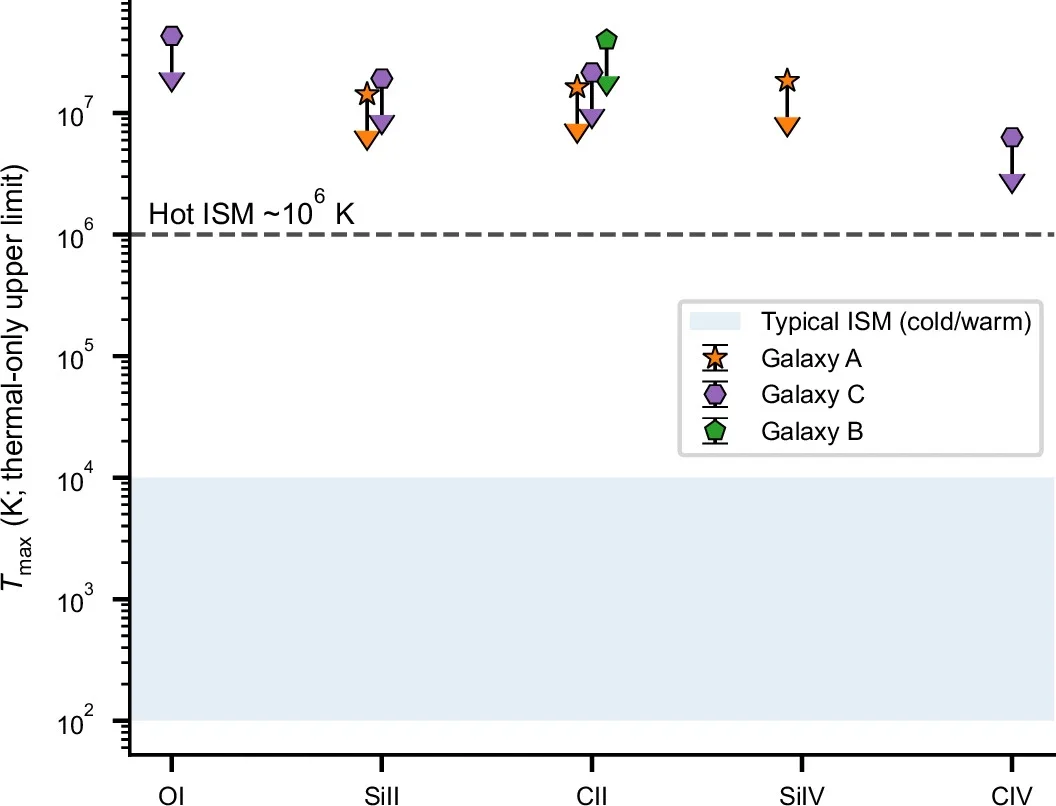
Galaxies are not closed containers. Gas falls into them, forms stars, becomes chemically enriched and can later be pushed outward by stellar winds, supernova explosions and other energetic processes.
Some expelled material eventually returns, while some travels farther into a galaxy’s surroundings. This continuing movement of ordinary matter is called the baryon cycle.
In mature galaxies, baryon cycling strongly influences star formation, chemical evolution and interactions with the circumgalactic medium.
The JWST results show that important ingredients of this cycle were already present during the Epoch of Reionization, when the universe’s first luminous objects were transforming the hydrogen between galaxies.
The three galaxies already contained disturbed, multiphase, metal-bearing gas. Their absorption signatures even resemble some features seen in star-forming galaxies billions of years later.
“Think of these elements, which originated from the galaxies’ stars, as food dye dropped into a cup of water,” Zhu said. “The color begins to spread through the water.”
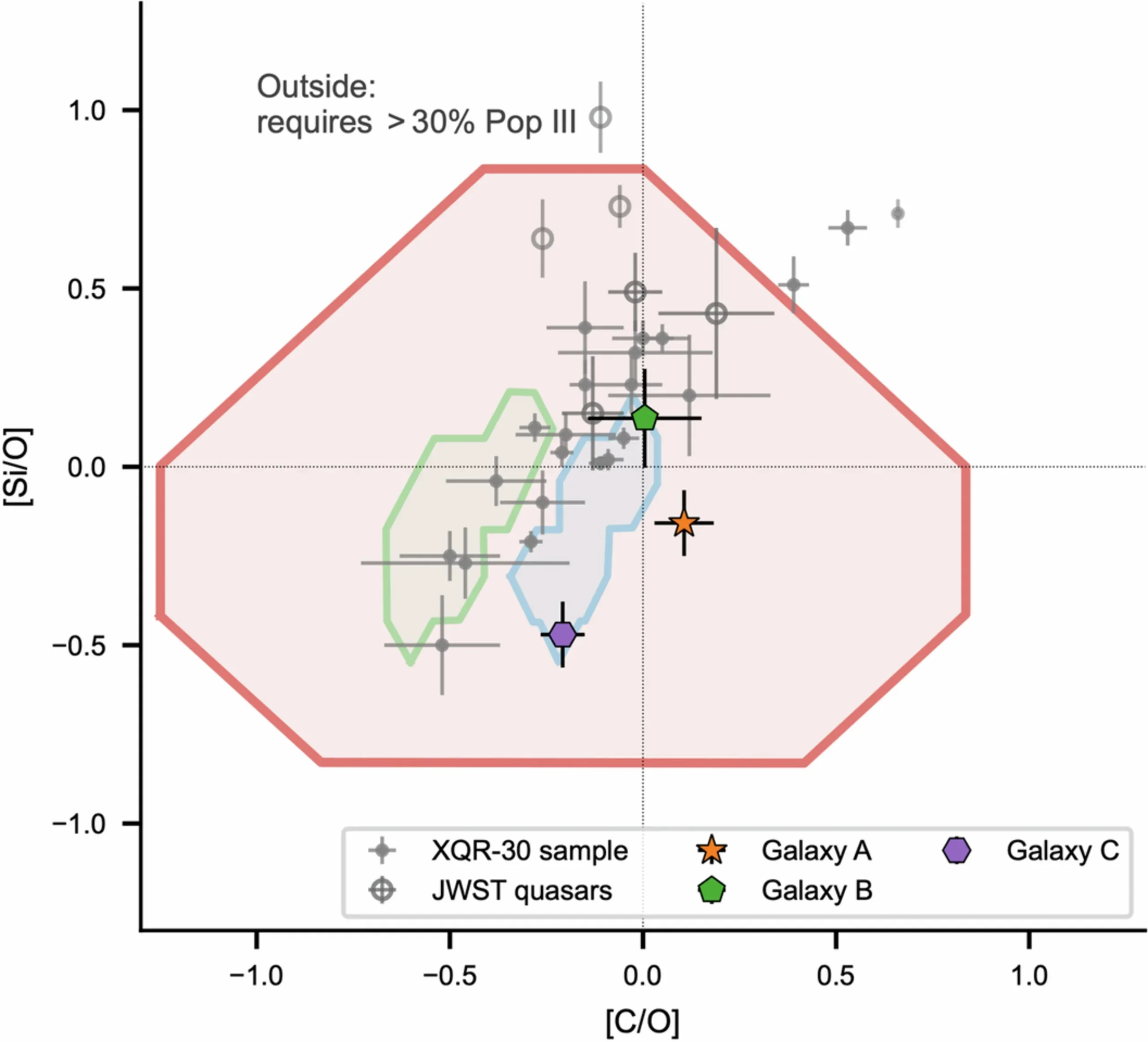
Early enrichment may also help explain why astronomers have struggled to identify Population III stars, the hypothetical first generation formed from essentially metal-free gas.
Once the first stars began producing and dispersing heavier elements, pristine environments would have become progressively harder to maintain. Gas contaminated by even small amounts of metals could form later generations with different properties.
The new observations do not show that metal-free gas had disappeared throughout the universe by 500 million years after the Big Bang. Other high-redshift absorption systems remain extremely metal poor, indicating that enrichment was uneven.
The sample also contains only three particularly luminous galaxies. Fainter and potentially more typical early galaxies may have developed differently.
Still, every sufficiently bright galaxy available in this SPURS sample showed blueshifted absorption from multiple metal ions. That makes a completely pristine environment around luminous early galaxies increasingly difficult to reconcile with the observations.
The first generations of galaxies were apparently not merely building stars. They were already beginning the long process of spreading stellar material through the cosmos, enriching the environments from which future galaxies, planets and eventually life would emerge.
These resources provide broader context on the first stars, circumgalactic gas, baryon cycling and the chemical evolution of the young universe.
The First Stars: This foundational review examines how metal-free Population III stars may have formed and how their feedback began chemically transforming the early universe. (Annual Review of Astronomy and Astrophysics, 2004)
The Evolution of the Intergalactic Medium: This review traces how diffuse gas between galaxies evolved alongside star formation, reionization and cosmic structure. (Annual Review of Astronomy and Astrophysics, 2016)
The Circumgalactic Medium: A comprehensive overview explains how gas surrounding galaxies acts as a reservoir for inflows, outflows, metals and recycled material. (Annual Review of Astronomy and Astrophysics, 2017)
The Cosmic Baryon and Metal Cycles: This review examines how galaxies produce, redistribute and recycle ordinary matter and heavy elements over cosmic history. (Annual Review of Astronomy and Astrophysics, 2020)
Key Physical Processes in the Circumgalactic Medium: Researchers review the physics controlling multiphase gas, galactic outflows and the exchange of matter between galaxies and their environments. (Annual Review of Astronomy and Astrophysics, 2023)
Research findings are available online in the journal Nature Astronomy.
The original story “JWST finds early galaxies were already spreading the ingredients for planets and life” is published in The Brighter Side of News.
Like these kind of feel good stories? Get The Brighter Side of News’ newsletter.
The post JWST finds early galaxies were already spreading the ingredients for planets and life appeared first on The Brighter Side of News.


Leave a comment
You must be logged in to post a comment.