Brain corals beneath small underwater shades regained color during a punishing Florida Keys summer, while nearby unshaded colonies continued paling. The structures did not cool the sea. Instead, they reduced incoming light, easing a stress that can make heat-related bleaching worse.
The field experiment, led by Karen Neely of Nova Southeastern University, tested two vulnerable Caribbean coral species. Published in Frontiers in Marine Science, it offers evidence for temporary protection of individual colonies. It does not establish a method for protecting entire reefs or preventing deaths during more severe heatwaves.
Both shaded and unshaded corals survived the bleaching stress during the trial. That limits what the results demonstrate, but the color differences were clear. They were greatest during the most thermally stressful periods.
The experiment followed Florida’s record-breaking 2023 marine heatwave. Branching corals suffered widespread losses, and some inshore locations also experienced substantial mortality among brain corals. Newfound Harbor, near Big Pine Key, was among the sites where damage was particularly severe.
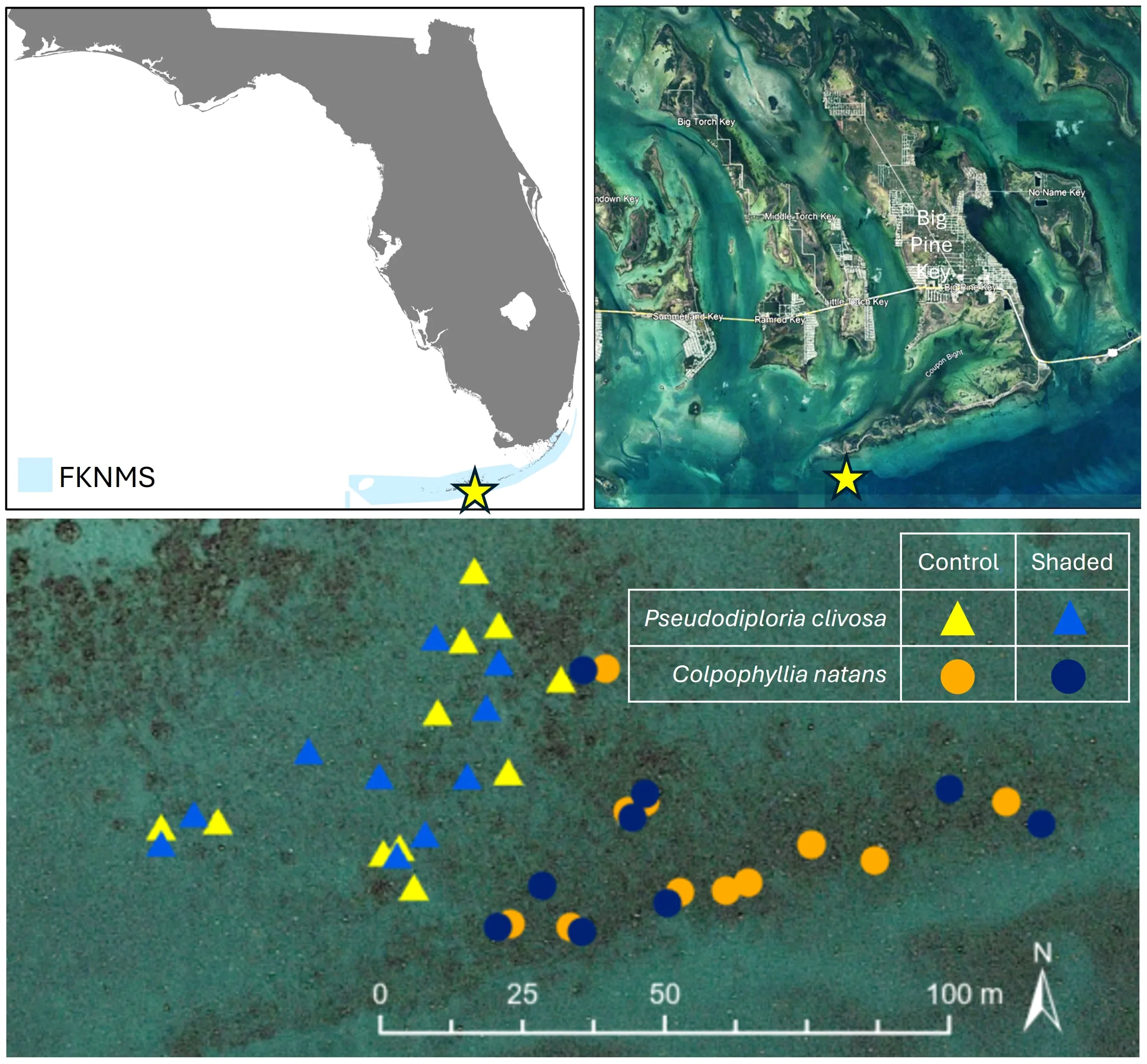
Neely and her colleagues returned there in 2024 to test whether shading could reduce bleaching in surviving colonies. They selected the brain corals Pseudodiploria clivosa and Colpophyllia natans. Both had been highly susceptible to heat-related mortality at the site the previous year.
Twenty colonies of each species were selected for the experiment. Within each species, ten received shades and ten remained unshaded as controls. Altogether, the trial involved 20 shaded colonies and 20 controls.
The location presented a demanding test. Satellite records identified 2024 as Newfound Harbor’s second-highest year of cumulative heat stress since records began in 1985. Only the previous summer had been worse.
Satellite-derived temperatures reached 31.8 degrees Celsius, while seabed instruments recorded higher peaks of 32.6 to 32.8 degrees. The satellite record documented 61 days above the site’s 30.5-degree bleaching threshold during the monitored interval. Conditions were stressful, even though bleaching proved less severe than anticipated.
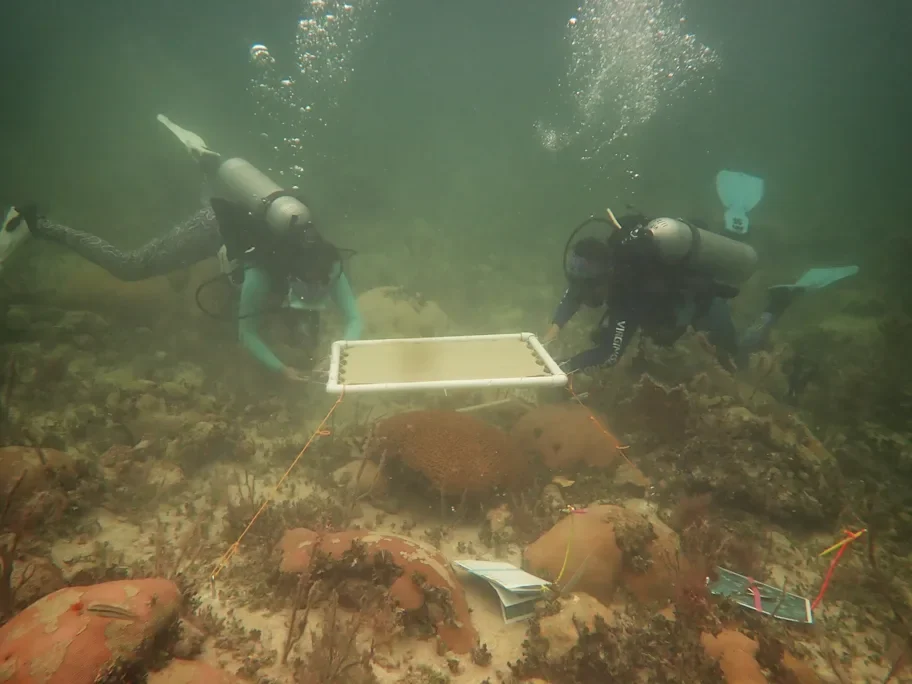
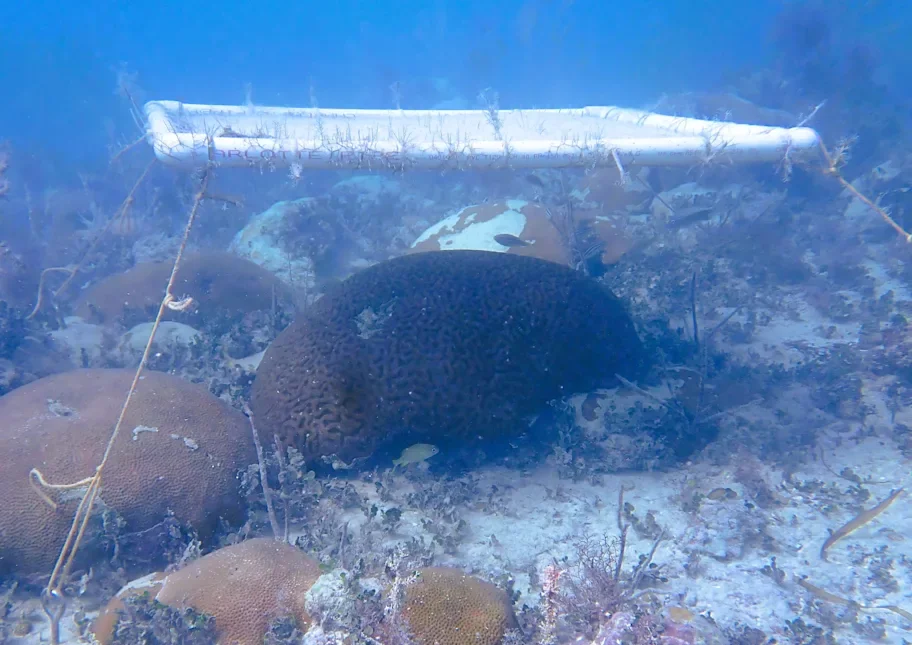
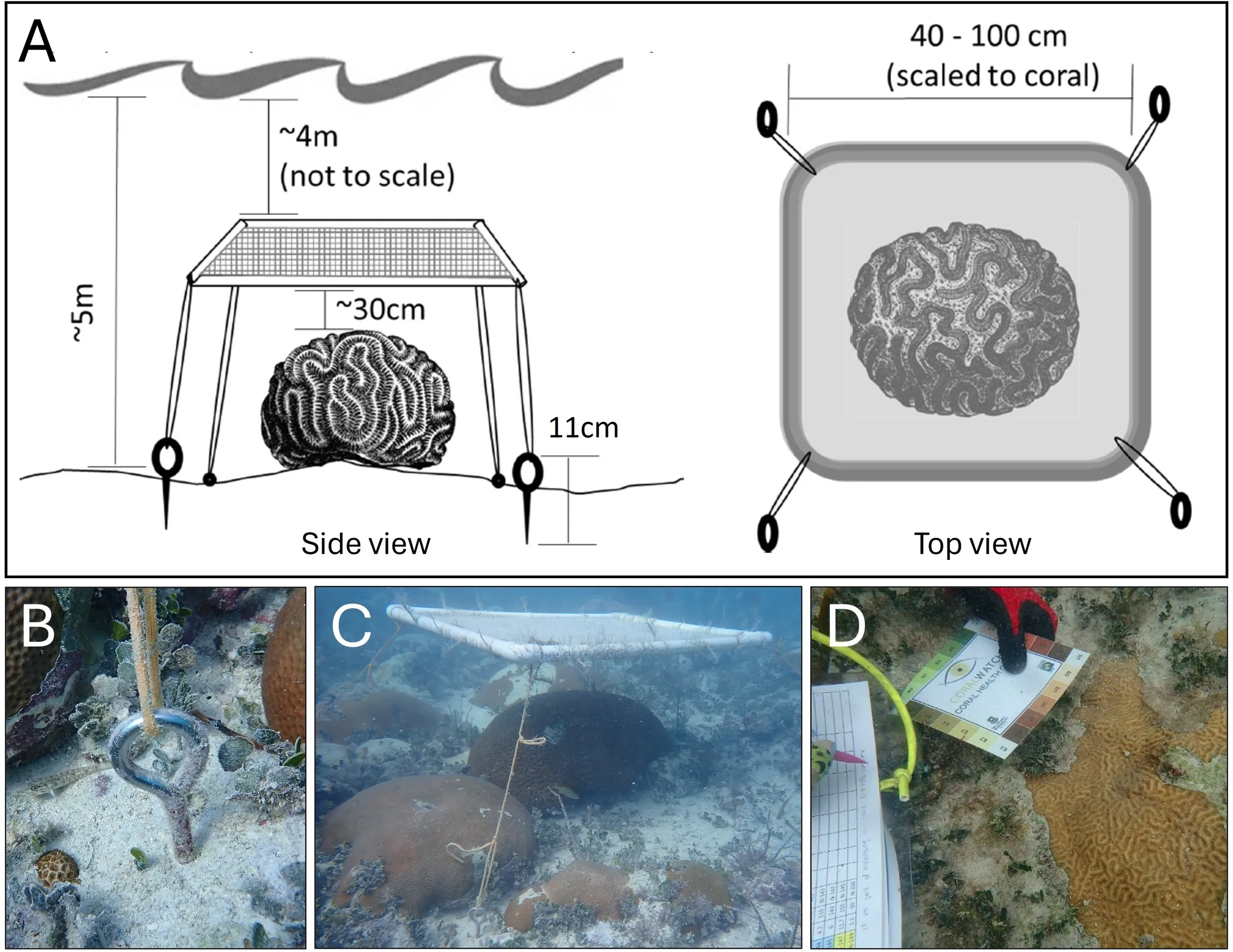
The team built each shade to fit its target coral. Foam-filled PVC frames provided buoyancy, while tan agricultural shade cloth covered the opening. The cloth was made from ultraviolet-resistant high-density polyethylene.
According to the manufacturer’s specifications, the fabric reduced incoming light by 60%. Cords connected the frame corners to eye screws installed in the surrounding seabed. Each shade floated approximately 30 centimeters above the colony.
Divers checked the corals roughly every two weeks and during shade removals or reinstallations. They assessed live tissue, damage and color using a coral health card. Small tissue biopsies allowed laboratory measurements of the algae living inside the corals.
These algae supply much of a coral’s nutrition and contribute to its color. Bleaching occurs when this partnership breaks down under stress. Reducing excessive light can ease one part of that stress, even when water remains hot.
The structures required maintenance throughout the experiment. Divers brushed them regularly to remove sediment and organisms that could increase shading beyond the intended level. The team also removed and reinstalled them around two tropical storms.
The researchers intended to install shades when cumulative heat stress reached four degree heating weeks. This measure combines the intensity and duration of temperatures above the bleaching threshold. Permitting delays pushed installation to August 16 and 17, when the measure had exceeded seven.
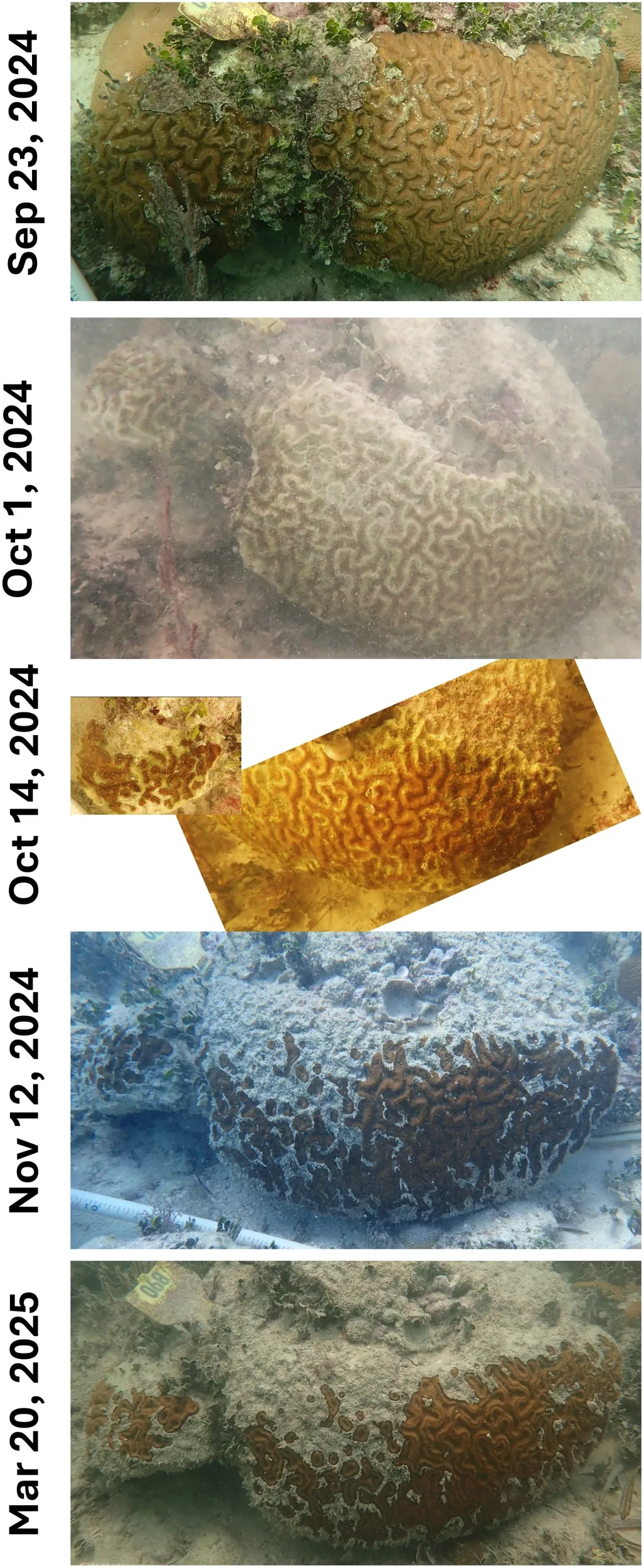
By then, colonies were already visibly pale. Nevertheless, shaded corals began darkening after deployment, while controls continued losing color until temperatures declined. Both species showed significantly darker shaded colonies during peak thermal stress.
The researchers also compared how quickly color changed during warming and recovery. During increasing heat stress, shaded Pseudodiploria clivosa regained color significantly faster than controls. Colpophyllia natans showed a similar direction of change, although that particular rate comparison did not reach statistical significance.
After temperatures declined, controls regained color faster than shaded colonies in both species. That recovery pattern accompanied the earlier advantage among shaded corals. The principal treatment differences occurred when thermal stress was greatest.
No bleaching-related mortality occurred in either treatment group. One coral did suffer tissue damage after a storm dislodged it and rolled it across the seabed. That injury was separate from the bleaching response the experiment tested.
The relatively mild bleaching surprised the team given the summer’s heat. Most sampled corals contained predominantly Durusdinium, a heat-tolerant group of symbiotic algae. These organisms may have helped both treatment groups withstand temperatures expected to cause greater damage.
The researchers suspect the 2023 heatwave helped shape those communities. However, they did not know the experimental colonies’ algae composition before that event. A shift toward Durusdinium therefore remains an explanation rather than a demonstrated change in these particular corals.
Heat tolerance also carries possible trade-offs. Durusdinium associations can involve slower coral growth and potentially greater disease susceptibility. Preventing bleaching without requiring such a shift would be useful, but this experiment did not demonstrate that outcome.
Laboratory measurements did not show a consistent shading advantage in algae abundance across both species. Permits required biopsies from colony edges, which often receive natural shade and showed less paling. Sampling those areas may have obscured differences visible across the whole colony.
Color changes could also reflect differences in algae pigments rather than simply algae numbers. The study identifies that possibility as a question for further investigation. Visual recovery alone cannot resolve the underlying mechanism.
“Scaling is the big limitation of this study; shading is not a cure-all for coral reefs,” Neely said.
The findings support a temporary intervention for selected colonies of the two tested species. Other corals may respond differently, and the thermal limit beyond which shading stops helping remains unknown. Earlier installation might also change results, but that needs testing.
Longer follow-up could examine disease and reproductive output after shade removal. For now, the experiment shows reduced paling during heat stress, not proven improvements in survival or reproduction. Addressing climate change remains necessary for reefs’ long-term future.
These resources examine how light, heat and local reef conditions influence bleaching and the potential benefits of shading.
Hot spots in hot waters: spatial patterns of bleaching-related mortality within individual reefs: Examines how bleaching-related coral mortality varies within individual reefs, informing the selection of colonies for targeted protection. (Frontiers in Marine Science, 2026)
Shading responses are species-specific in thermally stressed corals: Investigates differences among coral species in their responses to reduced light during thermal stress. (Frontiers in Marine Science, 2024)
Too hot to handle? The impact of the 2023 marine heatwave on Florida Keys coral: Documents bleaching and mortality during the extreme heatwave that prompted the shading trial. (Frontiers in Marine Science, 2024)
Intermittent shading can moderate coral bleaching on shallow reefs: Tests whether shading for limited periods can reduce bleaching on shallow reefs. (Frontiers in Marine Science, 2023)
The Effects of Shade and Light on Corals in the Context of Coral Bleaching and Shading Technologies: Reviews research on coral light responses and the scientific basis for shading interventions. (Frontiers in Marine Science, 2022)
Research findings are available online in the journal Frontiers in Marine Science.
The original story “Underwater umbrellas reduce bleaching in heat-stressed coral reefs” is published in The Brighter Side of News.
Like these kind of feel good stories? Get The Brighter Side of News’ newsletter.
The post Underwater umbrellas reduce bleaching in heat-stressed coral reefs appeared first on The Brighter Side of News.


Leave a comment
You must be logged in to post a comment.