A repetitive stretch of DNA outside protein-making instructions can help determine whether a gene switches on during early brain development. Experiments comparing human and chimpanzee cells traced that difference to a regulatory system involving ZNF558, a gene shared by both species. Altering its activity changed the growth and gene-expression patterns of laboratory-grown human brain organoids.
The work, led by Johan Jakobsson at Lund University in Sweden, appeared online in Cell Stem Cell. The findings show how changes in gene regulation can produce developmental differences even when the protein-coding gene itself remains conserved.
They do not establish why humans think differently from chimpanzees or identify a single genetic explanation for human brain evolution. Instead, the experiments connect a particular DNA region with gene activity and changes in a laboratory model. That narrower result gives researchers a mechanism they can investigate further.
Most human DNA does not directly encode proteins. Some of that noncoding DNA regulates when and where genes become active, while other sequences have structural or still-uncertain roles. The older label “junk DNA” can therefore obscure important differences between sequences with demonstrated functions and those that remain poorly understood.
The Lund team examined a repetitive region near ZNF558, a gene that produces a protein involved in controlling other genes. That region contains copies of the same DNA segment arranged consecutively. Scientists call this a variable number tandem repeat because the number of copies can differ between individuals and species.
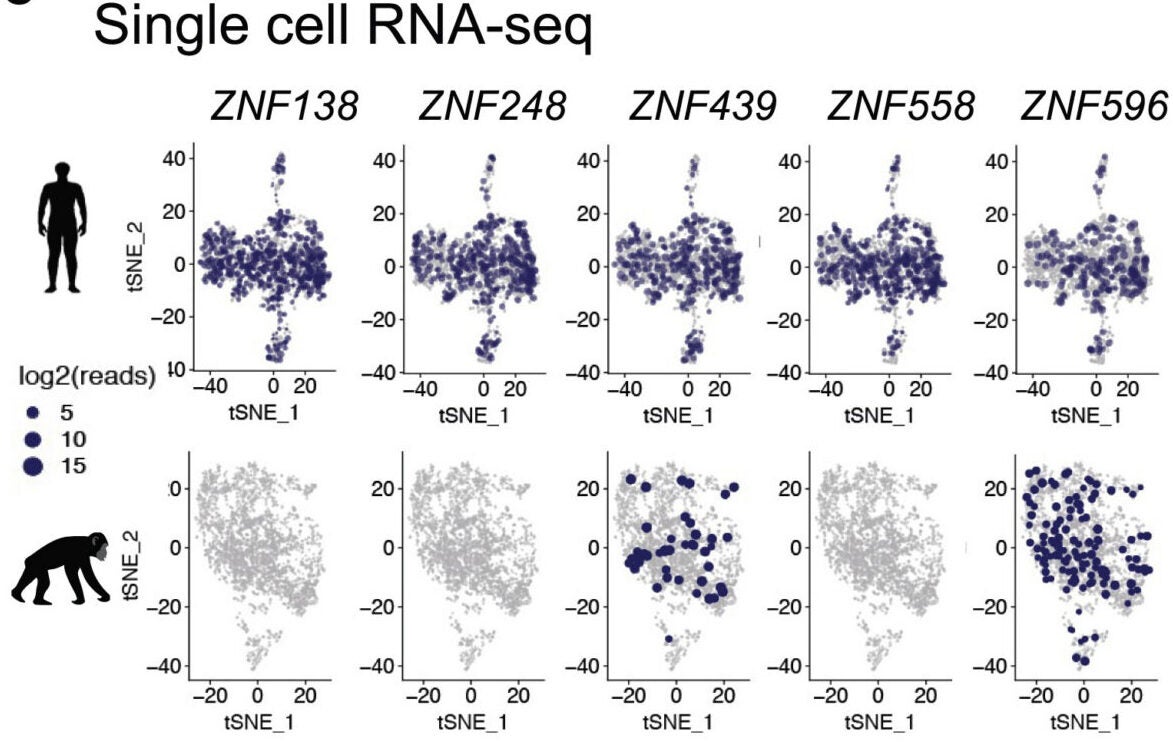
The repeat was generally longer in chimpanzees than in humans. Its length was associated with whether ZNF558 became active in developing forebrain cells. The researchers then used targeted experiments to test whether manipulating the region could change that activity.
This distinction shifts attention from changing a protein’s structure to changing its deployment. Two species can carry a similar gene yet use it differently during a particular developmental stage. The study provides evidence for that possibility without implying that protein-coding changes have no role in brain evolution.
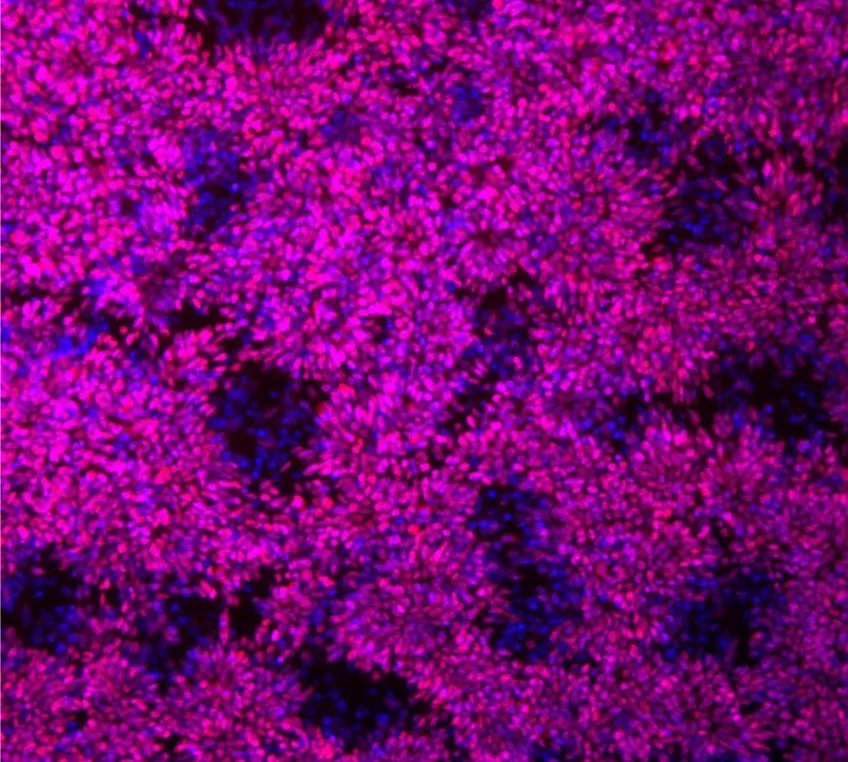
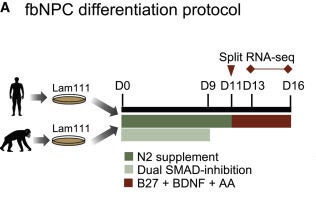
The researchers used induced pluripotent stem cells, which are specialized cells reprogrammed into a state capable of generating many cell types. They then directed those cells toward forebrain neural progenitors. These are developing cells that can give rise to neurons, rather than mature, functioning brains.

“Instead of studying living humans and chimpanzees, we used stem cells grown in a lab,” said Jakobsson, a professor of neuroscience. “The stem cells were reprogrammed from skin cells by our partners in Germany, the USA and Japan.” The approach allowed comparisons under controlled culture conditions.
Matching developmental stages was important because differences in cell maturity could otherwise resemble species differences. The team compared gene activity across several days and checked markers of cell identity. Single-cell measurements included 4,355 human cells and 3,620 chimpanzee cells, with about 95% belonging to one main population in each species.
Those thousands of cells were not thousands of independent donors. The initial chimpanzee stem-cell comparisons involved two individuals, with additional published data helping test the findings. Such checks strengthened the analysis, while leaving a need to examine variation across more individuals and experimental settings.
ZNF558 belongs to a family of proteins that can repress gene activity. Many members of this family help control transposable elements, DNA sequences capable of moving or copying within genomes. The researchers found evidence that ZNF558 originally evolved to suppress a group of these elements called LINE-1.
In the developing forebrain cells studied here, however, its detectable regulatory effect centered on a different target. Silencing ZNF558 increased activity of SPATA18, a gene involved in mitochondrial maintenance. The experiments did not detect corresponding changes in the activity of the transposable elements examined.
Mitochondria help cells generate usable energy, and their maintenance can influence cell behavior. SPATA18 produces a protein involved in clearing mitochondria through a process called mitophagy. Human forebrain progenitors showed less SPATA18 activity than chimpanzee progenitors, consistent with repression by ZNF558.
The team also introduced extra ZNF558 into chimpanzee cells. SPATA18 activity decreased, showing that the regulatory connection could operate there too. The difference therefore involved how a shared system was used, rather than the complete absence of its components in chimpanzees.
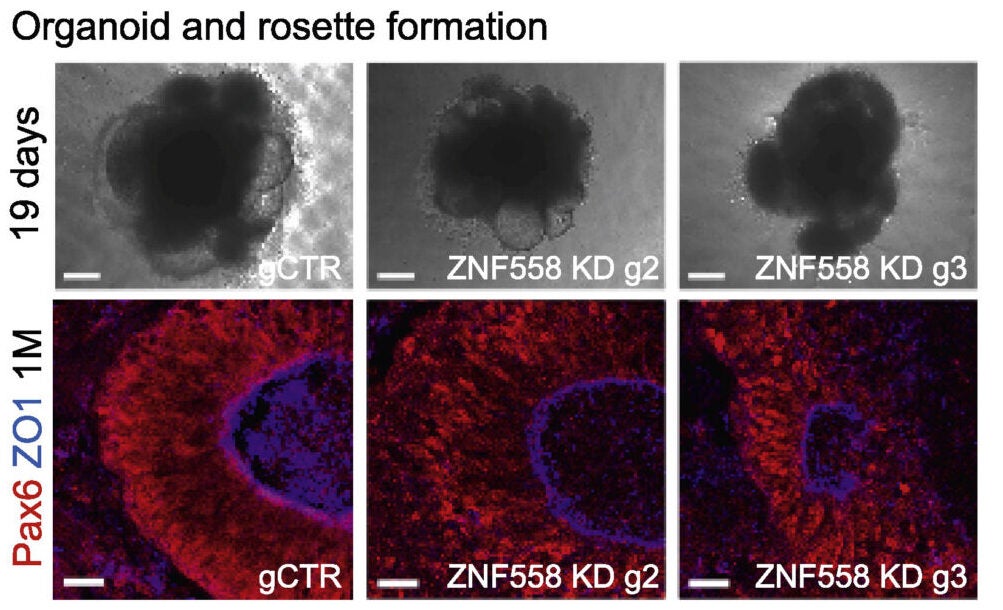
To investigate consequences beyond individual gene measurements, the researchers grew cerebral organoids. These three-dimensional tissue models reproduce selected features of early brain development. They allow experiments on developmental processes but cannot capture every feature of an intact brain.
The team reduced ZNF558 activity using CRISPR interference, a method that suppresses gene activity without cutting out the DNA sequence. Organoids still formed and contained the same broad cell types as controls. During their first month, however, the modified organoids appeared smaller.
Later analyses examined gene activity at two and four months. Neurons in the modified organoids showed patterns associated with more advanced maturation, including genes involved in neuronal differentiation and connections. These molecular differences supported a role in developmental timing, rather than demonstrating enhanced neuronal function.
The results leave an important mechanistic question unresolved. Although SPATA18 provides a plausible connection to mitochondrial biology, the study did not fully establish how that pathway produces the organoid changes. Smaller tissue models and altered gene expression also cannot directly establish differences in adult brain size, behavior or intelligence.
The researchers tested the neighboring repeat by imposing repressive regulation on the shorter human version. ZNF558 activity fell, while SPATA18 activity increased. This manipulation supported the repeat’s regulatory role, although it did not reproduce evolution by physically lengthening or shortening the sequence.
The authors proposed that a longer repeat could support a larger region of tightly packed, repressed DNA. Shortening might expose regulatory sequences or allow a nearby noncoding RNA molecule to influence the gene. The experiments did not settle exactly how these features interact, leaving the physical mechanism of repeat-dependent regulation incompletely understood.
Repeat length also varied among humans. Analysis of data from 409 human lymphoblastoid cell lines, derived from immune cells, found an association between longer repeats and lower ZNF558 expression. That result did not establish a relationship with human cognitive ability or measure the effect directly in developing brains.
Nor was the regulatory mechanism exclusive to humans across all primates. Other datasets showed ZNF558 expression during brain development in orangutans and macaques. The researchers also found no comparable human–chimpanzee expression difference in several adult tissues, emphasizing the importance of developmental context.
The next challenge is to determine exactly how repeat length controls ZNF558 and how mitochondrial regulation affects developmental timing. Experiments using more genetic backgrounds could help separate consistent effects from individual variation. Testing those links would clarify how much this particular regulatory change contributed to brain evolution, without assigning the entire process to one stretch of DNA.
These resources explain noncoding DNA, comparative brain models and the regulatory proteins involved.
An integrated transcriptomic cell atlas of human neural organoids
This atlas compares organoid cell types with developing human brain references, helping researchers assess the strengths and limitations of laboratory models. (Nature, November 2024)
An early cell shape transition drives evolutionary expansion of the human forebrain
This comparative organoid study investigates how early changes in cell shape and developmental timing contribute to differences between humans and other apes. (Cell, March 2021)
What is noncoding DNA?
This guide explains regulatory sequences and other functions of DNA that does not encode proteins. (MedlinePlus Genetics, updated January 2021)
Organoid single-cell genomic atlas uncovers human-specific features of brain development
Comparisons of primate organoids reveal differences in developmental pace and gene regulation, providing context for experiments on individual regulatory mechanisms. (Nature, October 2019)
KRAB zinc-finger proteins contribute to the evolution of gene regulatory networks
This study investigates how proteins associated with controlling transposable elements also contribute to broader gene regulation. (Nature, March 2017)
Research findings are available online in the journal Cell Stem Cell.
The original story “The secret to being human may be hidden in our DNA” is published in The Brighter Side of News.
Like these kind of feel good stories? Get The Brighter Side of News’ newsletter.
The post The secret to being human may be hidden in our DNA appeared first on The Brighter Side of News.


Leave a comment
You must be logged in to post a comment.