A furry predator only half a meter long carried surprisingly modern feeding machinery through Jurassic waters. Its hooked teeth helped grip slippery prey, while bones inside its skull suggest a throat equipped for controlled swallowing.
The newly described species, Megacauda sungei, lived about 165 million years ago in what is now Inner Mongolia, China. Researchers from Shenyang Normal University, the University of Chicago, the University of Bonn and collaborating institutions report the fossil in Nature.
Their anatomical analysis connects two evolutionary stories: the early spread of swimming lifestyles and the development of mammalian feeding structures. Crucially, the fossil preserves the bony framework for reconstructing soft tissues, rather than a surviving soft palate itself.
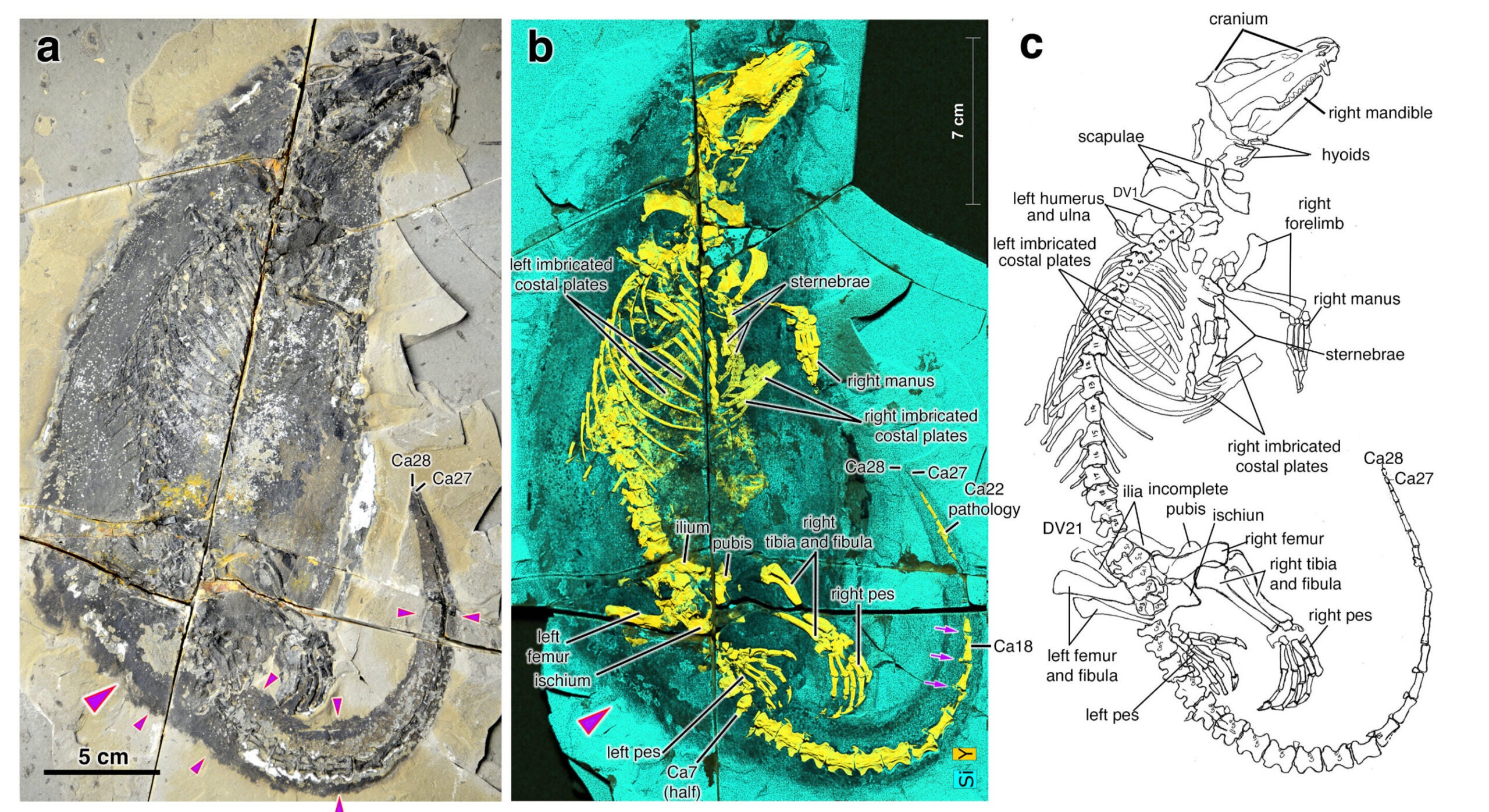
At roughly 50 centimeters, or 1.6 feet, from nose to tail, Megacauda was small beside many dinosaurs. Among its mammaliaform relatives, however, it was unusually large. Estimates based on skull measurements and comparisons with living animals place its mass at approximately one to two kilograms.
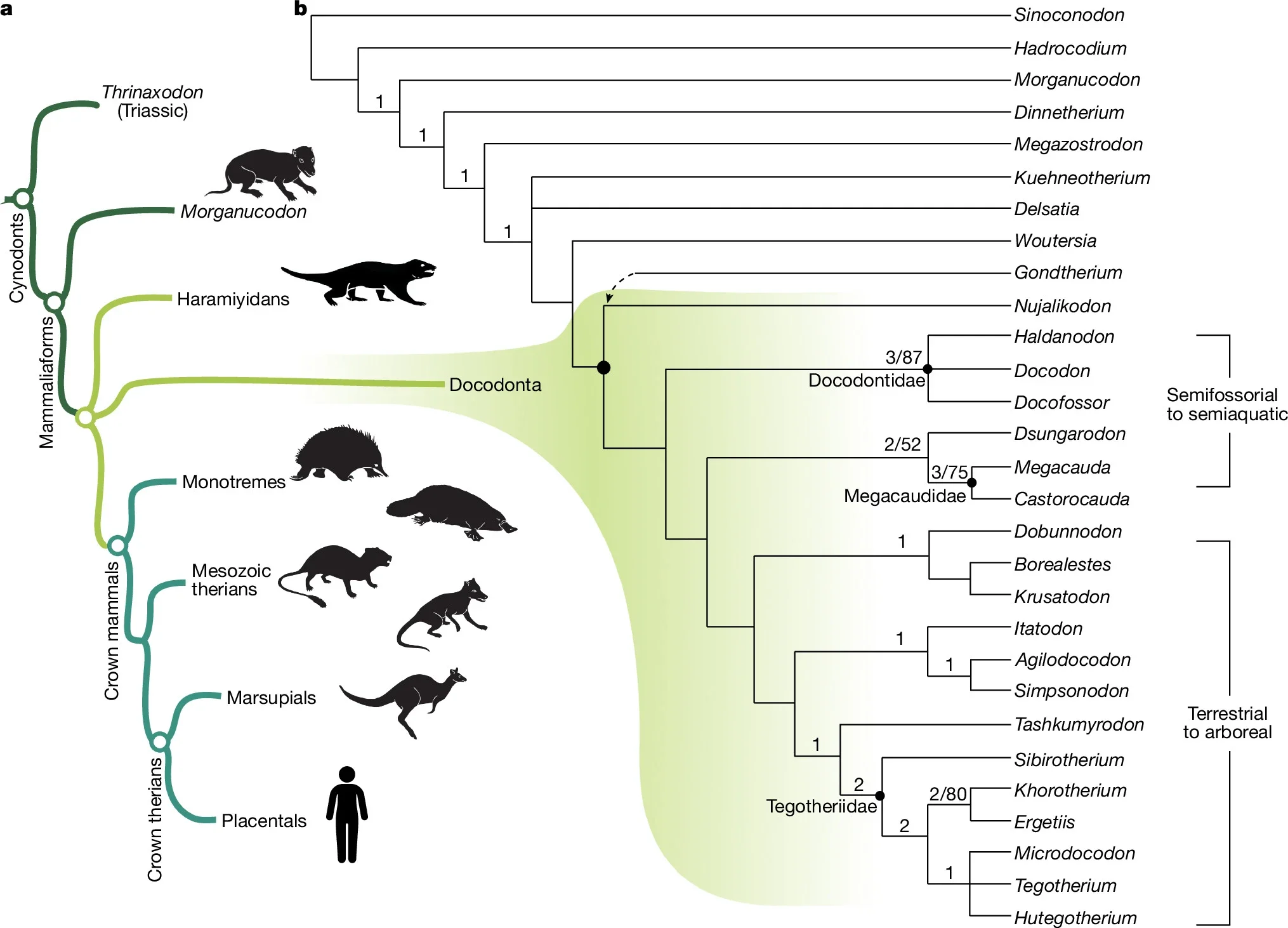
Mammaliaforms include modern mammals and extinct relatives outside the group containing all living mammals. Megacauda belonged to the docodonts, an extinct branch known for specialized teeth and a striking range of lifestyles. Its resemblance to an otter or platypus does not establish direct ancestry with either animal.
“The new species Megacauda sungei is the largest of the mammaliaforms from the Jurassic,” said Thomas Martin, a paleontologist at Bonn. The upper end of its estimated weight, about two kilograms, equals roughly 4.4 pounds.
The specimen came from Xiayingzi in Inner Mongolia and entered the collection of the Paleontological Museum of Liaoning in Shenyang. Detailed examination revealed that it represented a previously undescribed species. Its genus name means “large tail,” while sungei honors the museum’s honorary director, Sun Ge.
Computed tomography allowed the team to reconstruct the fossil’s anatomy in 3D. Comparisons with other fossils and living species helped them interpret features of its skull, limbs and tail. These comparisons support a semiaquatic lifestyle, involving movement both in water and on land.
The flattened tail included broad vertebrae and projecting structures that supported muscles. Its hind feet had elongated outer toes, while the ankle permitted movements useful for paddling. Other aspects of the skeleton resemble swimming adaptations in living monotremes, the mammal group that includes platypuses.
The authors propose that Megacauda combined forelimb paddling with movements of its hind limbs and tail. This is a reconstruction of likely behavior from anatomy, rather than direct evidence of its swimming strokes. Its forelimbs also had features compatible with digging.
Swimming mammaliaforms were already known, including the docodont Castorocauda, described in 2006. The new specimen comes from a lower, older layer of the same geological formation. It therefore pushes evidence of this lifestyle further back within that local fossil sequence.
The analysis also groups Megacauda and Castorocauda within a newly named family, Megacaudidae. Their shared features suggest that specialization for life around water developed within this early branch of mammal relatives.
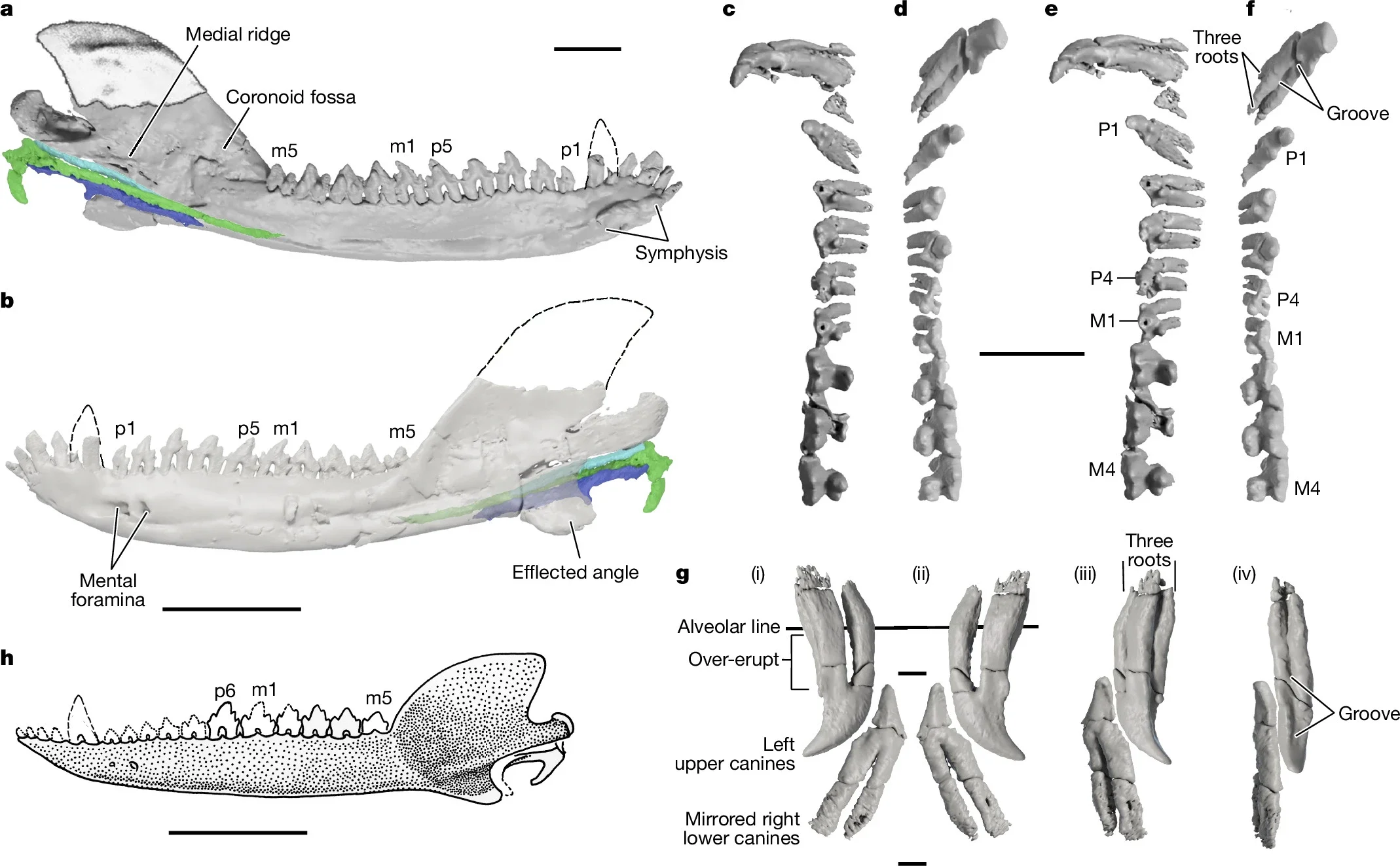
The teeth offer another line of evidence about how Megacauda lived. Several tooth cusps curve backward, a configuration suited to holding struggling, slippery prey. Compressed tooth crowns also provided cutting surfaces.
An especially unusual feature appears in the upper canines: each had three roots. The researchers interpret the reinforced canine structure as useful for puncturing prey. Its combination of gripping and shearing teeth points toward a predatory diet.
Likely food included small vertebrates, such as fish and salamanders, as well as invertebrates. Those possibilities follow from tooth shape and comparisons with other animals. The study does not document a preserved meal proving which species it ate.
Its cutting teeth also differed mechanically from those of cats and dogs. The fossil indicates a shearing action involving a different direction of jaw movement. Similar feeding functions therefore developed through distinct anatomical arrangements, an example of evolutionary convergence.
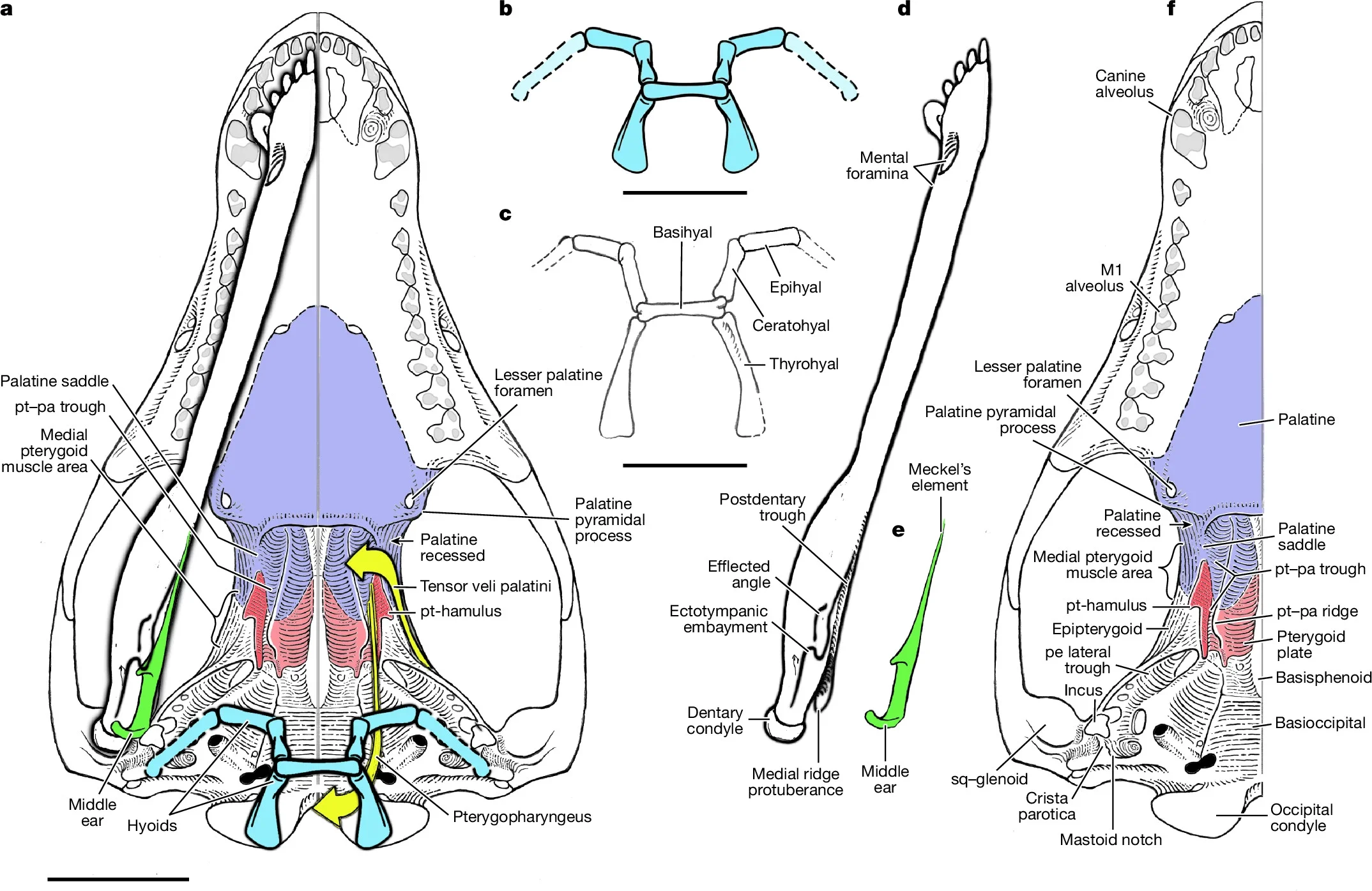
The most revealing structures lie around the passage connecting the mouth, nasal cavity and throat. Rare preservation exposed the bony palate, surrounding skull features and small throat bones called hyoids. Together, they allow a more complete reconstruction than teeth or an isolated jaw could provide.
One key feature is the pterygoid hamulus, a small, hook-bearing structure near the back of the palate. In living mammals, this structure helps redirect a muscle that tensions the soft palate. The fossil’s hamulus closely resembles the corresponding structure in marsupials and placental mammals.
Based on that resemblance, the authors infer that Megacauda possessed a comparable muscle and soft palate. They also propose another throat muscle whose attachment sites fit the preserved bones. In living mammals, that muscle helps close the passage toward the nose during swallowing.
The hyoids provide complementary evidence. Their saddle-shaped arrangement and mobile connections resemble structures involved in mammalian tongue and throat movements. Such coordinated movements help propel food and liquid, rather than relying only on gravity.
These interpretations remain reconstructions because the relevant muscles are not preserved. Even so, several independent bony features support the proposed feeding system. Comparisons with living species connect the preserved attachment sites to muscles with known functions. The study places important components of mammalian swallowing deep within an extinct Jurassic lineage.
The reconstructed anatomy also bears on suckling. In living mammals, a tensioned soft palate gives the tongue a surface to press against while controlling pressure during feeding. Closing the nasal passage helps keep swallowed liquid on its intended route.
The fossil supports the presence of structures needed for these functions, but it does not preserve nursing behavior. Nor does it establish when milk production first evolved. Its contribution is anatomical evidence about the machinery that made mammalian feeding possible.
That machinery developed alongside more ancient features. Megacauda retained middle-ear structures associated with the jaw, even while possessing comparatively advanced throat anatomy. Evolution assembled these traits in stages rather than delivering the modern mammalian body all at once.
Docodonts also occupied trees, underground habitats and aquatic environments. Their diversity challenges a simple picture of early mammal relatives confined to one way of life. This fossil adds a substantial swimmer whose skull records another part of that evolutionary experimentation: how to move food safely through the throat.
These resources explore swimming adaptations, throat anatomy and the varied development of early mammals.
A swimming mammaliaform from the Middle Jurassic and ecomorphological diversification of early mammals: The description of Castorocauda established evidence of swimming and burrowing adaptations in a Jurassic docodont. (Science, 2006)
New Jurassic mammaliaform sheds light on early evolution of mammal-like hyoid bones: The Microdocodon fossil documents throat bones relevant to the evolution of mammalian swallowing. (Science, 2019)
Evolution, diversification and function of the maternal–infant dyad in mammalian feeding: This review examines nursing and the coordinated feeding functions of mammalian mothers and infants. (Philosophical Transactions of the Royal Society B, 2023)
Jurassic fossil juvenile reveals prolonged life history in early mammals: Juvenile and adult Krusatodon fossils reveal slower development than in similarly sized living mammals. (Nature, 2024)
Bone microstructure supports a Mesozoic origin for a semiaquatic burrowing lifestyle in monotremes (Mammalia): Fossil bone structure offers evidence about the origins of swimming and burrowing in the lineage containing platypuses and echidnas. (Proceedings of the National Academy of Sciences, 2025)
Research findings are available online in the journal Nature.
The original story “The Jurassic Period’s ‘top predator’ was smaller than a house cat” is published in The Brighter Side of News.
Like these kind of feel good stories? Get The Brighter Side of News’ newsletter.
The post The Jurassic Period’s ‘top predator’ was smaller than a house cat appeared first on The Brighter Side of News.


Leave a comment
You must be logged in to post a comment.