Some of the strangest objects uncovered by the James Webb Space Telescope may represent a fleeting stage in the birth of enormous black holes.
Known as Little Red Dots, the compact objects appear throughout observations of the early universe. Their unusual colors, broad hydrogen emission and unexpectedly large inferred black hole masses have resisted a single explanation.
New simulations now show how objects resembling these dots can arise naturally in dense regions of the young cosmos. The work, published in Nature, was led by Sunmyon Chon of the Max Planck Institute for Astrophysics and used the Japanese ATERUI III supercomputer at the National Astronomical Observatory of Japan.
Rather than proving that every Little Red Dot has the same origin, the simulations offer a self-consistent pathway that reproduces several defining observations. It begins with unusually massive stars and ends with black holes growing at extraordinary rates.
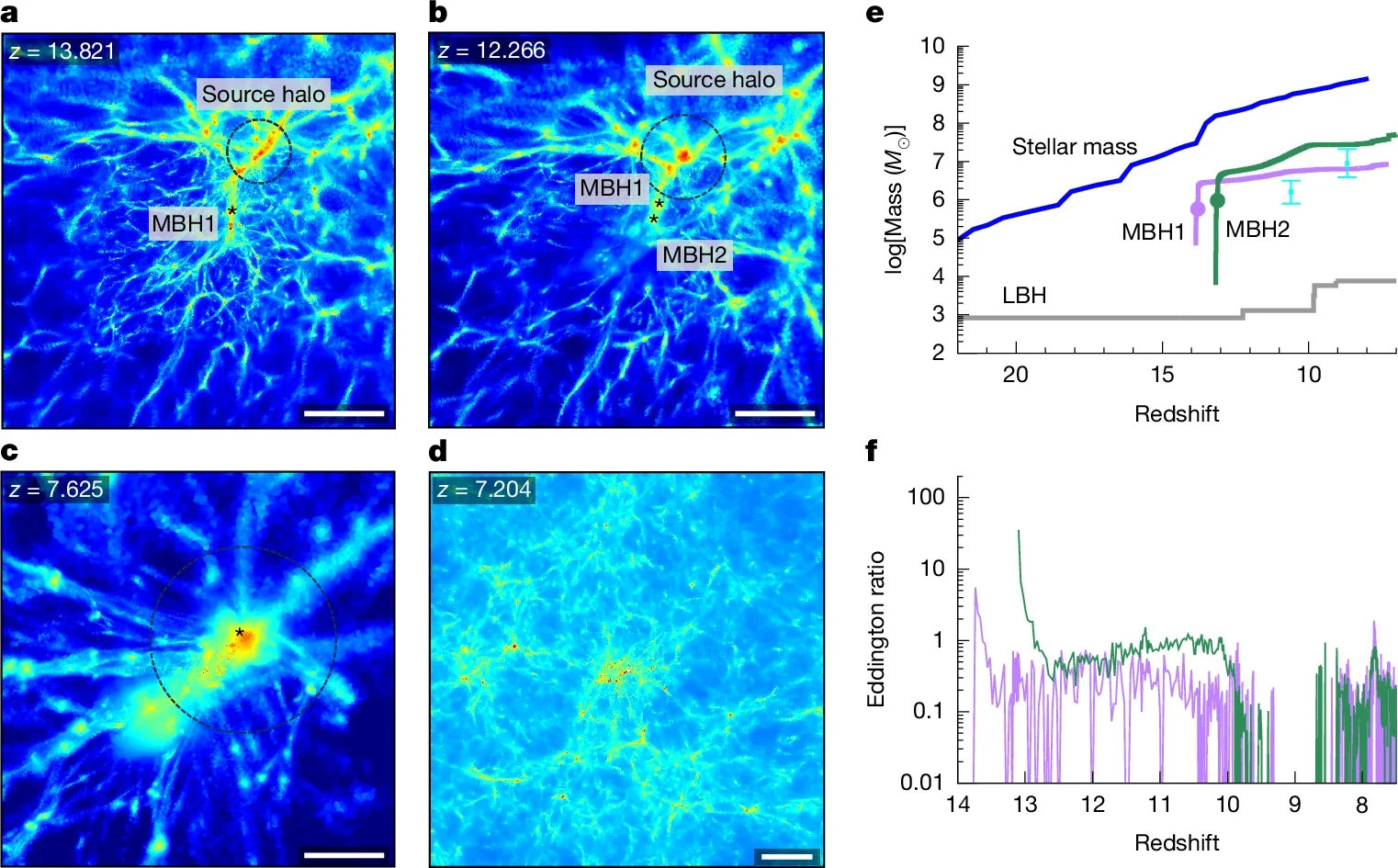
The puzzle begins less than a billion years after the Big Bang, when astronomers already see black holes millions or billions of times more massive than the Sun.
Building such objects so quickly has long challenged models. Black holes formed from ordinary massive stars start relatively small and may struggle to accumulate enough material before radiation and other feedback push surrounding gas away.
The simulations followed a different route in an overdense protocluster environment. Nearby star-forming galaxies flooded surrounding gas clouds with intense far-ultraviolet radiation, including radiation capable of breaking apart molecular hydrogen.
Molecular hydrogen normally helps primordial gas cool enough to fragment into many smaller stars. Suppressing that cooling delays ordinary star formation and allows much larger reservoirs of gas to accumulate before collapsing.
In the simulated environment, central protostars eventually grew to between about 500,000 and 900,000 solar masses. More detailed calculations showed individual objects reaching several hundred thousand solar masses before collapsing into massive black hole seeds.
These seeds begin life dramatically larger than the remnants left by ordinary stars.
Formation alone does not solve the early black hole problem. The seeds still need enormous amounts of fuel.
The simulations showed that the newly formed black holes remained surrounded by dense, optically thick gas. That environment created conditions for brief periods of super-Eddington accretion.
The Eddington limit describes a balance between gravity pulling material inward and radiation pushing outward. In ordinary circumstances, intense radiation from a feeding black hole can limit how quickly additional gas falls in.
But radiation can become trapped in extremely dense accretion flows. Photons are dragged inward faster than they can escape, reducing their ability to halt the inflow.
The simulated black holes consequently accreted at rates several to a few tens of times the Eddington rate for less than 1 million years. They quickly grew to several million solar masses and eventually surpassed 10 million solar masses by a redshift near 10.
By comparison, simulated black holes originating from Population III stars, with seed masses around 800 Suns, grew inefficiently. Radiation from those early stars depleted much of the nearby gas, leaving the smaller seeds with too little fuel.
Rapid growth alone would not connect the simulations to JWST’s Little Red Dots. The objects also need to reproduce their peculiar spectra.
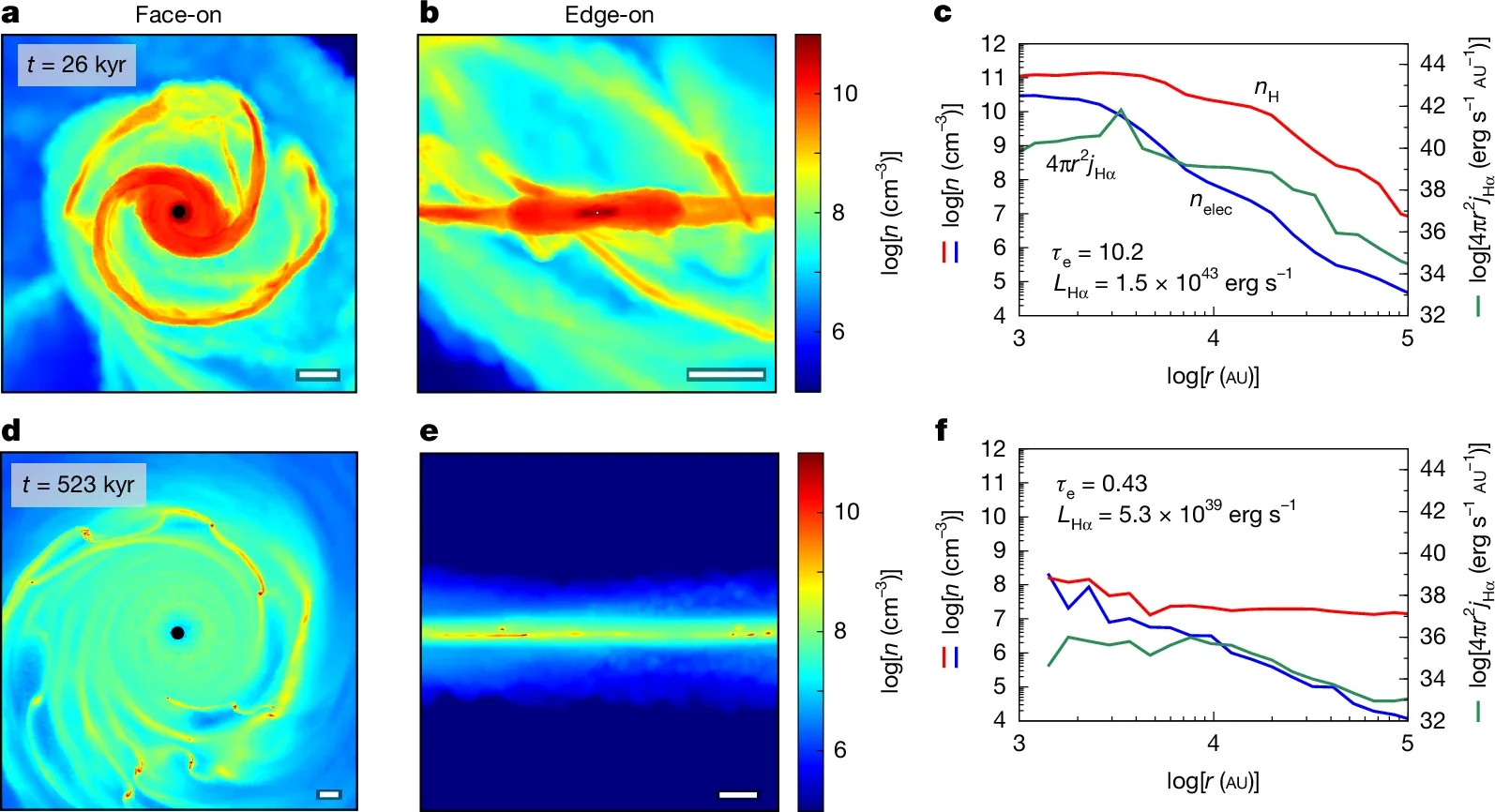
The dense gas disks around the simulated black holes did just that.
Gas densities exceeded 100 million hydrogen atoms per cubic centimeter in important regions, while some areas surpassed 10 billion per cubic centimeter. Those conditions changed how hydrogen absorbed and emitted light.
The resulting environments produced strong Balmer absorption and broad hydrogen features resembling those observed in Little Red Dots. Shortly after one simulated black hole formed, its surrounding gas generated an H-alpha luminosity of about 1.5 × 10^43 ergs per second, comparable to values inferred for real objects.
Electron scattering through the thick surrounding gas could also broaden emission lines to more than 1,000 kilometers per second. That offers an alternative to interpreting every broad line as gas moving at tremendous orbital speeds.
Several hundred thousand years later, the dense envelope became thinner and the object transitioned toward a more familiar active galactic nucleus, or AGN. The simulations therefore suggest that the Little Red Dot appearance could represent a short-lived phase in black hole growth.
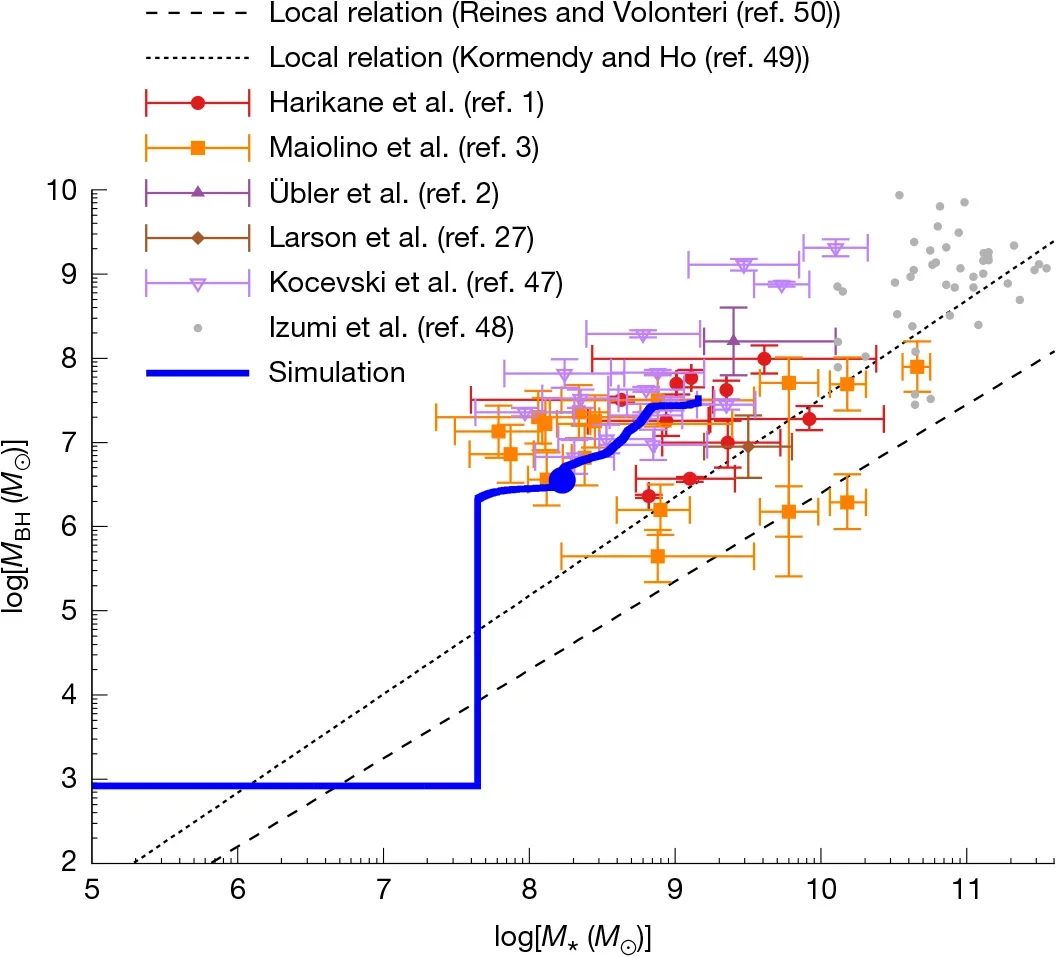
JWST has made the early black hole problem harder by finding apparently overmassive black holes in surprisingly small galaxies.
Some Little Red Dots appear to contain black holes representing a much larger share of their host galaxy’s mass than black holes in nearby galaxies. The new simulations naturally generated the same imbalance.
By redshift 8, the simulated black holes had settled inside a galaxy containing roughly one billion solar masses of stars. The ratio between black hole mass and stellar mass reached about 1%, roughly an order of magnitude above relationships measured in the nearby universe.
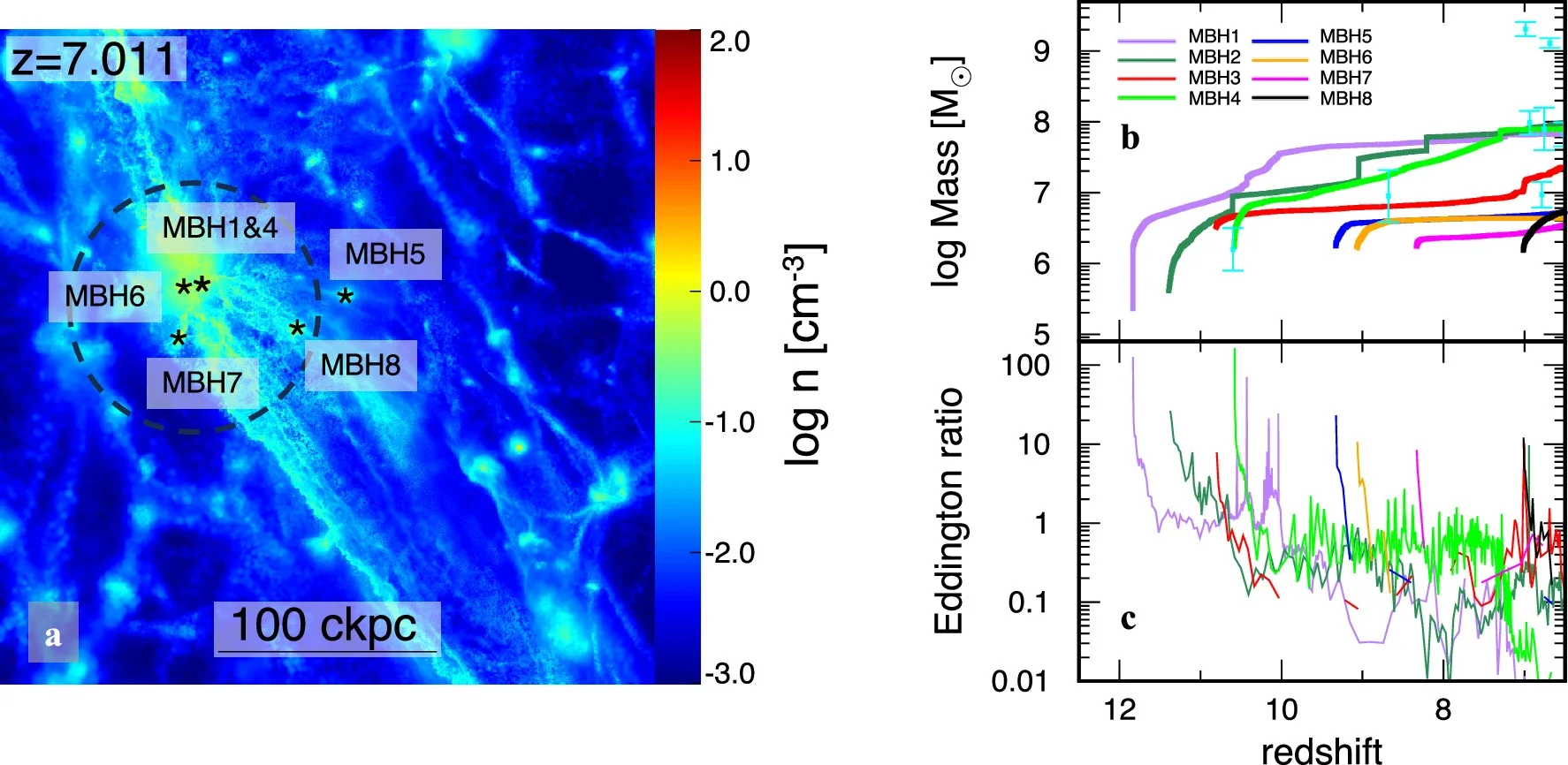
The simulations also produced a lower-limit abundance of massive black hole systems consistent with the number of Little Red Dots astronomers need to explain.
That does not establish that this pathway accounts for the entire observed population. The calculation follows selected environments favorable to massive seed formation, and several uncertainties remain in how gas flows operate across larger galactic scales.
The researchers also note that their simulations do not fully resolve the long-term gas supply needed to sustain continued Eddington-level growth toward billion-solar-mass quasars.
The emerging picture connects several stages that astronomers have often studied separately.
Intense ultraviolet radiation first prevents a primordial gas cloud from fragmenting normally. Supermassive stars then form, collapse into unusually heavy black hole seeds and become buried within dense reservoirs of gas.
For a relatively short period, those black holes consume material at rates rarely sustainable in the modern universe. Their thick surroundings produce red continua and unusual hydrogen signatures similar to those now appearing throughout JWST surveys.
The result offers a possible bridge between the birth of massive black hole seeds and the enormous quasars already present several hundred million years after the Big Bang.
Little Red Dots therefore may be more than another unexpected population revealed by Webb. They could provide astronomers with snapshots of supermassive black holes during one of the most rapid growth phases they ever experience.
These studies examine the observations and physical mechanisms behind Little Red Dots, massive black hole seeds and rapid growth in the early universe.
Little Red Dots: An Abundant Population of Faint Active Galactic Nuclei at z ∼ 5 Revealed by the EIGER and FRESCO JWST Surveys: JWST observations established Little Red Dots as an abundant population of compact, red sources with evidence for faint active galactic nuclei. (The Astrophysical Journal, 2024)
Little red dots as young supermassive black holes in dense ionized cocoons: High-quality JWST spectra support an interpretation in which many Little Red Dots contain young black holes surrounded by extremely dense ionized gas. (Nature, 2026)
A gas-enshrouded and gas-reddened black hole at cosmic dawn: JWST observations identified an early black hole enveloped in dense gas, providing an observational example of conditions that may support rapid accretion. (Nature, 2026)
Sustained super-Eddington accretion in high-redshift quasars: Cosmological simulations examine how black holes can experience extended periods of accretion above the Eddington limit and grow rapidly in the young universe. (Astronomy & Astrophysics, 2024)
The Assembly of the First Massive Black Holes: This review examines competing pathways for producing massive black hole seeds and growing them into the first quasars. (Annual Review of Astronomy and Astrophysics, 2020)
Research findings are available online in the journal Nature.
The original story “Supercomputer simulations may finally explain Webb’s mysterious Little Red Dots” is published in The Brighter Side of News.
Like these kind of feel good stories? Get The Brighter Side of News’ newsletter.
The post Supercomputer simulations may finally explain Webb’s mysterious Little Red Dots appeared first on The Brighter Side of News.


Leave a comment
You must be logged in to post a comment.