Radio bursts from a young giant planet have given astronomers something they have sought for decades: a signal that can be confidently traced to an exoplanet rather than its host star.
Using the MeerKAT radio telescope array in South Africa, researchers detected recurring, strongly polarized radio bursts from Beta Pictoris b. The planet circles a young star about 63.4 light-years from Earth and has roughly 12 times Jupiter’s mass.
The signal is not evidence of extraterrestrial technology. Its characteristics instead point to auroral activity generated by charged particles interacting with the planet’s powerful magnetic field.
The findings are led by researchers from the Center for Astrophysics | Harvard & Smithsonian and the University of Oregon. The work has been posted on arXiv and has not yet undergone peer review.
Planets throughout the Solar System produce radio emission from their magnetospheres. Earth, Jupiter, Saturn, Uranus and Neptune all generate auroral radio waves as energetic charged particles move through magnetic environments.
Astronomers have therefore spent years searching for comparable signals from planets orbiting other stars. The challenge has been determining exactly where a radio signal originates.
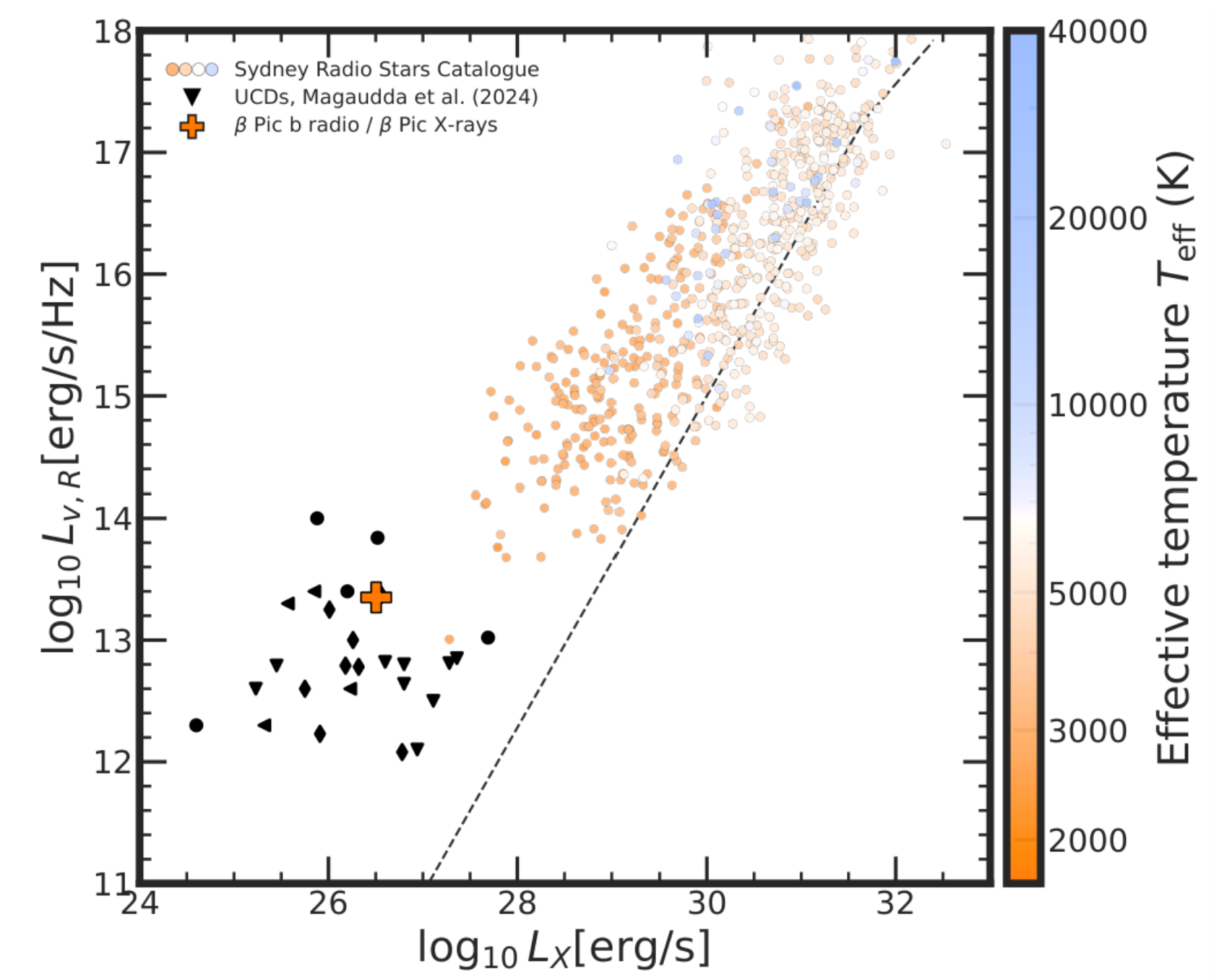
Radio emission has previously been detected from systems containing exoplanets, but stellar magnetic activity can produce similar signals. Researchers could not unambiguously separate emission from the planet and the star.
Beta Pictoris offered unusually favorable conditions. Its host is an A6V star that is relatively magnetically quiet, while Beta Pictoris b is a young, massive planet orbiting about 10 astronomical units from the star.
The planet is also far enough from its host to become spatially distinguishable under sufficiently precise observations.
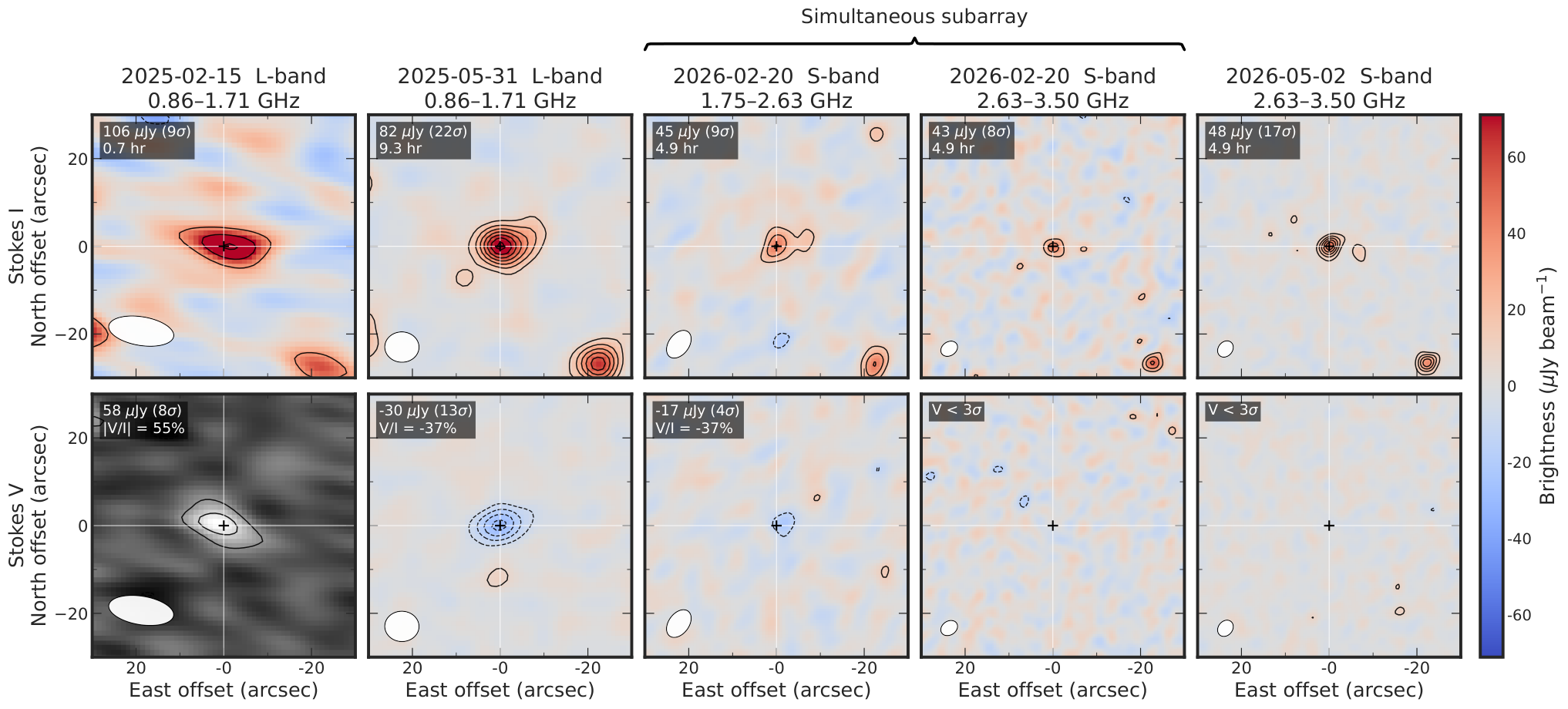
Researchers observed the system with MeerKAT four times during 2025 and 2026, covering frequencies from approximately 0.85 to 3.5 gigahertz.
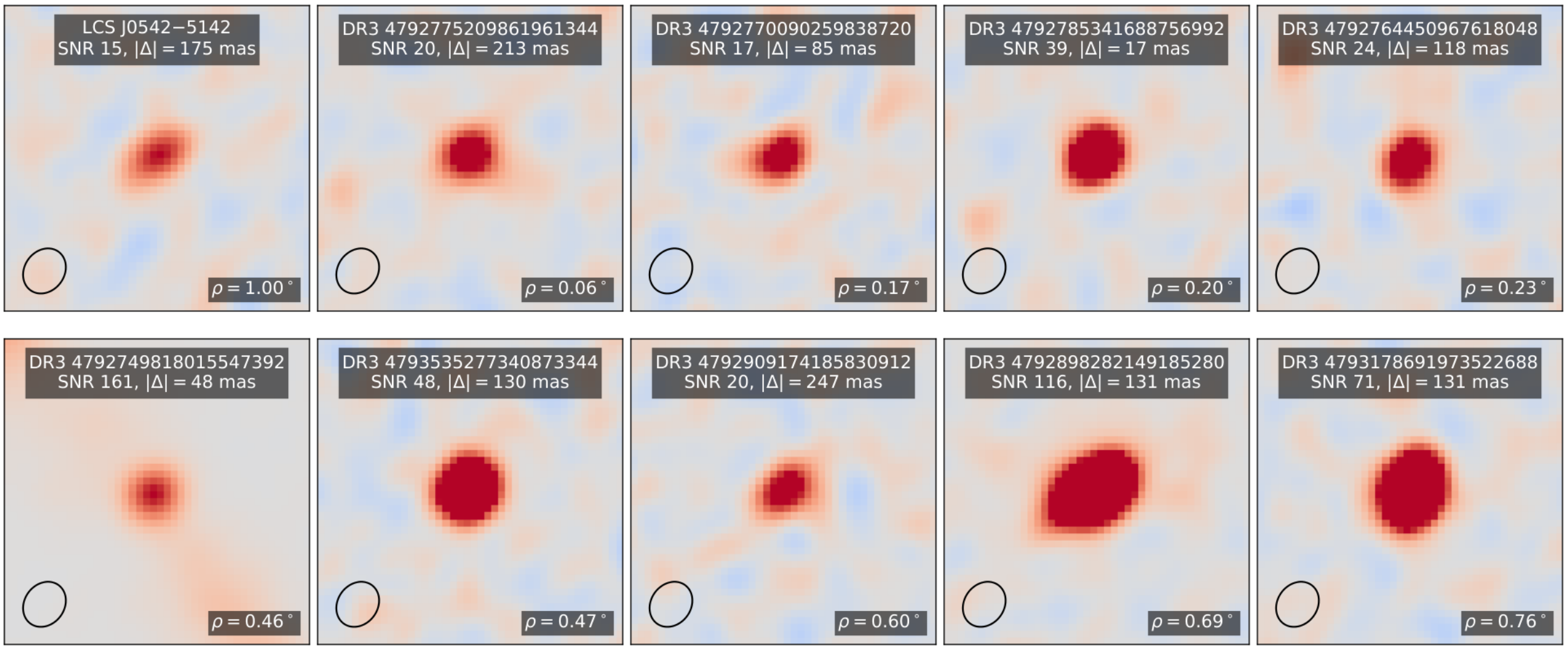
Detecting radio emission near Beta Pictoris was only the first step. The decisive task was proving that the signal actually came from planet b.
The team used distant quasars as extremely stable positional references. Nine quasars identified in the Gaia celestial reference system, together with a very-long-baseline interferometry calibrator, allowed researchers to precisely align the radio image with the known positions of the star and planets.
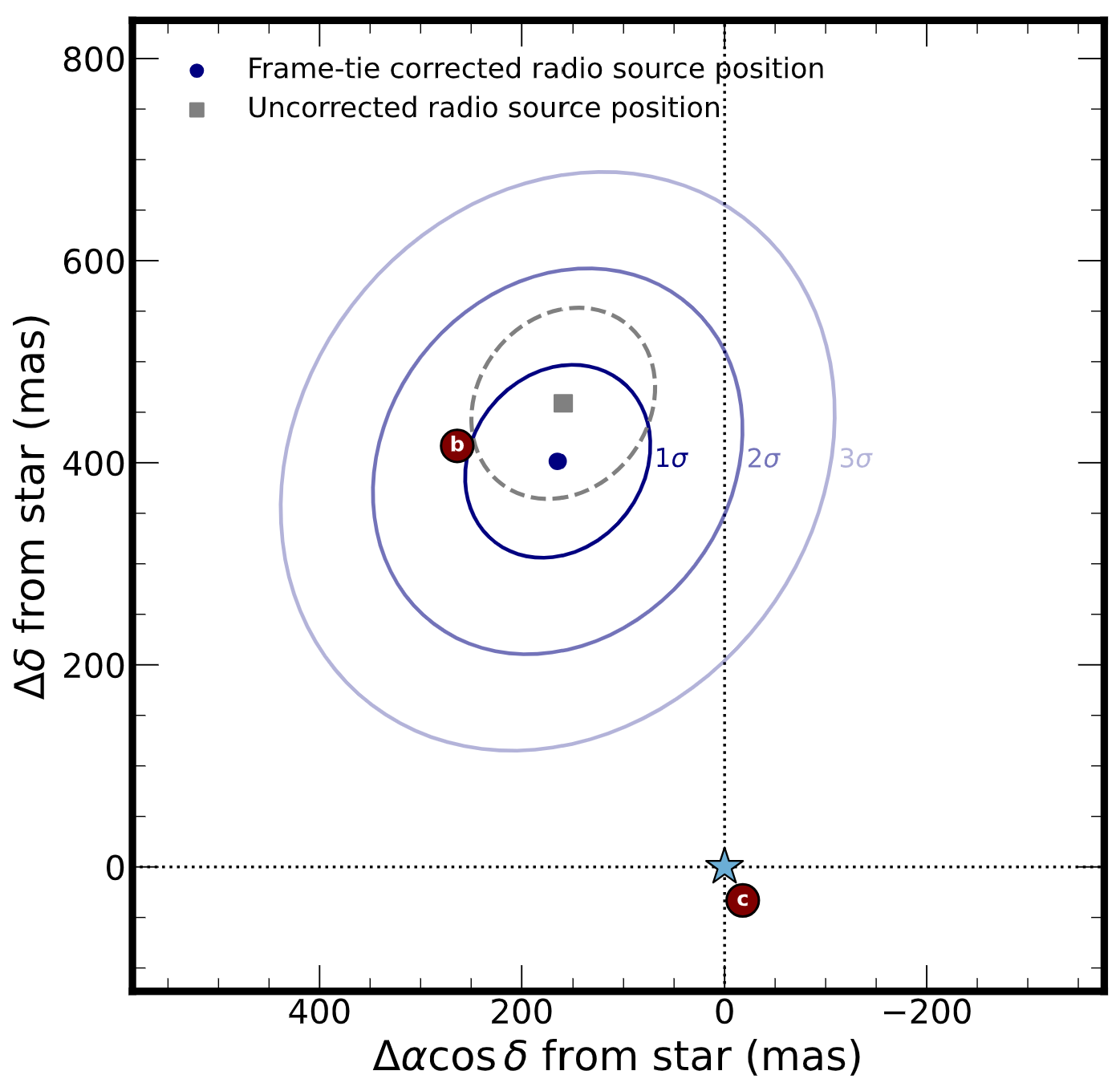
After accounting for measurement uncertainty and systematic effects, the radio source aligned with Beta Pictoris b.
Its location was inconsistent with the host star at 4.4-sigma significance and with Beta Pictoris c at 4.8 sigma. The position remained associated with planet b after researchers performed additional tests of ionospheric distortion and source-location accuracy.
The planet and star are sufficiently separated that the team could distinguish the two positions despite the enormous distance involved.
That localization is what makes the observation different from earlier candidate exoplanet radio detections.
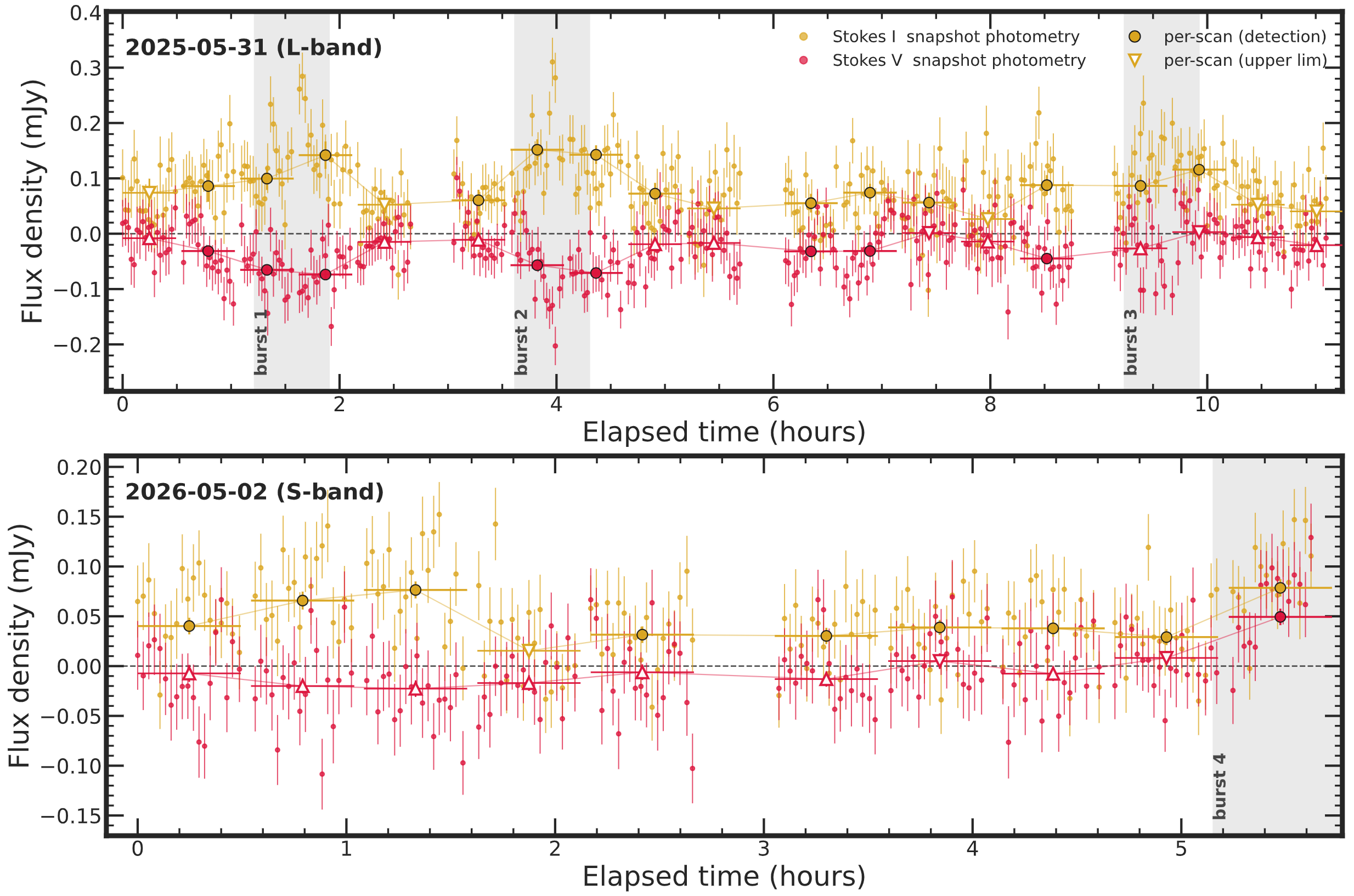
The detected emission contained both faint persistent radiation and rapid recurring bursts.
Those bursts showed circular polarization of roughly 40% to 70%. Circular polarization means the electric field of the radio wave rotates as the wave travels, producing a characteristic corkscrew-like pattern.
Strong circular polarization combined with rapid variability is a hallmark of electron cyclotron maser instability, or ECMI.
The same physical process generates powerful auroral radio emission from planets including Jupiter. Electrons moving through a magnetized plasma transfer energy into coherent radio waves at frequencies tied directly to local magnetic-field strength.
Alternative explanations appear less convincing. Producing the signal through plasma emission would require electron densities far above those expected inside planetary or brown-dwarf magnetospheres.
The researchers therefore identify ECMI as the most plausible source of the bursts.
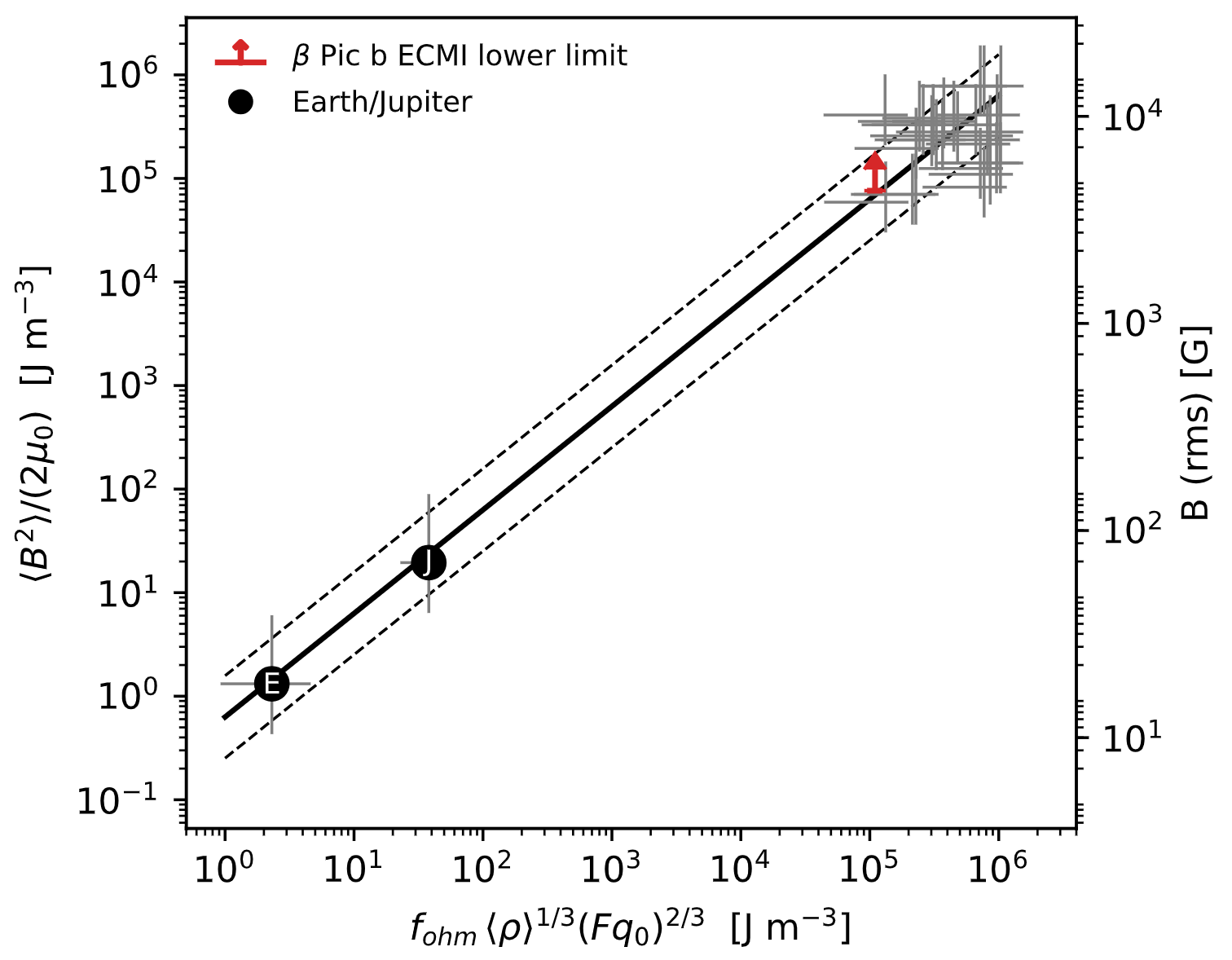
That interpretation allowed the team to do something even more significant: directly constrain an exoplanet’s magnetic field.
The frequency of ECMI radiation depends on the strength of the magnetic field where the emission originates. A field of approximately 1 kilogauss corresponds to an electron cyclotron frequency near 2.8 gigahertz.
MeerKAT detected emission extending to 3.5 gigahertz, the upper edge of the observing band. That requires a magnetic field of at least about 1.25 kilogauss at the emission site.
For comparison, Earth’s surface magnetic field is generally measured in fractions of a gauss. The inferred field around Beta Pictoris b is therefore thousands of times stronger.
The result is consistent with theoretical predictions for young, massive giant planets. Beta Pictoris b still radiates substantial heat from its interior, and vigorous convection combined with rapid rotation could drive a powerful magnetic dynamo.
Previous modeling predicted a mean surface field around the kilogauss range. The new radio measurement provides the first direct observational test of such predictions for a confirmed exoplanet.
Beta Pictoris b rotates remarkably quickly.
Spectroscopic observations indicate a rotation period of roughly eight to nine hours, while later measurements place it close to nine hours. Jupiter also rotates rapidly, completing a day in just under 10 hours.
The researchers propose that this rapid rotation may help drive the planet’s radio aurora through magnetosphere-ionosphere coupling.
In such a system, plasma inside the magnetosphere struggles to rotate at exactly the same speed as the planet at large distances. The resulting difference in motion generates electrical currents along magnetic-field lines, accelerating electrons toward the atmosphere and producing auroral emission.
One intriguing clue comes from the timing of the detected bursts. Two bursts were separated by roughly eight hours, close to the estimated rotation period.
The evidence is not yet sufficient to establish periodic modulation, but continued monitoring could reveal the geometry and tilt of the planet’s magnetic field.
The researchers also considered stellar-wind interactions and an Io-like interaction with a hypothetical moon. Their calculations suggest neither mechanism can easily supply enough energy to explain the observed radio power.
Magnetic fields are important for understanding planetary interiors and atmospheres. They reveal information about internal dynamos and can influence how strongly a planet interacts with stellar winds.
Until now, those fields could not be directly measured for confirmed exoplanets.
Radio astronomy could therefore open an entirely new window into planetary physics. Continued observations of Beta Pictoris b may reveal its magnetic geometry, rotation-linked variability and magnetospheric plasma environment.
The researchers identified seven other directly imaged giant planets in five nearby systems where similar positional techniques might work. Current telescopes may not be sensitive enough to detect them, but the team estimates that a five- to sevenfold improvement could bring those worlds within reach.
Next-generation radio observatories could provide that sensitivity.
For decades, astronomers have searched for radio voices from planets beyond the Solar System. Beta Pictoris b appears to have finally supplied one, not from technology, but from a vast natural aurora generated inside a magnetic field stronger than any directly measured around an exoplanet before.
These resources explore the search for planetary auroras, magnetic fields and radio emission beyond the Solar System.
A search for auroral radio emission from β Pictoris b: Earlier observations searched the same planet at lower radio frequencies but found no signal, placing limits on its possible auroral emission before the new MeerKAT detection. (Monthly Notices of the Royal Astronomical Society, 2024)
The Detectability of Radio Auroral Emission from Proxima b: This theoretical study examines how stellar winds interacting with an exoplanetary magnetic field could generate detectable auroral radio signals. (The Astrophysical Journal Letters, 2017)
Radio and Optical Aurorae in the Coolest Brown Dwarf: Observations of auroral radio emission from an ultracool dwarf helped establish that planetary-mass objects can generate powerful magnetically driven radio bursts. (The Astrophysical Journal, 2016)
The magnetic fields of extrasolar planets: This work develops dynamo-based predictions for the magnetic-field strengths of giant exoplanets and brown dwarfs. (Astronomy & Astrophysics, 2010)
Auroral Radio Emissions from Ultracool Dwarfs: A Review: This review summarizes the physics of electron cyclotron maser emission and its relevance to brown dwarfs and giant exoplanets. (Universe, 2022)
Research findings are available online in the journal arXiv.
The original story “South Africa’s MeerKAT array detects the first radio signal directly from an exoplanet” is published in The Brighter Side of News.
Like these kind of feel good stories? Get The Brighter Side of News’ newsletter.
The post South Africa’s MeerKAT array detects the first radio signal directly from an exoplanet appeared first on The Brighter Side of News.


Leave a comment
You must be logged in to post a comment.