For more than three decades, a tiny Scottish fossil helped scientists tell the story of vertebrates moving permanently onto land. New images hidden inside the rock have now transformed that story.
Westlothiana lizziae, nicknamed “Lizzie,” was once described as the earliest known reptile and later placed near the ancestry of amniotes. That enormous group eventually produced reptiles, birds and mammals, including humans.
Synchrotron X-ray scans have now exposed anatomy invisible when the crushed fossil was first studied. Instead of an early land-adapted amniote, researchers found an animal retaining functional gills, primitive skull structures and feeding adaptations associated with life in water.
The study, led by researchers at the American Museum of Natural History and University of Oxford, was published in Nature. It does more than reclassify one fossil. The findings change how scientists interpret several anatomical features used to reconstruct when vertebrates became fully terrestrial.
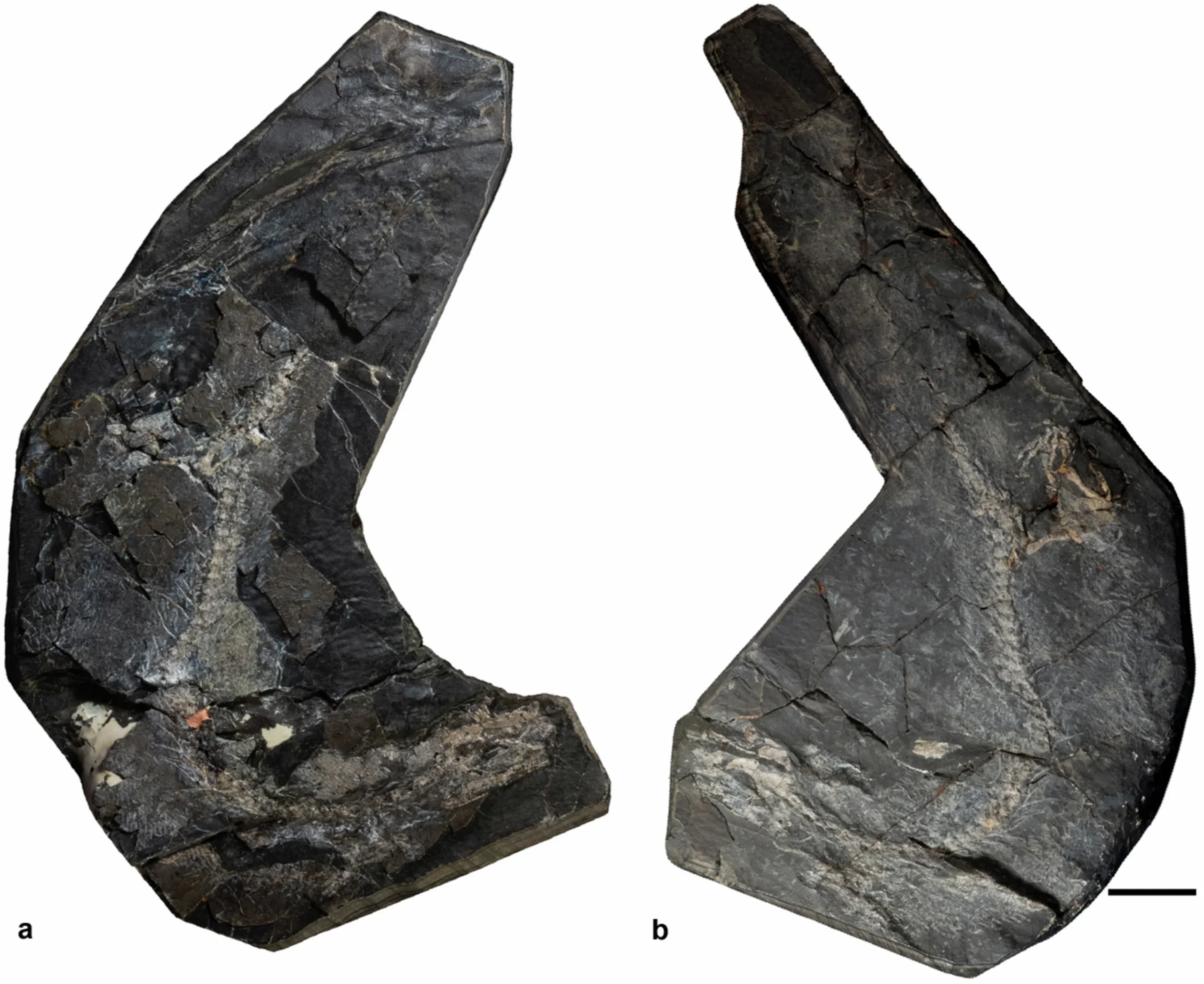
The fossil was discovered at East Kirkton in Scotland in 1984 and formally named in 1990. Its nearly complete skeleton appeared strikingly advanced for the Early Carboniferous.
Westlothiana had five toes on its feet, relatively sturdy limbs and curved terminal toe bones that resembled claws. Its body therefore seemed to combine ancient anatomy with features approaching those of the earliest amniotes.
There was a major problem. The animal had been crushed into two slabs, hiding much of its skull, palate, braincase and throat inside the surrounding rock. Earlier interpretations depended largely on anatomy visible at the exposed surfaces.
Researchers brought the specimen to the European Synchrotron Radiation Facility in Grenoble, France, where intense X-rays allowed them to reconstruct buried bones digitally. The resulting three-dimensional anatomy looked unexpectedly primitive.
“Lizzie has been an icon for the early evolution of amniotes for decades,” co-lead author Xavier Jenkins said. “But when we were finally able to see inside the fossil, we found an animal that looked very different from what we expected.”
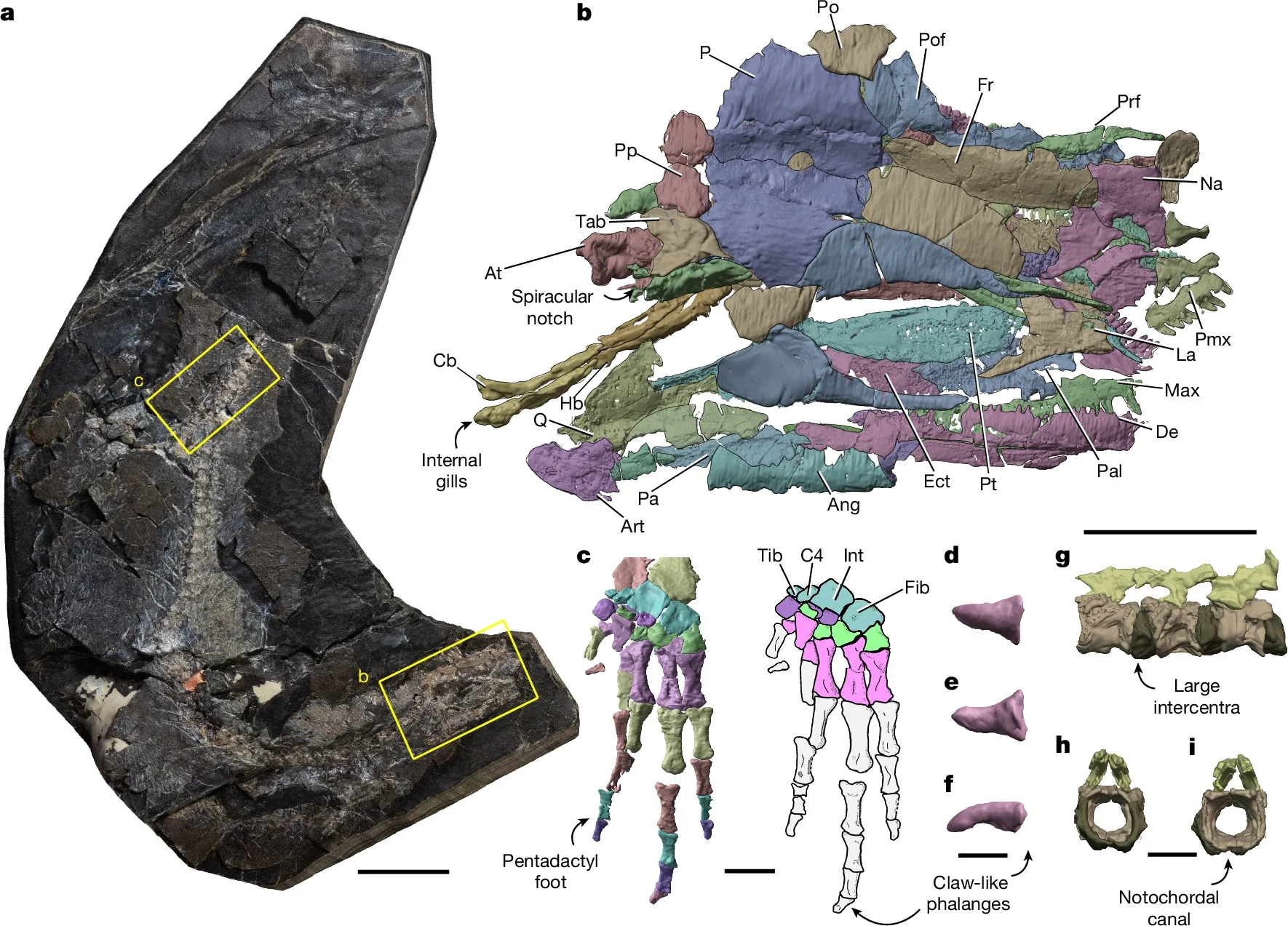
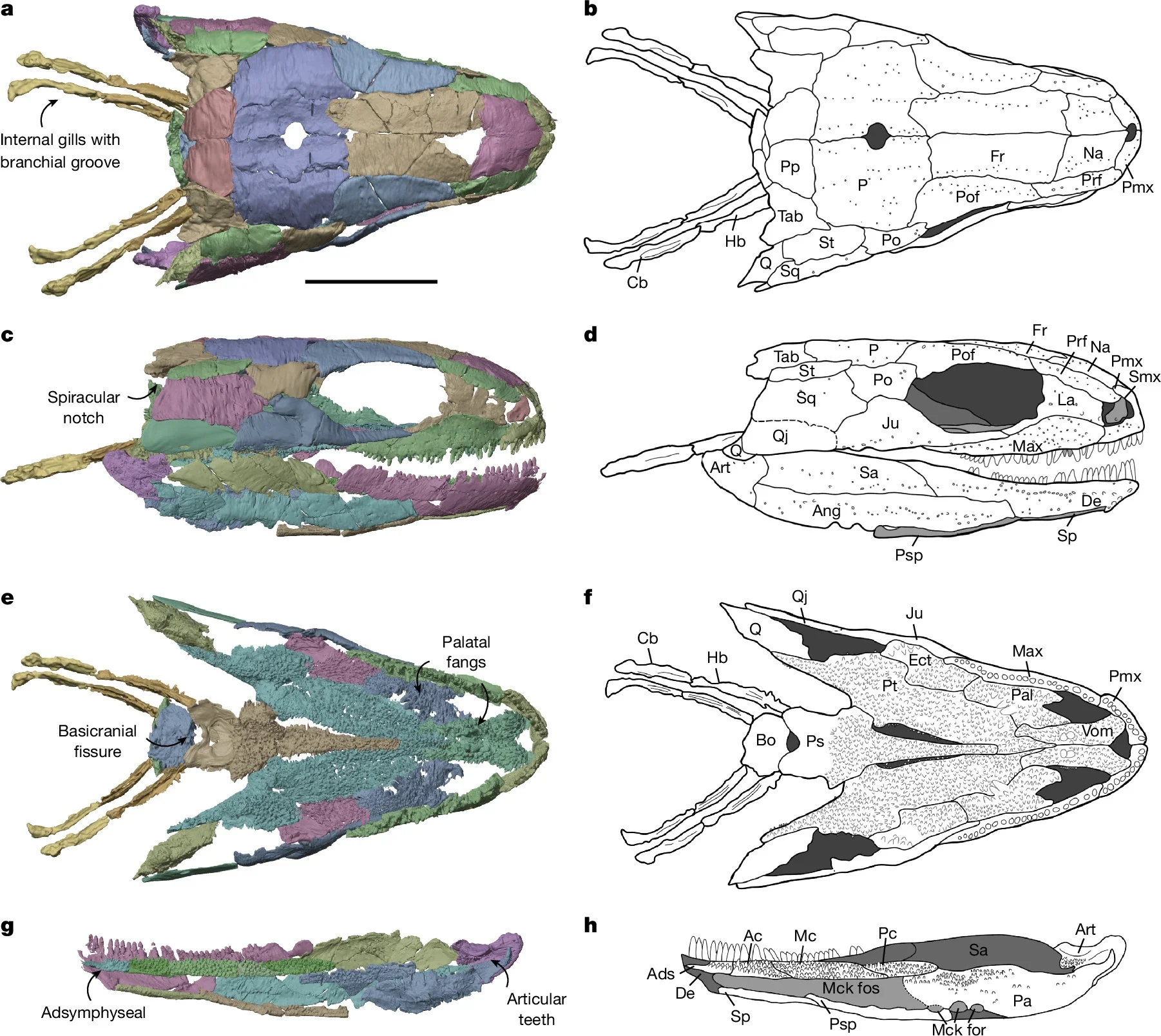
Among the strongest evidence were parts of an ossified branchial apparatus, structures associated with gills. Grooves along some of those bones probably carried blood vessels to functional internal gills.
Other features told the same story. The vertebrae retained wide channels for the notochord, a flexible supporting structure more characteristic of aquatic early tetrapods. The animal also had an elongated body, with forelimbs substantially smaller than its hindlimbs.
Its mouth was equally revealing. The palate and lower jaw contained extensive fields of tiny tooth-like structures, alongside larger fangs. The arrangement resembles feeding surfaces used by aquatic animals to grip small or slippery prey.
The combination led the researchers to interpret Westlothiana as primarily aquatic or amphibious rather than a fully terrestrial animal.
“It turns out looks can be deceiving, and Lizzie lived a completely different lifestyle than we previously thought,” co-lead author Ben Igielman said.
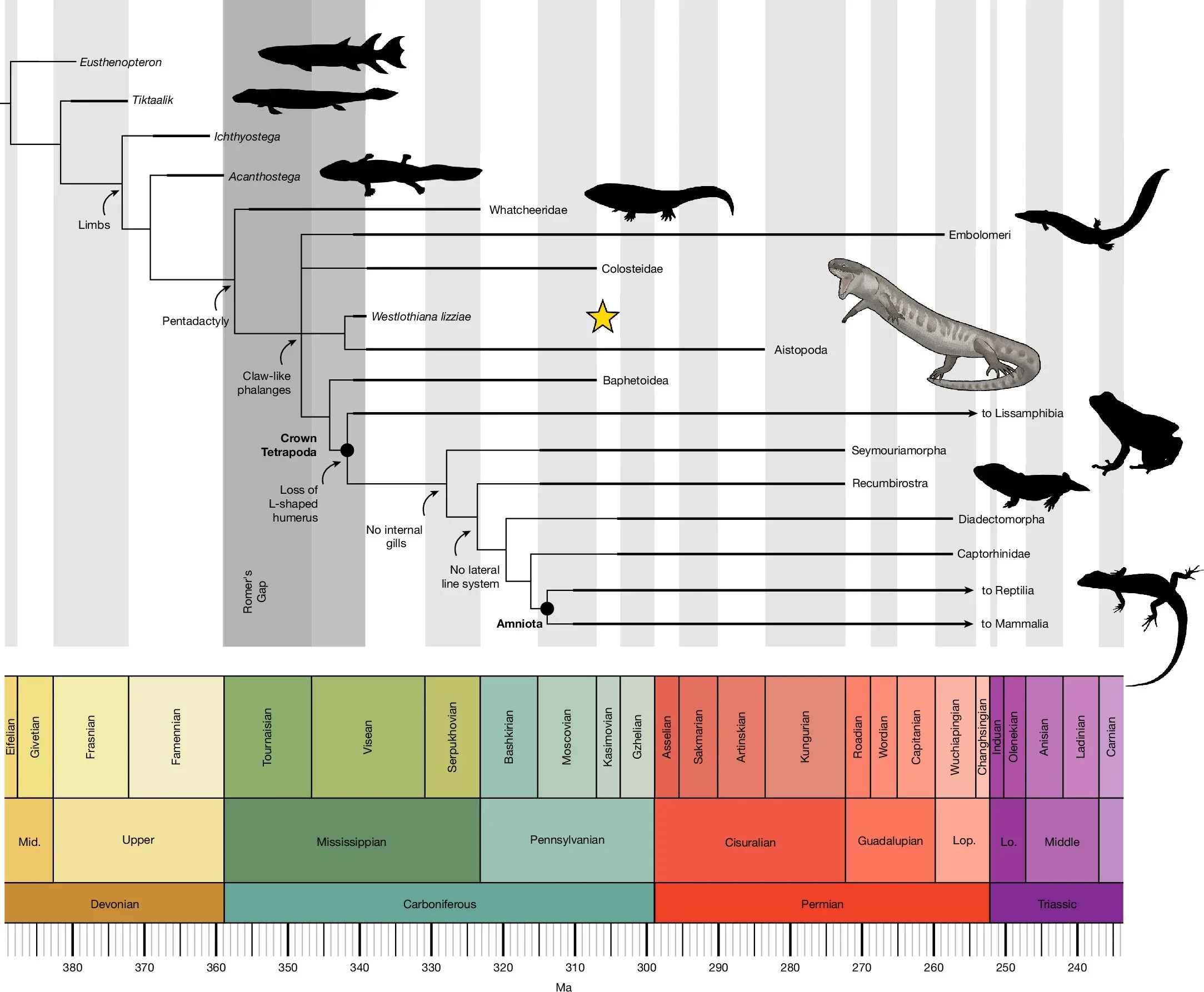
The team incorporated the newly revealed anatomy into several evolutionary analyses. All placed Westlothiana outside the group containing living amphibians and amniotes.
Their primary analysis positioned it as a relatively advanced stem tetrapod, close to Utaherpeton and the unusual limbless aistopods. It remained far removed from the amniote branch where researchers had frequently placed it.
Primitive characteristics hidden inside the skull proved especially important. These included a cranial notochordal canal, primitive palate architecture and several features of the braincase and lower jaw absent from definite amniotes.
“This is a big surprise,” study co-author Roger Benson said. Traits that once made Westlothiana appear reptile-like, he explained, apparently evolved before the common ancestor of modern amphibians and amniotes.
That produces a more complicated picture of the transition onto land. Vertebrates did not simply lose aquatic characteristics while progressively acquiring a standard package of terrestrial ones.
Some of Westlothiana‘s apparently advanced anatomy was real. Its limbs show features potentially useful for supporting weight, and its feet possessed five digits with curved terminal bones.
Those structures were not identical to the claws of modern amniotes. The terminal bones lacked features associated with a keratin sheath, but their shape may still have improved traction when the animal moved on land.
The important discovery is where those adaptations now sit on the evolutionary tree. They were present in an animal that retained functional gills and apparently spent substantial time in water.
“The broader lesson is that terrestrial-looking traits, such as a reptile-like foot, a weight-bearing forelimb, and claw-like phalanges were not unique features of tetrapods, but rather accumulated piecemeal in their close relatives,” Jenkins said.
The water-to-land transition therefore looks increasingly like a mosaic. Anatomical changes useful on land appeared while their owners were still strongly connected to aquatic habitats.
The discovery also enters a recent debate over when amniotes first evolved.
In 2025, researchers described Early Carboniferous tracks from Australia bearing what they interpreted as claw impressions. Because claws were considered characteristic of amniotes and their close relatives, the tracks were proposed as evidence that crown amniotes existed more than 350 million years ago.
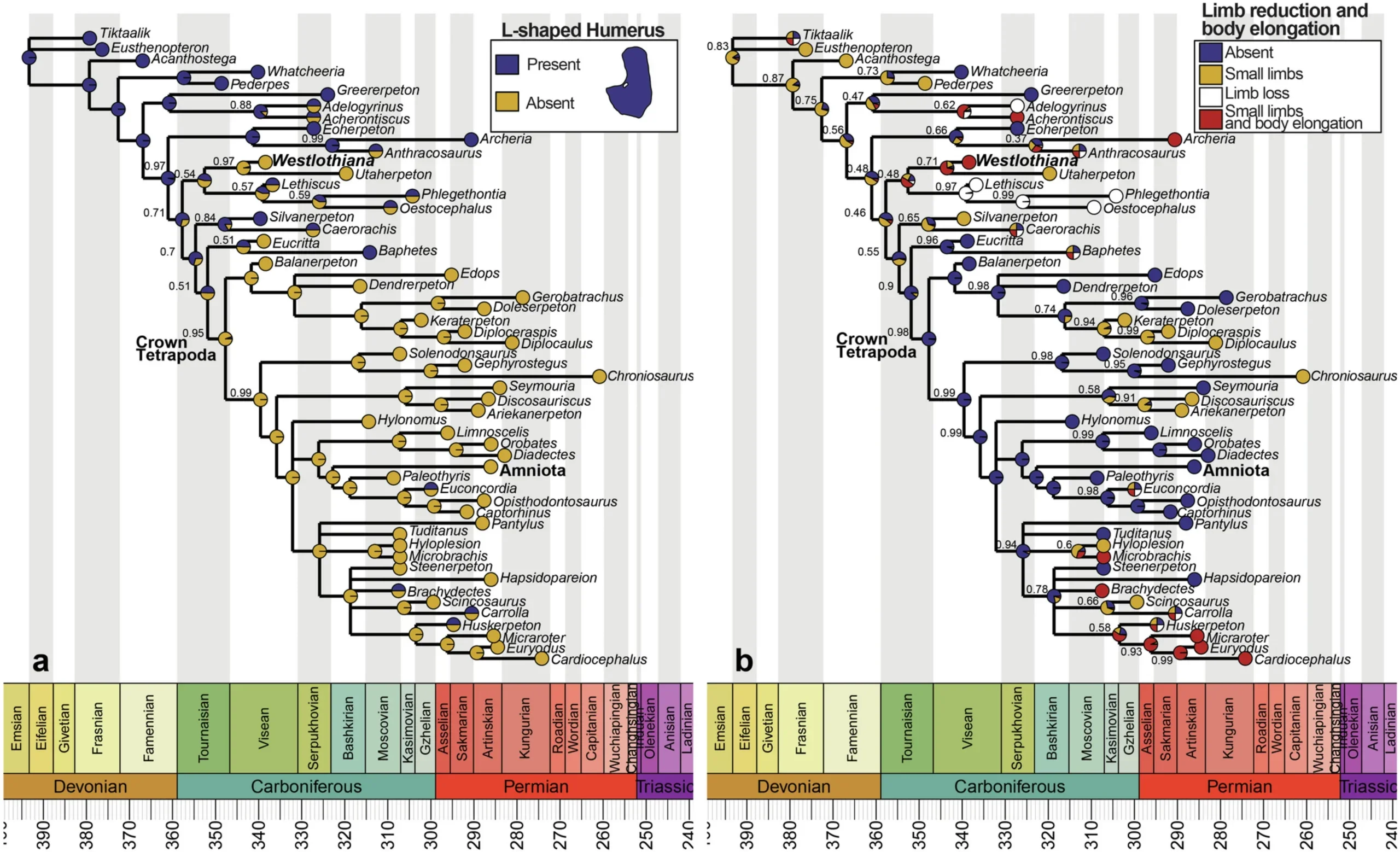
Westlothiana weakens that reasoning. Its curved claw-like toe bones occur well outside the tetrapod crown group, showing that such structures evolved earlier than previously recognized.
Clawed tracks alone therefore cannot establish that an amniote made them. More primitive tetrapods could potentially have produced similar impressions.
The new authors argue that body fossils currently provide no secure evidence for crown amniotes before the Late Carboniferous. That would place their confirmed appearance tens of millions of years later than the interpretation based on the Australian tracks.
Modern scanning is increasingly rewriting the evolutionary identities of fossils collected decades ago. Small Carboniferous specimens are particularly difficult because their delicate skeletons are frequently flattened and partly hidden inside rock.
The new study examined only the holotype of Westlothiana. Preliminary observations suggest another fossil previously assigned to the species may actually represent a different animal, adding yet another unresolved question.
The result also makes East Kirkton more important for understanding the poorly sampled period following the first limbed vertebrates. Recent radiometric work places parts of its remarkable fauna near a critical interval in the early diversification of tetrapods.
For decades, Lizzie seemed important because it appeared unusually close to reptiles. Its new position may make it even more revealing.
The fossil now captures an evolutionary stage when animals could retain gills and aquatic feeding adaptations while already carrying feet and limbs that foreshadowed a future increasingly spent on land.
These studies provide additional context on the dating, anatomy and evolutionary relationships of early tetrapods during the period surrounding Westlothiana.
Earliest amniote tracks recalibrate the timeline of tetrapod evolution: Australian tracks with apparent claw impressions were interpreted as evidence for unexpectedly early amniotes, an interpretation directly challenged by the new Westlothiana anatomy. (Nature, 2025)
New U-Pb constraints and geochemistry of the East Kirkton Quarry, Scotland: Implications for early tetrapod evolution in the Carboniferous: Zircon dating refined the age of East Kirkton and placed its remarkable tetrapod fauna within a particularly important interval of early Carboniferous evolution. (PLOS ONE, 2025)
Carboniferous recumbirostran elucidates the origins of terrestrial herbivory: High-resolution scans of another early tetrapod illuminate how terrestrial adaptations and ecological specialization evolved among groups whose relationships remain actively debated. (Nature Ecology & Evolution, 2026)
A Mississippian (early Carboniferous) tetrapod showing early diversification of the hindlimbs: A fossil from East Kirkton revealed that diverse foot and hindlimb anatomies had already emerged early in the Carboniferous transition toward terrestrial life. (Communications Biology, 2022)
Hidden morphological diversity among early tetrapods: CT reconstruction of the ancient aistopod Lethiscus moved it down the tetrapod family tree, foreshadowing how hidden anatomy can overturn long-standing classifications. (Nature, 2017)
Research findings are available online in the journal Nature.
The original story “Scotland’s famous ‘Lizzie’ fossil was not the early reptile scientists thought” is published in The Brighter Side of News.
Like these kind of feel good stories? Get The Brighter Side of News’ newsletter.
The post Scotland’s famous ‘Lizzie’ fossil was not the early reptile scientists thought appeared first on The Brighter Side of News.


Leave a comment
You must be logged in to post a comment.