Mitochondria have spent billions of years solving one of biology’s hardest problems: turning energy stored in food into a form cells can readily use. A provocative new preprint proposes that part of their remarkable performance might involve a quantum interaction hidden inside their folded membranes.
Researchers detected an unusual infrared signal at 71 terahertz in living human cells, several mouse tissues and isolated mitochondria. The signal disappeared after biological samples were dried and ground, suggesting that it depended on organized mitochondrial structure rather than a single isolated molecule.
The team then developed a model in which infrared light couples with collective molecular vibrations inside mitochondrial membranes, producing a hybrid light-matter state called a polariton. When cultured cells were exposed to selected infrared frequencies, ATP production increased by about 10%.
The study, “A quantum state of mitochondria in the living cell,” was posted on bioRxiv on Sept. 15, 2026. It has not been peer-reviewed, and the proposed quantum mechanism remains an interpretation of the measurements rather than a directly observed mitochondrial quantum state.
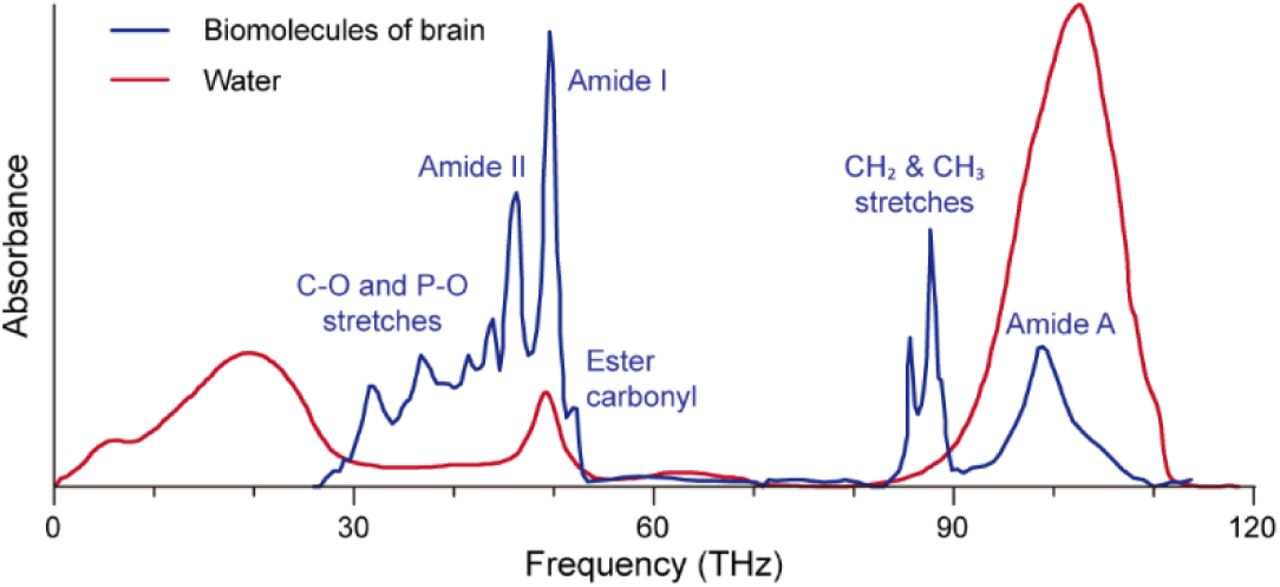
The researchers, led by Bo Song from the School of Optical-Electrical and Computer Engineering at the University of Shanghai for Science and Technology, used Fourier-transform infrared spectroscopy to examine HEK-293T human cells and tissues from mouse kidneys, livers, hearts and skeletal muscles. The technique measures how biological material absorbs different frequencies of infrared light, allowing scientists to identify characteristic molecular vibrations.
Several expected signals appeared. Vibrations around 50 terahertz were associated with proteins, while a strong region near 87 terahertz corresponded largely to carbon-hydrogen bonds in lipids and other molecules.
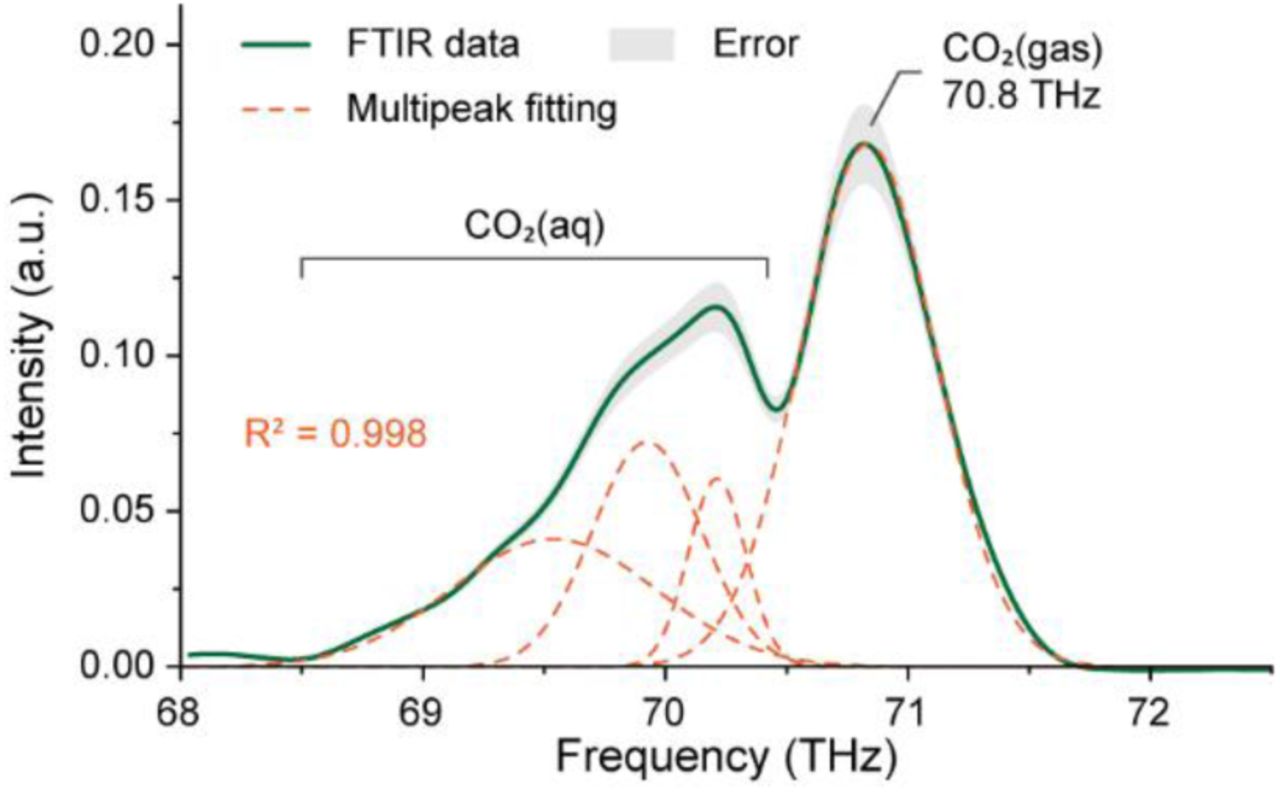
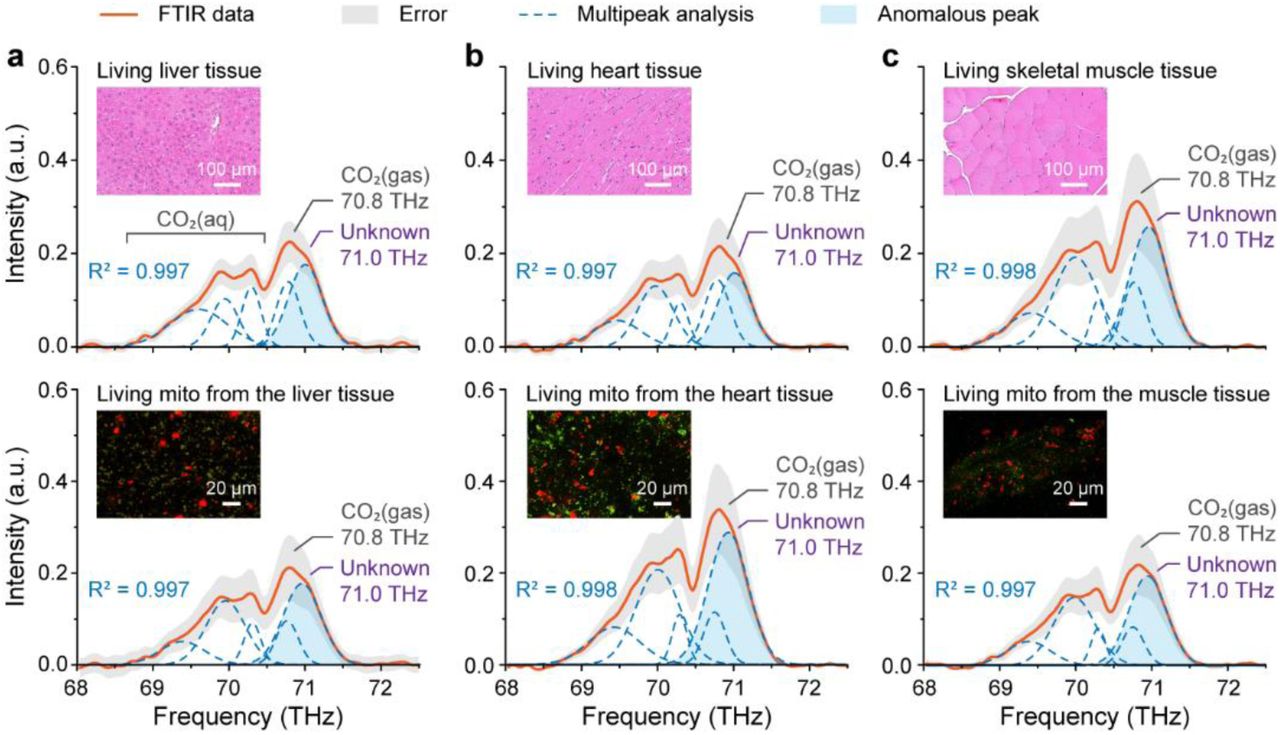
The researchers also detected peaks between 68 and 72 terahertz. Most could be attributed to dissolved or gaseous carbon dioxide, but a shoulder at approximately 71.0 terahertz remained unexplained.
That feature appeared in living cells and tissues as well as mitochondria isolated from them. It disappeared after samples were structurally disrupted, leading the researchers to associate it with intact mitochondrial organization rather than the vibration of a known individual molecule.
The same unexplained feature appeared across kidney, liver, heart and skeletal-muscle samples, suggesting that it was not unique to one tissue type.
The team focused on cristae, the elaborate folds of the inner mitochondrial membrane where the respiratory chain and ATP synthase carry out oxidative phosphorylation.
Cristae contain densely packed phospholipids whose hydrocarbon tails contain many CH2 groups. Those bonds have a characteristic stretching vibration close to 87 terahertz.
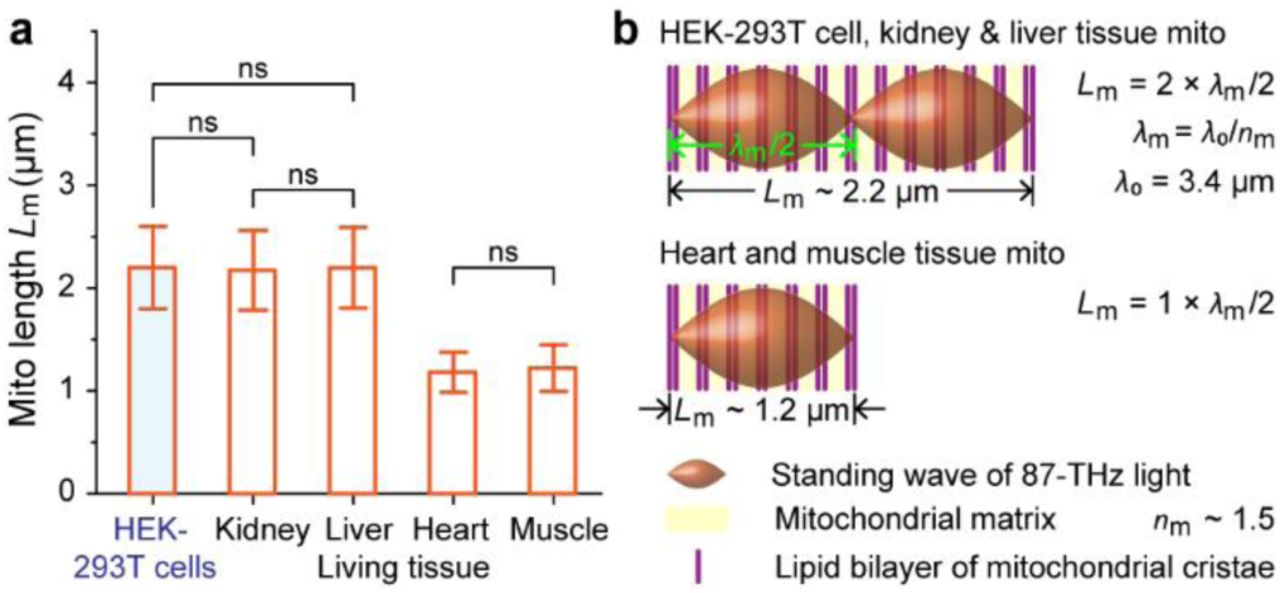
Measurements of active mitochondria in HEK-293T cells produced an average length of about 2.2 micrometers. The researchers calculated that 87-terahertz infrared light traveling through material with the approximate refractive index of mitochondrial membranes would have a wavelength near 2.3 micrometers.
That numerical similarity became central to their proposal. They suggest that an intact mitochondrion could behave somewhat like a microscopic optical cavity, allowing an infrared standing wave to interact collectively with the densely arranged CH2 vibrations in its cristae.
Similar dimensional relationships were reported for mitochondria from mouse tissues. Heart and skeletal-muscle mitochondria averaged about 1.2 micrometers, close to half the calculated wavelength, which also satisfies a standing-wave condition in the model.
Strong coupling between light and matter can create polaritons, quantum states that share properties of both photons and material excitations. Such states are well established in engineered optical systems, although demonstrating them inside functioning biological organelles would be considerably more unusual.
The researchers propose what they call a “mito-polariton.” In their model, an 87-terahertz electromagnetic mode couples collectively with CH2 vibrations distributed through ordered mitochondrial cristae.
That coupling splits the original vibrational energy into two predicted branches. The lower branch occurs near 71 terahertz, while the upper branch lies near 103 terahertz.
The 71-terahertz prediction matches the unexplained spectral feature. The 103-terahertz branch would fall among strong vibrations from water and proteins, making it difficult to distinguish experimentally.
This correspondence is intriguing but does not establish that the proposed polariton exists. The researchers inferred the state from a mathematical model designed to explain the spectral feature rather than directly measuring hallmark quantum properties such as coherent state dynamics or the full predicted energy splitting.
The team next asked whether stimulating the proposed system could affect mitochondrial energy output.
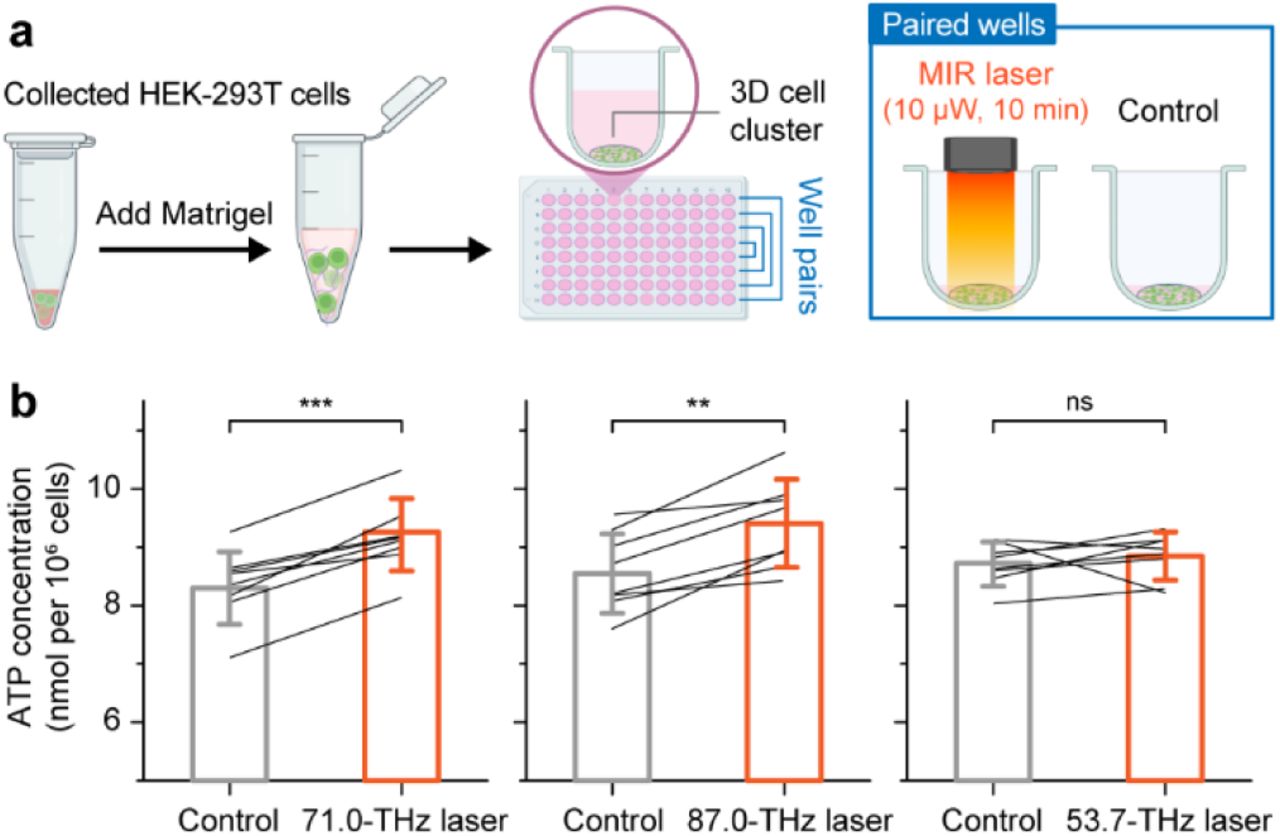
Living HEK-293T cells received weak mid-infrared illumination for 10 minutes at a power density of 10 microwatts per square millimeter. Each experimental condition included eight samples.
Exposure at 71 terahertz increased measured ATP production by 10.3% compared with cells that received no infrared stimulation. Illumination at 87 terahertz produced a similar increase of 10.1%.
A third frequency, 53.7 terahertz, served as a control and produced no statistically significant change. The frequency dependence argues against a completely nonspecific response to infrared exposure, although it does not by itself establish the mechanism responsible for the ATP increase.
The authors interpret the 71-terahertz response as resonant stimulation of the proposed mito-polariton and the 87-terahertz result as direct excitation of the CH2 vibration from which that state would arise.
The larger claim requires an important distinction. Quantum mechanics is already essential to molecular biology because electrons, chemical bonds and molecular energy levels are quantum mechanical.
Electron transfer through mitochondrial respiratory proteins, for example, can involve quantum tunneling. That is different from demonstrating a larger-scale coherent quantum state that performs a biological function.
The new preprint proposes the latter: a collective state formed by light and molecular vibrations that may influence cellular metabolism. That would place the finding closer to research on quantum coherence and polaritons in photosynthetic systems than to ordinary molecular quantum chemistry.
It would also require unusually strong evidence because biological cells are warm, wet and noisy environments where coherent quantum states can lose their defining properties rapidly.
Several limitations make the findings preliminary. The ATP experiment used one cultured human cell line, and only eight samples were included in each condition. The work does not show that the same stimulation changes energy metabolism in intact animals or human tissues.
Heating and other non-quantum infrared effects also require deeper investigation, even though the light intensity was low and the control frequency did not increase ATP. More importantly, the researchers have not yet measured the energy-transfer dynamics that would directly connect 87-terahertz excitation, the proposed polariton and ATP production.
Independent replication will be crucial. Future experiments could search directly for both predicted polariton branches, measure their coherence and lifetimes, manipulate mitochondrial structure while tracking the signal, and determine whether disrupting the proposed coupling eliminates the metabolic response.
For now, the work presents an unusual spectral observation accompanied by a quantum model that fits it and a frequency-specific metabolic effect. Whether those pieces truly reveal quantum machinery inside the cell’s power stations remains an open question.
These resources provide context on mitochondrial bioenergetics, quantum effects in biology and the light-matter physics underlying the new hypothesis.
The assembly, regulation and function of the mitochondrial respiratory chain: This review explains how respiratory-chain complexes generate the proton gradient that ultimately drives ATP production in mitochondria. (Nature Reviews Molecular Cell Biology, 2022)
Molecular machineries shaping the mitochondrial inner membrane: Researchers review how cristae architecture, ATP synthase and membrane-organizing proteins shape mitochondrial energy production. (Nature Reviews Molecular Cell Biology, 2025)
Quantum electron tunneling in respiratory complex I: Computational work examines quantum tunneling pathways between iron-sulfur clusters involved in mitochondrial electron transport. (The Journal of Physical Chemistry B, 2011)
Quantum biology: This review assesses evidence for biologically relevant quantum effects including coherence, tunneling and magnetoreception while discussing major uncertainties. (Nature Physics, 2013)
Quantum design of photosynthesis for bio-inspired solar-energy conversion: This review examines how quantum mechanical effects contribute to energy transfer and charge separation in photosynthetic systems. (Nature, 2017)
Research findings are available online in the journal bioRxiv.
The original story “Scientists propose a light-matter quantum state inside living cells” is published in The Brighter Side of News.
Like these kind of feel good stories? Get The Brighter Side of News’ newsletter.
The post Scientists propose a light-matter quantum state inside living cells appeared first on The Brighter Side of News.


Leave a comment
You must be logged in to post a comment.