Molten rock may carry an oxygen reserve that standard chemical calculations overlook. High-pressure experiments show that basaltic melts exposed to oxygen-rich conditions can retain substantial extra oxygen, potentially adding a missing component to models of Earth’s interior.
The study in National Science Review combines laboratory measurements with atomic-scale simulations. Yanhao Lin and Ho-Kwang Mao of the Center for High Pressure Science and Technology Advanced Research, known as HPSTAR, led the work with collaborators. The team included Haiyang Niu of Northwestern Polytechnical University and Wim van Westrenen of Vrije Universiteit Amsterdam, with Yongjiang Xu as first author.
The results raise a larger possibility: some rising magmas could transfer oxidizing power from deep reservoirs toward the surface. Establishing that capacity, however, is different from demonstrating how much oxygen natural magmas actually carry or release.
Oxygen makes up more than half the atoms in Earth’s silicate interior. It binds with elements such as silicon, magnesium and iron to form the materials dominating the mantle and crust. Yet geoscientists commonly calculate oxygen abundance from those other elements rather than measuring it directly.
That calculation relies on assumed proportions and oxidation states. Silicon, for example, usually contributes a predictable amount to the oxygen budget of a silicate. Iron complicates the calculation because its oxidation state can vary, changing how much oxygen conventional accounting assigns to it.
The team asked whether molten silicates could hold oxygen beyond those expected proportions. Water and carbon dioxide already feature in models as components that dissolve in magma and escape during ascent. Oxygen has generally lacked that independent role because scientists assumed the other elements fixed its abundance.
“Excess oxygen” describes a difference from that accounting framework, rather than oxygen appearing from nowhere. The experiments supplied oxygen from an external source. The question was whether the melt could accommodate it through bonding arrangements that conventional composition calculations would miss.
The researchers prepared a synthetic composition resembling mid-ocean ridge basalt and heated it between 1,200 and 1,800 degrees Celsius. Experiments ranged from ordinary atmospheric pressure to seven gigapascals. Piston-cylinder and cubic presses supplied the high-pressure conditions, while platinum dioxide provided an oxygen source.
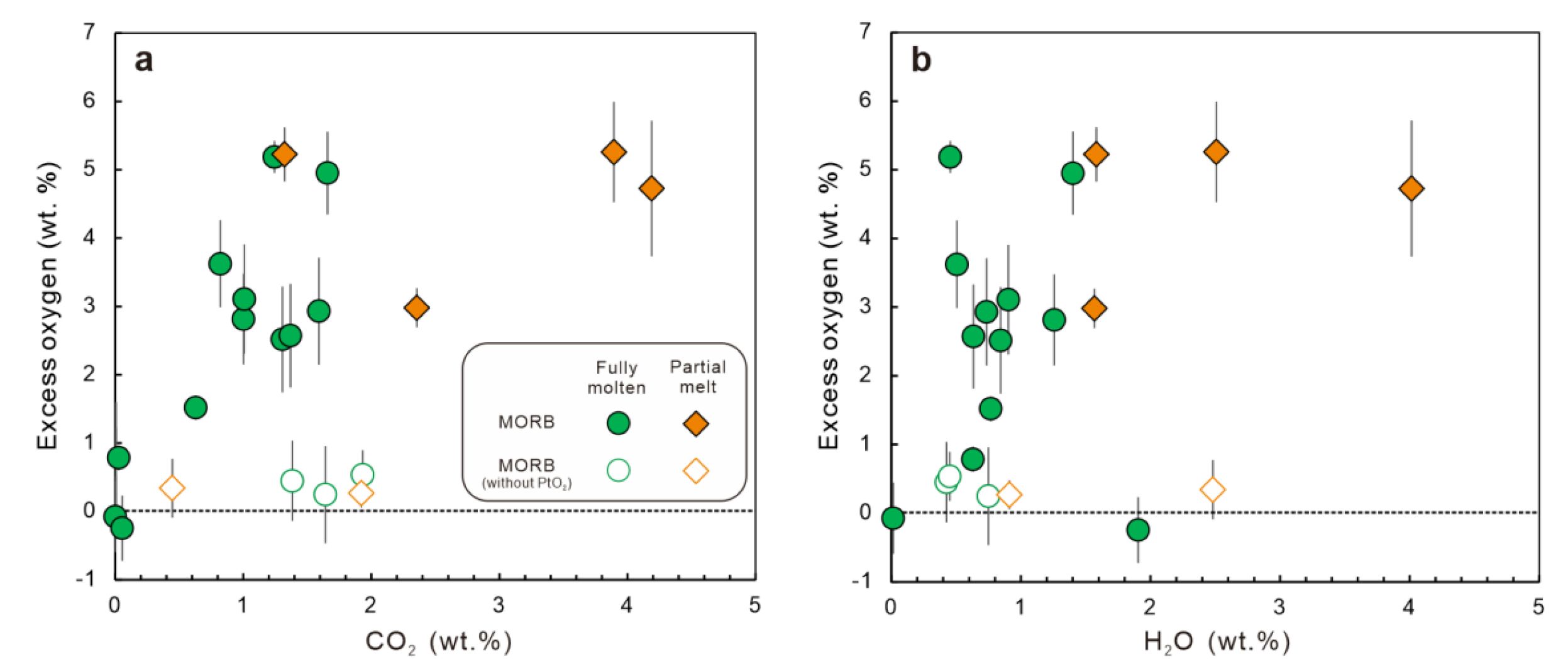
After cooling the samples into glass, the team measured their chemical composition using electron-probe analysis and secondary ion mass spectrometry. Measurements included hydrogen and carbon, allowing researchers to account for oxygen associated with water and carbon dioxide. They then calculated how much oxygen remained beyond conventional requirements.
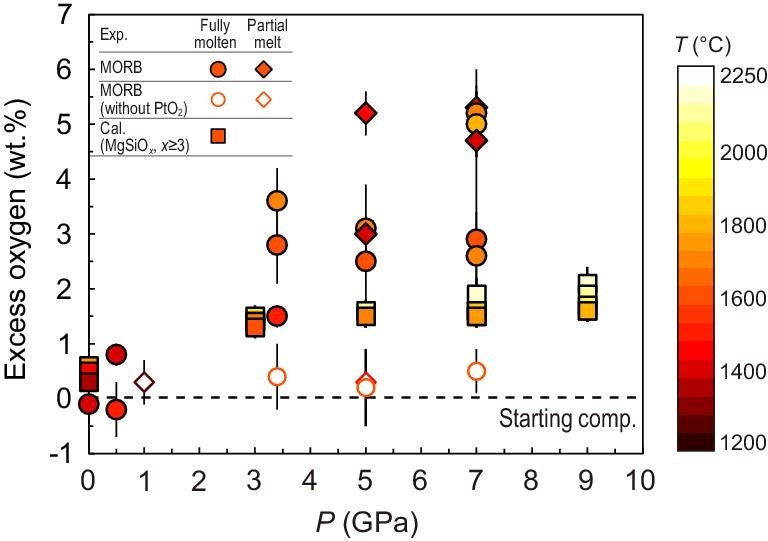
For this calculation, the researchers conservatively treated all iron as ferric iron, which assigns it more oxygen than ferrous iron would require. Even under that assumption, fully molten experimental samples retained progressively more excess oxygen with increasing pressure. The amount rose from approximately zero at atmospheric pressure to 5.2%, plus or minus 0.2%, by weight at seven gigapascals.
Control experiments without added platinum dioxide produced much lower values, approximately 0.2% to 0.5%. Those controls strengthened the case that the oxygen-rich environment supplied the additional oxygen. The comparison also shows why the highest result should not be treated as a measurement of ordinary mantle magma.
The researchers used Raman spectroscopy to look for molecular oxygen in the recovered glass. They found no oxygen-gas signature, supporting incorporation within the glass structure rather than storage as trapped oxygen bubbles. The measurement did not determine every bonding arrangement responsible for that storage.
Niu’s simulation work offered a closer view. The calculations used neural-network interatomic potentials trained to reproduce quantum-mechanical calculations, allowing the team to model oxygen interacting with molten magnesium silicate. Oxygen moved from a separate reservoir into the melt until the modeled system reached equilibrium.
The simulated excess increased from about 0.33% at atmospheric pressure to 2.12% at nine gigapascals. Those values were lower than the laboratory results, but the simplified magnesium-silicon-oxygen composition differed from experimental basalt. Both approaches nevertheless showed the same broad pressure-dependent trend.
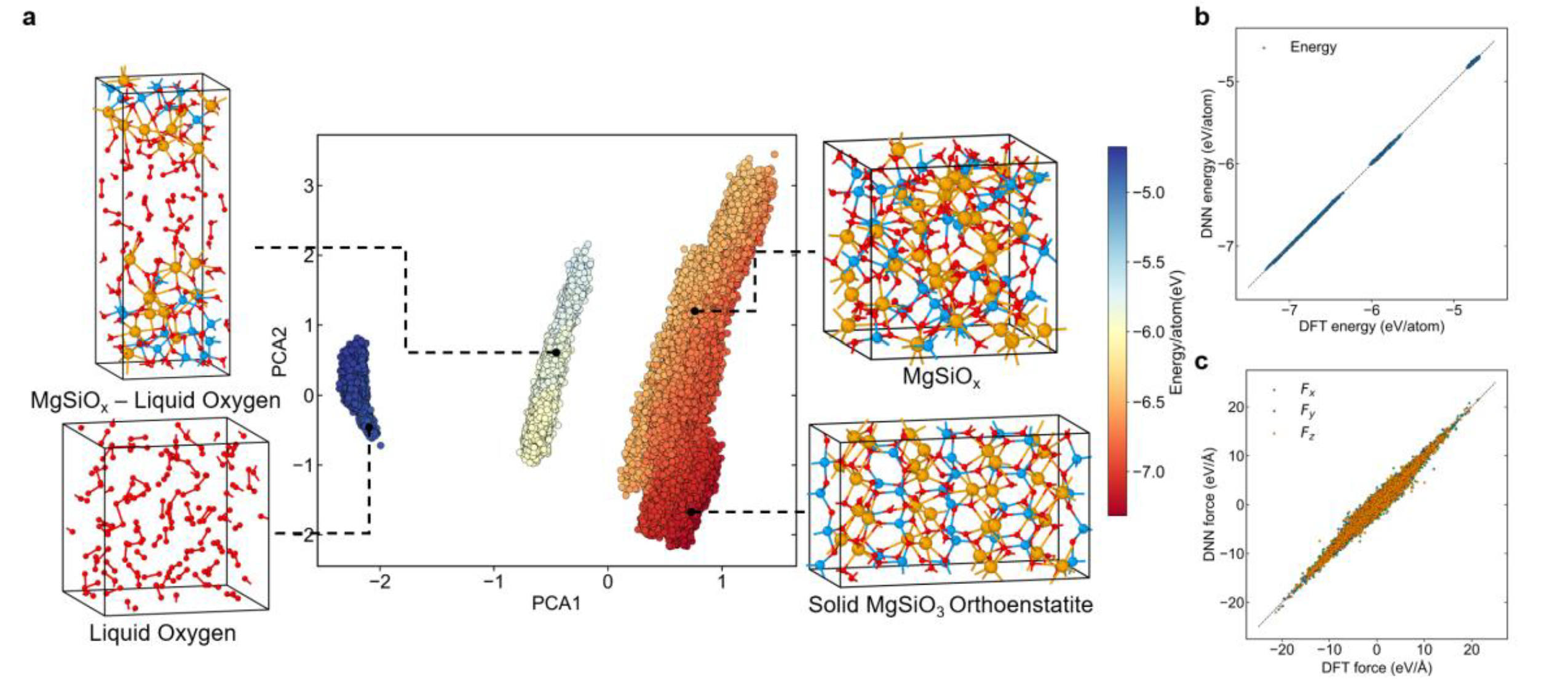
The simulations also revealed a wider distribution of effective oxygen charges as more oxygen entered the liquid. A small fraction formed short oxygen-oxygen bonds resembling peroxide species. These results suggest that oxygen can occupy more varied electronic environments than the conventional picture of uniformly charged oxide ions implies.
The experimental setup deliberately imposed highly oxidizing conditions. The authors describe it as an end-member case designed to test storage capacity, rather than a reproduction of the average mantle. They explicitly avoid claiming that all mantle-derived magmas contain substantial excess oxygen.
Even the reported capacity may underestimate what the melts held during the experiments. Some oxygen could have escaped while the samples cooled into glass. Measurements made directly at high temperature and pressure will be needed to determine how much the cooling process changed the results.
The experiments also did not establish a universal saturation limit. Some partially molten samples showed higher excess concentrations than fully molten samples, suggesting further effects from temperature or experimental conditions. The 5.2% result therefore describes one measured outcome, rather than the maximum oxygen content of every silicate melt.
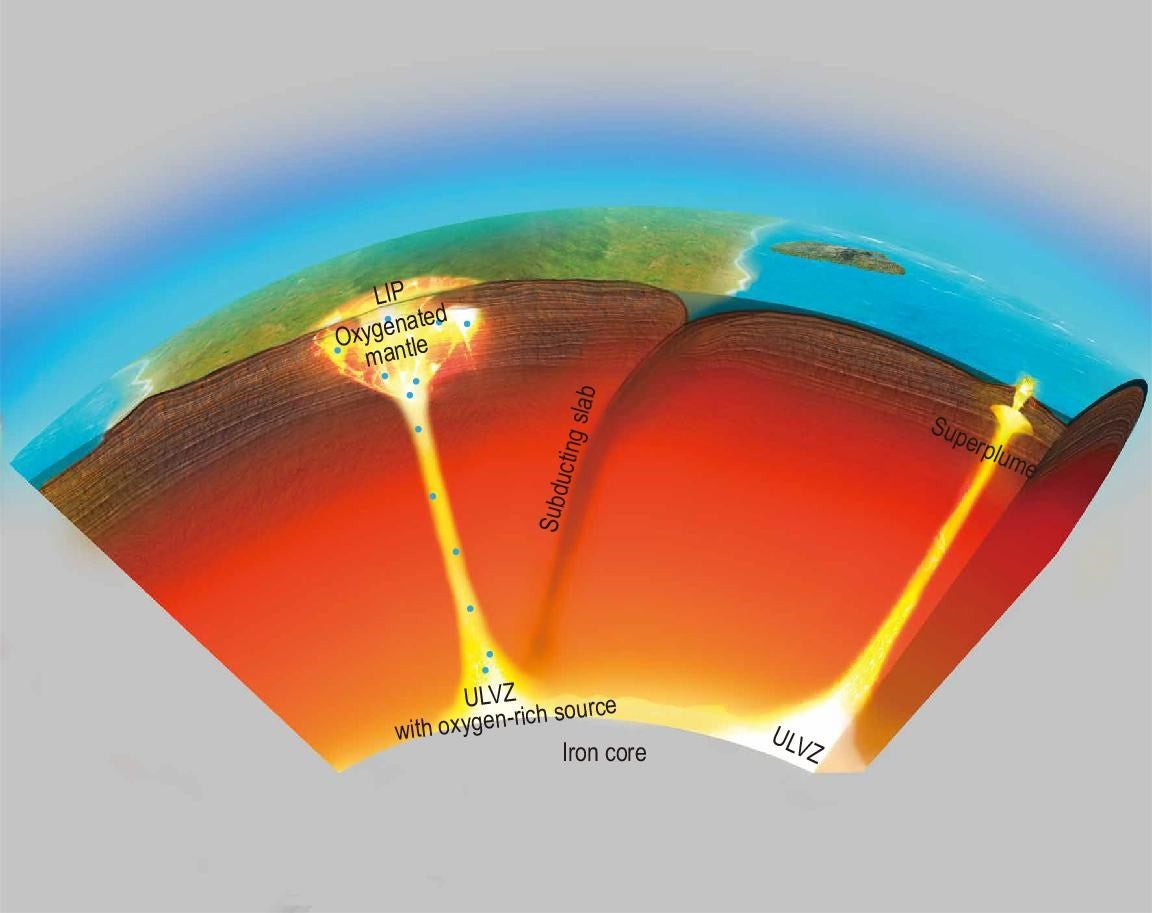
Natural implications depend on finding suitable source regions. Earth’s mantle contains both relatively oxidized and reduced domains, and the authors outline several processes that could create oxygen-rich reservoirs. Magma would need to form within, or interact with, such material to acquire a comparable oxygen surplus.
The pressure trend suggests that oxygen-rich magma could lose storage capacity as it rises. Released oxygen could then contribute to oxidation of shallower mantle material and crust. Whether a significant fraction reaches the atmosphere would depend on transport and reactions along the way.
The authors connect that possibility to extensive volcanic activity roughly 2.5 billion to 2 billion years ago, overlapping Earth’s early atmospheric oxygenation. Their illustrative calculation suggests that releasing 0.27% excess oxygen by magma mass, across their assumed ancient magmatic inventory, could match today’s atmospheric oxygen inventory. They stress that this is a scaling exercise, not a quantitative explanation of atmospheric oxygen’s origin.
Atmospheric accumulation also depends on oxygen production and consumption, including photosynthesis and reactions with reduced materials. The experiment does not replace that broader history. It identifies a potentially important transport mechanism whose contribution remains to be measured, with implications for magma oceans, planetary differentiation and the atmospheres of other rocky worlds.
These studies explore oxygen storage, volcanic chemistry and the interacting processes behind Earth’s atmospheric evolution.
Oxygen controls on magmatism in rocky exoplanets: Investigates how oxidizing conditions influence rock melting, providing context for oxygen’s role in planetary interiors. (Proceedings of the National Academy of Sciences, 2021)
FeO2 and FeOOH under deep lower-mantle conditions and Earth’s oxygen–hydrogen cycles: Reports an oxygen-rich iron oxide and examines possible links between deep chemical reactions and planetary oxygen cycling. (Nature, 2016)
Mantle data imply a decline of oxidizable volcanic gases could have triggered the Great Oxidation: Explores how changing volcanic gases could reduce oxygen consumption and help atmospheric oxygen accumulate. (Nature Communications, 2020)
Marine phosphorus and atmospheric oxygen were coupled during the Great Oxidation Event: Examines connections between ocean nutrients and atmospheric oxygen during Earth’s early oxygenation. (Nature Communications, 2025)
The rise of oxygen in Earth’s early ocean and atmosphere: Reviews geological evidence and the biological and chemical processes involved in Earth’s oxygenation history. (Nature, 2014)
Research findings are available online in the journal National Science Review.
The original story “Scientists discover oxygen trapped deep inside Earth’s magma, possibly explaining the rise of early life” is published in The Brighter Side of News.
Like these kind of feel good stories? Get The Brighter Side of News’ newsletter.
The post Scientists discover oxygen trapped deep inside Earth’s magma, possibly explaining the rise of early life appeared first on The Brighter Side of News.


Leave a comment
You must be logged in to post a comment.