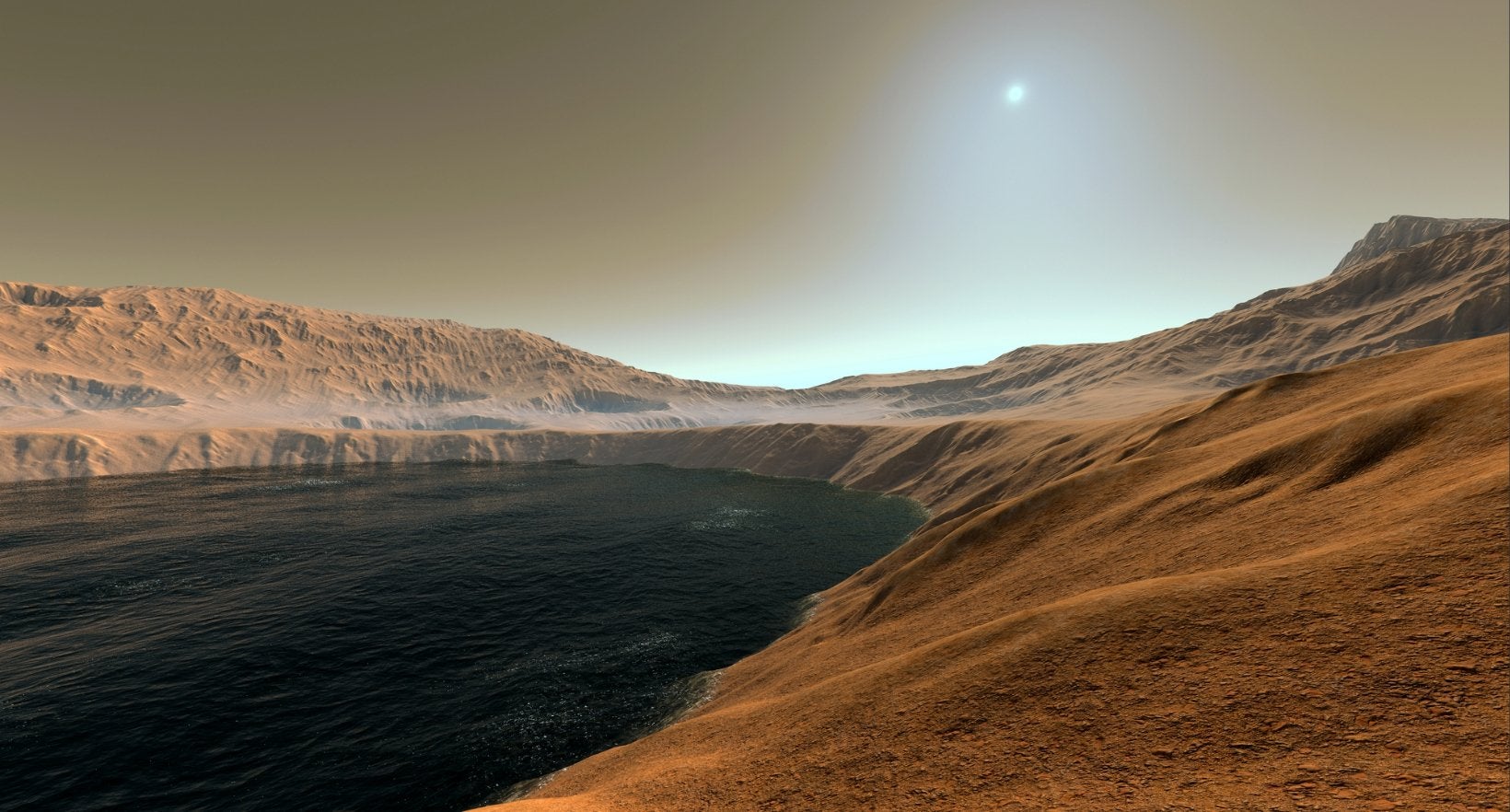
Mars may once have possessed something its barren surface no longer reveals: a geographically uneven rain of organic building material.
A new global simulation suggests that formaldehyde produced in the ancient Martian atmosphere fell preferentially onto wetter parts of the planet. Mountainous regions such as Tharsis and Elysium received some of the largest modeled deposits, potentially creating localized environments favorable for increasingly complex organic chemistry.
The research, led by scientists from Tohoku University, the Earth-Life Science Institute and the Institute of Science Tokyo, was published in The Planetary Science Journal. It extends earlier work showing that formaldehyde could form photochemically in a hydrogen-rich Martian atmosphere.
This time, the researchers asked where that material would actually have gone.
Formaldehyde, or H2CO, is chemically simple but important to origin-of-life research. Once dissolved in water, it can participate in reactions capable of producing sugars, amino acids and increasingly complex organic compounds.
Previous modeling showed that a reducing atmosphere on early Mars could generate substantial formaldehyde. Those calculations largely treated the planet as a global average, leaving unanswered whether some locations received much more than others.
Shungo Koyama and colleagues combined atmospheric photochemistry with a three-dimensional Mars climate model to resolve that geography.
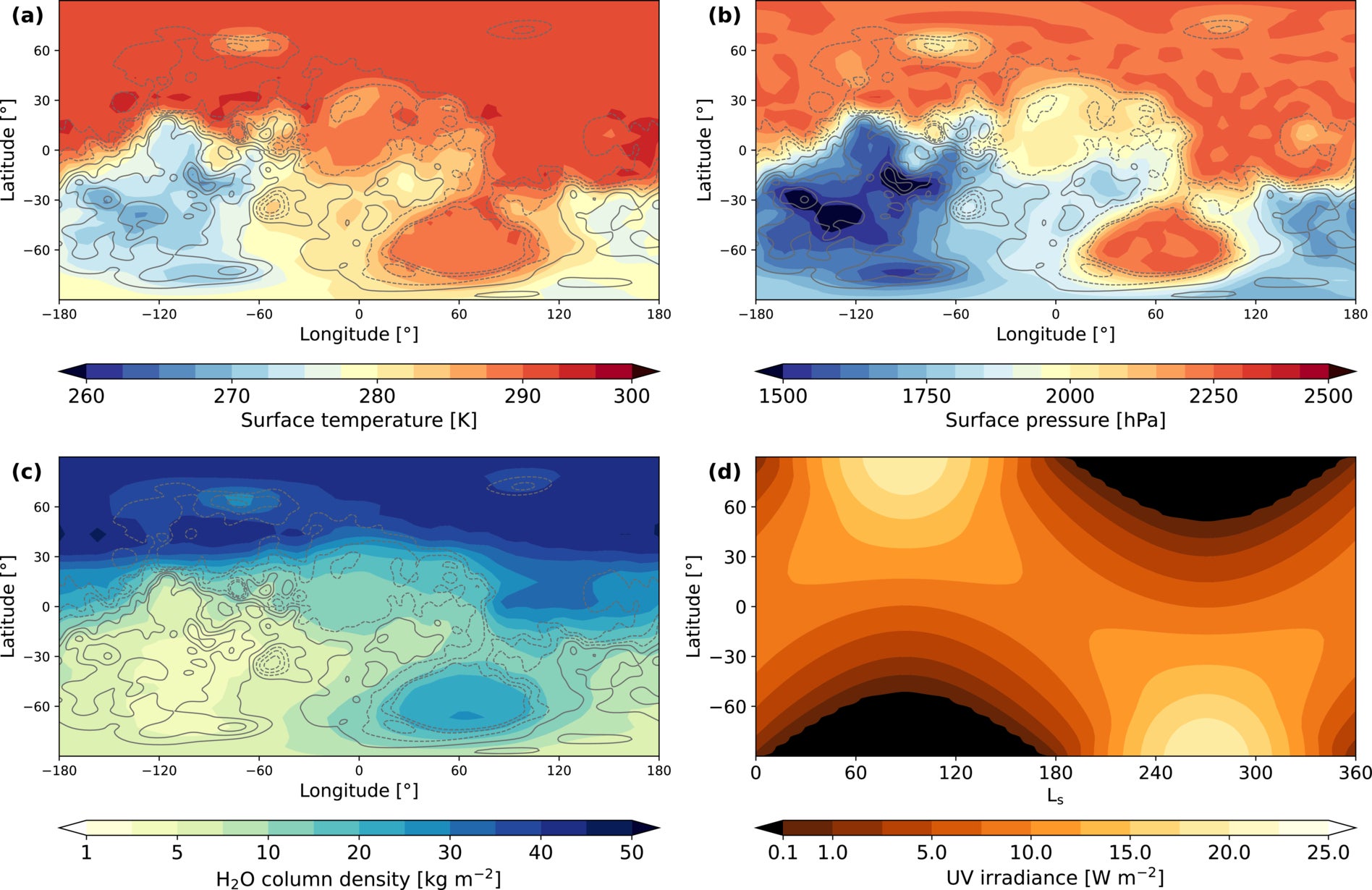
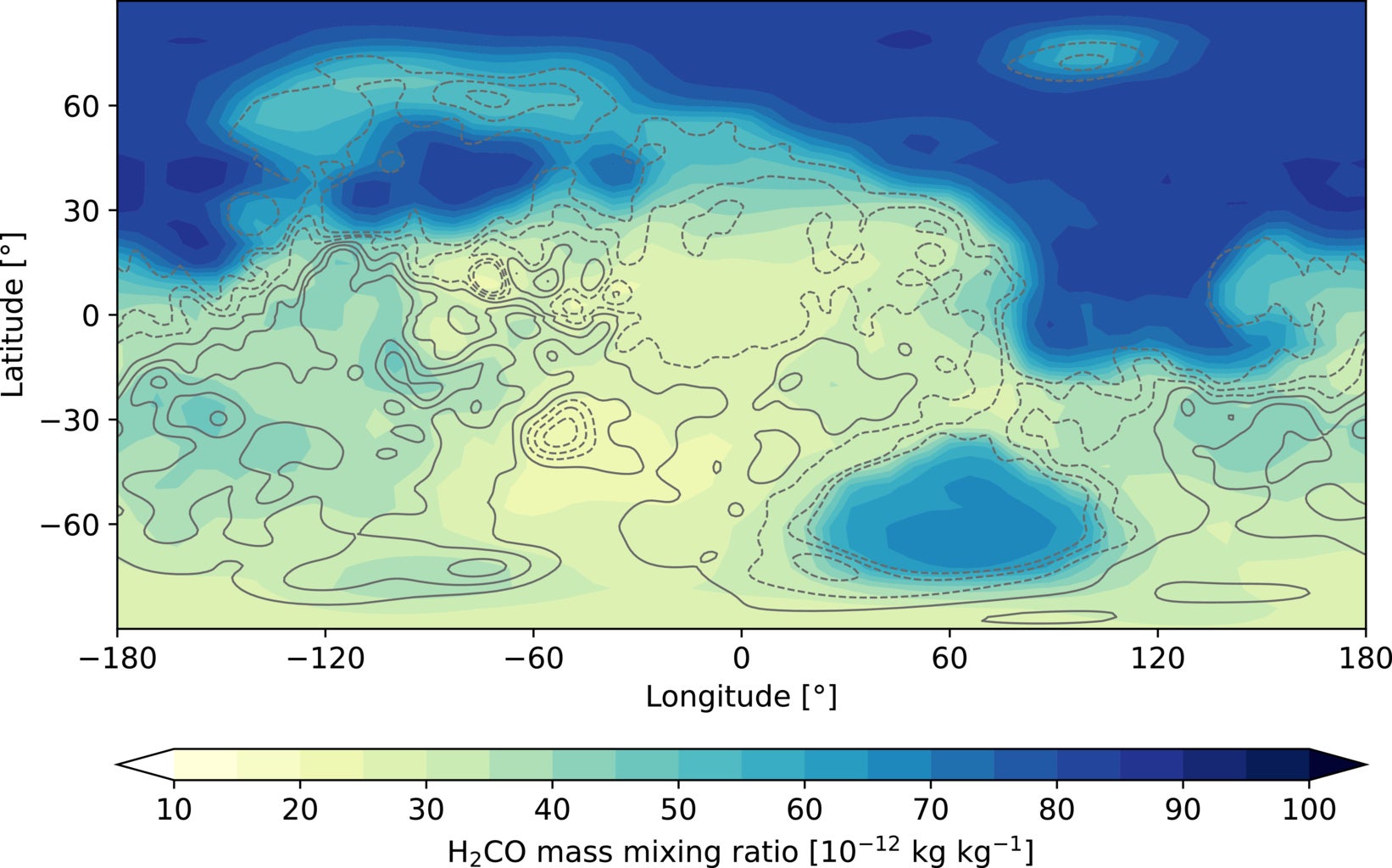
Their simulated Mars had a 2-bar carbon dioxide atmosphere containing 6% hydrogen and an axial tilt of 40 degrees. The scenario represents a possible warm interval about 3.8 billion to 3.6 billion years ago, when geological evidence indicates that rivers, lakes and other liquid-water environments existed.
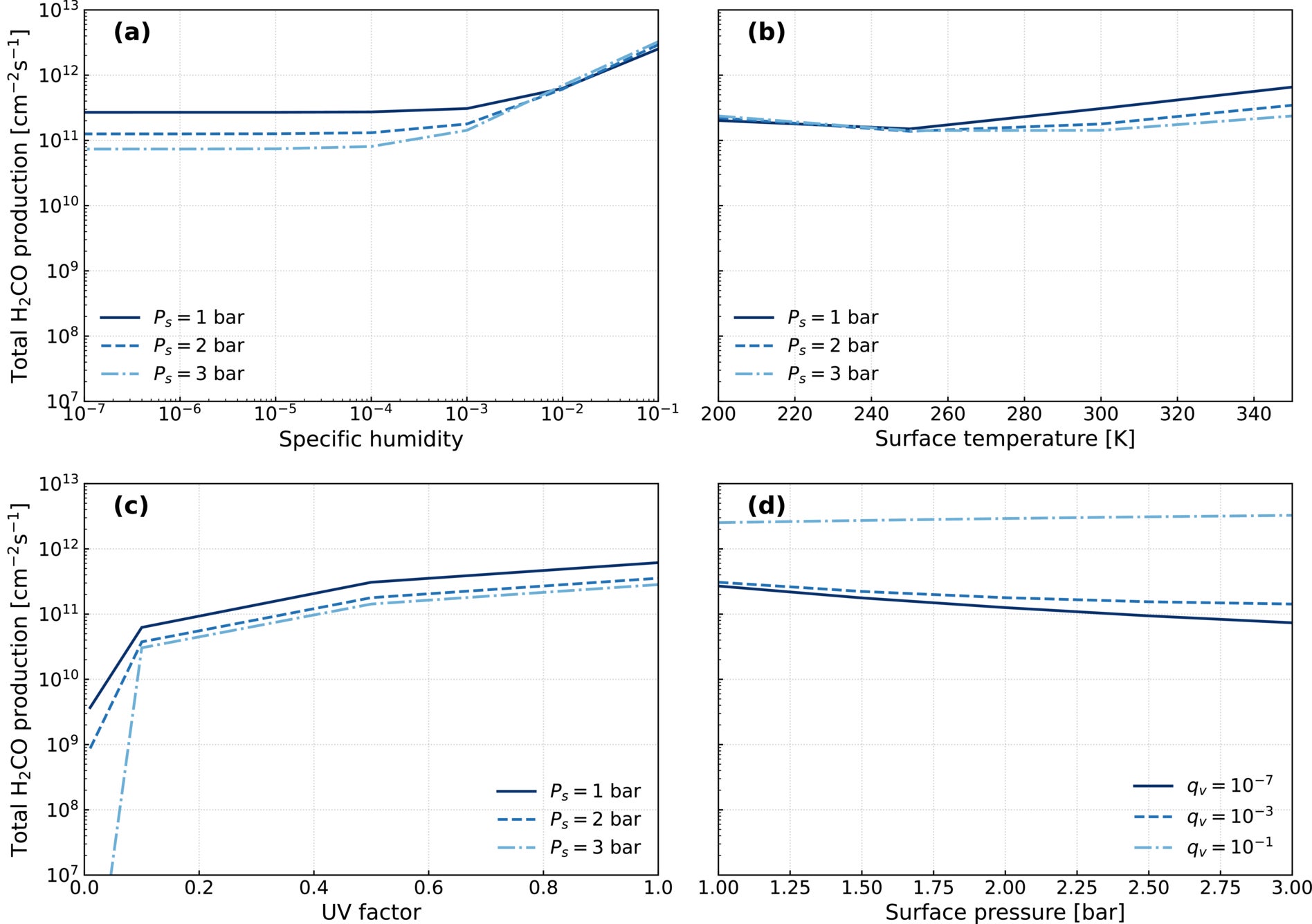
The team calculated formaldehyde production across 560 combinations of surface temperature, water vapor, atmospheric pressure and ultraviolet radiation.
Water vapor emerged as the dominant control once humidity crossed a critical level.
Ultraviolet radiation broke water molecules apart, supplying reactive hydrogen that helped convert atmospheric carbon monoxide into formaldehyde. Wetter air therefore produced more H2CO than dry air under otherwise comparable conditions.
Making formaldehyde was only half the process. The molecules also needed a route from the atmosphere to the ground.
That route was precipitation.
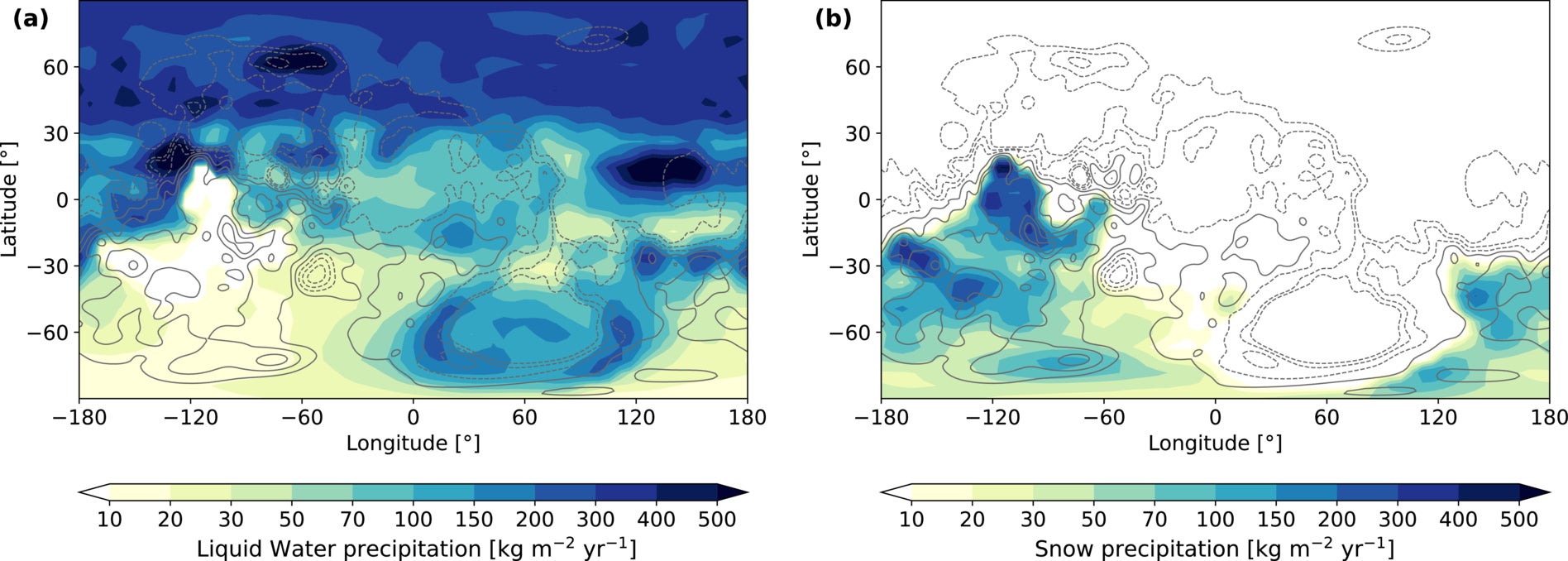
Formaldehyde dissolves readily in liquid water. As raindrops formed and descended through the atmosphere, H2CO entered them and was carried toward the surface. Snow proved much less effective because formaldehyde is far less soluble in ice.
The result was a close connection between Mars’ ancient hydrological cycle and its atmospheric organic chemistry. Regions with abundant water vapor could generate more formaldehyde, while frequent rainfall efficiently delivered it to the ground.
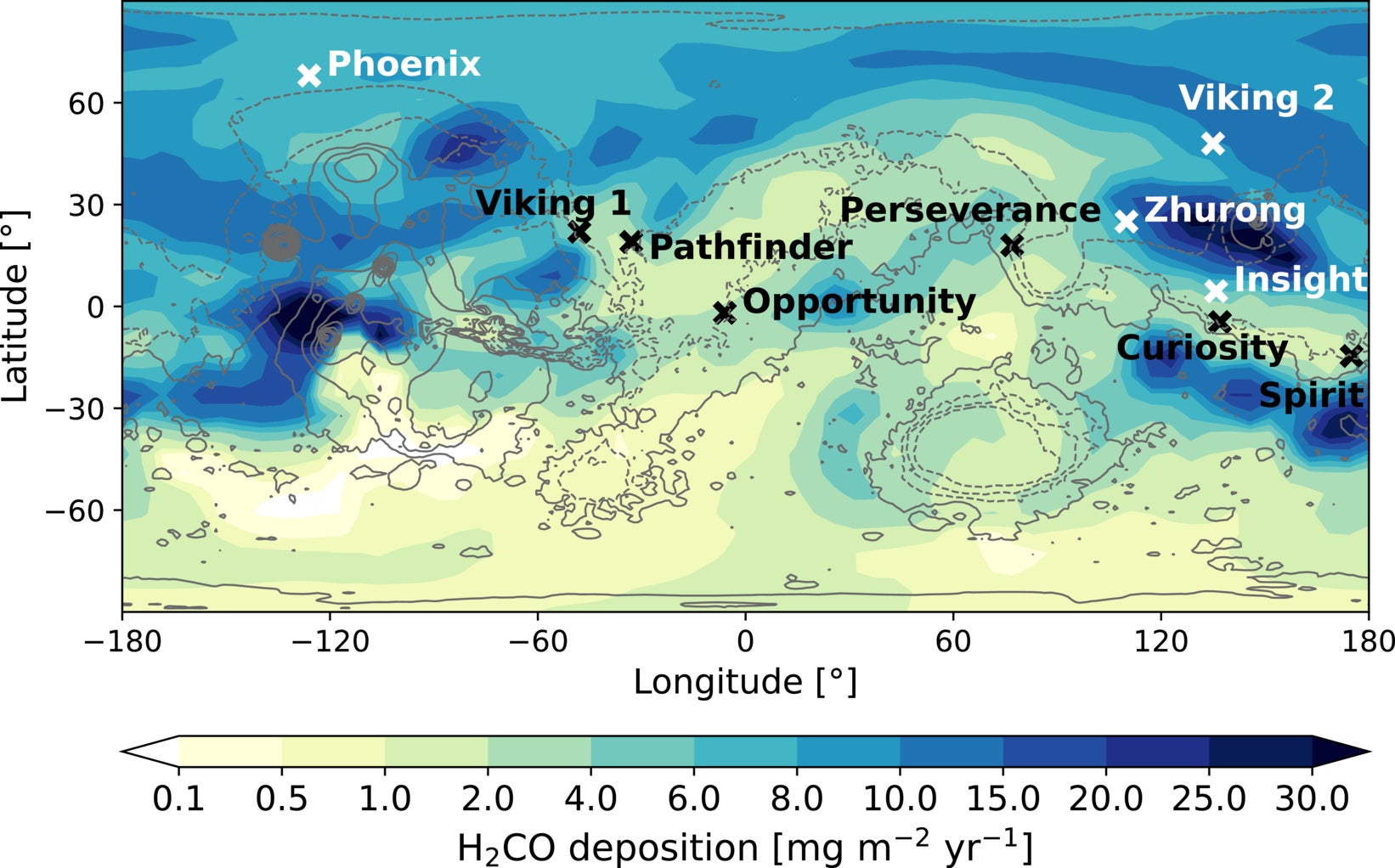
The simulated planet received an average of about 5.86 milligrams of H2CO per square meter each year. Yet individual regions differed by roughly two orders of magnitude.
Northern Mars generally received several times more than the southern hemisphere, largely because the model contained a northern ocean and stronger rainfall in the wetter north.
Some of the strongest concentrations appeared around major highlands.
Tharsis and Elysium reached deposition rates near 50 milligrams per square meter per year, about an order of magnitude above the planetary average.
The cause was not simply elevation. Moist air forced upward across mountainous terrain cooled and condensed, producing precipitation through a process known as orographic lifting. That rain then transported atmospheric formaldehyde to the surface.
The most interesting destinations may have been downhill from those highlands. Rivers and groundwater could have carried dissolved H2CO into lakes and closed basins, where evaporation concentrated it further.
Such environments could potentially have provided both liquid water and repeated supplies of chemically useful carbon compounds.
That does not mean life developed there. The simulations address chemical availability, not biology.
The researchers compared their map with locations already explored on Mars.
Gale Crater, where Curiosity has detected ancient organic matter, had a modeled deposition rate of about 2.18 milligrams per square meter per year. Jezero Crater, explored by Perseverance, received about 3.33 milligrams.
Both fall below the modeled global average.
That is intriguing because organic matter has nevertheless been detected at both locations. If atmospheric formaldehyde contributed to those organics, extremely high deposition may not have been necessary.
Other landing sites received more. The model gave Viking 2 about 10.5 milligrams per square meter annually and the Zhurong landing region roughly 11 milligrams.
Direct comparisons remain difficult. Rocks differ in age, alteration history and exposure to oxidants, all of which determine whether ancient organic material survives.
The study contains several important uncertainties.
Its warm Mars atmosphere represents one plausible climate state rather than proof that such conditions persisted globally. Other studies favor predominantly cold conditions punctuated by temporary warming events.
The model also assumes a fixed atmospheric composition and does not fully simulate horizontal transport of formaldehyde. Volcanic sulfur compounds could either suppress production by blocking ultraviolet light or help preserve H2CO through different chemical reactions.
Preservation presents another major problem. Formaldehyde exposed directly at the Martian surface would be vulnerable to ultraviolet radiation, cosmic rays and oxidizing compounds such as perchlorates.
Burial, ice or rapid conversion into more complex organics could improve survival, but researchers cannot yet calculate precisely how much ancient H2CO-derived material should remain.
That distinction is crucial. The new map predicts delivery billions of years ago, not present-day abundance.
One of the strongest tests would involve comparing ancient rocks from areas predicted to have received very different amounts of formaldehyde.
The model also predicts differences in carbon isotopes. Atmospheric formaldehyde produced through the proposed pathway should be unusually depleted in carbon-13. Regions receiving larger supplies could therefore preserve distinctive isotopic signatures if enough material survived.
Future missions could compare ancient sediment from high-deposition basins with rocks from predicted low-deposition regions.
Such measurements would test a larger idea emerging from the research: on ancient Mars, water may have done more than provide environments where prebiotic chemistry could occur.
The water cycle itself may have determined where some of its most important raw ingredients accumulated.
These studies explore how atmosphere, water, carbon chemistry and climate could have combined to create chemically favorable environments on ancient Mars.
Stable carbon isotope evolution of formaldehyde on early Mars: Modeling shows how Martian atmospheric chemistry could generate strongly carbon-13-depleted formaldehyde and potentially help explain unusual organic carbon signatures measured by Curiosity. (Scientific Reports, 2024)
Synthesis of 13C-depleted organic matter from CO in a reducing early Martian atmosphere: Laboratory experiments and modeling show that ultraviolet photochemistry could create strongly carbon-13-depleted carbon monoxide that feeds organic synthesis. (Nature Geoscience, 2024)
Atmospheric formaldehyde production on early Mars leading to a potential formation of bio-important molecules: This earlier study demonstrated that plausible reducing Martian atmospheres could produce formaldehyde capable of supplying precursors for sugars and other biologically relevant molecules. (Scientific Reports, 2024)
Episodic warm climates on early Mars primed by crustal hydration: Climate and photochemical modeling suggests hydrogen released through crustal processes could have produced repeated warm, humid episodes lasting long enough to help form valley networks. (Nature Geoscience, 2024)
3D Simulations of the Early Martian Hydrological Cycle Mediated by a H2-CO2 Greenhouse: Global climate simulations examine how dense carbon dioxide and hydrogen atmospheres could generate rainfall, lakes and above-freezing conditions on early Mars. (Journal of Geophysical Research: Planets, 2021)
Research findings are available online in The Planetary Science Journal.
The original story “Rainstorms billions of years ago may have created habitable hotspots on Mars” is published in The Brighter Side of News.
Like these kind of feel good stories? Get The Brighter Side of News’ newsletter.
The post Rainstorms billions of years ago may have created habitable hotspots on Mars appeared first on The Brighter Side of News.


Leave a comment
You must be logged in to post a comment.