A future quantum internet will need something today’s internet takes for granted: the ability to hold information while distant parts of a network catch up.
Researchers in Spain have now demonstrated a solid-state quantum memory that stores individual photons for substantially longer than previously achieved with this kind of system. The device preserved nonclassical correlations for as long as 180 microseconds, enough time for light to travel an equivalent fiber distance of roughly 36 kilometers.
The work, led by researchers at ICFO in Barcelona, was published in Physical Review Letters. The experiment combines a rare-earth-doped crystal with a technique called spin rephasing, which counteracts one of the central problems confronting quantum memories: the gradual loss of coherence.
The achievement does not create a working quantum internet. Practical networks will require longer storage, higher efficiencies and connections among many nodes. But it demonstrates that an established solid-state memory architecture can preserve quantum light while using a technique capable of much longer storage.
Ordinary networks send bits representing zeros and ones. Quantum networks would instead distribute quantum states, or qubits, whose unusual properties include superposition and entanglement.
Entanglement allows separated quantum systems to share correlations that cannot be reproduced classically. It lies behind proposals for distributed quantum computing, advanced sensing and forms of secure quantum communication.
Distance creates a major obstacle because photons traveling through optical fibers are eventually lost. Classical networks solve a similar problem with repeaters that detect and regenerate signals, but unknown quantum states cannot simply be copied.
Quantum repeaters instead aim to establish entanglement across shorter network segments and then connect those segments. For this approach to work, some quantum states must wait in memory while entanglement succeeds elsewhere in the network.
That makes storage time critical. A memory that loses coherence before neighboring links finish their operations cannot synchronize the network.
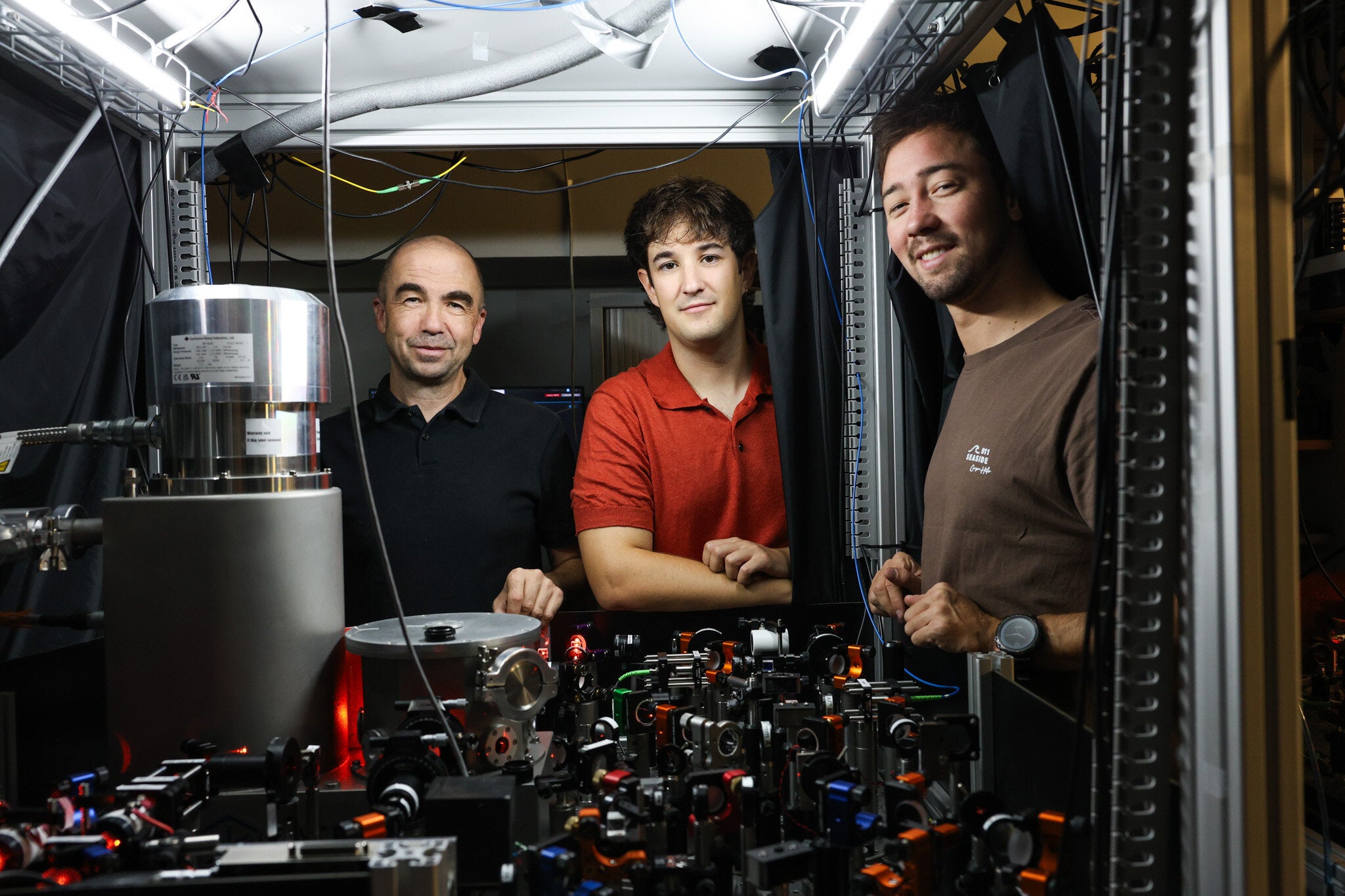
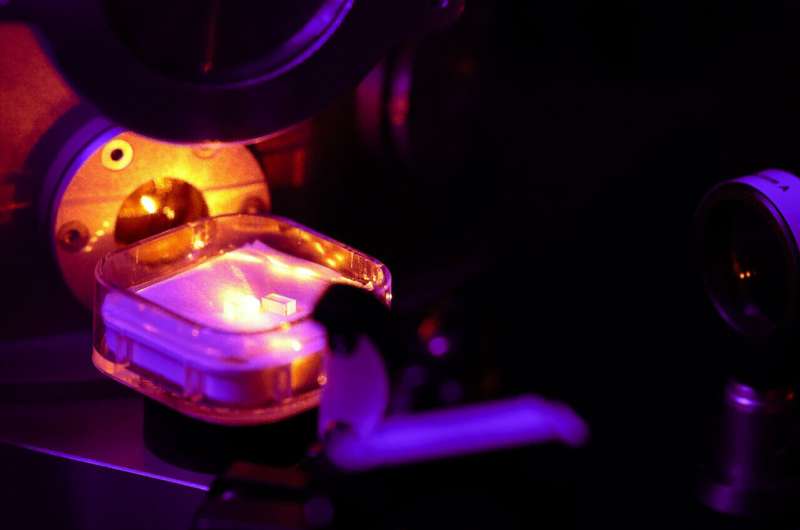
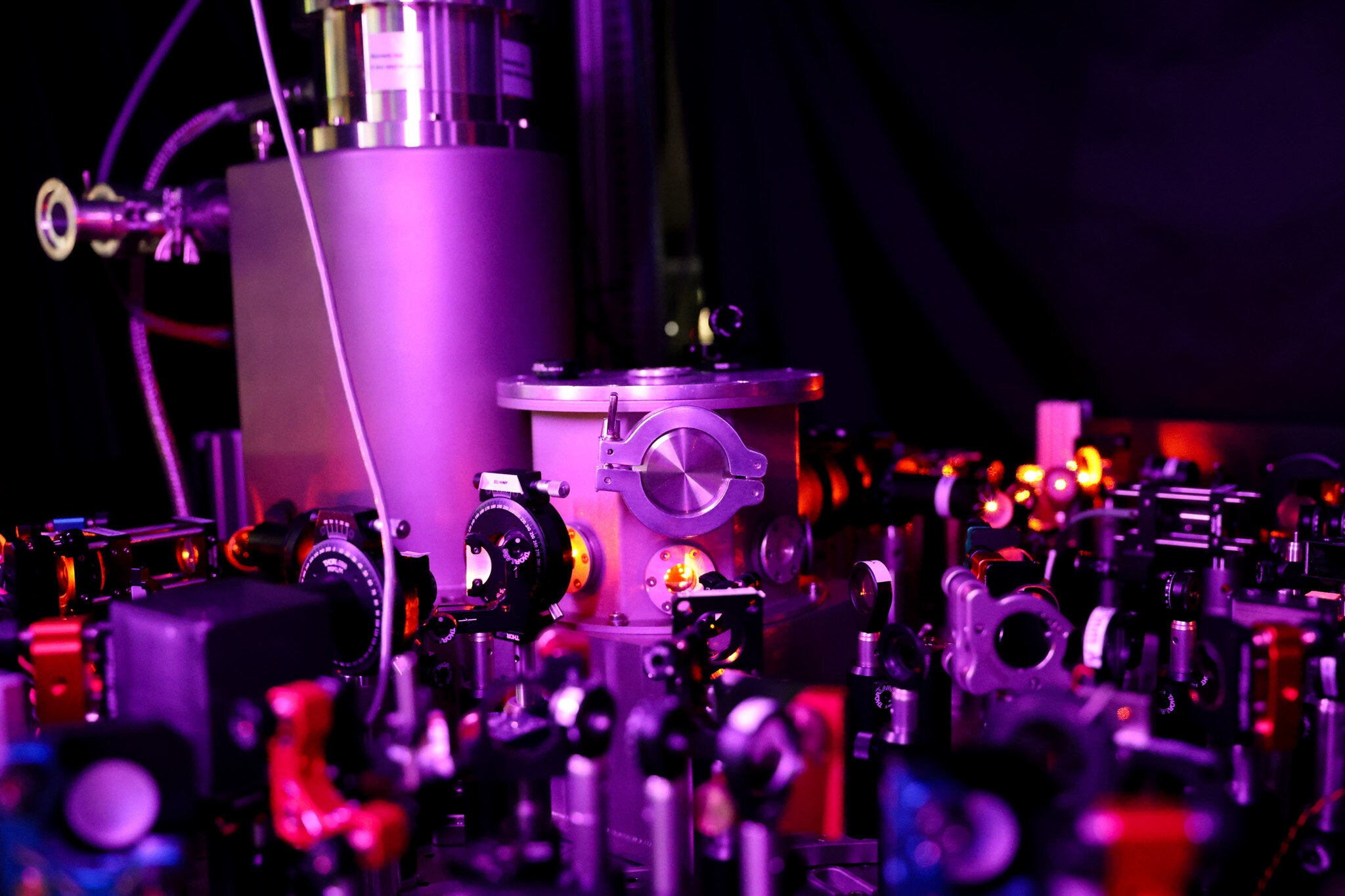
The ICFO team built its memory from a praseodymium-doped yttrium orthosilicate crystal, written chemically as Pr³⁺:Y₂SiO₅. The crystal was cooled to about 3 kelvin inside a cryostat.
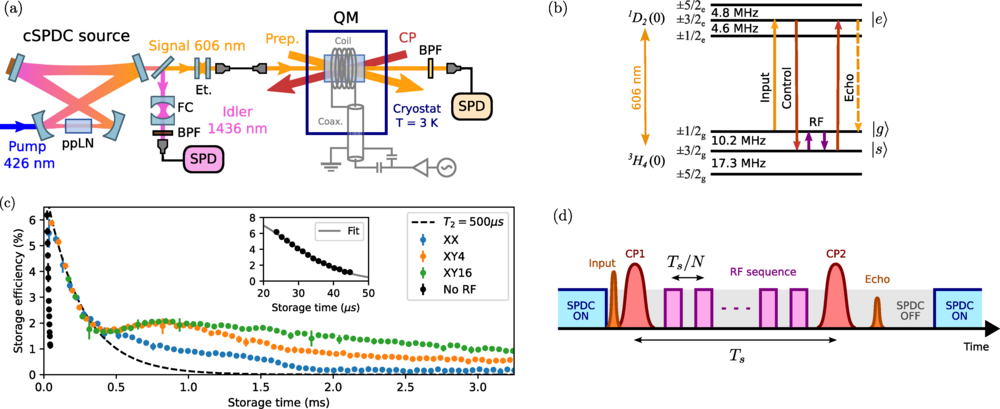
Researchers generated pairs of photons using a cavity-enhanced spontaneous parametric down-conversion source. One photon had a wavelength of 606 nanometers, matching the optical transition used by the memory. Its partner had a wavelength of 1,436 nanometers, placing it in the telecom range suitable for fiber-optic transmission.
Detection of the telecom photon acted as a herald, signaling that its partner was available for storage.
Inside the crystal, the researchers used an atomic frequency comb, or AFC. They prepared groups of praseodymium ions with a carefully spaced pattern of absorption frequencies. When the incoming photon entered the crystal, it was collectively absorbed across many ions rather than stored in one particular atom.
Optical control pulses then transferred that collective excitation into a long-lived hyperfine spin state, effectively pausing the normal optical re-emission process. Later, another control pulse converted the excitation back into light.
This method also allows the retrieval time to be chosen while the photon is stored, a useful property for synchronizing quantum-network links. Pasted text
Holding the excitation in a spin state solves one problem but creates another.
Each praseodymium ion sits in a slightly different microscopic environment inside the crystal. Those differences cause the ions’ quantum phases to evolve at slightly different rates.
Over time, the ensemble falls out of step. The collective excitation dephases, preventing the ions from reconstructing the original photon efficiently.
The researchers countered that process using radiofrequency pulses applied to the crystal. Their approach is similar in principle to reversing a group of clocks that have begun drifting apart so their accumulated differences eventually cancel.
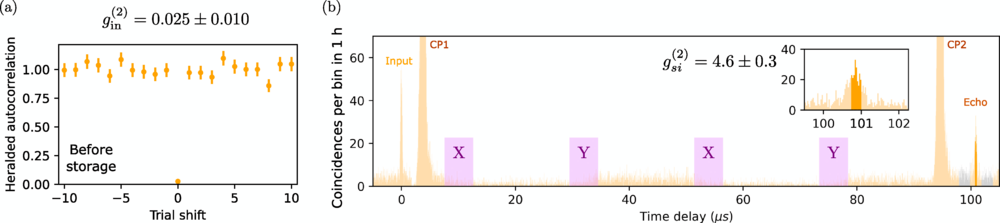
The team used an XY4 sequence containing four carefully phased radiofrequency pulses. These pulses flip the evolution of the spins and make the individual phases converge again after another period of evolution.
The procedure is known as spin rephasing or dynamical decoupling.
Tests with ordinary classical light showed how dramatically the rephasing pulses extended storage.
Without effective rephasing, spin dephasing rapidly suppressed useful photon echoes. With more advanced XY4 and XY16 sequences, measurable classical-light echoes persisted beyond 3 milliseconds, nearly two orders of magnitude longer than earlier spin-wave AFC storage in the same material without spin rephasing.
The harder test involved genuine single-photon-level quantum light.
The researchers stored the 606-nanometer photons while retaining their relationship with the 1,436-nanometer heralding photons. They then measured correlations between detections after retrieval.
Nonclassical correlations remained detectable for storage times reaching 180 microseconds. The highest measured signal-idler cross-correlation reached 4.6 with an uncertainty of 0.4, comfortably above the classical bound used in the experiment.
The researchers also estimated that the retrieved light retained single-photon characteristics over relevant storage intervals. Together, those tests show that the memory was not merely producing delayed light. It was retaining properties associated with the original quantum state.
A storage time of 180 microseconds corresponds to roughly 36 kilometers of propagation through optical fiber.
That comparison matters because a quantum memory in a repeater must hold its state while light and classical heralding signals travel between network nodes. Extending memory lifetime therefore increases the possible distance between synchronized components.
Importantly, the heralding photon was already produced at a telecom wavelength. Many quantum systems operate at wavelengths poorly suited to standard communications fiber and require an additional frequency-conversion step.
The ICFO system avoids that requirement for the heralding channel while using photons with a moderate 2.5-megahertz bandwidth that match the memory.
“Our scheme thus establishes praseodymium-doped quantum memories as a major candidate for the scalable implementation of quantum networks,” senior researcher Hugues de Riedmatten said.
The 180-microsecond quantum result is still far shorter than the storage times that large multisegment quantum networks may eventually require.
The difference between the 180-microsecond single-photon result and roughly 3-millisecond classical result also shows that spin coherence itself was not the only limitation. Quantum operation suffered from lower storage efficiency and increasing noise as the delay grew.
Part of that noise appears connected to small residual magnetic fields interacting with the radiofrequency sequence. Better control of the magnetic environment could therefore extend useful single-photon storage.
The researchers estimate that moderate controlled fields could push individual-ion spin coherence toward milliseconds, while specially engineered magnetic conditions known as zero first-order Zeeman configurations could eventually support far longer storage.
For a quantum internet, the important advance is not simply keeping light trapped for another fraction of a millisecond. It is showing that quantum information encoded in individual photons can survive spin rephasing inside a solid-state memory while a telecom-compatible partner travels through a network.
That gives quantum repeaters a little more time to wait, and long-distance quantum connections a little more room to grow.
These resources explore quantum repeaters, atomic frequency comb memories and the technologies needed to build long-distance quantum networks.
Quantum repeaters: From quantum networks to the quantum internet: A comprehensive review of quantum repeater architectures, entanglement distribution and the technological requirements for extending quantum communication beyond direct transmission limits. (Reviews of Modern Physics, 2023)
Multimode quantum memory based on atomic frequency combs: This foundational work explains how atomic frequency comb memories can store multiple optical modes, an important capability for increasing quantum-network communication rates. (Physical Review A, 2009)
Solid-state quantum memory using the atomic frequency comb protocol: This experiment demonstrated the atomic frequency comb approach in rare-earth-doped solids and established a major platform for optical quantum memory research. (Nature, 2008)
Quantum storage of light using spin-wave atomic frequency combs: Researchers demonstrated spin-wave storage with controllable retrieval, a central capability for synchronizing quantum-repeater operations. (Physical Review Letters, 2010)
Progress in quantum teleportation: This review examines quantum teleportation, entanglement distribution and how these tools could connect distant nodes for communication and distributed quantum computing. (Nature Reviews Physics, 2023)
Research findings are available online in the journal Physical Review Letters.
The original story “Quantum memory stores single photons for record time in major leap towards a quantum internet” is published in The Brighter Side of News.
Like these kind of feel good stories? Get The Brighter Side of News’ newsletter.
The post Quantum memory stores single photons for record time in major leap towards a quantum internet appeared first on The Brighter Side of News.


Leave a comment
You must be logged in to post a comment.