For the first time,
A single particle of antimatter has become a controllable quantum system, with scientists observing individual steps in its energy. Suspended inside an exceptionally cold trap, the positron remained isolated from surrounding matter for months. Its behavior offers a route toward testing whether an electron and its antimatter counterpart obey the same fundamental rules.
Northwestern University physicists describe the first one-positron quantum cyclotron in Physical Review Letters. Gerald Gabrielse, the university’s Board of Trustees Professor of Physics and director of its Center for Fundamental Physics, led the study. Thomas Myers, a doctoral student in his laboratory, is the first author.
The achievement goes beyond keeping antimatter alive inside a trap. The team resolved the positron’s lowest cyclotron energy levels and its spin states, then detected transitions between them. That control could enable a more precise measurement of its magnetic moment, a property describing its magnetic strength and orientation.
A positron has the electron’s mass but carries positive rather than negative electric charge. When the two meet and annihilate, their energy emerges in other forms, including photons. Preserving a positron for study therefore requires keeping it away from electrons in ordinary matter.
The deeper motivation concerns a symmetry called CPT, combining charge conjugation, parity reversal and time reversal. These operations exchange particles with antiparticles, reverse spatial directions and reverse time. CPT symmetry underpins the Standard Model and predicts matching masses and equal magnetic-moment magnitudes with opposite signs for electrons and positrons.
A discrepancy between carefully measured properties would challenge that framework. However, observing quantum transitions does not itself establish any disagreement with the theory. The new experiment supplies an essential tool for making the comparison, rather than a result showing that matter and antimatter differ unexpectedly.
“We’re very precisely examining the most fundamental and simple systems to find where the theory breaks down,” Gabrielse said. The universe’s overwhelming excess of matter remains part of that broader motivation, although this experiment has not explained its origin.
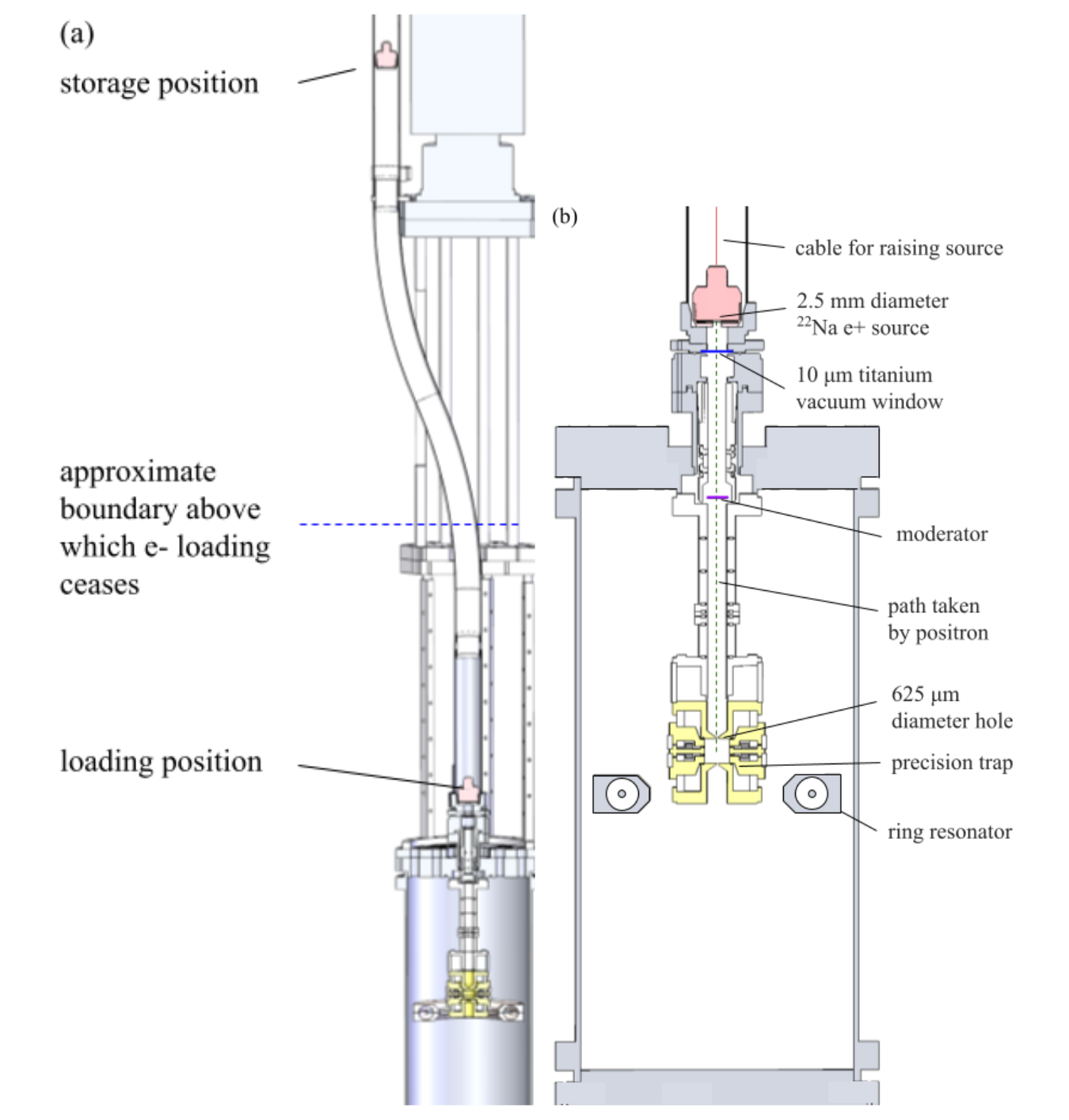
The positrons originated in radioactive sodium-22, whose decay can release particles carrying up to 546 kiloelectronvolts of kinetic energy. A kiloelectronvolt is an energy unit equal to 1,000 electronvolts. Capturing one required removing most of that energy and guiding it into an enclosed vacuum.
The apparatus used a tungsten moderator to slow the particles through collisions. Near its surface, a slowed positron could collect an electron, forming a weakly bound system called positronium. Guided by the magnetic field, that neutral pair could pass through a small opening into the trap.
Inside, an electric field separated the pair. The electron escaped, while the positively charged positron remained confined by the trap’s electric and magnetic fields. This loading method took roughly eight to 11 hours to capture a positron, but repeated loading became unnecessary once one remained trapped.
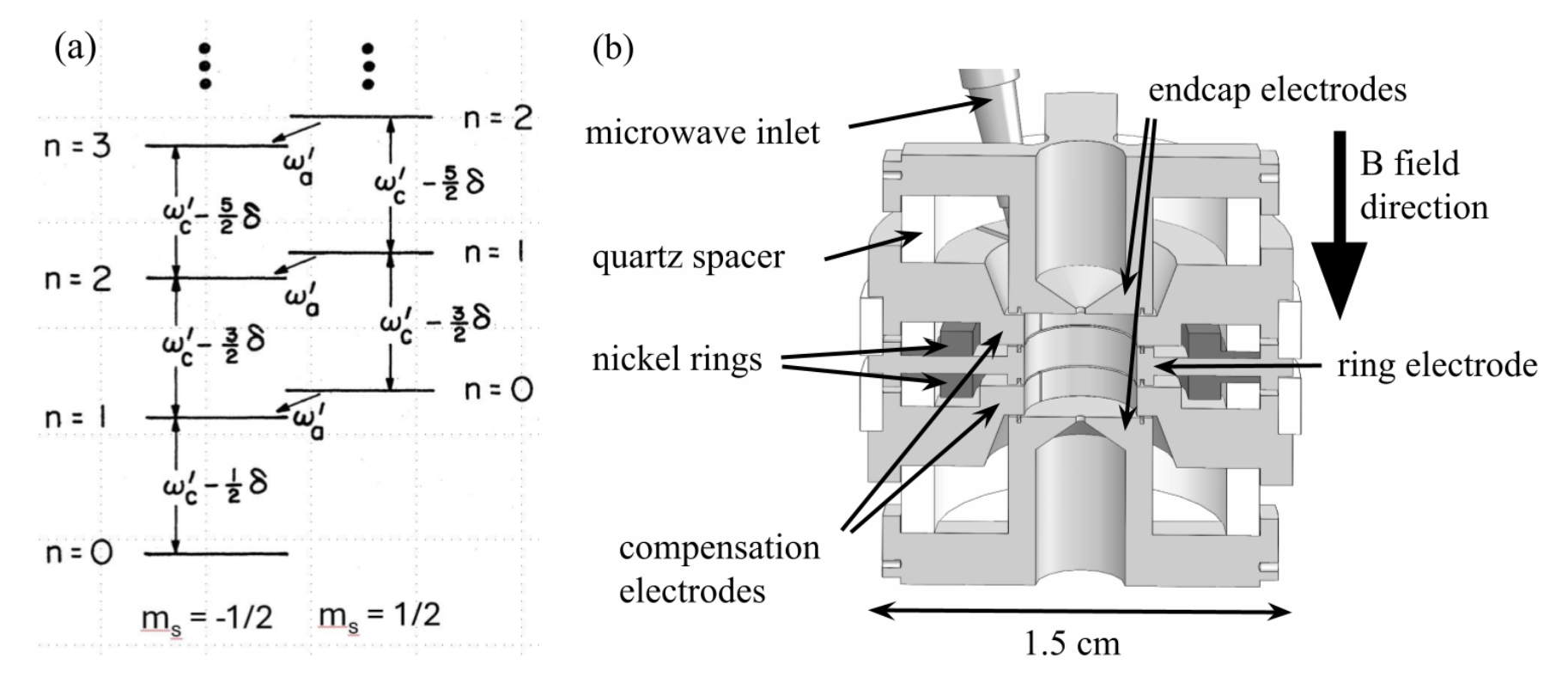
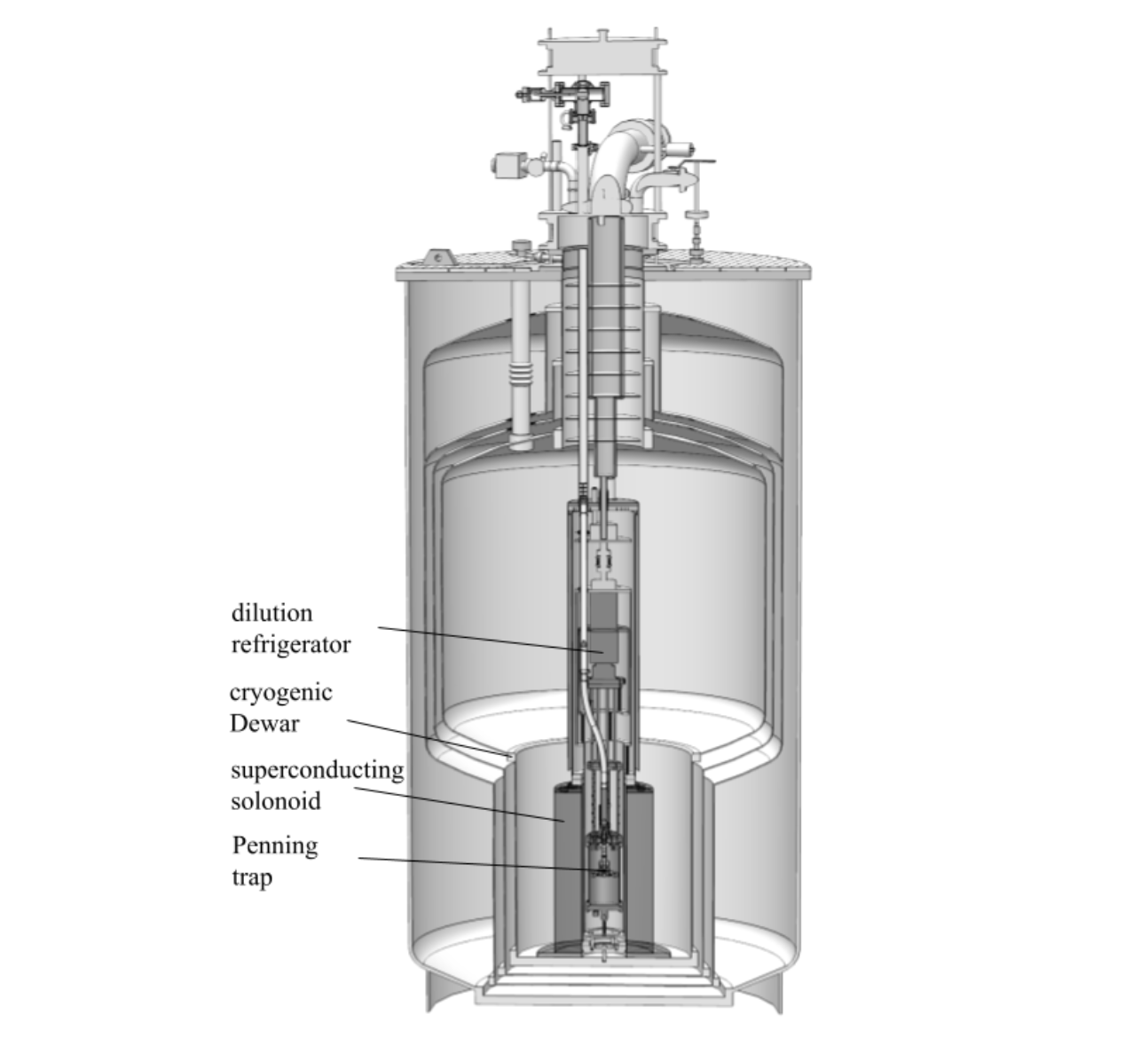
The device, called a Penning trap, confines charged particles without requiring contact with container walls. A superconducting magnet supplied a field of 5.6 teslas, while carefully shaped electric fields completed the confinement. The electrodes and sealed vacuum enclosure sat at approximately 300 millikelvins, just 0.3 degrees above absolute zero.
That temperature served two purposes beyond simply slowing motion. The cold enclosure trapped residual gas on its surfaces, producing an exceptionally clean vacuum. It also suppressed thermal radiation that could otherwise excite the positron’s cyclotron motion and obscure its lowest energy states.
Cyclotron motion is the circular motion of a charged particle in a magnetic field. In the quantum description, that motion occupies discrete energy levels instead of taking any arbitrary energy. Cooling prepared the positron in its cyclotron ground state, the lowest available level of that particular motion.
That qualification matters because a trapped particle has several kinds of motion. Reaching the cyclotron ground state does not mean that the positron stops moving altogether. The experiment also controlled other motion within the trap, including a slower circular drift, so it did not compromise the demonstration.
Microwaves near 156 gigahertz supplied energy to drive cyclotron transitions. The measurements showed individual upward steps followed by downward steps as the particle emitted radiation. Stronger driving sometimes produced two successive excitations, followed by two emissions, making the discrete energy changes especially clear.
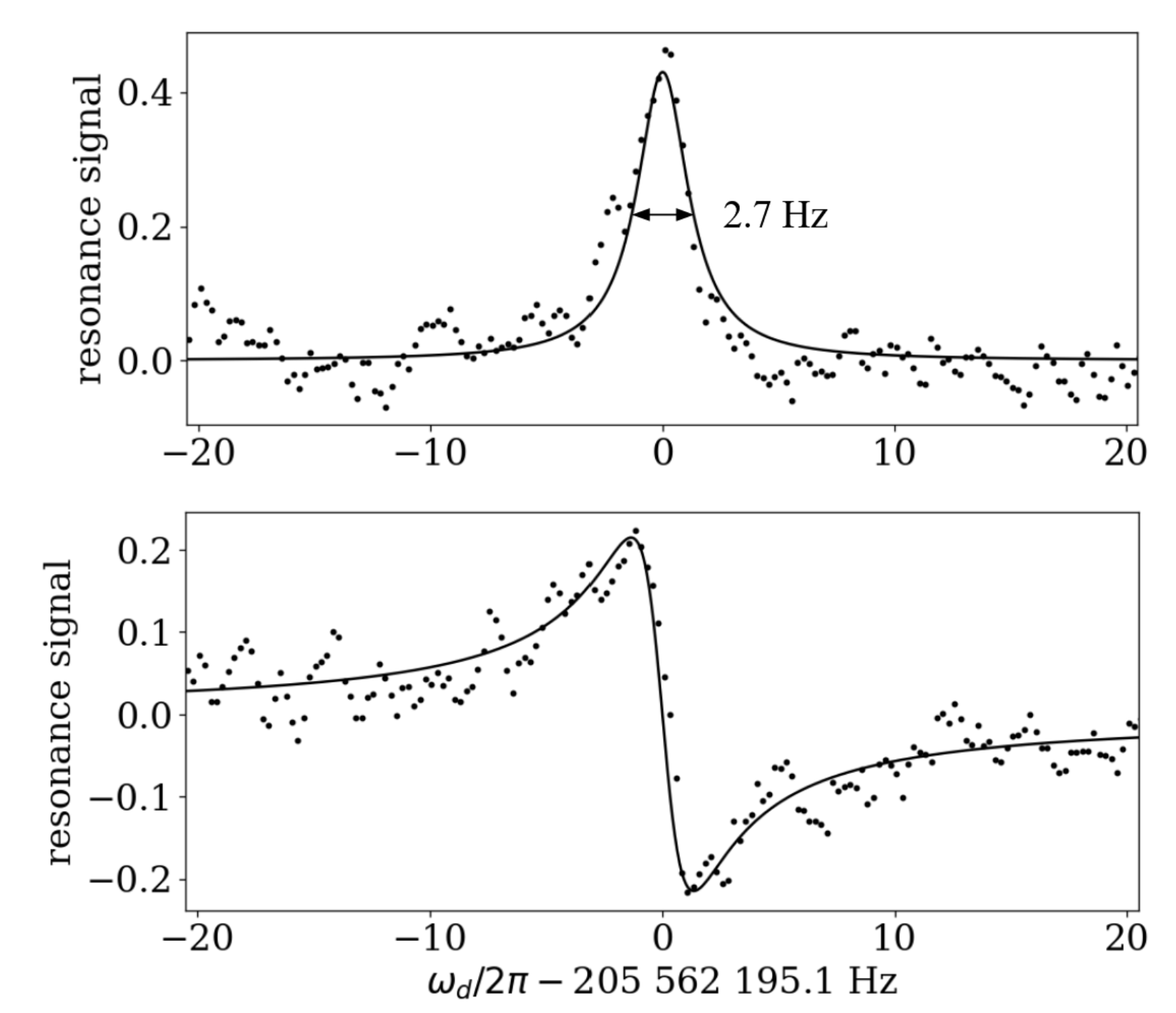
Detecting one particle’s state requires extracting a remarkably small signal. The positron oscillated along the magnetic-field direction at approximately 206 megahertz, inducing a current in a connected detection circuit. Cryogenic electronics amplified that signal so the team could track its oscillation frequency.
A deliberately introduced magnetic-field variation linked that frequency to the cyclotron and spin states. Spin is an intrinsic quantum property associated with the particle’s magnetism. A one-step change produced a frequency shift of approximately 3.8 hertz, allowing the researchers to distinguish otherwise inaccessible states.
The method is called quantum nondemolition detection because reading those states does not itself change them. Measurements revealed both cyclotron jumps and driven spin flips. The observed shift sizes also supported the conclusion that the signals came from one positron rather than two trapped particles.
Another design challenge involved how quickly excited states disappear. Without the cavity’s influence, the first excited cyclotron state would last only about 83 milliseconds at this magnetic field. That interval was too short for the averaging needed to identify its state reliably.
The trap electrodes therefore also formed a microwave cavity that suppressed spontaneous radiation emission. In this demonstration, the excited-state lifetime reached approximately four seconds. The loading opening had to admit positrons while preserving this cavity effect, making access and measurement precision competing engineering demands.
Spin states presented a different timescale because they couple much more weakly to the environment. The researchers calculated a spontaneous spin-decay time of about 2.1 years before any further cavity suppression. That figure is a theoretical estimate, rather than a measured storage time for an excited spin state. The distinction helps explain why resolving spin required a different balance of controls than detecting short-lived cyclotron excitations.
Gabrielse’s team previously measured the electron’s magnetic moment with a one-electron quantum cyclotron to approximately one part in 10 trillion. The positron apparatus could eventually bring comparable quantum measurement techniques to antimatter. Measuring the relevant transition frequencies would allow the team to determine its magnetic moment.
The authors estimate that such a comparison could sharpen tests of CPT symmetry in the lepton sector by more than 30 times. Electrons and positrons belong to that particle family. Reaching that improvement will require further optimization and a detailed investigation of measurement uncertainties, rather than simply repeating the demonstrated transitions.
For now, the advance establishes a platform for that work. The team can prepare, excite and read a single positron’s quantum states while retaining the particle for months. The next task is to turn that control into a magnetic measurement precise enough to make the proposed symmetry comparison meaningful.
These studies explain complementary antimatter tests, the electron measurement benchmark and earlier comparisons of electrons with positrons.
Four ppm measurement of the antihydrogen ground-state hyperfine splitting
Microwave spectroscopy measured an energy splitting in antihydrogen with four-parts-per-million precision. This offers a complementary way to compare matter and antimatter through atomic energy levels. (Nature, May 2026)
Coherent spectroscopy with a single antiproton spin
The study demonstrates coherent manipulation of an antiproton’s spin. It provides context for how increasingly precise control of individual antimatter particles supports fundamental physics tests. (Nature, July 2025)
Measurement of the Electron Magnetic Moment
This experiment measured the electron’s magnetic moment with an uncertainty of 0.13 parts per trillion. It establishes the precision benchmark the positron team hopes to approach. (Physical Review Letters, February 2023)
A parts-per-billion measurement of the antiproton magnetic moment
A precision measurement of the antiproton’s magnetic moment enabled comparison with the proton. It illustrates how magnetic measurements test matter–antimatter symmetry in a different particle family. (Nature, October 2017)
New high-precision comparison of electron and positron g factors
Single electrons and positrons were alternately confined in the same trap for a direct comparison of their magnetic properties. This foundational experiment explains the earlier benchmark that quantum positron measurements aim to improve. (Physical Review Letters, July 1987)
Research findings are available online in the journal Physical Review Letters.
The original story “Quantum first: Physicists contain a single antimatter particle for months” is published in The Brighter Side of News.
Like these kind of feel good stories? Get The Brighter Side of News’ newsletter.
The post Quantum first: Physicists contain a single antimatter particle for months appeared first on The Brighter Side of News.


Leave a comment
You must be logged in to post a comment.