Quantum entanglement has survived one of its most extreme tests yet.
Physicists working with CERN’s ATLAS experiment found strong evidence that pairs of Z bosons produced when Higgs bosons decay possess entangled spin states. Unlike photons or trapped atoms used in traditional quantum experiments, Z bosons are massive elementary particles that disappear almost immediately after they form.
The ATLAS Collaboration reported the measurement in Physical Review Letters. Oxford physicists helped develop the methods behind the experiment, which used proton collisions collected during Runs 2 and 3 of the Large Hadron Collider, or LHC.
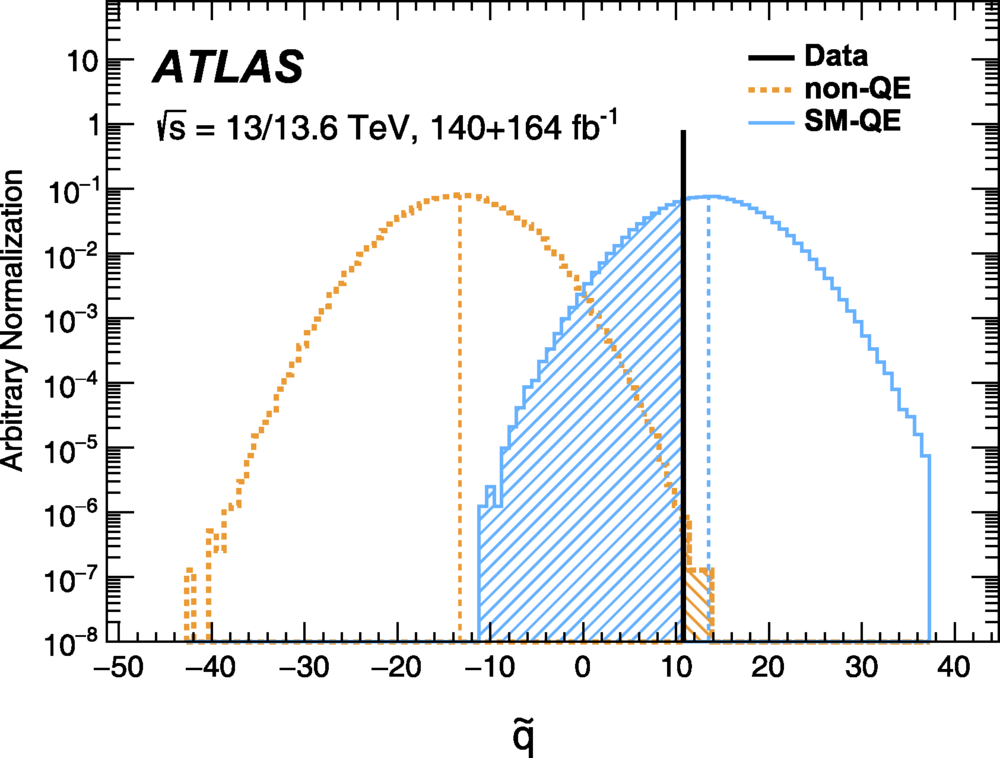
The strongest analysis rejected a specific nonentangled state at 4.7 standard deviations in favor of the entangled state predicted by the Standard Model. That falls just short of the 5-sigma threshold particle physicists traditionally use for a discovery, making “strong evidence” more precise than calling the result definitive confirmation.
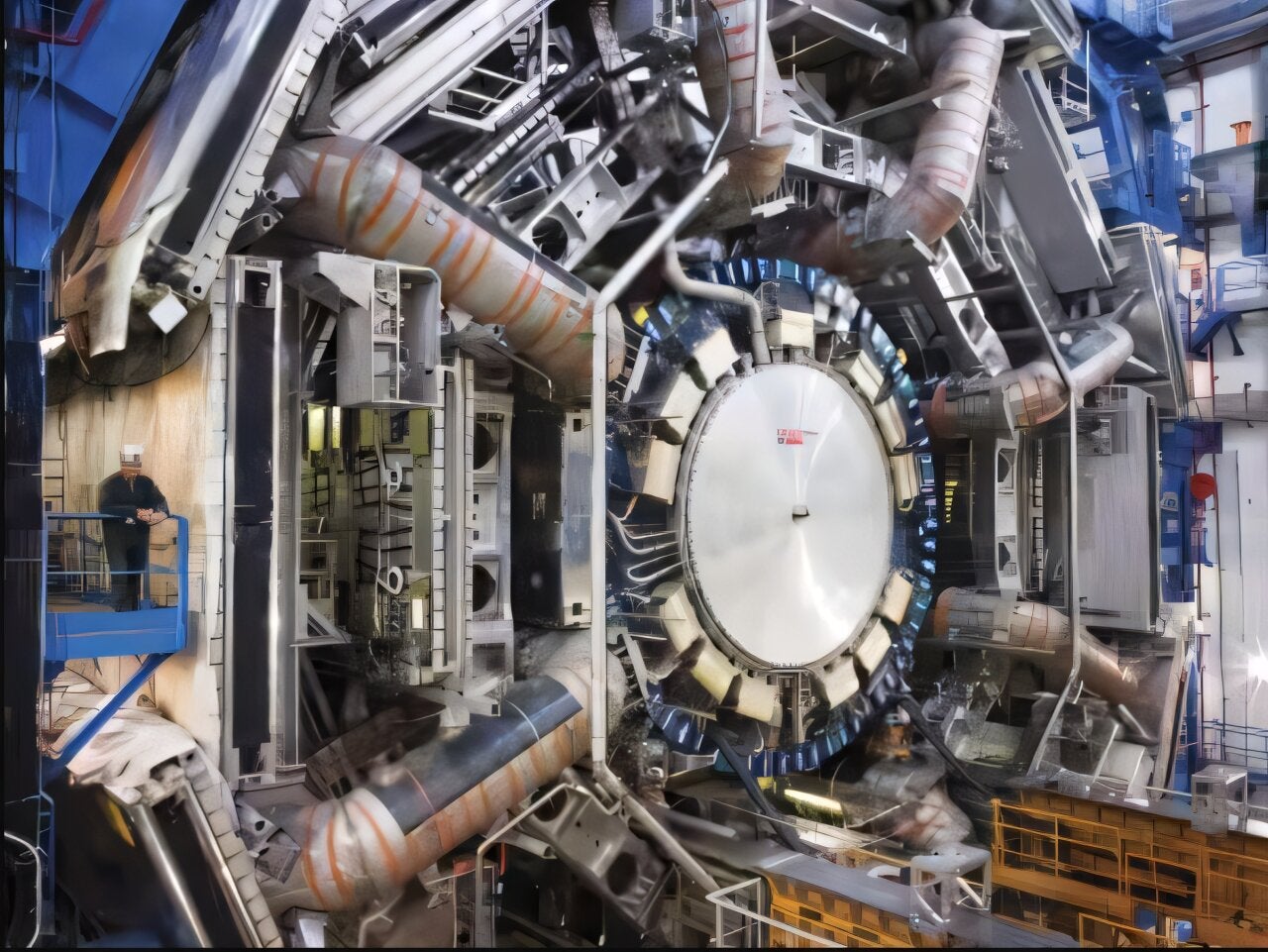
Entanglement occurs when components of a quantum system share a joint state that cannot be described as independent states for each component.
Measurements on entangled particles can therefore produce correlations stronger than would be expected from an unentangled quantum system. This does not allow information to travel instantaneously between the particles, despite Albert Einstein’s famous description of entanglement as “spooky action at a distance.”
Experiments have demonstrated entanglement with photons, electrons, atoms, ions and other systems. More recently, physicists realized that particle colliders could extend these tests into an entirely different physical regime.
The LHC accelerates protons to nearly the speed of light before smashing them together. The new ATLAS analysis used collisions at center-of-mass energies of 13 and 13.6 trillion electron volts.
“Using particle colliders allows us to test quantum mechanics at energies a trillion times higher and over distances smaller than the size of the nucleus,” Oxford physicist Alan Barr said. “This probes some of the extreme conditions where quantum mechanics might break down.”
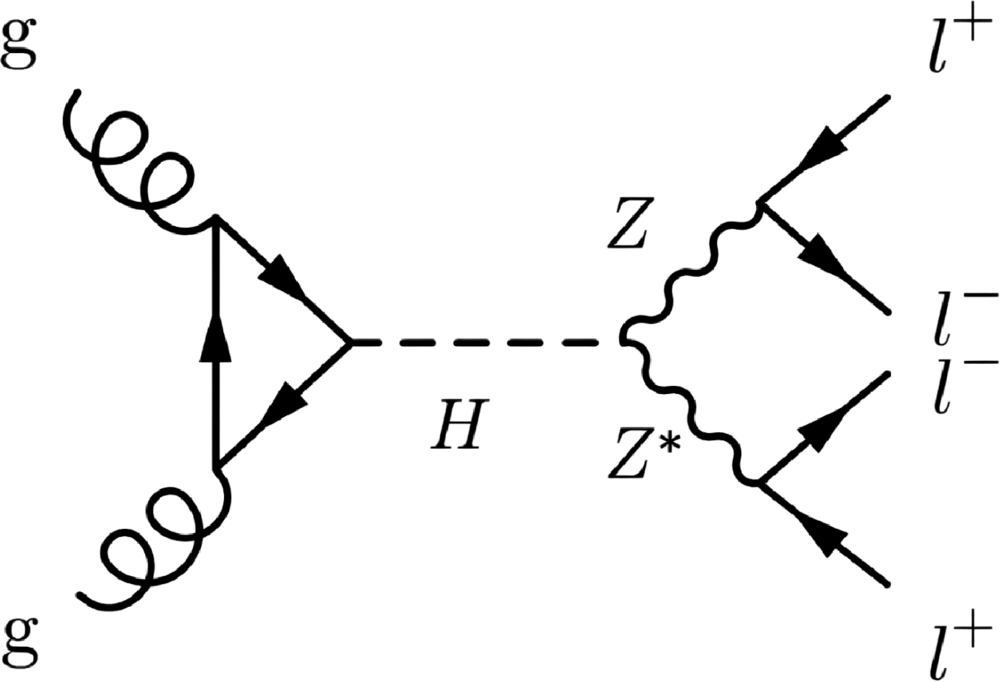
The researchers focused on an unusually clean sequence beginning with the Higgs boson.
A Higgs can decay into two Z bosons, although the Higgs is not massive enough to produce two ordinary on-shell Z bosons simultaneously. At least one must therefore be an off-shell, or virtual, Z boson.
Each Z has spin 1 and can occupy three spin states. In the Higgs decay studied by ATLAS, quantum mechanics predicts that the two Z bosons emerge in a coherent combination of different spin configurations rather than two independent states.
The Z bosons vanish far too quickly for physicists to measure their spins directly. Instead, each decays into pairs of electrons or muons.
ATLAS can reconstruct those charged particles with extraordinary precision. The directions in which they emerge retain information about the polarization of their parent Z bosons.
Researchers therefore used the angular distributions of four leptons left behind by the two Z bosons to reconstruct quantities connected to their original quantum spin state.
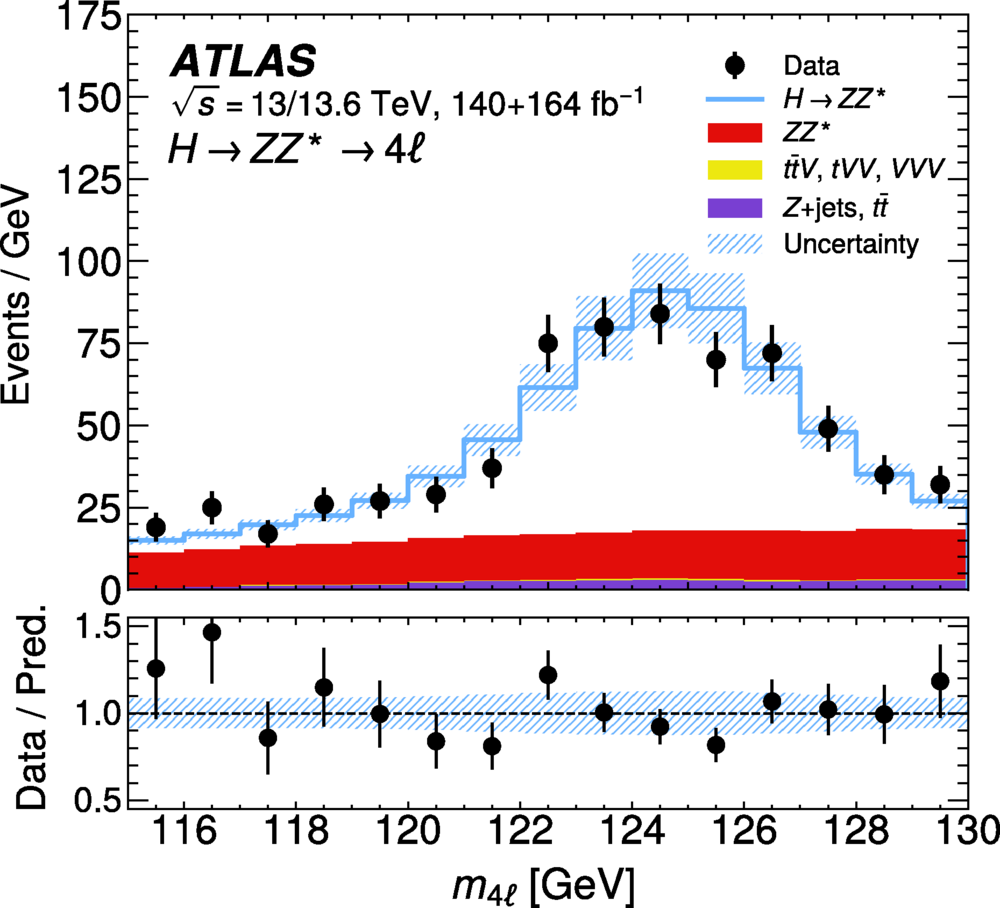
The analysis examined the spin-density matrix describing the paired Z system. Certain off-diagonal components of that matrix provide direct markers of entanglement.
The measured values were consistent with Standard Model predictions, although statistical uncertainty remained relatively large because Higgs decays into four charged leptons are rare.
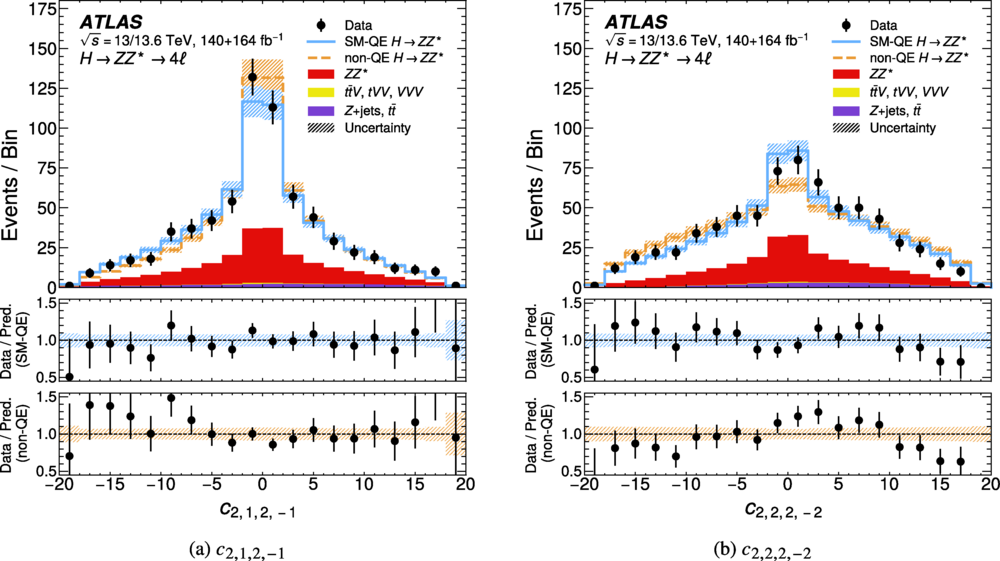
The researchers therefore performed a second, more sensitive test using the full shape of an entanglement-sensitive angular distribution.
They compared the Standard Model prediction with a separable alternative in which both Z bosons have longitudinal polarization. Under the assumptions used in the analysis, that configuration represents the relevant nonentangled state.
ATLAS rejected that hypothesis with an observed significance of 4.7 sigma, compared with an expected 4.9 sigma.
The interpretation depends on established Standard Model assumptions, including the Higgs boson’s known scalar properties and the behavior of weak Z-boson decays. The researchers also accounted for detector effects, backgrounds, interference and higher-order electroweak corrections.
The Z-boson result builds on another recent transformation in collider physics.
ATLAS and CMS previously observed spin entanglement in pairs of top quarks, the heaviest known elementary particles. ATLAS reported its top-quark observation in Nature in 2024.
Those experiments demonstrated that data originally collected to study fundamental particles could also become a laboratory for quantum information science.
The new measurement extends that approach to massive spin-1 bosons and Higgs decays. According to the researchers, it represents the first measurement of quantum entanglement between massive vector bosons at the electroweak scale.
“We’re used to thinking of entanglement as something delicate, seen in laboratory experiments with single photons,” Barr said. Finding the effect in heavy, short-lived Z bosons, he added, shows how deeply quantum behavior is embedded in nature.
The experiment does not suggest that quantum mechanics has failed at high energies. Instead, its results agree with the entangled state predicted by the Standard Model.
But the techniques could become increasingly powerful tests for departures from that theory.
Quantum tomography can reconstruct aspects of a particle system’s quantum state rather than examining only conventional quantities such as energy or momentum. That could make collider experiments sensitive to subtle changes in particle interactions or previously unknown couplings.
Larger datasets should sharpen those tests. ATLAS still has additional Run 3 data to analyze, while the planned High-Luminosity LHC will eventually deliver far more collisions.
That could transform entanglement from an unusual quantity measured at colliders into another precision tool for studying fundamental physics.
For decades, entanglement was associated mainly with carefully controlled laboratory systems. The LHC is showing that the same strange quantum connections persist inside some of the most violent particle collisions humans can create.
These studies explore earlier collider observations and the emerging use of quantum-information techniques in high-energy physics.
Observation of quantum entanglement with top quarks at the ATLAS detector: ATLAS reported entanglement in top-antitop pairs, establishing collider experiments as laboratories for quantum correlations at extreme energies. (Nature, 2024)
Observation of quantum entanglement in top quark pair production in proton-proton collisions at √s = 13 TeV: CMS independently observed spin entanglement in top-quark pairs using LHC collision data. (Reports on Progress in Physics, 2024)
Stringent bounds on HWW and HZZ anomalous couplings with quantum tomography at the LHC: This work shows how quantum-state reconstruction can provide sensitive tests of interactions between the Higgs and electroweak bosons. (Journal of High Energy Physics, 2023)
Quantum frontiers in high energy physics: This review surveys the growing intersection between quantum information, entanglement measurements and high-energy particle experiments. (Science China Physics, Mechanics & Astronomy, 2025)
Separability Criterion for Density Matrices: Asher Peres introduced a fundamental mathematical test for distinguishing separable from entangled quantum states, forming part of the framework used in modern entanglement studies. (Physical Review Letters, 1996)
Research findings are available online in the journal Physical Review Letters.
The original story “Physicists find Einstein’s ‘spooky’ quantum effect inside Higgs boson decays” is published in The Brighter Side of News.
Like these kind of feel good stories? Get The Brighter Side of News’ newsletter.
The post Physicists find Einstein’s ‘spooky’ quantum effect inside Higgs boson decays appeared first on The Brighter Side of News.


Leave a comment
You must be logged in to post a comment.