The Milky Way and Andromeda have appeared locked on a destructive course for decades. Now, thousands of simulations suggest their collision is not destiny, but a contest between gravity, uncertain measurements and two smaller neighboring galaxies.
Astronomers have known for a century that Andromeda is moving toward the Milky Way. Because the two spiral galaxies dominate the Local Group, which contains about 100 smaller galaxies, their approach became one of astronomy’s most familiar forecasts.
The standard account held that the pair would collide in five billion years. Gravity would distort both galaxies and eventually combine them into a large elliptical system sometimes nicknamed “Milkomeda.”
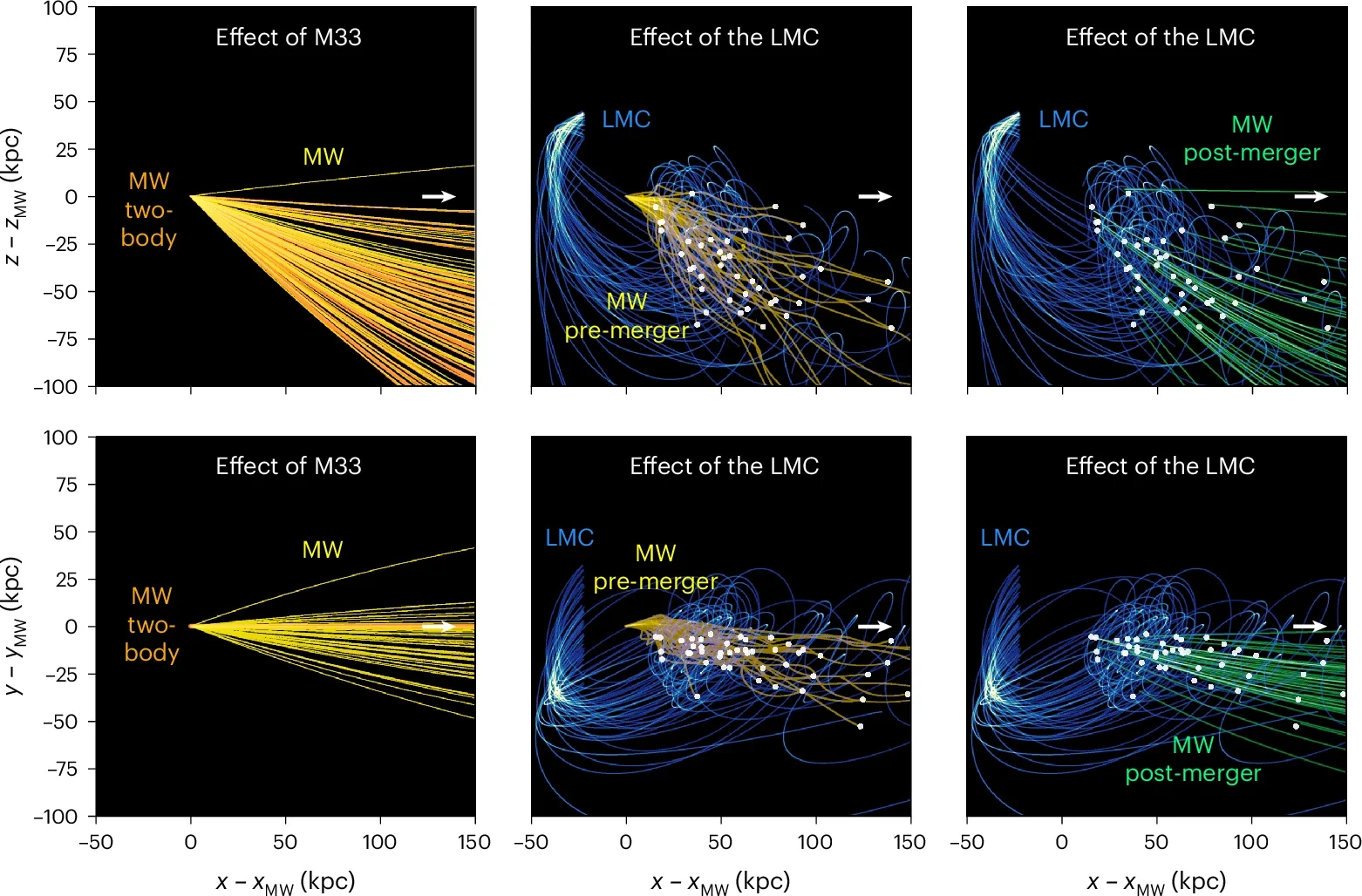
A team led by Till Sawala of the University of Helsinki modeled the Milky Way, Andromeda, the Triangulum galaxy M33 and the Large Magellanic Cloud.
The team used measurements from the Hubble Space Telescope and the European Space Agency’s Gaia mission. The observations track galactic positions and motion across the sky.
Such sideways motion is exceptionally difficult to measure at galactic distances. Even small errors can produce very different paths when projected billions of years ahead.
Instead of selecting only the most likely value for each measurement, the team sampled a broad range of plausible positions, velocities and masses. Its main model ran 50,000 possible realizations.
The Milky Way’s mass was set near one trillion times the Sun’s mass. Andromeda was estimated at about 1.3 trillion solar masses. M33 and the Large Magellanic Cloud were smaller but still massive enough to alter the larger galaxies’ motion.
The simulations followed the systems for 10 billion years or until a merger. They included dynamical friction, which causes galactic orbits to lose energy and decay.
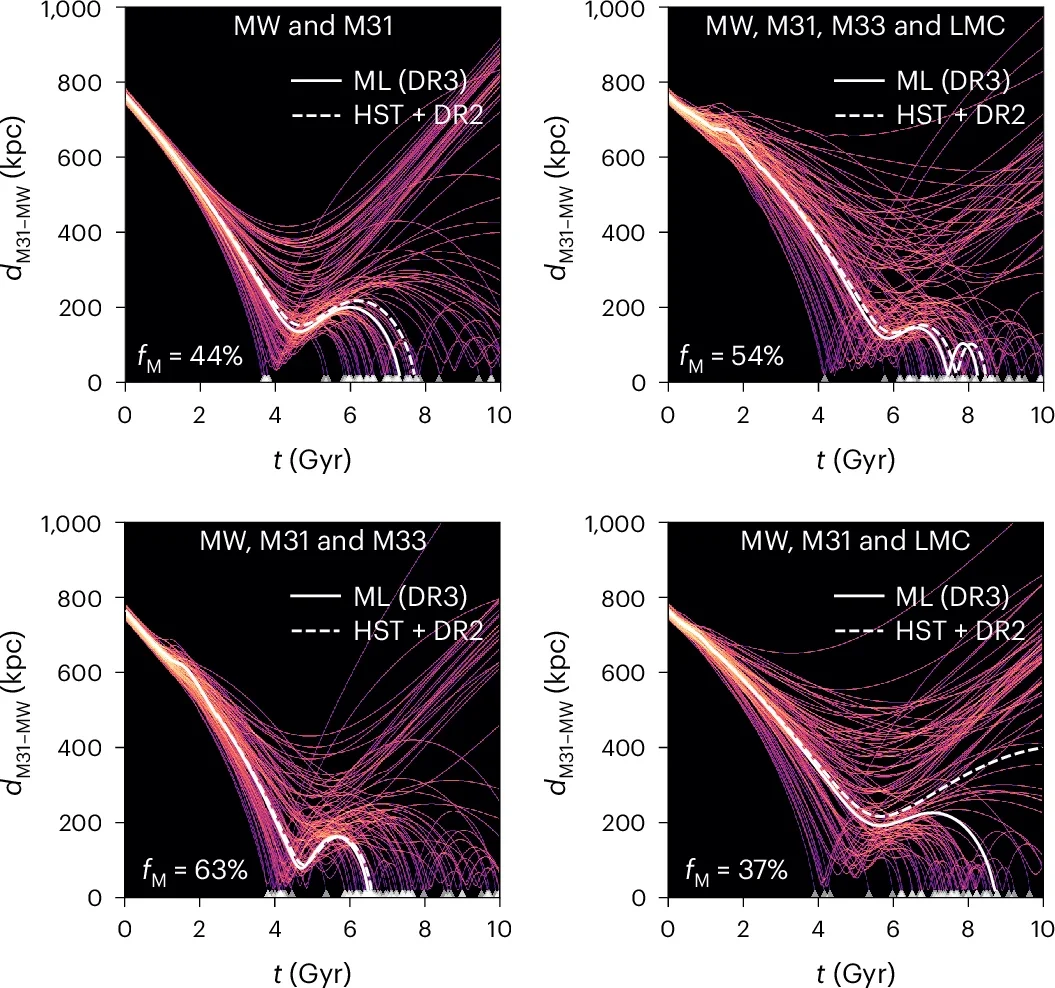
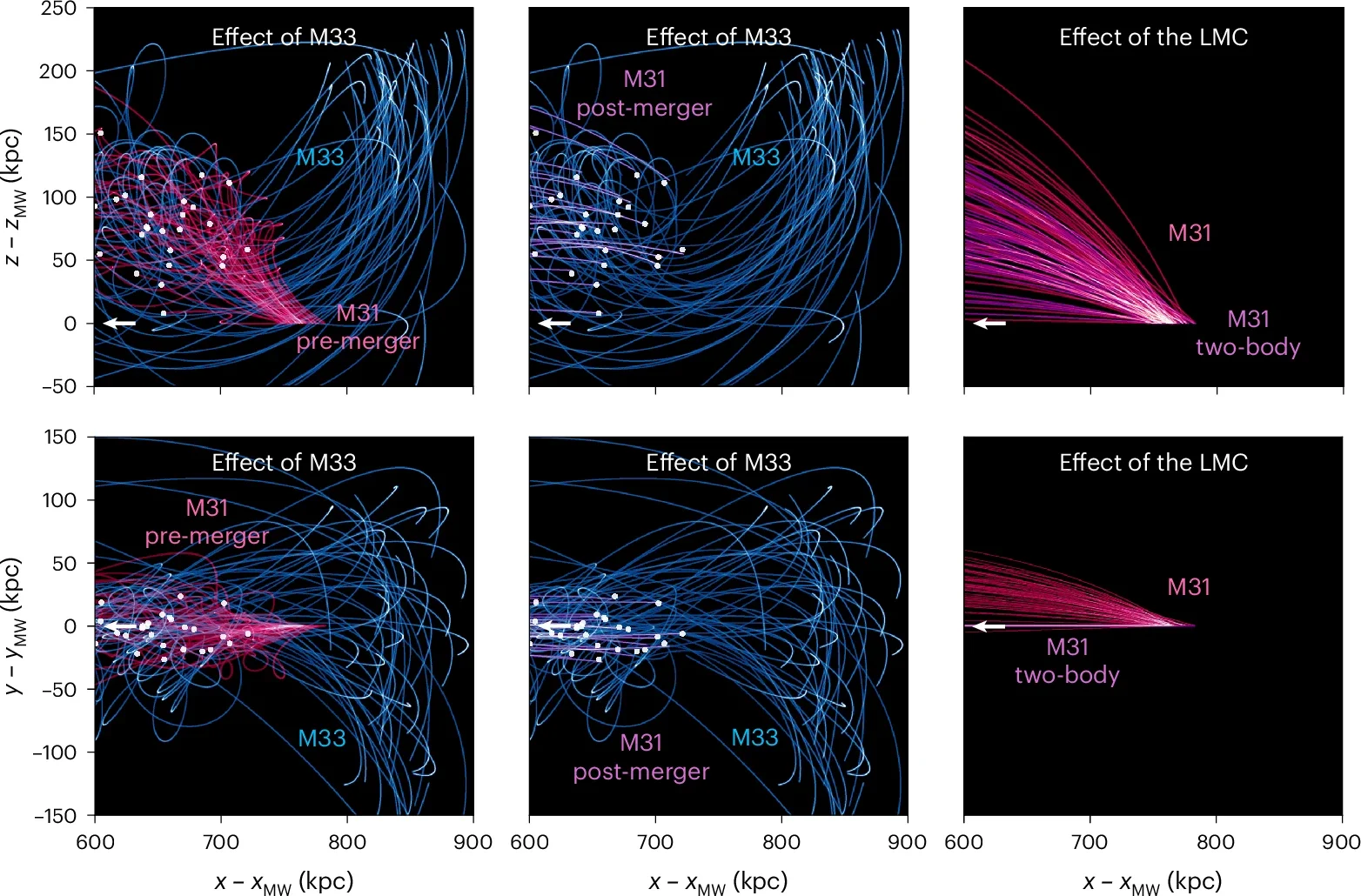
M33 and the Large Magellanic Cloud pulled the forecast in opposite directions.
M33 increased the chance of a Milky Way-Andromeda merger. Its gravity reduced Andromeda’s sideways motion relative to the Milky Way, encouraging a closer encounter.
The Large Magellanic Cloud had the opposite effect. Although its mass is only about 15% of the Milky Way’s, its pull changes the Milky Way’s motion and adds movement outside the original orbital plane.
“In earlier studies, researchers often focused only on the most likely measurements,” Sawala said. “We’ve simply been able to explore a much larger space of possibilities, thanks to better data.”
A model containing only the Milky Way and Andromeda produced mergers in slightly fewer than half of the simulations. Adding M33 raised the probability to about two-thirds. Adding only the Large Magellanic Cloud lowered it to slightly more than one-third.
When all four galaxies were included, the chance of the Milky Way and Andromeda merging within 10 billion years stood just above 50%.
The timing also shifted. Among simulations that ended in a merger, the median collision occurred after 7.6 billion years, much later than the familiar five-billion-year prediction.
Only about 2% merged during the next five billion years.
The Large Magellanic Cloud always merged with the Milky Way in the calculations. M33 had an 86% chance of joining Andromeda first.
The simulations produced two distinct outcomes.
In roughly half, the Milky Way and Andromeda passed close enough for their orbits to decay. They then merged, usually after an initial encounter, creating an intermediate-mass elliptical galaxy.
In most remaining cases, the galaxies never approached within about 200 kiloparsecs, or roughly 650,000 light-years. Without a close pass, dynamical friction could not pull them together.
“These results significantly alter our understanding of our galaxy’s fate,” said Alis Deason of Durham University’s Institute for Computational Cosmology. “We once thought we’d merge to form a colossal galaxy nicknamed ‘Milkomeda.’ Now, there’s a real chance we might avoid this entirely.”
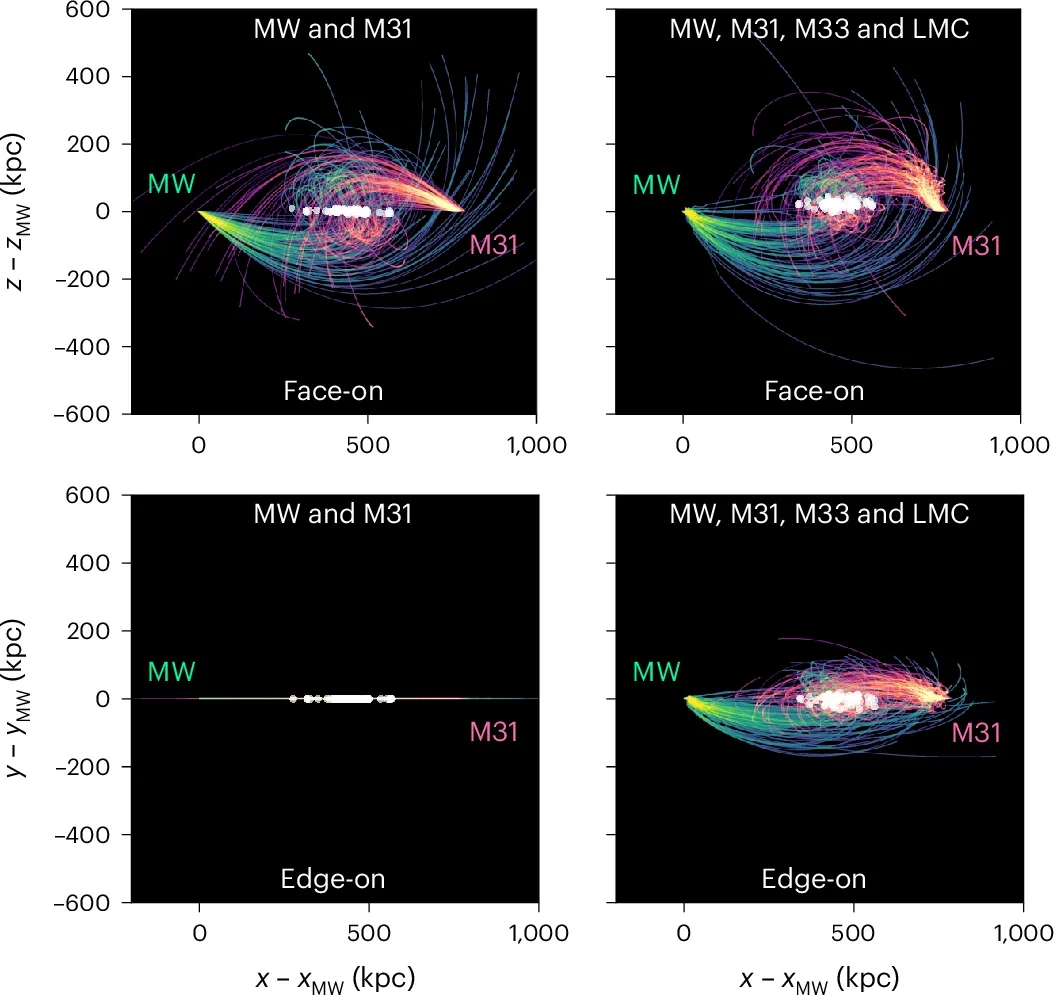
Earlier calculations were not necessarily wrong. Using the same restricted assumptions, the team recovered similar paths and timing.
“When we used the same initial assumptions as earlier studies, we found the same results,” Sawala said. “The difference now is we have a broader set of data to explore, making our predictions more nuanced.”
The outcome proved especially sensitive to Andromeda’s proper motion and the masses of all four galaxies. Within the allowed range of Andromeda measurements, some combinations produced a merger probability above 90%, while others brought it close to zero.
More precise observations will narrow those possibilities, but Andromeda alone will not settle the question. The distances, motions and masses of M33, the Large Magellanic Cloud and the two major galaxies also matter.
They treat the galaxies as smooth, spherical dark-matter haloes with fixed masses and concentrations. They do not fully include substructures, changing mass, gas behavior or the wider cosmic surroundings.
About a quarter of the Local Group’s bound mass may lie outside the two main haloes, adding uncertainty over billions of years.
The team tested different merger distances and treatments of dynamical friction. Those changes did not erase the central result: current observations support both survival and collision at nearly equal rates.
Future Gaia releases should improve measurements of motion across the sky. Better mass estimates and cosmologically constrained simulations may also sharpen the forecast.
“I’m astonished we can simulate such vast star collections over billions of years and determine their eventual fate,” said Carlos Frenk of Durham University. “This truly showcases the power of modern physics and computing.”
The findings replace a seemingly fixed prediction with a probability that can be tested and refined. They show how small measurement uncertainties can reshape forecasts on enormous scales when several galaxies exchange momentum.
The work identifies the measurements that matter most: Andromeda’s sideways motion, the masses of the four largest Local Group galaxies and the positions and velocities of M33 and the Large Magellanic Cloud.
The Milky Way may still merge with Andromeda. It may also pass by and remain separate into the future. For now, the most accurate answer is not a date, but an unresolved cosmic coin toss.
Research findings are available online in the journal Nature Astronomy.
The original story “New findings revise the Milky Way-Andromeda collision odds into a cosmic coin toss” is published in The Brighter Side of News.
Like these kind of feel good stories? Get The Brighter Side of News’ newsletter.
The post New findings revise the Milky Way-Andromeda collision odds into a cosmic coin toss appeared first on The Brighter Side of News.


Leave a comment
You must be logged in to post a comment.