Earth may have crossed a crucial threshold for the emergence of life surprisingly soon after the planet formed.
A new computer reconstruction suggests that by roughly 4.33 billion years ago, portions of Earth’s crust could remain cool and stable long enough for complex prebiotic chemistry to persist. Earlier environments may repeatedly have been reset by enormous asteroid, comet and planetesimal impacts.
The study, published in Nature Communications, was co-led by Planetary Science Institute senior scientist Oleg Abramov. Researchers used a three-dimensional thermal model to reconstruct how bombardment affected Earth’s crust between 4.5 billion and 3.5 billion years ago.
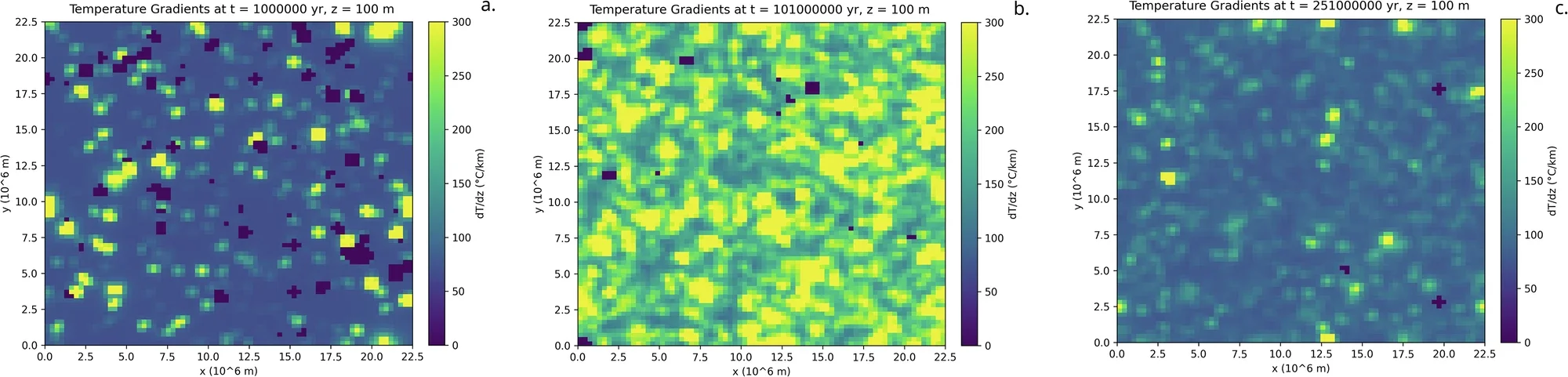
Their simulations point to an important transition after about 4.4 billion years ago. Large impacts became less capable of repeatedly overheating the entire shallow crust, while hydrothermal environments created by impacts remained common.
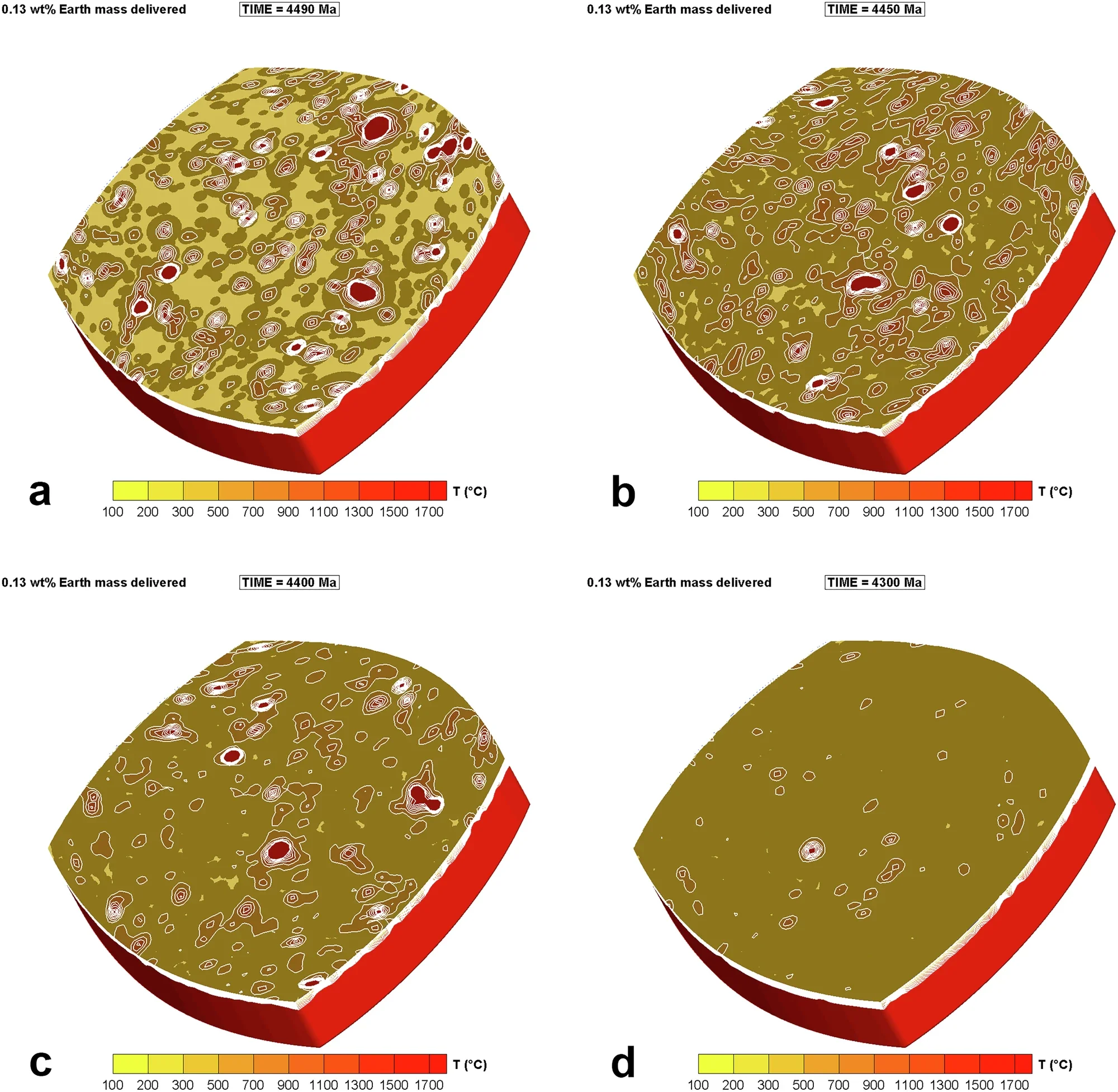
“These criteria point to the Earth becoming suitable for an early stage of life between 4.4 billion and 4.3 billion years ago, with optimal conditions at approximately 4.33 billion years ago,” Abramov said.
Life needs more than the right chemical ingredients. Those molecules also need enough time in a suitable environment to accumulate, interact and form increasingly complicated systems.
That continuity may have been difficult to achieve on the young Earth.
Following the Moon-forming impact roughly 4.5 billion years ago, the inner Solar System remained crowded with leftover planetary material. Asteroids, comets and planetesimals continued crashing into Earth during a period known as late accretion.
The largest collisions could generate enormous quantities of heat, vaporize oceans and leave hot rock spread across broad portions of the planet. Even areas that cooled between impacts could later be reheated.
For prebiotic chemistry, that repeated disruption creates a problem. Molecules such as RNA components, peptides and lipids can break down when exposed to high temperatures.
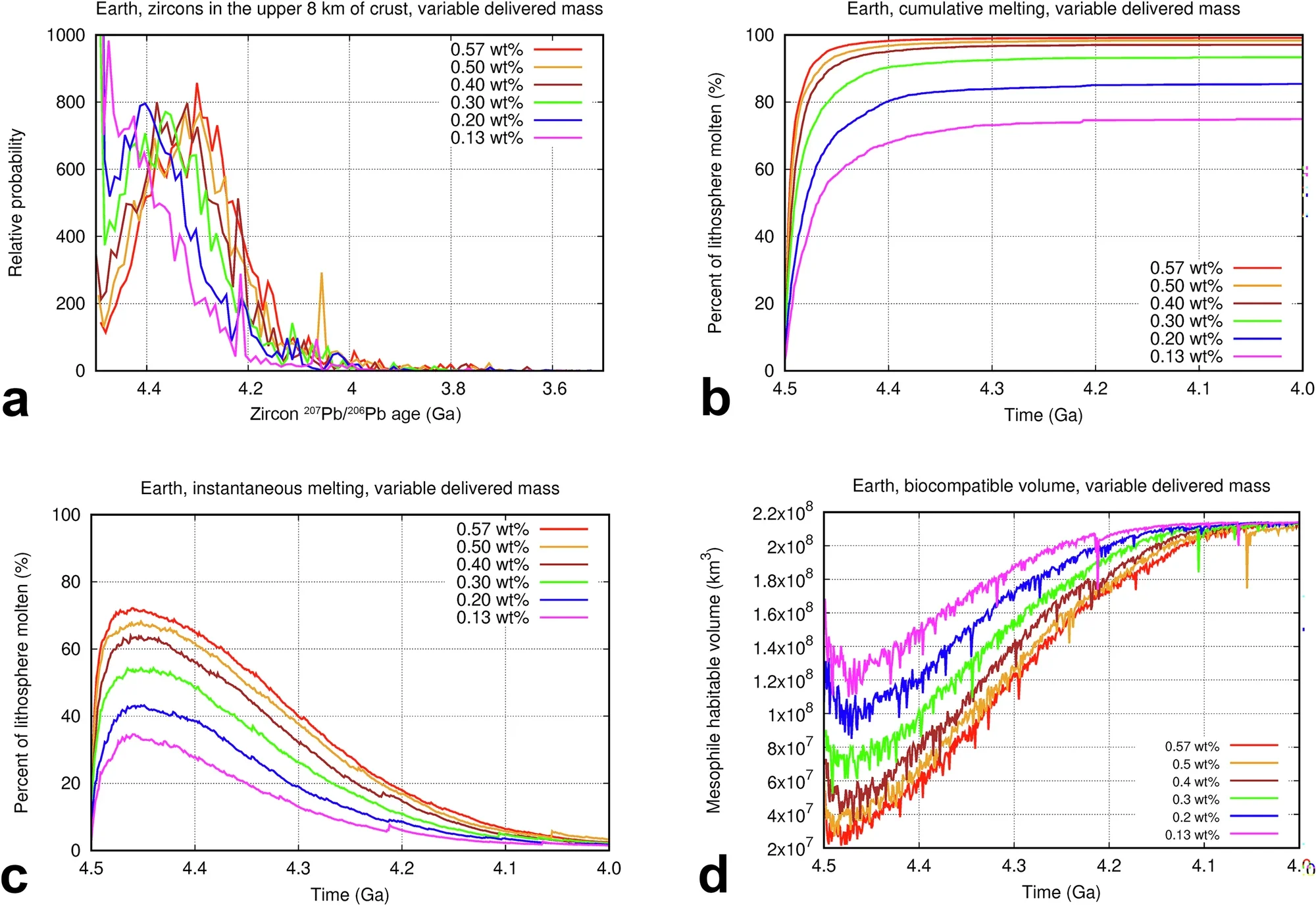
“Prebiotic chemistry needs continuously stable temperatures, not just a brief cool interval between impacts,” Abramov said. “Before about 4.4 billion years ago, a region that had cooled enough for prebiotic chemistry could still be heated again by a later impact, so the clock kept resetting.”
The researchers approached the origin-of-life timeline through planetary physics rather than starting with biological evidence.
Their three-dimensional model reconstructed impact heating throughout Earth’s crust while bombardment gradually declined. The impact history was constrained using evidence including the Moon’s crater record and highly siderophile elements preserved in Earth’s mantle.
The team then compared simulated crustal temperatures with conditions under which important biological molecules could remain stable.
A key distinction involved environments that were merely cool at a particular moment and areas that stayed cool afterward.
The researchers called the latter “never-sterilized” regions. Once such a region cooled below the study’s temperature threshold, no later modeled impact pushed it above that limit again.
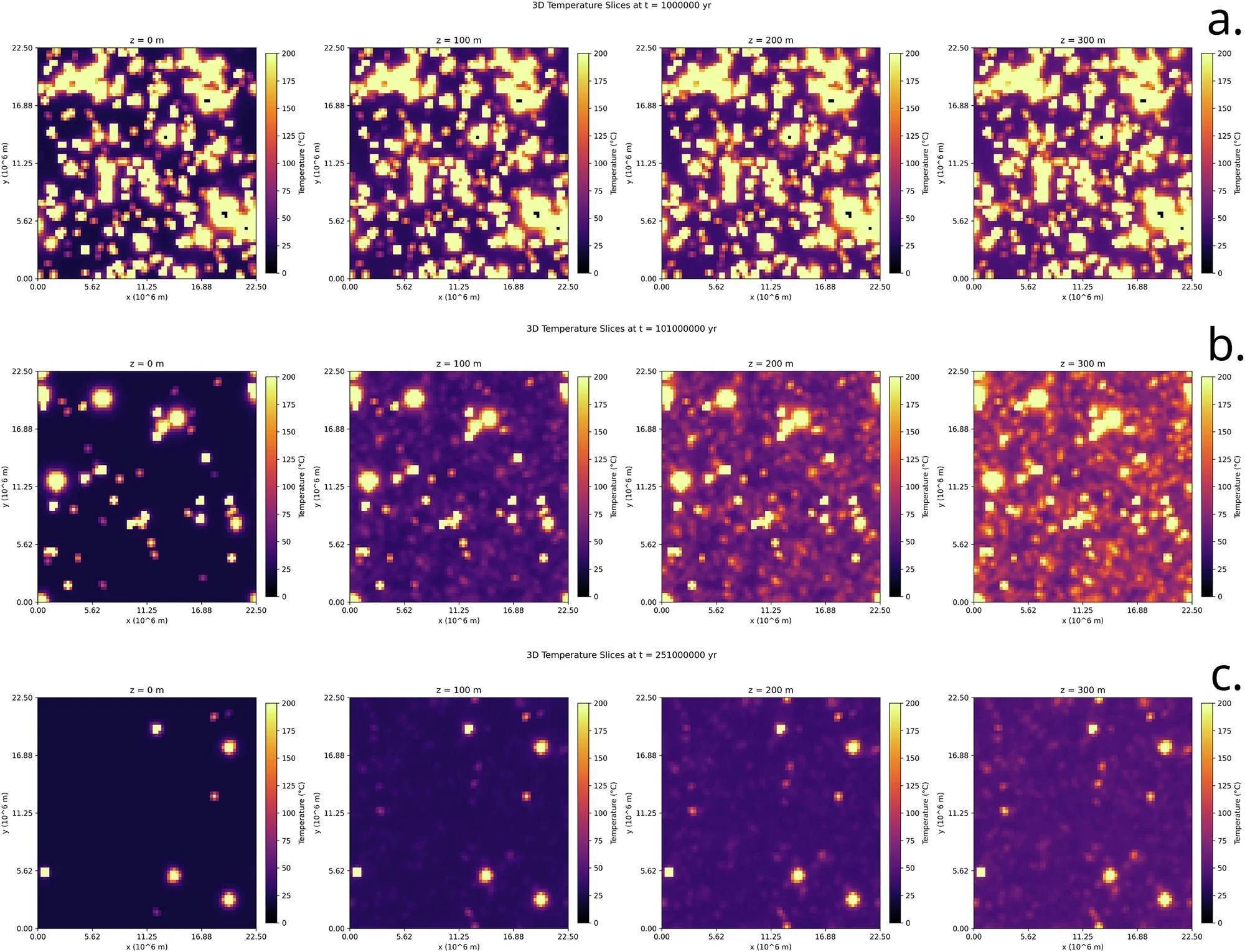
Those persistent environments first began appearing after approximately 4.4 billion years ago. As impacts became less intense, they expanded.
By about 4.25 billion years ago, more than half of the modeled shallow crust had entered this persistent state.
The researchers were particularly interested in the RNA World hypothesis.
RNA can store genetic information while also performing chemical functions that today are often handled by proteins. That combination has made an RNA-based stage one prominent model for life before the modern DNA-protein system developed.
The study does not attempt to demonstrate that an RNA World actually existed 4.33 billion years ago. Instead, it asks when Earth’s physical environment could have supported the long-term survival of molecules needed for such chemistry.
The answer appears to fall shortly after 4.4 billion years ago.
That timing is broadly compatible with other evidence suggesting that early Earth cooled quickly. Ancient zircons indicate that liquid water was interacting with crust by about 4.3 billion years ago.
Recent molecular-clock estimates have also placed the last universal common ancestor, or LUCA, between about 4.09 billion and 4.33 billion years ago. LUCA was not necessarily the first living organism. It represents the ancestral population from which all known cellular life ultimately descends.
Any RNA-based or more primitive biological systems would therefore have preceded it.
Asteroid impacts were not purely destructive.
An impact injects tremendous heat into fractured rock. As groundwater circulates through that hot material, it can create hydrothermal systems containing water, minerals, thermal gradients and chemical energy.
Such environments have long been proposed as possible settings for reactions connected with the origin of life.
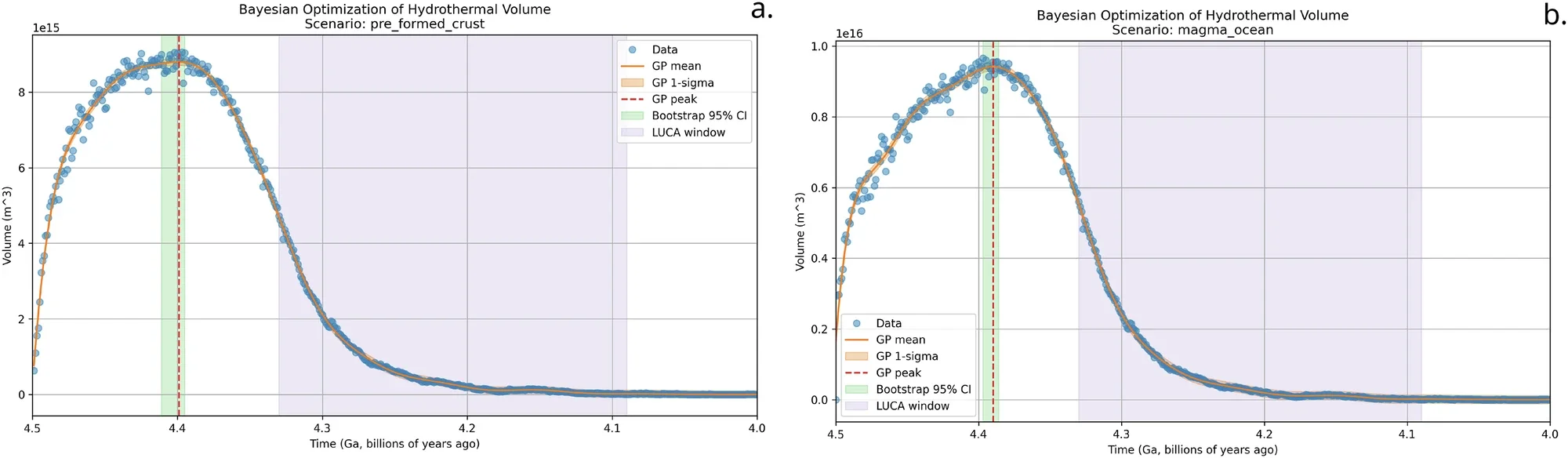
The simulations found a useful overlap. As Earth approached 4.4 billion years ago, globally devastating impacts were becoming rarer, but impacts were still energetic enough to generate widespread hydrothermal environments.
Impact-generated hydrothermal volumes peaked around that period before declining with the falling bombardment rate. Interconnected hydrothermal clusters became particularly abundant around 4.3 billion years ago.
That combination produced the study’s proposed sweet spot near 4.33 billion years ago: enough planetary stability for delicate chemistry to persist, paired with abundant chemically active environments.
The researchers emphasize that the model identifies physical conditions suitable for prebiotic chemistry rather than the moment life actually appeared.
The amount of material that struck early Earth remains uncertain, and changing that assumption shifts the estimated timing. Different chemical models for the origin of life also require different environmental conditions.
RNA-first chemistry is only one possibility. Other hypotheses propose that metabolic networks emerged before sophisticated genetic systems, while another possibility involves RNA and peptides developing together.
The modeling remains relevant to several of those ideas because all require environments where useful molecules can survive long enough to participate in repeated reactions.
What the study narrows is the physical window.
Earth began as a world repeatedly transformed by enormous impacts. Within roughly 200 million years of its formation, however, parts of its crust may have crossed from temporary habitability into lasting chemical stability.
If the earliest steps toward life needed a quiet place to persist, the new simulations suggest that opportunity may have arrived around 4.33 billion years ago.
These resources explore the early environment, RNA-based chemistry and geological evidence surrounding the emergence of life.
Microbial habitability of the Hadean Earth during the late heavy bombardment: Earlier thermal modeling showed that even intense bombardment may not have sterilized every potential microbial habitat on early Earth. (Nature, 2009)
Oxygen-isotope evidence from ancient zircons for liquid water at the Earth’s surface 4,300 Myr ago: Ancient zircons provide evidence that liquid water interacted with Earth’s crust more than 4.3 billion years ago. (Nature, 2001)
The nature of the last universal common ancestor and its impact on the early Earth system: Molecular-clock analysis places LUCA at roughly 4.2 billion years ago and reconstructs an already established early ecosystem. (Nature Ecology & Evolution, 2024)
A prebiotically plausible scenario of an RNA–peptide world: Laboratory chemistry demonstrates a possible pathway in which RNA and peptides could have coevolved during early molecular evolution. (Nature, 2022)
The Origin of Life—Out of the Blue: This review examines chemical pathways capable of producing important molecular building blocks under plausible early-Earth conditions. (Angewandte Chemie International Edition, 2016)
Research findings are available online in the journal Nature Communications.
The original story “New 3D model finds Earth may have become ready for life 4.33 billion years ago” is published in The Brighter Side of News.
Like these kind of feel good stories? Get The Brighter Side of News’ newsletter.
The post New 3D model finds Earth may have become ready for life 4.33 billion years ago appeared first on The Brighter Side of News.


Leave a comment
You must be logged in to post a comment.