Two blue-green worlds near the edge of the solar system may conceal different histories beneath their clouds. Uranus and Neptune resemble each other in size and broad planetary structure. Their hidden chemistry, however, may preserve clues that their building materials came from different environments around the young Sun.
A study in Astronomy & Astrophysics examines that possibility using atmospheric chemistry and planet-formation models. Led by Tom Briand, the international team includes Southwest Research Institute scientist Olivier Mousis. The results favor a more oxygen-rich deep atmosphere on Neptune.
“Uranus and Neptune may resemble twins today, but their chemistry is telling us that they are more like cousins with very different histories,” Mousis said. That interpretation is promising, but remains dependent on models of inaccessible atmospheric layers and the disk from which the planets formed.
Neither planet has an Earth-like solid surface beneath its visible clouds. Their outer atmospheres contain abundant hydrogen and helium, while deeper layers become increasingly difficult to characterize. Much of their elemental composition must therefore be inferred indirectly.
Water is especially difficult to measure because its cloud layer lies far beneath the levels accessible to many observations. Carbon monoxide provides an alternative clue. Its abundance is linked to water through chemical reactions in the hot, deep atmosphere.
At great depth, reactions proceed quickly enough to maintain chemical equilibrium. Rising gas cools until those reactions become slower than atmospheric transport. The carbon monoxide abundance then becomes effectively frozen into the moving gas, preserving information about conditions farther below.
Interpreting that signal requires care because carbon monoxide can also arrive from outside a planet. Comet impacts and other external sources can affect the upper atmosphere. The study focuses on the tropospheric component used to investigate the deeper reservoir, rather than treating every detected molecule as internally produced.
Recent observations from the Atacama Large Millimeter/submillimeter Array established carbon monoxide’s presence in Uranus’s troposphere. Briand and colleagues analyzed the 2022 observations separately to avoid combining measurements obtained under different viewing geometries. Their estimate was 5.6 parts per billion, with an uncertainty of 0.2 parts per billion.
For Neptune, they used an established tropospheric estimate of 0.20 parts per million, with an uncertainty of 0.05. That corresponds to approximately 200 parts per billion. The difference is substantial, but it does not translate directly into an equivalent difference in oxygen abundance.
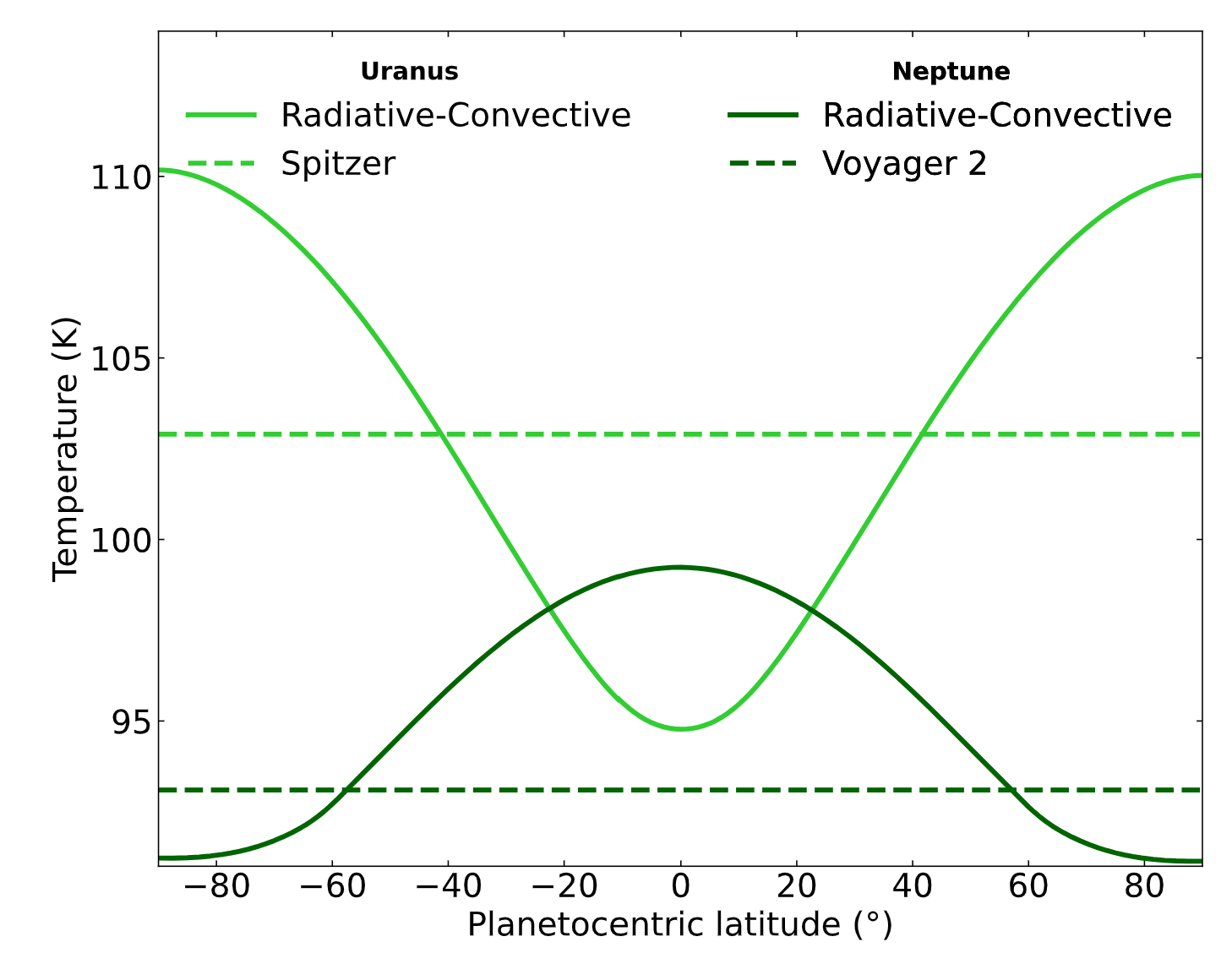
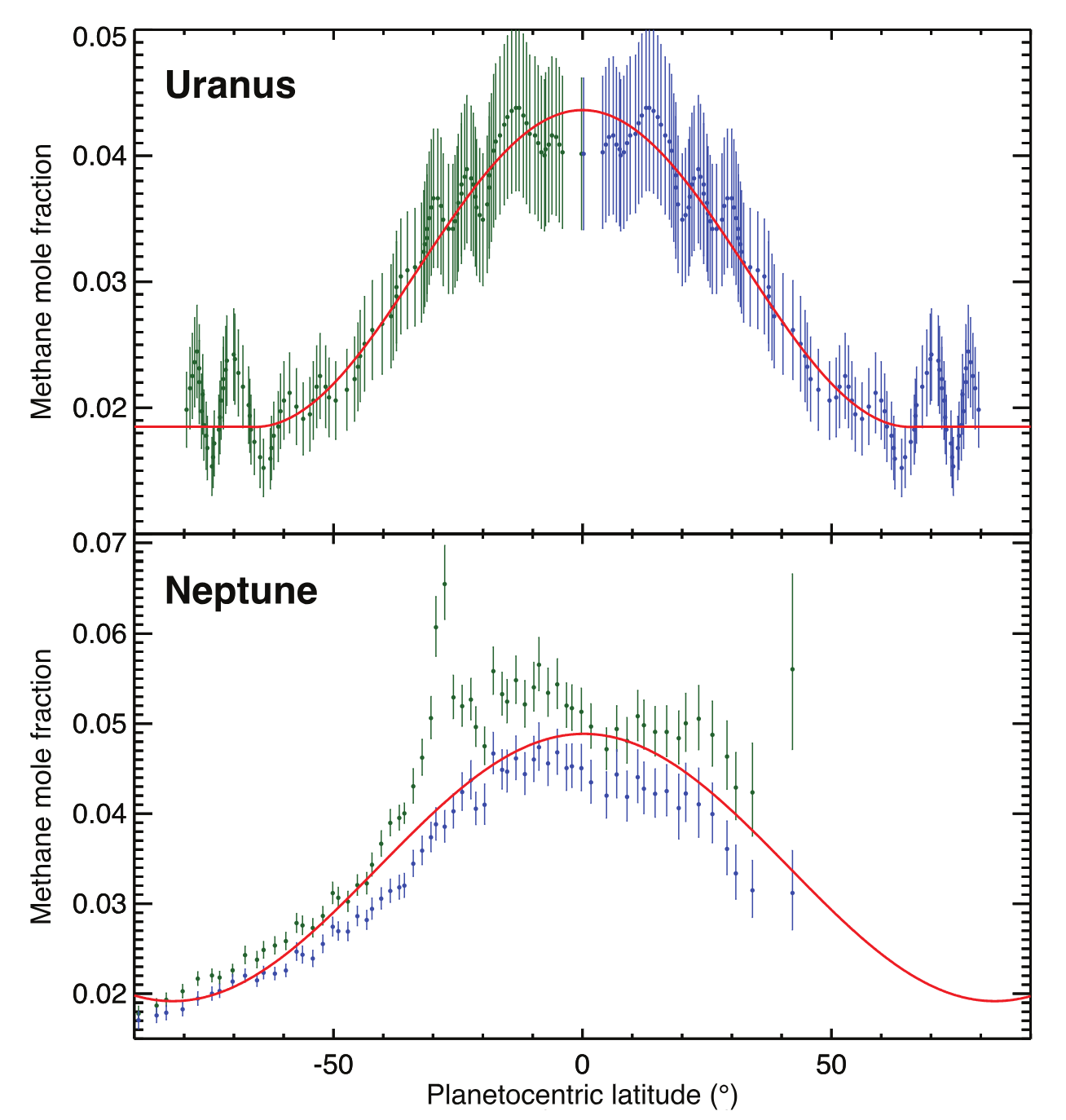
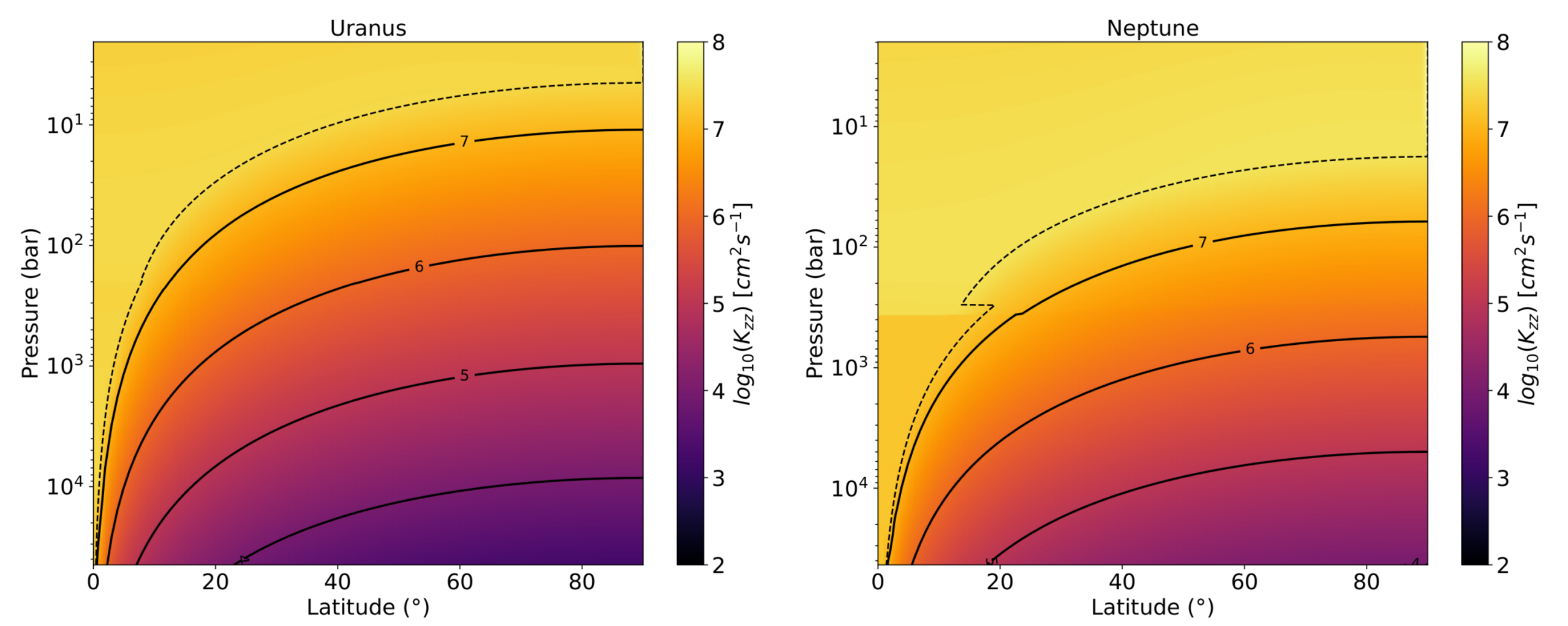
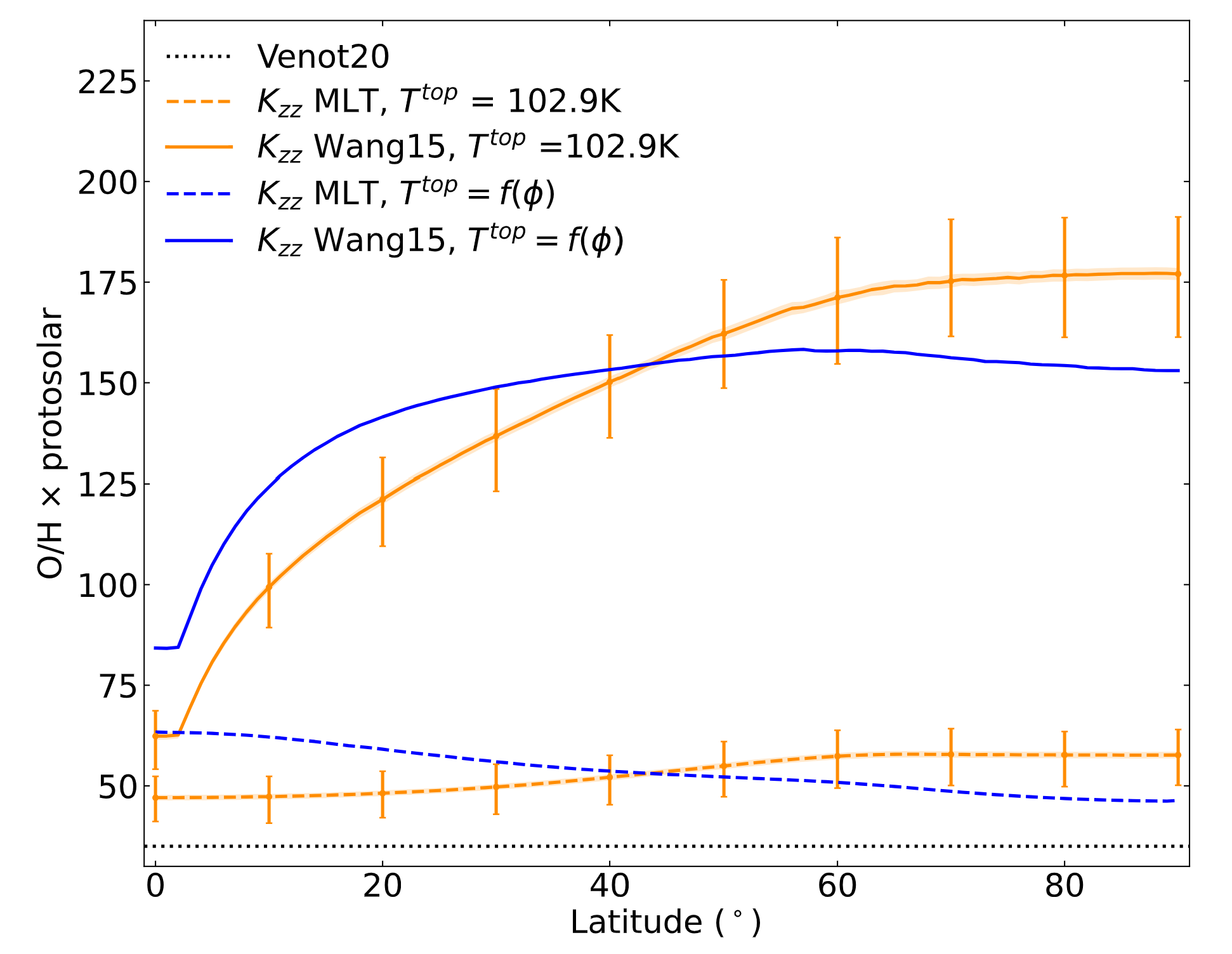
The team used a chemistry-and-transport model to connect the observations with the hidden atmosphere. It allowed temperature, methane abundance and mixing efficiency to vary with latitude. It also considered how condensation can inhibit convection and alter the temperature structure beneath clouds.
In one configuration, allowing mixing to vary with latitude while holding the upper temperature boundary fixed, Uranus required oxygen-to-hydrogen enrichment of roughly 62 to 177 times the protosolar value. Neptune required approximately 222 to 342 times that reference. These are inferred enrichment ratios relative to the young solar system’s composition, not direct oxygen measurements or percentages.
To investigate formation, the researchers combined their oxygen estimates with modeled carbon abundances. Their inferred carbon-to-oxygen ratios ranged from approximately 0.06 to 0.52 for Uranus and 0.02 to 0.12 for Neptune. A lower ratio means less carbon relative to oxygen.
Here, oxygen means the element incorporated into substances such as water. The results do not describe reservoirs of breathable oxygen gas. They concern the chemical inventory that could have contributed to building the planets.
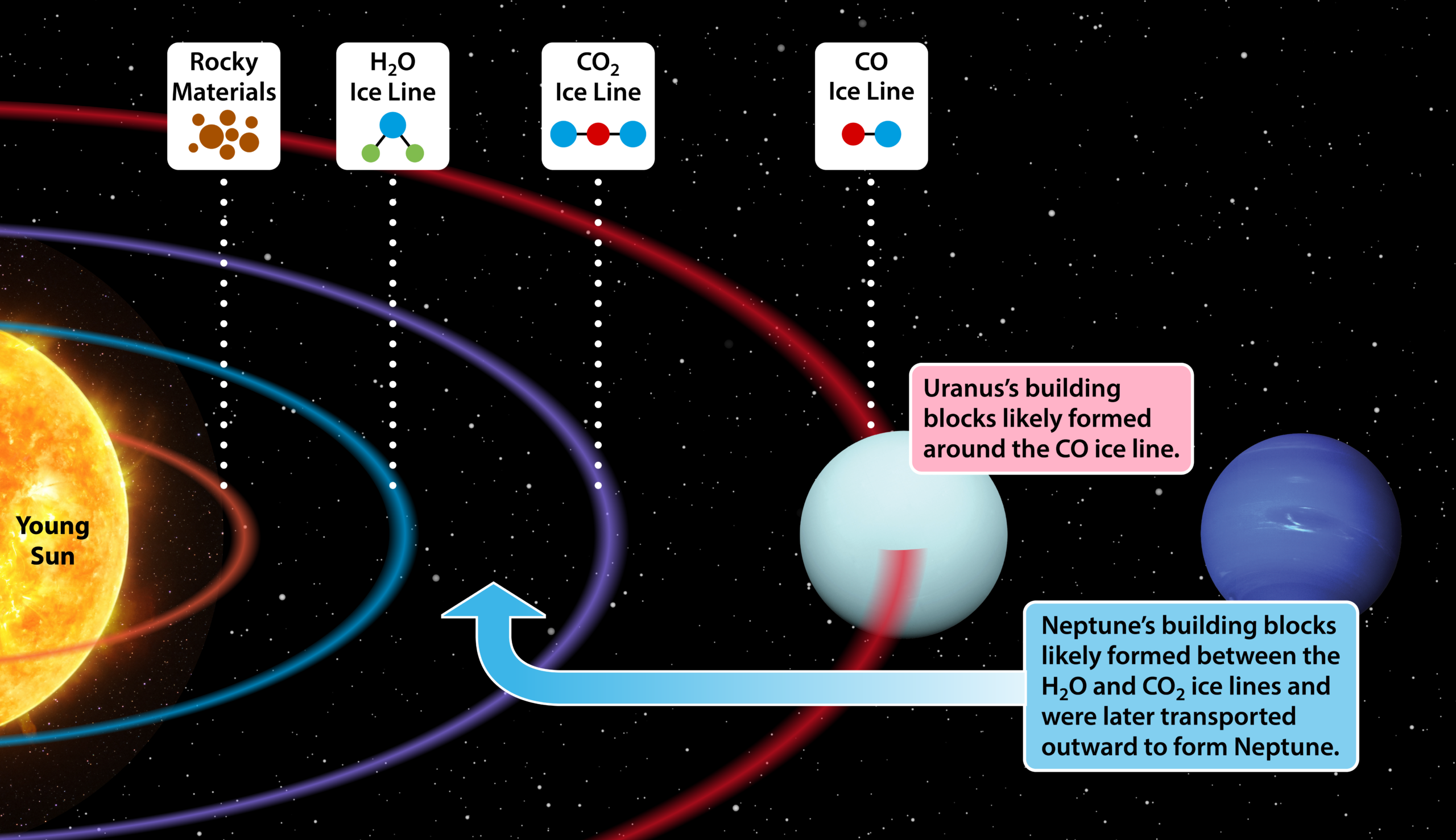
The team compared those ratios with a model of the protoplanetary disk, the gas-and-dust structure surrounding the young Sun. Different compounds condense at different temperatures. Their ice lines therefore create regions with different mixtures of solid and gaseous ingredients, while cooling and transport shift those boundaries over time.
Near the water ice line, solids can become rich in water while much of the carbon remains gaseous. Such material could help explain Neptune’s low inferred carbon-to-oxygen ratio. Under the model’s assumptions, that favors ingredients associated with a region closer to the Sun than Neptune’s present orbit.
The interpretation is compatible with formation nearer the Sun followed by outward migration. However, the study did not trace a unique journey for Neptune or its building blocks. It compared chemical requirements with possible disk environments.
The oxygen contrast is not a simple chemical fingerprint with only one possible explanation. Vertical mixing strongly affects how much carbon monoxide reaches observable levels. Slower transport can require a different deep oxygen abundance to reproduce the same measured signal.
The authors identify the magnitude of that mixing as their largest modeling uncertainty. Rotation, magnetic effects and condensation can influence it. They also explore whether weaker mixing on Uranus could reconcile the planets with more similar deep compositions.
Their carbon-to-oxygen ranges overlap between approximately 0.06 and 0.12. That overlap leaves room for shared compositional possibilities. The formation comparison additionally assumes that later evolution did not substantially separate carbon from oxygen, a process outside the study’s scope.
The latitude-dependent results should not be read as a measured map of different oxygen reservoirs inside either planet. The authors suggest the calculations may bracket a single, well-mixed deep reservoir. Spatially resolved carbon monoxide observations could help distinguish actual chemical differences from transport and viewing effects.
Voyager 2 remains the only spacecraft to have visited either world, passing Uranus in 1986 and Neptune in 1989. An orbiter and atmospheric probe could supply measurements that remote observations cannot. The study suggests that low-latitude sampling may offer particular value because mixing is expected to be more efficient there.
Even a probe reaching about 10 bars would remain above the expected deep water cloud. Its measurements of trace gases could nevertheless test atmospheric models and constrain transport. Direct exploration would complement the chemical inference rather than automatically measure the entire planetary inventory.
The proposed Uranus Orbiter and Probe was identified as a top-priority new flagship mission by the planetary science decadal survey. A 2026 mission-concept study examined later launch opportunities. Those studies provide planning options, rather than a confirmed launch date.
Understanding these worlds also matters beyond the solar system, where planets of comparable size are common. Better constraints on Uranus and Neptune would help scientists interpret distant planets whose interiors remain unresolved. For now, their apparent resemblance offers a useful warning: Similar-looking planets need not have assembled from identical ingredients.
These five publications explain the observations, chemical models and mission concepts behind efforts to understand Uranus and Neptune.
Research findings are available online in the journal Astronomy & Astrophysics.
The original story “Neptune and Uranus appear to have significantly different chemical origins” is published in The Brighter Side of News.
Like these kind of feel good stories? Get The Brighter Side of News’ newsletter.
The post Neptune and Uranus appear to have significantly different chemical origins appeared first on The Brighter Side of News.


Leave a comment
You must be logged in to post a comment.