Some of the universe’s smallest galaxies contain a surprisingly similar proportion of iron, despite holding different amounts of stars. Computer simulations now offer an explanation: a single explosion from a very massive first-generation star could have supplied much of that iron. The finding gives astronomers a testable way to investigate stars that disappeared billions of years ago.
The result comes from MEGATRON, an international simulation project led by researchers at the University of Bath. Collaborators include the University of Chicago and France’s Institut d’Astrophysique de Paris. Four papers published in The Open Journal of Astrophysics examine how starlight, gas and chemistry shaped young galaxies.
One paper follows the chemical legacy of the first stars into hundreds of simulated dwarf galaxies. Its central finding concerns an iron pattern already measured in nearby galaxies, rather than a direct observation of the earliest stellar explosions. Other MEGATRON studies investigate galaxy spectra and the gas within and around galaxies.
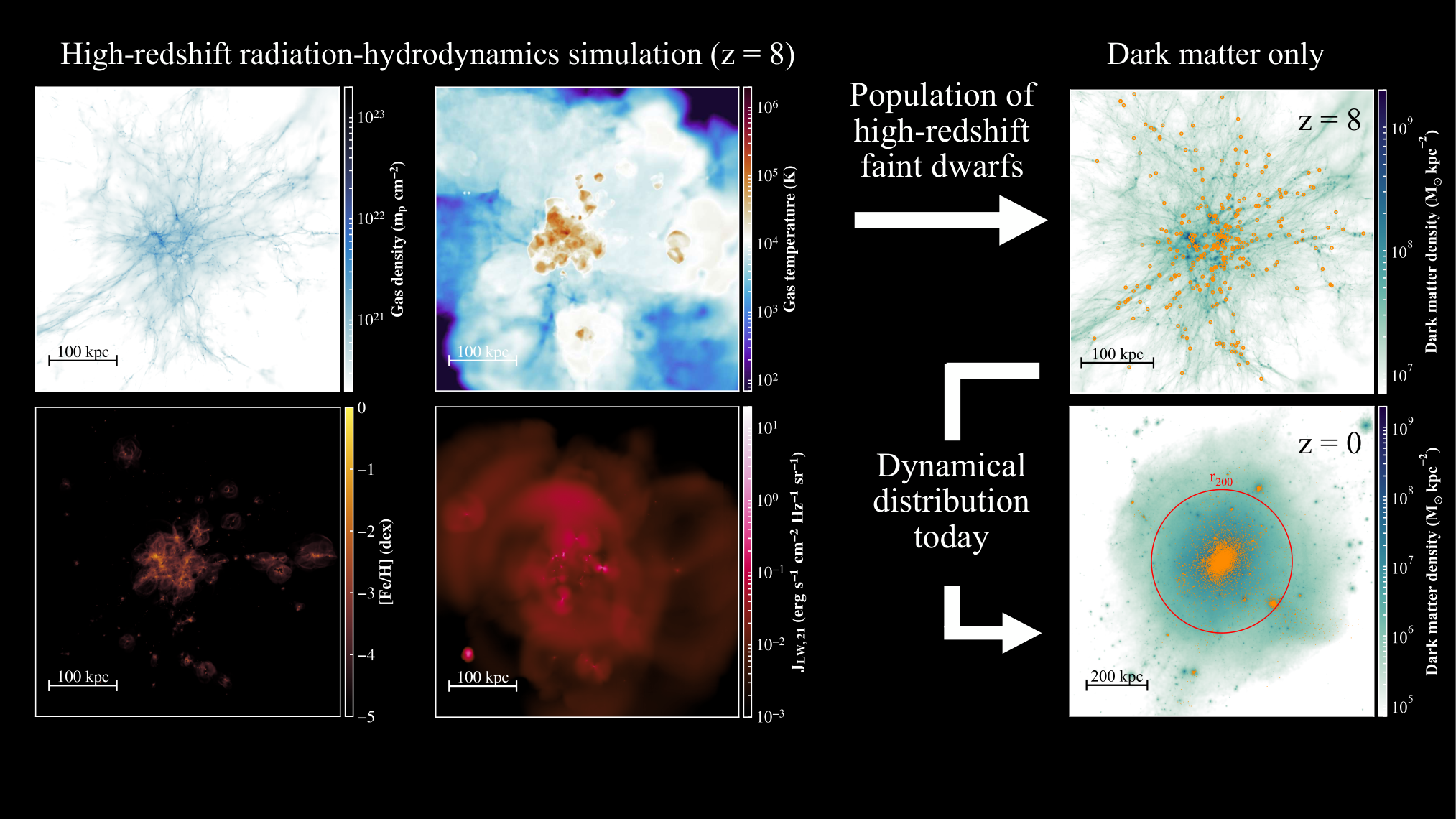
Astronomers approach the early universe from two directions. The James Webb Space Telescope observes distant galaxies whose light began traveling when the cosmos was young. Closer to home, ancient stars preserve chemical clues about the gas from which they formed.
Those surviving stars generally belong to later generations, rather than the original stars that first illuminated space. Their atmospheres can nevertheless retain evidence of elements produced by earlier stars. Comparing those chemical records with distant galaxies requires models that connect stellar births, radiation, explosions and the movement of gas.
Martin Rey, a physicist at Bath and a lead MEGATRON contributor, described that connection. “The James Webb Space Telescope gives us a direct glimpse of the infant cosmos, while stellar archaeology allows us to study the relics of those earliest times in our own Galactic neighbourhood,” he said. “MEGATRON provides a physical bridge between the two.”
The distinction matters because the two approaches measure different things. Distant galaxy observations often reveal oxygen in glowing gas, while nearby stellar studies commonly measure iron. A successful model must explain how such different chemical records developed from the same underlying processes.
The simulations begin with gas lacking the heavy elements that stars would later produce. Astronomers call elements heavier than helium “metals,” including familiar substances such as carbon and oxygen. The first stars formed from this unenriched material, then altered the conditions for subsequent generations.
That enrichment changed more than the ingredients available for eventual planets. Heavy elements also help gas lose heat, influencing how subsequent stars form and how galaxies develop. Following their movement through space therefore lets the team investigate both the origin of chemical elements and the physical conditions that allowed later generations of stars to emerge from gas transformed by earlier stellar activity.
MEGATRON follows gravity, flowing gas, traveling radiation and changing chemistry together. Its chemical network includes more than 80 types of atoms, ions and molecules, rather than 80 separate elements. Tracking these interactions helps show where gas cools, gathers and becomes capable of forming stars.
For the iron study, the team simulated a region expected eventually to assemble into a galaxy with roughly the Milky Way’s mass. Four versions began with the same initial conditions but changed assumptions about how later generations of stars formed and affected their surroundings. The calculations resolved structures only a few parsecs across; one parsec equals about 3.26 light-years.
These detailed simulations cover an early period within the universe’s first billion years. They do not follow every gas cloud and star through to the present day. Separate calculations help the researchers estimate which early galaxies might survive around the eventual larger galaxy.
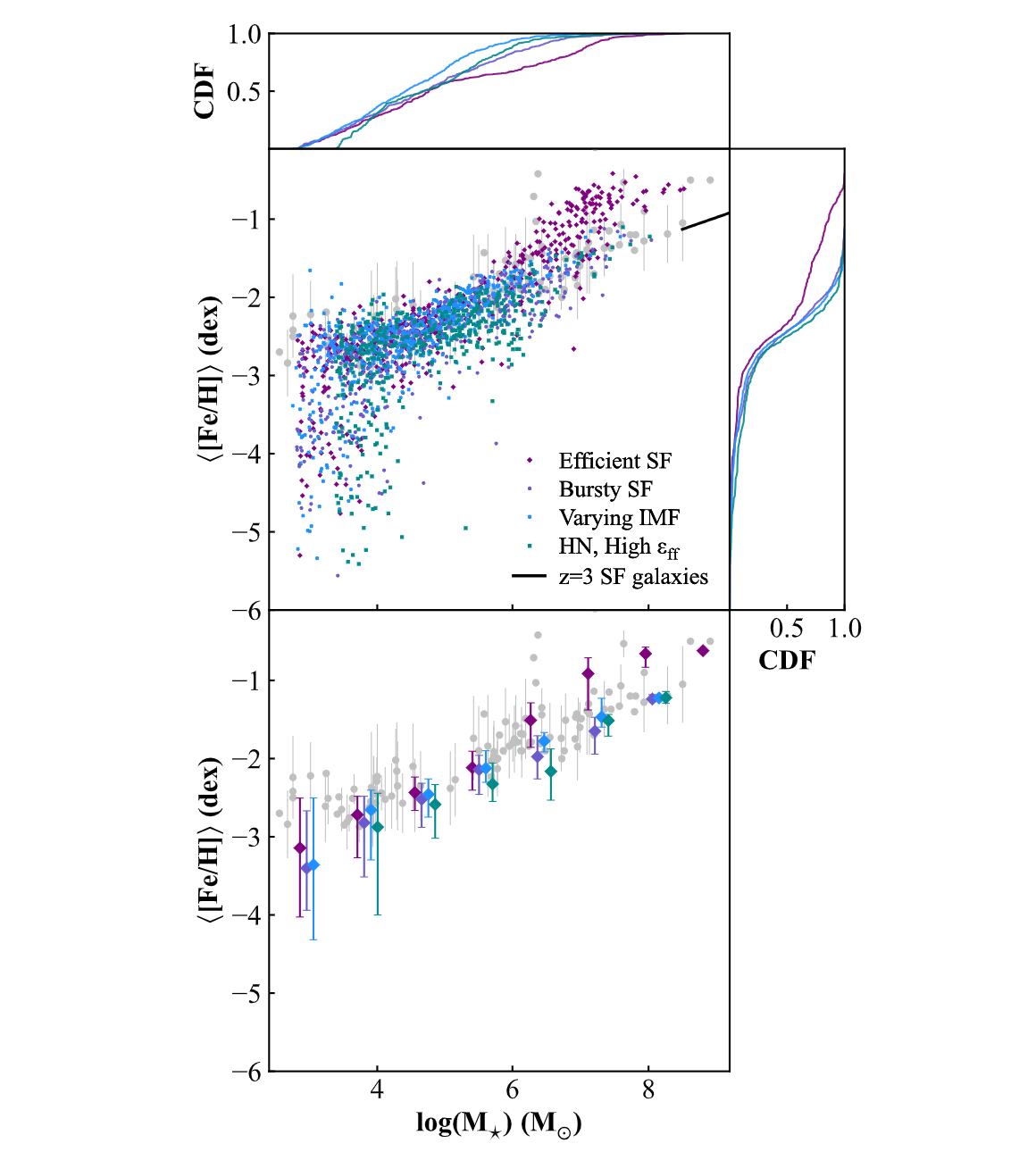
Larger galaxies generally contain more iron relative to hydrogen than smaller galaxies do. Among the faintest dwarf galaxies, however, that relationship flattens. Many have similar average iron abundances even as their stellar masses decline.
All four MEGATRON versions reproduced this low-mass plateau. It appeared in galaxies containing no more than about 100,000 solar masses of stars. Their characteristic iron-to-hydrogen ratio was roughly 300 times lower than the Sun’s.
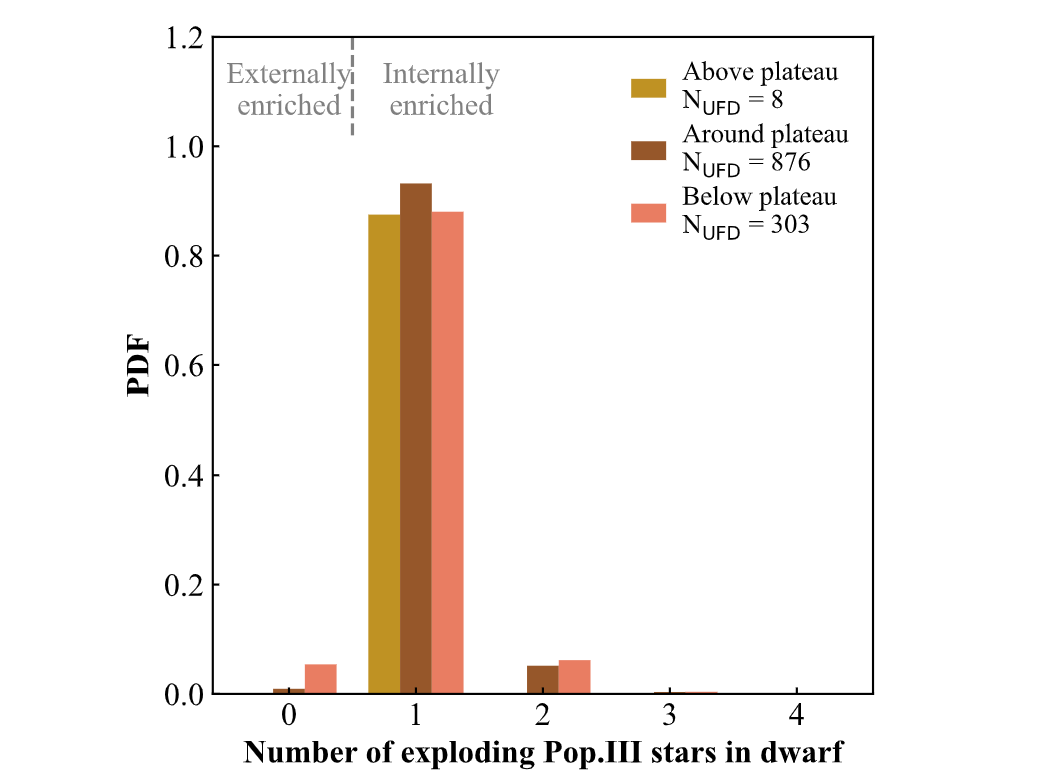
Within the simulations, the researchers traced that pattern to especially powerful explosions called pair-instability supernovae. These can destroy extremely massive stars and scatter newly forged elements into surrounding gas. A single such explosion from a sufficiently massive first star could provide the iron that establishes the plateau.
Starlight helped determine whether the iron stayed available for future stars. Certain ultraviolet photons broke apart molecular hydrogen, an important coolant in early gas clouds. Without that cooling, star formation was delayed until the surrounding dark matter structures had grown more massive.
Those larger structures exerted enough gravity to retain much of the material expelled by stellar explosions. Later stars then formed from the enriched gas, preserving its chemical signature. In this explanation, radiation affects the eventual iron record by changing when and where the first stars can form.
The agreement does not establish that this sequence actually produced the observed galaxies. Although all four versions reproduced the faint-galaxy plateau, only three matched the broader relationship between stellar mass and iron abundance well. One version retained too much iron in more massive dwarfs because its outflows were weaker.
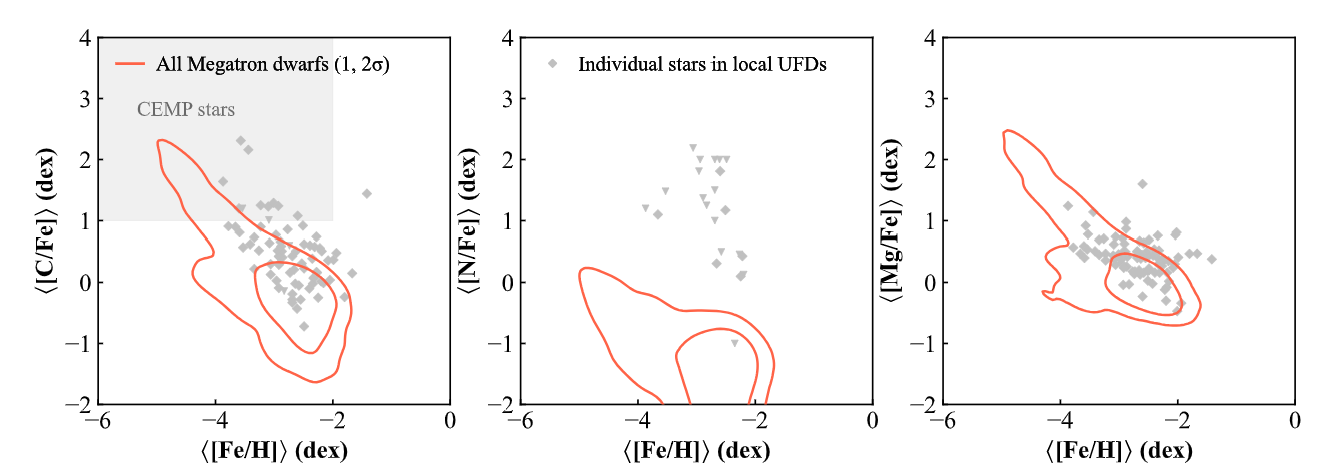
Other elements also expose gaps in the models. Predicted carbon and magnesium abundances differed from observations, and nitrogen production fell far short of measured levels. Matching iron therefore does not mean the simulations reproduce the full chemical history of early galaxies.
Crucially, all four runs used the same assumptions about the first stars. Their agreement tests changes in later stellar behavior, not the uncertain masses or explosion properties of the earliest generation. Different first-star populations, chemical yields or radiation environments could change the outcome.
The chosen region also represents one environment around a developing Milky-Way-mass galaxy. It need not match the actual history of our galaxy or conditions everywhere else. The authors acknowledge that other enrichment mechanisms could potentially explain the iron plateau.
Alongside the plateau, the simulations predict a smaller population of galaxies with substantially less iron. Roughly one-fifth of the modeled faint dwarfs had average iron-to-hydrogen ratios at least 1,000 times below the Sun’s. That prediction concerns whole-galaxy averages, not simply the discovery of an unusually iron-poor individual star.
Forecasts using a separate dark-matter-only simulation suggest that the plateau and iron-poor population could survive among present-day satellite galaxies. Those forecasts omit effects such as disruption by the larger galaxy’s stellar disk. More complete modeling is needed to sharpen the comparison with nearby systems.
Observations provide the next test. Chemical measurements remain sparse in extremely faint galaxies, making their average abundances difficult to establish. A more complete census could reveal whether the predicted iron-poor population exists, helping distinguish this account of the first stellar explosions from competing explanations.
These studies explain how astronomers model early galaxies and extract their chemical histories.
MEGATRON: Disentangling Physical Processes and Observational Bias in the Multi-Phase ISM of High-Redshift Galaxies
This study examines how gas conditions affect the properties astronomers infer from young galaxies’ light. (The Open Journal of Astrophysics, February 2026)
The Impact of Star Formation and Feedback Recipes on the Stellar Mass and Interstellar Medium of High-Redshift Galaxies
These simulations test how assumptions about star formation and stellar energy alter young galaxies and their observable properties. (The Open Journal of Astrophysics, February 2026)
JADES: The star formation and chemical enrichment history of a luminous galaxy at z ∼ 9.43 probed by ultra-deep JWST/NIRSpec spectroscopy
Detailed Webb observations reveal the chemical composition of a young galaxy, illustrating the measurements early-universe models must explain. (Astronomy & Astrophysics, May 2025)
The First Stars: Formation, Properties, and Impact
This review explains how the first stars formed, changed their surroundings and left evidence that astronomers can investigate. (Annual Review of Astronomy and Astrophysics, June 2023)
The Faintest Dwarf Galaxies
This review describes why extremely faint satellite galaxies preserve valuable evidence about early star formation and chemical enrichment. (Annual Review of Astronomy and Astrophysics, June 2019)
Research findings are available online in The Open Journal of Astrophysics.
The original story “MEGATRON simulations connect the first stars with the universe’s smallest galaxies” is published in The Brighter Side of News.
Like these kind of feel good stories? Get The Brighter Side of News’ newsletter.
The post MEGATRON simulations connect the first stars with the universe’s smallest galaxies appeared first on The Brighter Side of News.


Leave a comment
You must be logged in to post a comment.