The world’s rarest mineral does not look especially imposing at first glance. It is a faceted orange gem, just 1.61 carats, small enough to sit easily on a fingertip. Yet that tiny stone, recovered from northern Myanmar, stands alone. No second specimen of kyawthuite has ever been confirmed, and that makes it a geological outlier with a story far larger than its size.
Its color is saturated orange with a red overtone. It is transparent, highly lustrous, and dense enough to feel heavier than it looks. Tests on the gem showed a measured density of 8.256 grams per cubic centimeter, about eight times the density of water. The mineral is also brittle, with a Mohs hardness of 5, perfect cleavage on one plane, and no fluorescence under ultraviolet light.
What makes kyawthuite remarkable is not that it is built from impossibly rare ingredients. Its simplified chemical formula is Bi3+Sb5+O4, a bismuth-antimony oxide with a small amount of tantalum. Bismuth and antimony are uncommon metals, but not vanishingly scarce in Earth’s crust. The mystery is not the ingredients. It is how nature assembled them into this one known crystal.

The mineral’s documented story began in January 2010 at Chaung-gyi, or Big Stream, just north of Mogok in Burma, now Myanmar. While visiting the alluvial gem area there, Dr. Kyaw Thu bought two waterworn crystals from a miner known as “Kha-ne-say,” one yellow and one orange.
He first suspected both stones were scheelite because of their high density and lustre. After faceting them, he confirmed that the yellow crystal was scheelite. The orange stone was something else. Its lustre differed, and its density was much higher. Unable to match it to any known gem, Kyaw Thu sent it to the Gemological Institute of America laboratory in Bangkok.
Staff there could not identify it either. X-ray diffraction work later indicated that the orange gem matched synthetic BiSbO4. That result opened the door to a more detailed study, which led researchers to describe it as a new mineral species. The International Mineralogical Association approved the mineral and its name in 2015, and its full scientific description followed in 2017.
Kyawthuite was named for Kyaw Thu, a Burmese mineralogist, petrologist, and gemologist with a PhD from Yangon University. The holotype, the reference specimen for the species, is the same 1.61-carat faceted gem and is now housed at the Natural History Museum of Los Angeles County.

Kyawthuite was found as a waterworn crystal in alluvium at Chaung-gyi-ah-le-ywa, about 5 kilometers north-northeast of Mogok. The region is geologically rich. Its rocks include leucogranite, syenite, marble, calc-silicate rocks, and gneiss. Gemstones turn up both in stream deposits and in nearby primary deposits such as marbles, skarns, and pegmatites.
That setting matters because no one saw kyawthuite form in place. The stone was found in alluvium, already worn by transport. So the researchers had to work backward from its chemistry, structure, and tiny impurities to infer where it likely came from.
Their conclusion was cautious but pointed. Kyawthuite probably crystallized in a pegmatite from a high-temperature melt or fluid. Synthetic BiSbO4 can be grown in the lab, but the authors argued that a synthetic origin was extremely unlikely in this remote gem region. The orange gemstone carried trace chemical impurities, including tantalum and very small reported amounts of titanium, niobium, tungsten, and uranium, that fit a natural origin better than a manufactured one. A series of hollow tube inclusions near the girdle of the gem also supported that view.
The mineral’s crystal structure helped separate it from a curiosity into a distinct species. In kyawthuite, Sb5+O6 octahedra share corners to form checkerboard-like sheets parallel to one crystallographic plane. Bismuth atoms sit above and below the open squares in those sheets and link them into a framework. Researchers also found partial substitution of antimony into the bismuth site, a feature consistent with the structure they measured.
That may be the clearest lesson in the stone’s story. Rarity in minerals does not always come from rare elements. Sometimes it comes from a very narrow set of conditions that almost never lines up.
The research suggests kyawthuite formed under high temperatures. Work on synthetic BiSbO4, cited by the authors, showed crystal growth under conditions ranging from roughly 450 to 1200 degrees Celsius depending on the method. The natural mineral appears to reflect that same kind of high-temperature environment, but one that also brought together bismuth, antimony, oxygen, and trace tantalum in just the right way.
Even its optical properties underscore how unusual it is. Its refractive index could not be directly measured because suitable liquids were unavailable above 2. The mineral proved biaxial, but its optical sign remained ambiguous. It showed no obvious pleochroism, no observed twinning, and only very small amounts of hydrogen, not enough to count as a meaningful part of its chemistry.
The result is a mineral that is not simply rare because no one has looked hard enough. It may be rare because nature rarely makes it at all.
Myanmar’s Mogok region has long been known for extraordinary gemstones, and the geological setting offers one reason why. The area holds a mix of igneous and metamorphic rocks tied to intense tectonic history. In the case of kyawthuite, that setting may have produced a short-lived chemical and thermal window in which this mineral could crystallize, then survive weathering, transport, and discovery.
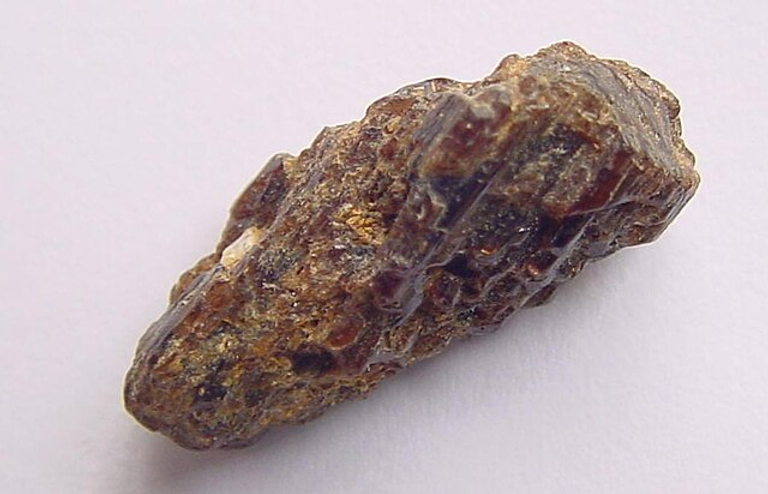
For now, though, all of that history rests on a single gem cut from one waterworn crystal, with a few tiny fragments removed from its culet for testing.
Kyawthuite does not change daily life, but it sharpens how geologists think about mineral rarity. The stone shows that a mineral can be unique not because its elements are absent, but because the conditions needed to assemble them may be exceptionally specific.
It also highlights the scientific value of gem materials recovered from alluvial deposits, where a waterworn crystal can still preserve enough structural and chemical evidence to define a new species.
The work points to Mogok as a place where more unusual minerals may still be waiting, especially in pegmatite-related environments. At the same time, kyawthuite is a reminder that mineral discovery depends not only on geology, but also on whether specimens make their way into scientific hands. With only one confirmed example, every detail extracted from this gem matters.
Research findings are available online in the journal Mineralogical Magazine.
The original story “Kyawthuite is Earth’s rarest mineral — only one specimen has ever been found” is published in The Brighter Side of News.
Like these kind of feel good stories? Get The Brighter Side of News’ newsletter.
The post Kyawthuite is Earth’s rarest mineral — only one specimen has ever been found appeared first on The Brighter Side of News.


Leave a comment
You must be logged in to post a comment.