A brief radio flash reached Earth from a galaxy too faint for the ground-based observations used to find it. NASA’s James Webb Space Telescope revealed its home: a small galaxy forming stars rapidly when the universe was only about 3 billion years old.
The observational study, led by Manisha Caleb of the University of Sydney, appeared in Science. It identifies FRB 20240304B as the most distant fast radio burst with a measured host-galaxy redshift reported to date.
The discovery does more than extend the distance record. The galaxy’s youthful stellar population helps narrow explanations for the burst’s source. Its radio signal also carries evidence of the ionized gas encountered during its journey.
The MeerTRAP project detected the burst with South Africa’s MeerKAT radio telescope on March 4, 2024. Fast radio bursts last only milliseconds, making precise localization essential. Without reliable coordinates, associating a fleeting signal with a particular galaxy becomes difficult.
Stored telescope data allowed the researchers to reconstruct radio images and locate this event precisely. Its signal suggested a very distant source. However, radio propagation alone could not establish the host’s distance confidently.
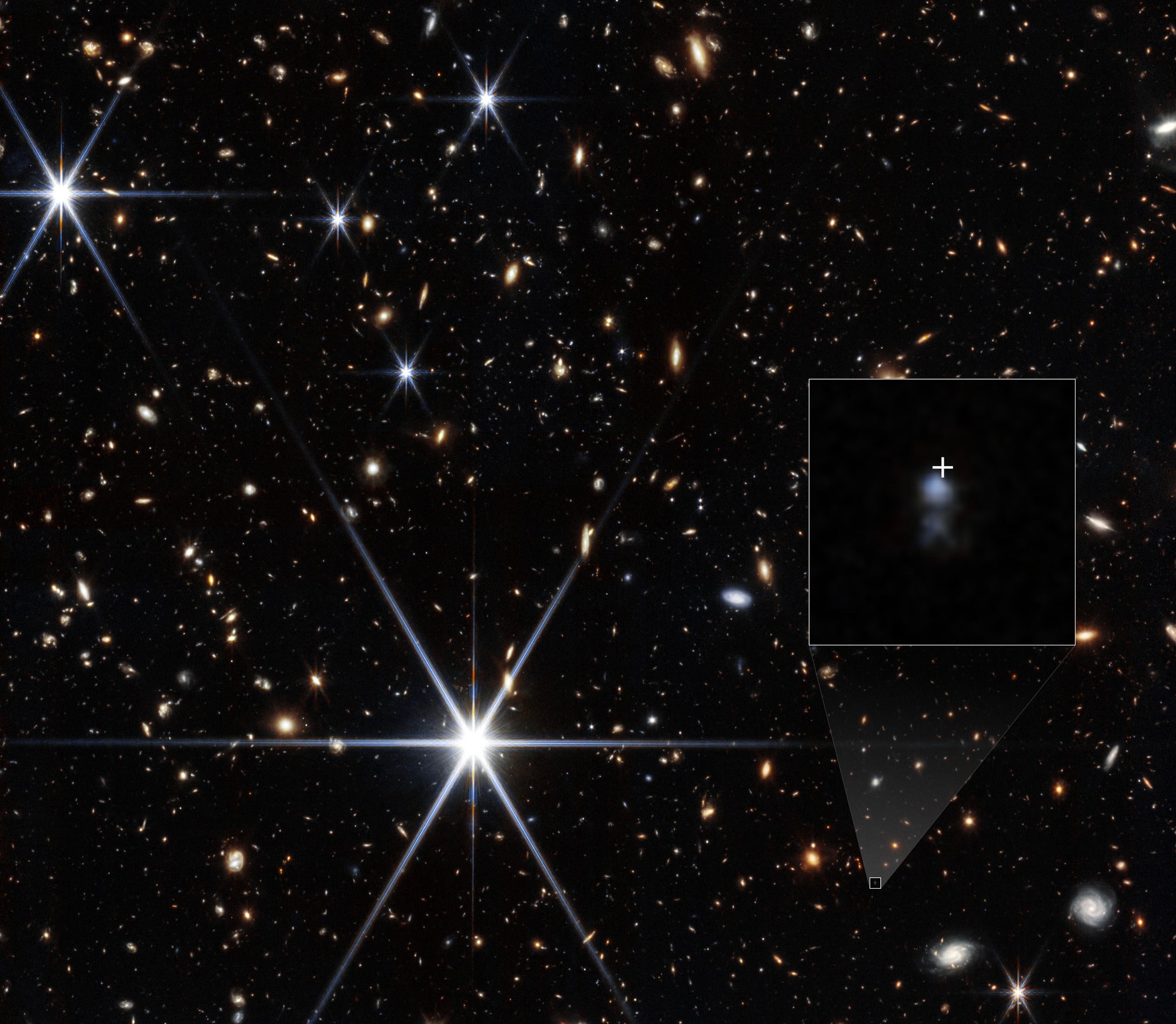
Archival optical surveys showed no galaxy at the location. Deeper observations with the Keck Observatory and MMT Observatory also failed to detect a host. The team therefore obtained more sensitive near-infrared observations with Webb.
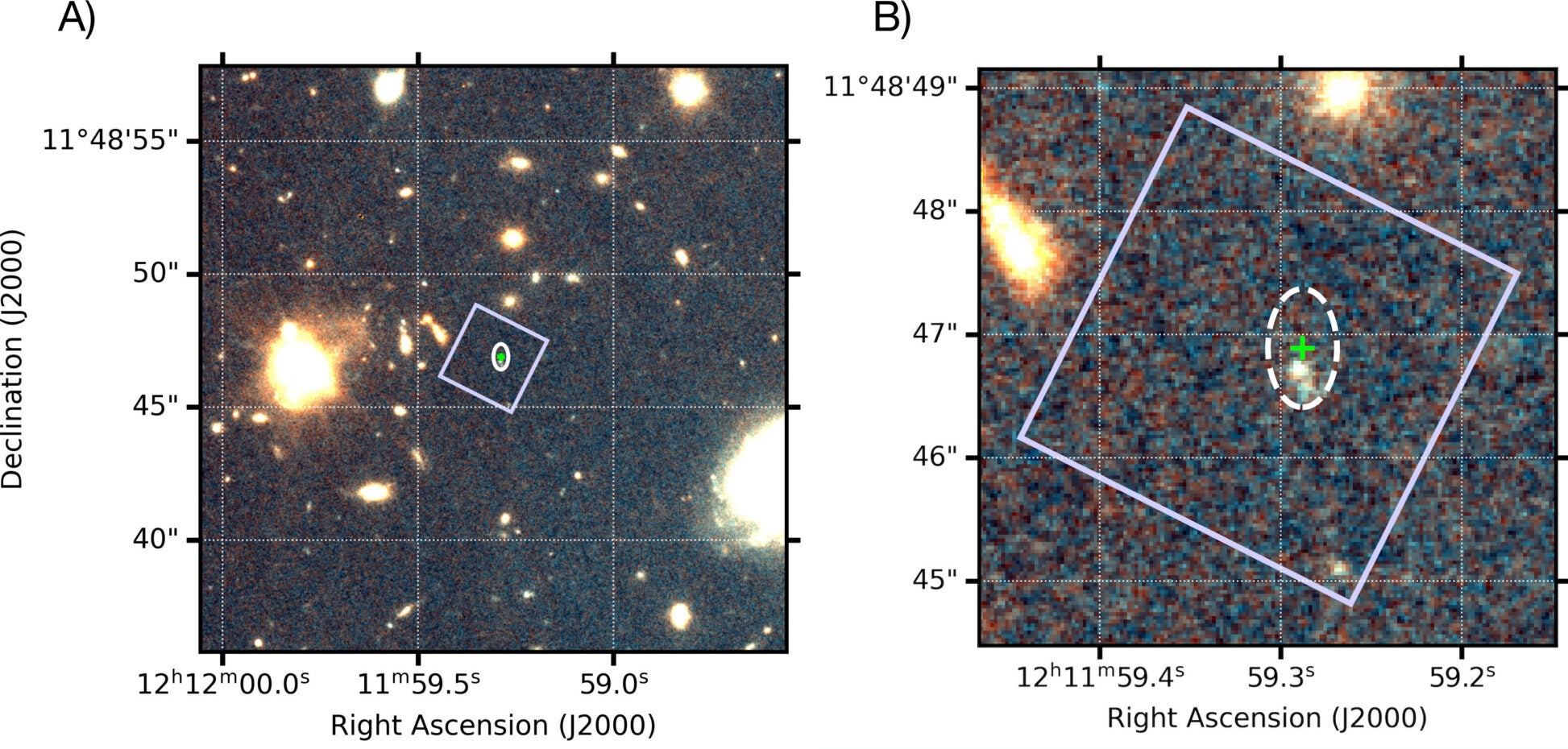
Its Near-Infrared Camera revealed a faint galaxy approximately 0.23 arcseconds from the measured burst position. A statistical association analysis assigned a 97.5% probability that this was the host. That strong association still carries uncertainty, rather than constituting an absolute identification.
Webb’s Near-Infrared Spectrograph then detected hydrogen and oxygen emission lines from the galaxy. Those lines supplied a spectroscopic redshift of 2.148 ± 0.0013. Previously reported FRB hosts had reached a maximum measured redshift of 1.016.
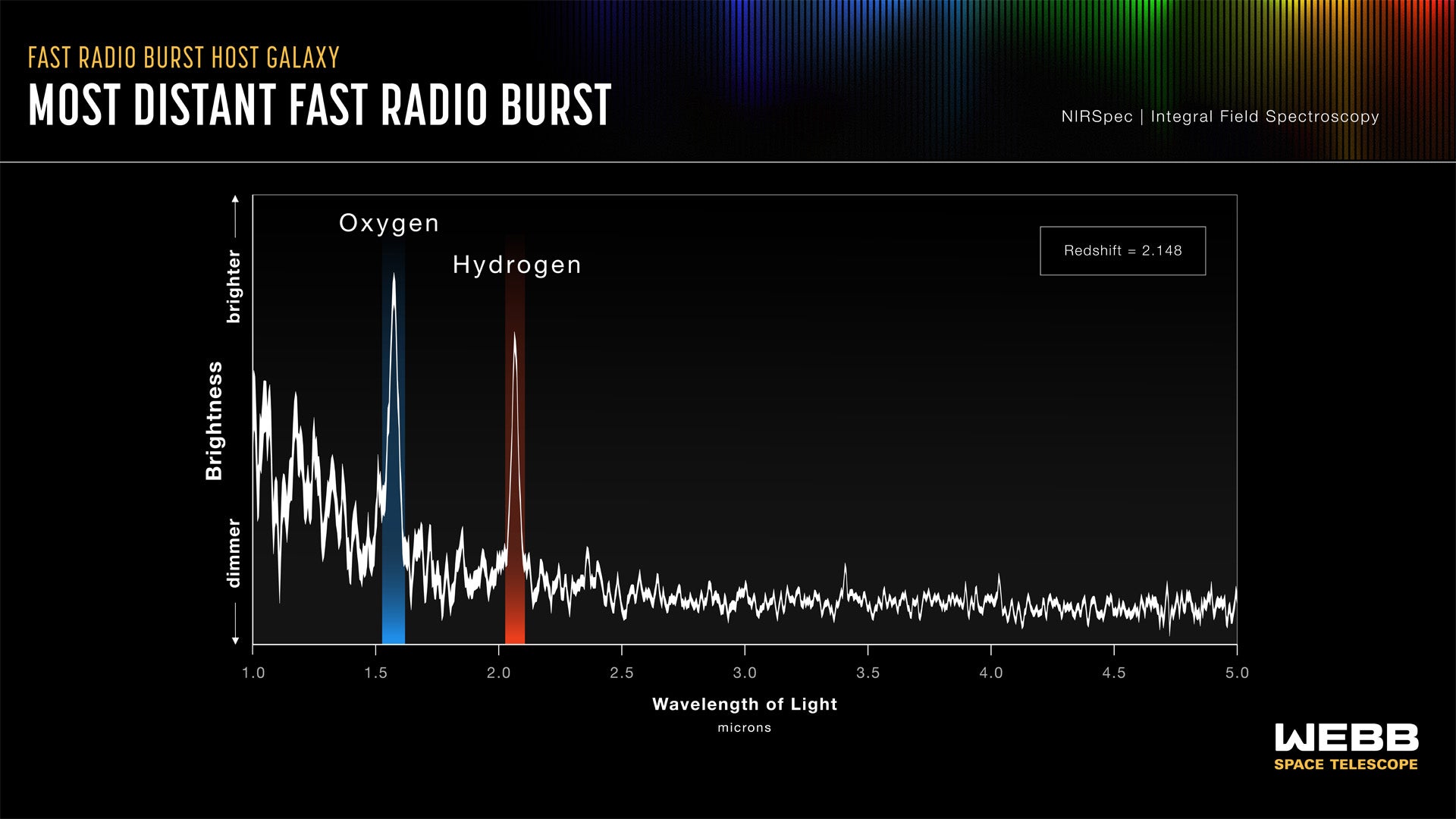
Redshift describes how cosmic expansion stretches light to longer wavelengths. This measurement places the galaxy at an epoch when the universe was approximately 3.2 billion years old. It existed during cosmic noon, the broad period when cosmic star formation reached its peak.
The host was much smaller than the team anticipated. Most previously studied FRB hosts are massive star-forming galaxies. Here, the researchers found a dwarf galaxy that was actively producing stars and relatively poor in elements heavier than helium.
Its estimated stellar metallicity was about one-tenth the Sun’s. The reconstructed star-formation history suggested that approximately 90% of its stellar mass formed during the preceding 30 million years. That estimate describes the dominant stellar population, rather than proving every star was young.
The galaxy’s high star-formation rate relative to its existing mass reinforced that picture. Its characteristic stellar mass-growth timescale was about 30 million years. Together, these findings indicate an intense episode of recent star formation.
That setting differs markedly from an older galaxy dominated by evolved stars. It gives astronomers a clock against which to assess proposed burst sources. A mechanism requiring a lengthy delay after star formation would have more difficulty explaining this particular environment.

One proposed origin for FRBs involves merging neutron stars. Such models can require long intervals between the formation of the stars and their eventual collision. The study argues that sources with delays of several billion years should become less common at this early epoch.
Another explanation involves young magnetars, neutron stars with exceptionally strong magnetic fields. These can form after massive stars die in supernova explosions. That pathway allows a burst source to appear within a few million years of star formation.
The dwarf galaxy’s properties fit the shorter-delay scenario. Its young population and active star formation therefore support magnetar models. They make long-delay merger explanations less likely for this event.
The distinction is statistical, not a direct observation of the object producing the burst. The researchers did not identify an individual magnetar in the distant galaxy. Nor does this single event establish that every FRB shares the same origin.
“Our work suggests that it’s very unlikely that this FRB was produced by a merger,” Caleb said. The result narrows the possibilities while leaving the underlying emission mechanism unresolved. The host’s properties provide a constraint, rather than conclusive proof.
Radio waves passing through ionized gas experience frequency-dependent delays. Lower-frequency waves arrive later, allowing astronomers to estimate the total electron column along the sightline. The quantity describing that delay is called the dispersion measure.
The team measured a dispersion measure of 2458.20 ± 0.012 parsecs per cubic centimeter. Its value includes contributions from the Milky Way, intervening structures, diffuse intergalactic gas and the host. A large value therefore cannot automatically be translated into a unique distance.
With the spectroscopic redshift established, the researchers could compare the signal against the expected relationship between dispersion and distance. This relationship is known as the Macquart relation. FRB 20240304B extends such observations to a redshift of approximately two.
Its sightline crosses the nearby Virgo Cluster and passes near an unnamed galaxy group at redshift 0.31131. The team estimated that both contribute to the observed dispersion. These estimates depend on models and observations of the intervening gas.
The signal also showed changes in polarization caused by magnetic fields along its path. Combined with dispersion, those measurements suggested a weakly magnetized or tangled medium in the host environment. They offer complementary information about gas that is difficult to study directly.
Turbulent plasma also broadened the pulse, giving it an extended tail. The researchers measured a scattering timescale of 5.6 ± 0.3 milliseconds at one gigahertz. Their analysis suggests most of this scattering arose within the host, although that interpretation depends on assumptions about the intervening material.
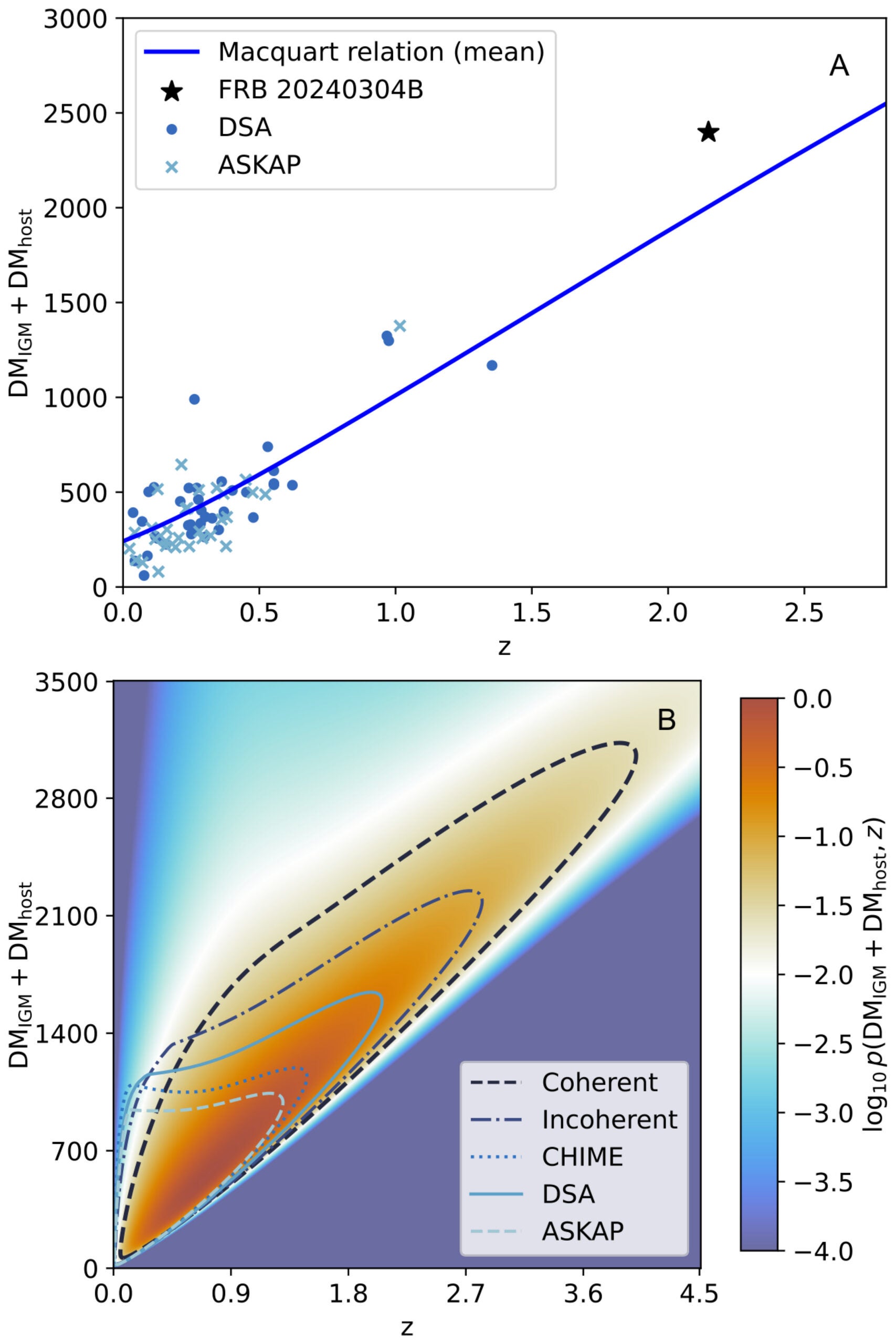
The record also exposes limits in the existing FRB sample. Approximately 100 bursts have identified hosts with measured redshifts, according to the paper. Most lie at redshifts below about 0.5, partly because distant events are harder to detect and localize.
Sensitive radio telescopes can sometimes detect a burst without locating it accurately enough to identify its galaxy. Even a precise radio position may require substantial infrared observing time. This event demonstrates why radio discovery and host-galaxy spectroscopy must work together.
The team predicts additional high-redshift detections with MeerKAT, although the forecast depends on assumptions about burst energies. Webb can help characterize their faint hosts. Larger samples will test whether this young dwarf represents a common early-universe environment or an unusual example.
These studies explore burst sources, host environments and the use of radio signals to trace ordinary matter across space.
A luminous fast radio burst that probes the Universe at redshift 1: Reports the earlier distant burst that extended spectroscopically localized FRBs to redshift near one. (Science, 2023)
Preferential occurrence of fast radio bursts in massive star-forming galaxies: Examines host-galaxy populations and their implications for the formation of FRB sources. (Nature, 2024)
A bright millisecond-duration radio burst from a Galactic magnetar: Documents a radio burst from a Milky Way magnetar, providing evidence connecting these objects with FRB-like emission. (Nature, 2020)
A census of baryons in the Universe from localized fast radio bursts: Uses radio-wave dispersion and known host distances to measure ordinary matter along cosmic sightlines. (Nature, 2020)
A single fast radio burst localized to a massive galaxy at cosmological distance: Demonstrates precise localization of a single detected burst and identification of its host galaxy. (Science, 2019)
Research findings are available online in the journal Science.
The original story “JWST traces the most distant known fast radio burst to a strange dwarf galaxy” is published in The Brighter Side of News.
Like these kind of feel good stories? Get The Brighter Side of News’ newsletter.
The post JWST traces the most distant known fast radio burst to a strange dwarf galaxy appeared first on The Brighter Side of News.


Leave a comment
You must be logged in to post a comment.