A pair of narrow rings circling a small world between Saturn and Uranus no longer looks as stable as astronomers once thought.
Observations from the James Webb Space Telescope show that Chariklo’s dense inner ring became substantially more opaque compared with measurements from previous years. At the same time, its much fainter outer ring appeared to lose opacity.
The changes emerged from a stellar occultation observed on Oct. 18, 2022, when Chariklo’s rings crossed in front of a distant star. Researchers led by the Institute of Astrophysics of Andalusia, or IAA-CSIC, compared the JWST measurements with occultations obtained during the previous decade.
Their findings leave the physical cause unresolved. But they challenge the idea that narrow rings around small Solar System bodies should remain relatively unchanged over such short periods.
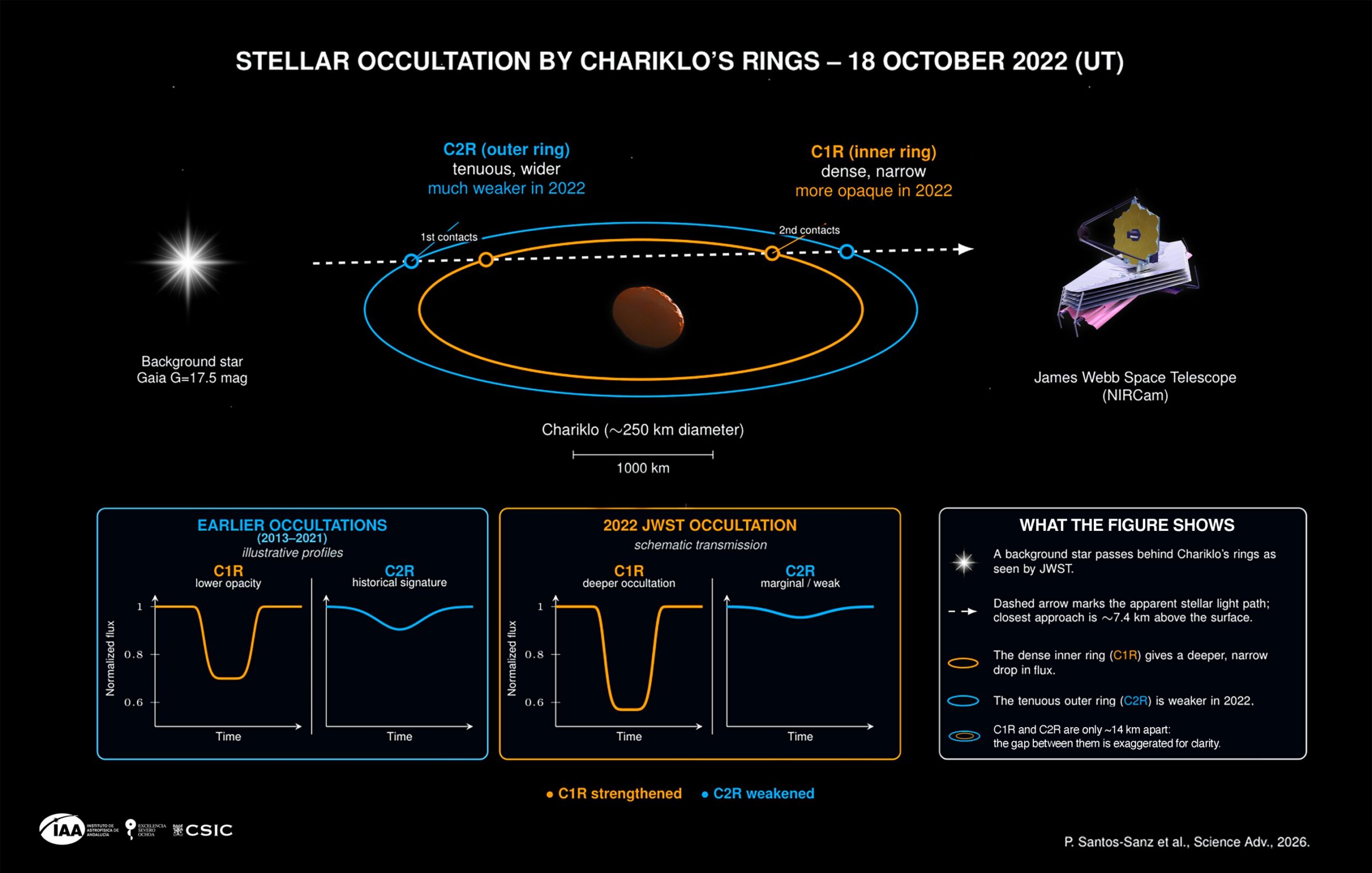
Chariklo is only about 250 kilometers across and travels roughly 17 times farther from the Sun than Earth does. Its two rings, C1R and C2R, orbit approximately 390 and 405 kilometers from its center.
Even JWST cannot directly photograph structures this narrow at Chariklo’s distance. Instead, astronomers use the brief loss of starlight produced when ring material passes between a telescope and a background star.
The 2022 event nearly included Chariklo itself. JWST’s line of sight passed about 7.4 kilometers above the body’s surface, allowing both rings to cross the star without Chariklo completely blocking it.
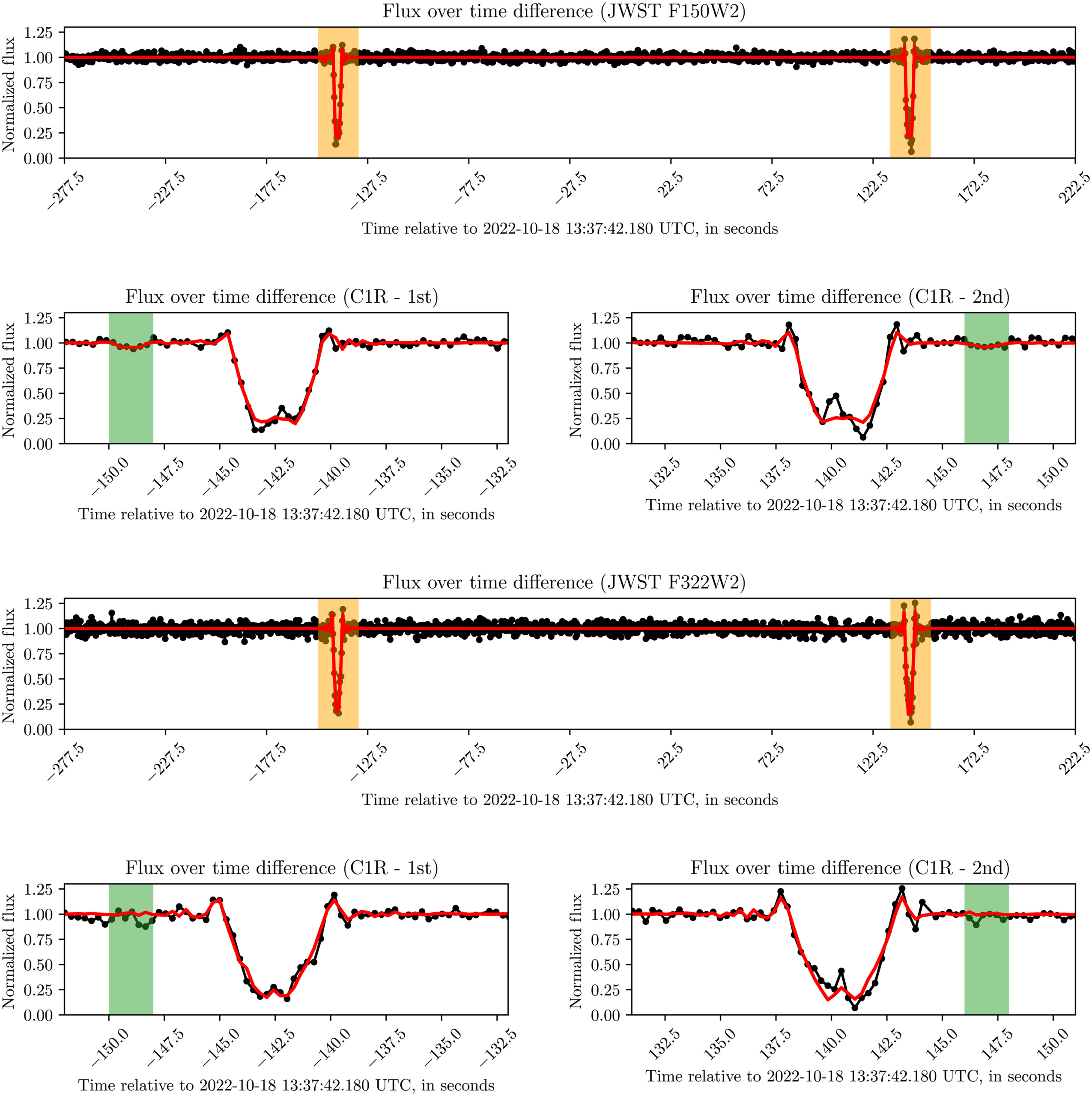
JWST collected 14,827 integrations over roughly 1.25 hours with its Near-Infrared Camera. Each exposure lasted 0.304 seconds.
An unusually low relative velocity made the observation especially useful. Chariklo moved across JWST’s line of sight at only about 2.5 kilometers per second, providing spatial sampling of roughly 750 meters along the projected stellar path.
The observation also became the first specifically predicted stellar occultation by a small Solar System body successfully observed with JWST.
C1R, the broad and dense inner ring, produced an unmistakable drop in stellar brightness along with diffraction features at its edges.
The surprise came from how much light it blocked.
Earlier occultations yielded an average normal opacity of 0.303 ± 0.028. JWST measured 0.431 ± 0.012. Researchers calculated a z score of 4.2 for the difference, making a random statistical fluctuation unlikely.
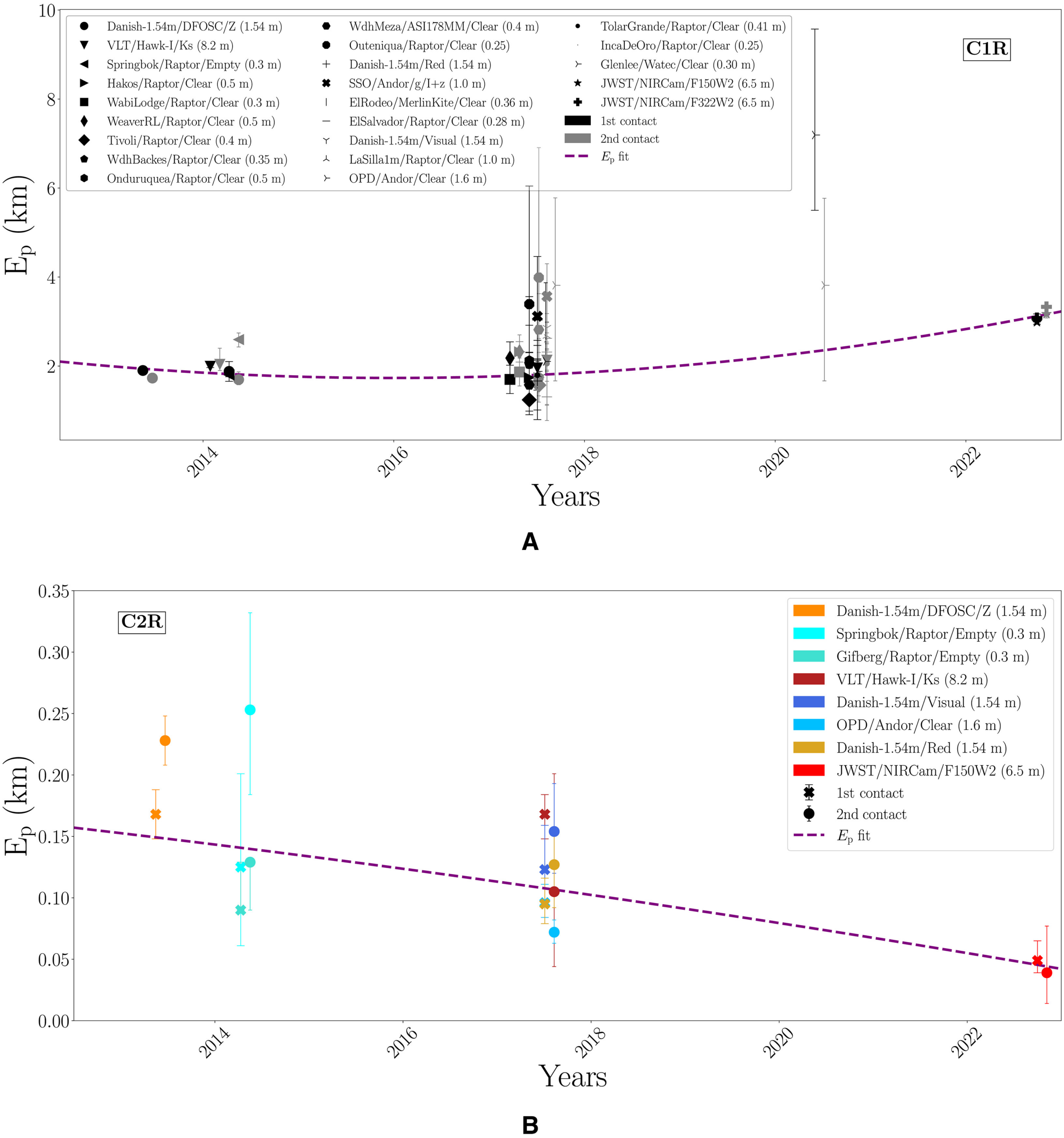
Equivalent width, another measurement describing how strongly a ring blocks light, also increased. Compared with observations from 2013, 2014 and 2017, C1R’s equivalent width in the JWST data was about 50% greater.
One possibility was that JWST happened to cross an unusually dense section of a ring whose material varies around its circumference.
Simulations made that explanation difficult to sustain. The chance of obtaining opacity values as high as those measured by JWST through random sampling of an uneven ring was about 1 in 1,000 in one infrared band and roughly 4 in 100,000 in the other.
C2R presented a contrasting picture.
The outer ring was only marginally detected at 1.5 micrometers and disappeared below detection at 3.2 micrometers. Both observations occurred simultaneously and sampled the same region.
Compared with 2017 measurements, its equivalent width was roughly 60% lower.
The limited historical record prevents researchers from determining whether C2R steadily faded between 2017 and 2022 or changed more abruptly. Simulations again suggested that ordinary variation around the ring was unlikely to explain the sequence of weak measurements.
The material apparently missing from C2R cannot simply account for C1R’s increase. The change measured in the inner ring was approximately 10 times larger.
That leaves several possibilities. Material in C1R may have increased, collisions among particles could have generated more small fragments, or the rings may have undergone other structural changes.
Different wavelengths introduce another source of uncertainty because small particles can block light differently depending on their size and composition.
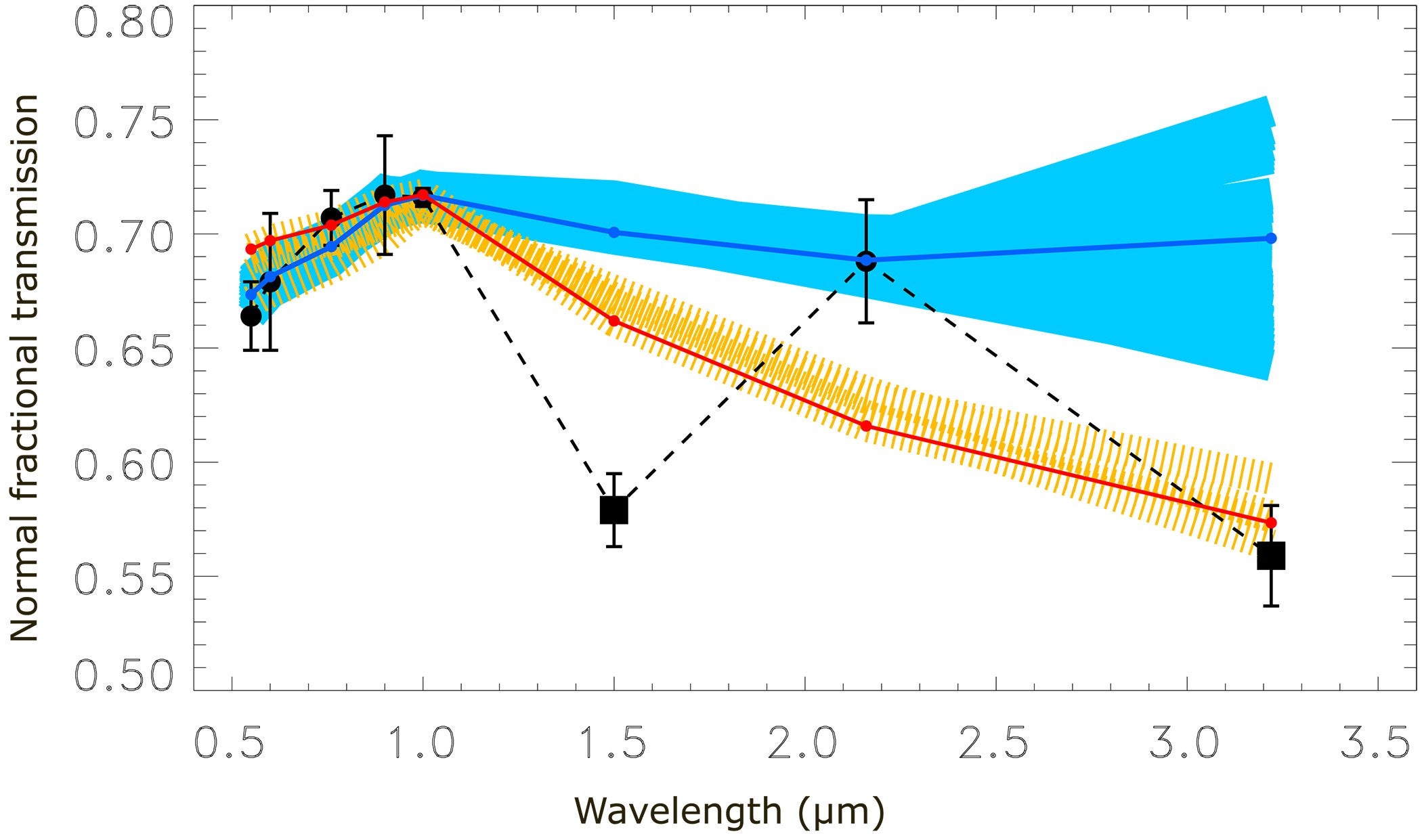
Earlier visible-light occultations generally made C1R appear more opaque than observations near 2.1 micrometers. Researchers tested mixtures containing particles such as water ice and silicate grains to see whether wavelength alone could reproduce the measurements.
Those models could explain parts of the older record.
Once the JWST data were included, however, no tested combination successfully reproduced all observations. Models dominated by silicate grains between 1 and 10 micrometers performed best, but the overall fits remained poor.
The team therefore concluded that wavelength effects alone do not adequately explain C1R’s stronger opacity after 2017.
C2R remains more difficult to interpret because scientists have fewer well-resolved observations of it.
Despite their changing opacity, the orbital positions of both rings have remained remarkably consistent over roughly a decade.
That creates another puzzle. If material is being lost, created or redistributed, some process may still be keeping the rings confined to narrow regions around Chariklo.
C1R lies near a 1:3 spin-orbit resonance with Chariklo, where a ring particle completes one orbit for every three rotations of the central body. Such a relationship may influence the ring’s structure, although it could also promote outward movement that requires another confining mechanism.
One possibility is an unseen shepherd satellite near C1R. A small moon could help contain ring particles, and researchers suggest one might potentially share the region occupied by C2R while also supplying fresh material.
For C2R, the estimated median spreading timescale from the JWST measurements was only 0.34 years, with a one-sigma range of 0.21 to 0.96 years.
That short timescale makes continuing confinement or replenishment particularly important if the outer ring is genuinely evolving.
For now, another occultation may provide the clearest test. Visible-light measurements could reveal whether C1R remains unusually opaque and whether C2R still appears depleted.
Chariklo’s rings were already surprising when their discovery in 2013 showed that dense rings could surround something much smaller than a giant planet. A decade later, the same system is delivering a second surprise: small-body rings may not merely exist, they may change substantially within only a few years.
These studies trace the discovery and characterization of Chariklo’s rings and show how other small bodies have complicated traditional ideas about where rings can exist and remain stable.
A ring system detected around the Centaur (10199) Chariklo: The 2014 discovery paper used a multichord stellar occultation to reveal Chariklo’s two dense rings, establishing the first known ring system around a small Solar System body. (Nature, 2014)
The Structure of Chariklo’s Rings from Stellar Occultations: Twelve occultations between 2014 and 2016 revealed sharp edges, changing widths within C1R and a much less constrained C2R, providing the key historical measurements against which later observations can be compared. (The Astronomical Journal, 2017)
Refined physical parameters for Chariklo’s body and rings from stellar occultations observed between 2013 and 2020: This analysis refined Chariklo’s shape and ring geometry, confirmed fine structure in C1R and found no significant difference between simultaneous visible and red-band opacity profiles. (Astronomy & Astrophysics, 2021)
The size, shape, density and ring of the dwarf planet Haumea from a stellar occultation: A stellar occultation revealed a ring around the dwarf planet Haumea, showing that narrow ring systems are not unique to Chariklo among small distant bodies. (Nature, 2017)
A dense ring of the trans-Neptunian object Quaoar outside its Roche limit: Quaoar’s ring was found far beyond its classical Roche limit and close to a 1:3 spin-orbit resonance, strengthening evidence that resonance and collision physics can help maintain rings around small bodies in unexpected locations. (Nature, 2023)
Research findings are available online in the journal Science Advances.
The original story “JWST finds evidence that Chariklo’s rings are changing faster than astronomers expected” is published in The Brighter Side of News.
Like these kind of feel good stories? Get The Brighter Side of News’ newsletter.
The post JWST finds evidence that Chariklo’s rings are changing faster than astronomers expected appeared first on The Brighter Side of News.


Leave a comment
You must be logged in to post a comment.