Walking feels so automatic that one of its most unusual features is easy to overlook. With almost every ordinary step, the heel touches the ground first and the foot rolls forward toward the toes.
Chimpanzees can land heel-first too, which once suggested this walking pattern was simply inherited from a common ape ancestor. A new experiment shows something more complicated. Chimpanzees vary widely in how their feet hit the ground, while humans use heel strikes with remarkable consistency.
That difference could have carried a major evolutionary advantage. Researchers found that modern people use substantially less energy when walking heel-first than when forced to land farther forward on the foot. The trade-off is a much sharper impact each time the heel hits the ground.
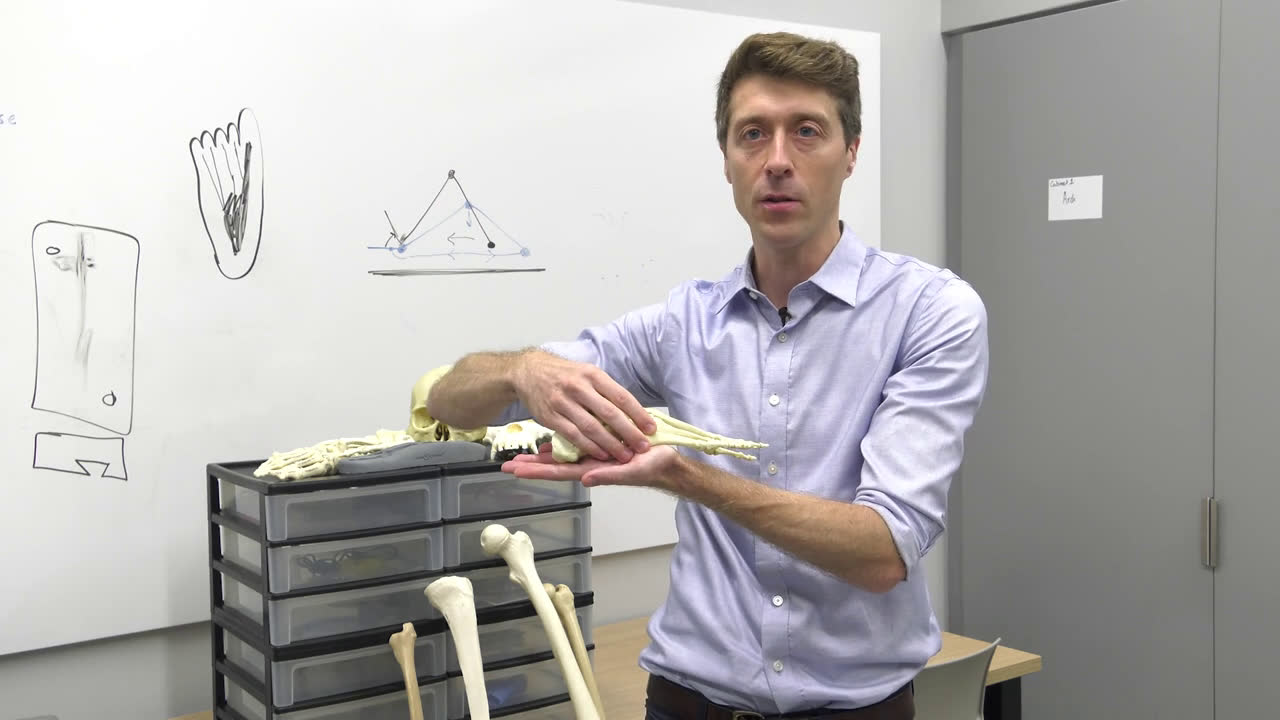
The study, published in the Proceedings of the National Academy of Sciences, was led by Penn State anthropologist Nicholas Holowka. The results suggest human ancestors evolved both a highly economical walking technique and anatomical changes that allowed their skeletons to tolerate its harder landings.
Earlier descriptions of great ape locomotion often emphasized that chimpanzees and humans both use plantigrade feet, meaning the entire sole eventually contacts the ground. The new experiments examined the beginning of each step much more precisely.
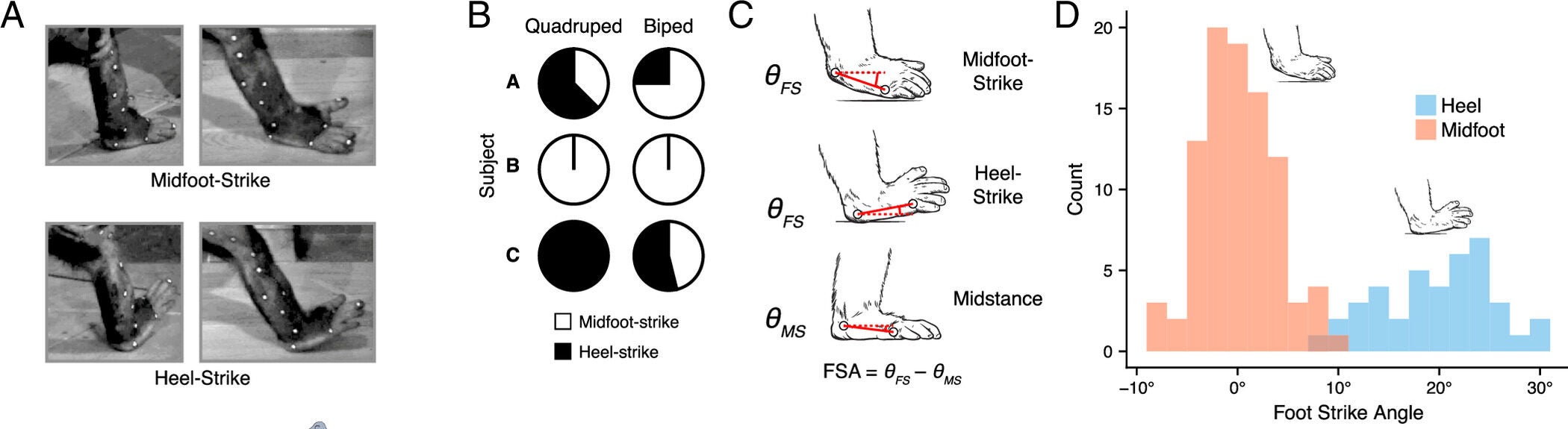
Researchers recorded three male chimpanzees with high-speed cameras as they traveled along a force-plate runway. The animals walked both on all fours and upright on two legs. Additional chimpanzee measurements from earlier studies expanded the comparison.
Their foot strikes were highly variable. One chimpanzee heel-struck during 31 of 76 recorded strides, another used no heel strikes in 43 strides, and a third heel-struck during 17 of 29.
Two animals that sometimes landed heel-first did so less often when walking upright than when moving on all fours. Chimpanzees therefore appeared to favor a softer midfoot landing more frequently during bipedal locomotion.
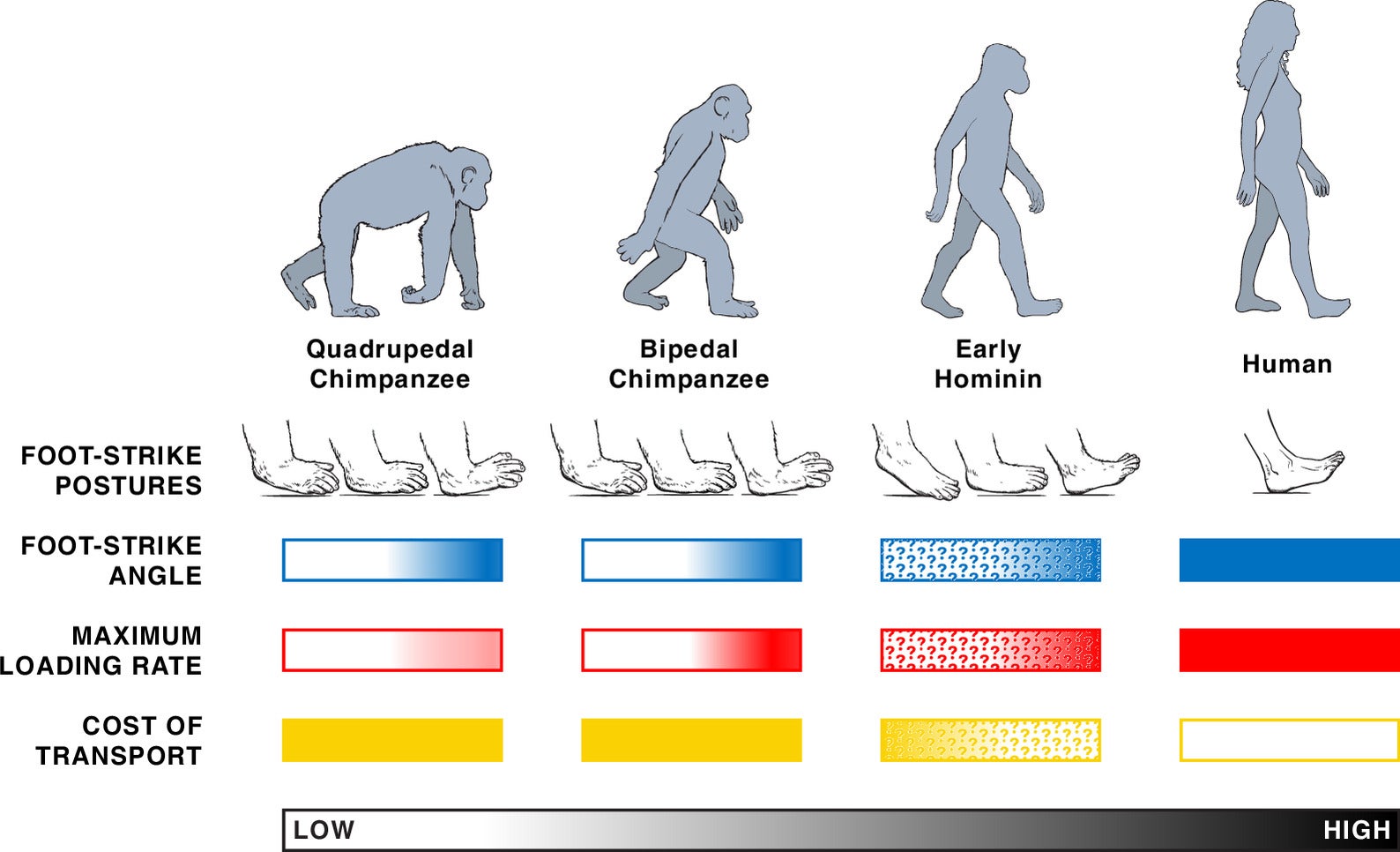
Human behavior was strikingly different. Every normal walking step measured in the human experiments was heel-first, and the angle at which the foot contacted the ground was tightly clustered. Individual chimpanzees showed foot-strike angle ranges 2.4 to 8.6 times larger than the average range observed in humans.
“When people think about what makes human walking unique, they talk about upright walking, our backs are straight and our legs are extended,” Holowka said. “What we’re saying in this article is that landing on our heel is a unique aspect of human walking that’s maybe been underappreciated.”
To understand why natural selection might have favored such consistency, the team asked people to deliberately change the way they walked.
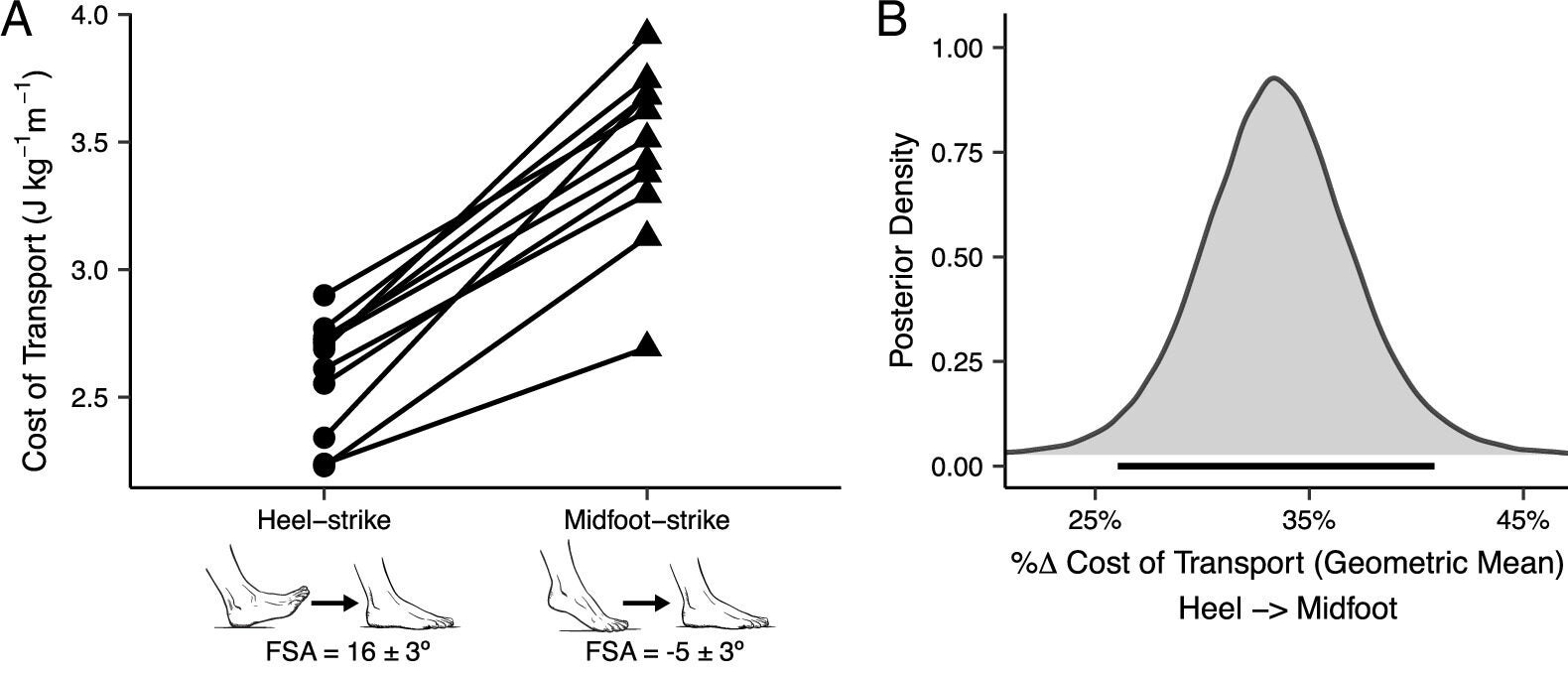
Eleven participants walked using both their ordinary heel-first gait and a modified midfoot strike resembling the landing style frequently used by chimpanzees. Researchers measured oxygen consumption and carbon dioxide production to calculate metabolic energy expenditure.
The difference was large. Normal heel-first walking produced an average net metabolic cost of 2.59 joules per kilogram per meter. Midfoot walking increased that to 3.46 joules per kilogram per meter.
Statistical modeling indicated that midfoot walking required about 26.1% to 40.8% more metabolic energy than heel striking.
That advantage may come partly from the way a heel-first foot rolls across the ground. Starting at the heel effectively lengthens the leg during the step and helps the body travel forward smoothly rather than requiring muscles to perform as much work.
Over a short stroll, the difference may seem modest. Across the many kilometers traveled each day by hunters and gatherers, however, those energy savings could become biologically important.
The same feature that saves energy creates a striking mechanical disadvantage.
“When you are trying to sneak across a creaky wooden floor, you tend to walk on the balls of your feet,” said study co-author Nathan Thompson of the New York Institute of Technology College of Osteopathic Medicine. “It’s a softer way to walk.”
The force-plate measurements demonstrated exactly why.
When humans heel-struck, their impact peak forces were 168% to 206% higher than during midfoot walking. Maximum loading rates, which measure how rapidly forces build after the foot contacts the ground, were 121% to 162% higher.
Chimpanzees showed the same basic trade-off. During bipedal walking, their heel strikes produced loading rates roughly 58% to 138% higher than their midfoot strikes.
Yet maximum vertical force changed very little between human walking styles. The important difference was how suddenly the initial collision occurred rather than simply the total force generated throughout the step.
Those results suggest the earliest upright hominins could have faced a difficult choice.
The common ancestor of chimpanzees and humans probably used a mixture of heel and midfoot landings while moving on all fours. Once early hominins began walking habitually on two legs, landing heavily on the heel would have increased impact loading on structures not yet shaped like those of modern humans.
One possibility is that early bipeds continued using frequent midfoot strikes. That strategy would have softened impacts but increased the metabolic cost of traveling long distances.
Alternatively, natural selection could favor anatomical changes that allowed harder heel strikes without damaging the lower limbs. Modern humans have relatively large knee and ankle joints as well as robust heel bones capable of distributing high forces across larger areas.
The fossil record is not complete enough to reveal exactly when consistently safe heel striking appeared. The researchers suggest the necessary adaptations were probably established by the emergence of Homo erectus.
Homo erectus spread from Africa into parts of Asia after roughly 2 million years ago, demonstrating an ability to travel over enormous distances. More efficient walking would have helped support that expanding geographic range.
It could also have complemented hunting and gathering, strategies that often require people to cover substantial distances before returning with enough food to justify the energy spent searching.
“We think that the heel-strike played a role in enabling key human behaviors, such as using hunting and gathering strategies that require people to walk really long distances every day to get food, but for a big payoff in food resources,” Holowka said.
High-impact heel strikes are now a routine feature of healthy human walking, even among people who habitually go barefoot. The researchers found little reason to view ordinary heel-first walking itself as harmful for healthy people whose bodies evolved to withstand it.
Instead, the study reveals an evolutionary bargain hidden in thousands of ordinary steps. Humans accepted a harder collision with the ground in return for dramatically cheaper movement, then evolved stronger anatomy to handle the consequences.
These studies examine heel striking, foot mechanics, walking efficiency and the anatomical changes that shaped human bipedal locomotion.
The role of plantigrady and heel-strike in the mechanics and energetics of human walking with implications for the evolution of the human foot: Tests why heel-first walking can reduce locomotor costs and increase effective limb length while also producing larger impact forces. (Journal of Experimental Biology, 2016)
The influence of foot posture on the cost of transport in humans: Shows that raising the heel and adopting a more digitigrade walking posture substantially increases the energetic cost of human walking. (Journal of Experimental Biology, 2010)
Mechanics of heel-strike plantigrady in African apes: Examines why chimpanzees and gorillas use heel-first plantigrade walking and what those mechanics may reveal about the locomotion of early hominins. (Journal of Human Evolution, 2020)
Foot anatomy, walking energetics, and the evolution of human bipedalism: Investigates relationships between lower-limb anatomy, foot form and metabolic walking costs while evaluating how confidently anatomy can reconstruct locomotor efficiency in fossil hominins. (Journal of Human Evolution, 2021)
A quantification of calcaneal lateral plantar process position with implications for bipedal locomotion in Australopithecus: Studies heel-bone anatomy associated with dissipating forces during heel strike and applies those findings to Australopithecus locomotion. (Journal of Human Evolution, 2018)
Research findings are available online in the journal PNAS.
The original story “Humans walk very differently from chimpanzees, helping our ancestors to conquer the world” is published in The Brighter Side of News.
Like these kind of feel good stories? Get The Brighter Side of News’ newsletter.
The post Humans walk very differently from chimpanzees, helping our ancestors to conquer the world appeared first on The Brighter Side of News.


Leave a comment
You must be logged in to post a comment.