A spinning pair of eyes and a kite shaped like a bird of prey could help tackle a deadly fishing problem. Trials off Cornwall found that these simple devices substantially reduced the odds of diving seabirds becoming trapped in gillnets.
The looming-eyes buoy lowered the odds of a bycatch event involving guillemots and razorbills by 59%. The commercially available “scarybird” kite lowered them by 71%. Neither device eliminated captures, and the experiment found no statistically significant difference between their performance on that measure.
The findings appear in Conservation Letters, with data analysis led by the University of Exeter. Devon-based Fishtek Marine led the trials, working with Cornish fishermen and the Royal Society for the Protection of Birds, or RSPB.
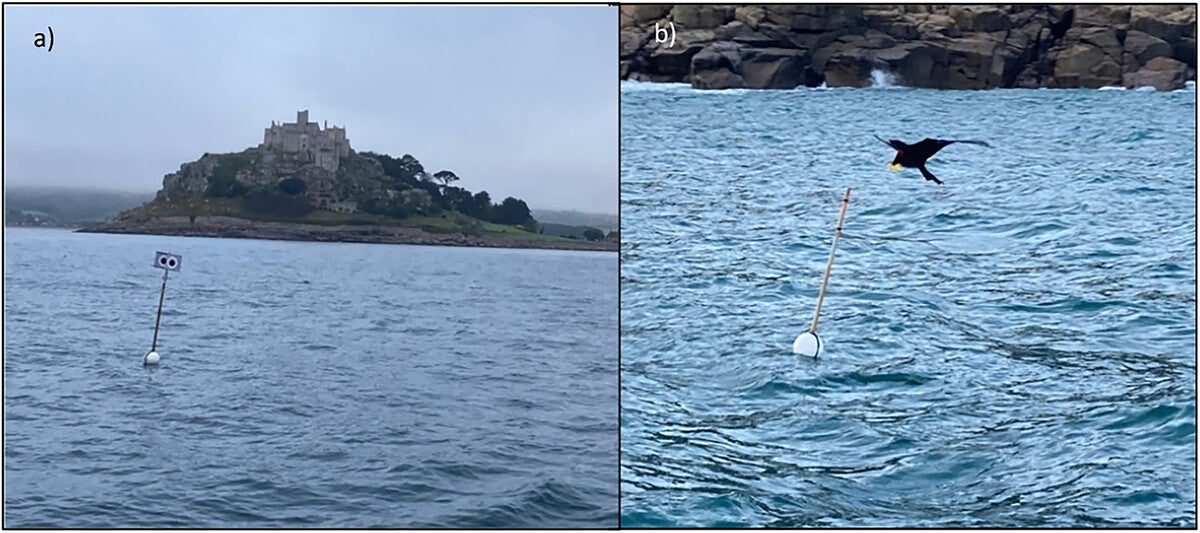
Diving seabirds pursue food beneath the surface, where fishing nets can trap them and prevent them from returning for air. An estimated 95,000 seabirds die annually in European gillnet fisheries. Developing practical protection for these fisheries has proved difficult.
The new deterrents act above the water, aiming to discourage birds from diving near the nets. Fishtek Marine and the RSPB jointly developed the looming-eyes buoy through an eight-year collaboration. Its rotating head presents an animated eye effect intended to scare birds away.
The alternative uses a predator-shaped kite originally sold as a bird-scaring product. Both devices attach to modified fishing buoys made with bamboo poles, floats and underwater counterweights. That arrangement keeps the deterrent supports upright at sea.
Because the devices operate above the surface, fishermen can add them to existing gear. Their effectiveness nevertheless depends on deployment conditions and the birds encountering them. A successful trial in one fishery does not establish equal protection across different species or locations.
Ten fishermen participated across the project, with at least seven vessels monitored at any one time. Recorded fishing ran from October 19, 2023, through March 31, 2025. Electronic monitoring systems tracked fishing effort throughout the study.
Cameras, positioning data and sensors documented where crews set and hauled nets and where bycatch appeared during retrieval. This provided a detailed record without relying solely on fishermen reporting accidental captures. Reviewers also verified the footage and fishing information.
The experiment used paired comparisons in the same fishing grounds. Crews deployed nets carrying a buoy or kite alongside separate control nets without deterrents. Rotating deployment locations helped reduce site-specific bias, while separation between paired nets limited interaction among treatments.
Altogether, the vessels set and hauled 1,057 monitored nets. These comprised 353 control nets, 352 kite-equipped nets and 352 buoy-equipped nets. Their combined length reached 129 kilometers.
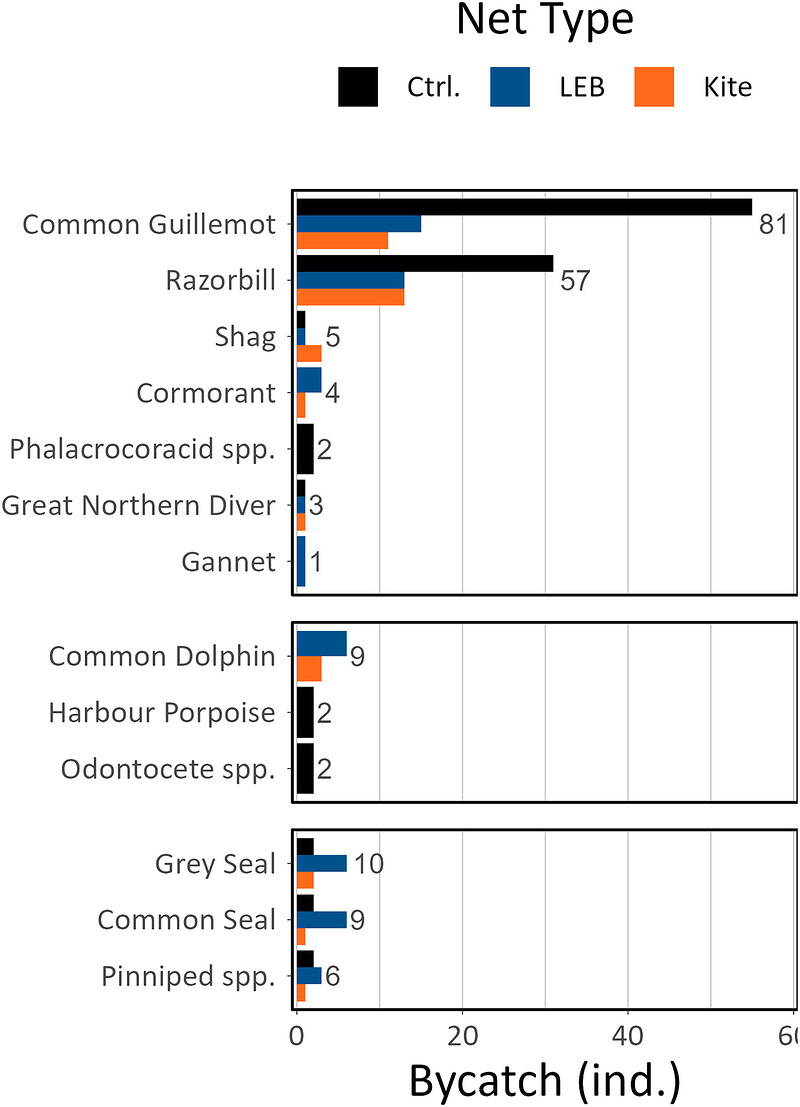
Monitoring recorded 153 birds caught across the experiment. Common guillemots accounted for 81 individuals and razorbills for 57, making these auks the main focus of the analysis. Seals and cetaceans also appeared in the wider bycatch record.
The statistical analysis examined two questions: whether a net haul contained any auk bycatch, and how many birds it contained when captures occurred. Both deterrents significantly reduced the odds of an event compared with untreated nets. The 59% and 71% figures describe that first comparison.
Those percentages are not equivalent to measured reductions in total seabird deaths across a fleet. Among hauls containing bycatch, buoy-equipped nets also had significantly lower auk counts than control nets. The corresponding reduction for kites did not reach statistical significance.
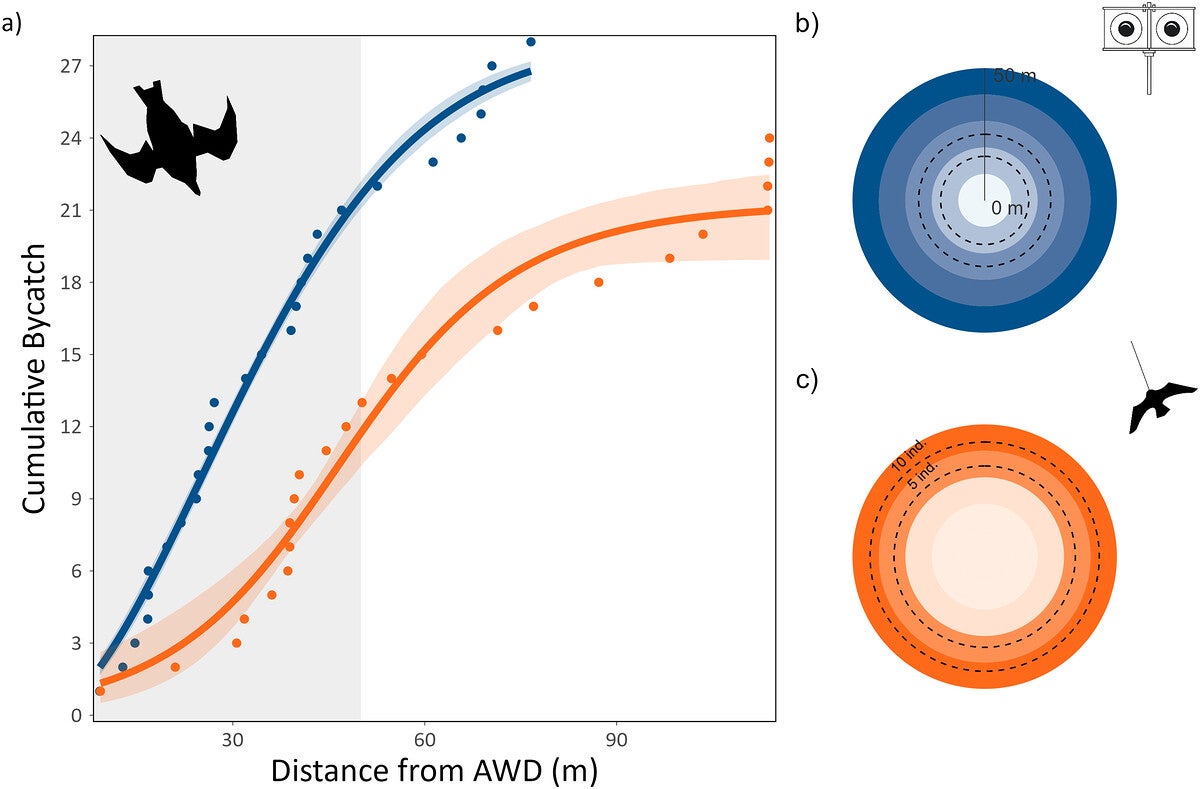
Location relative to each device mattered. The main models focused on captures within 50 meters of a deterrent, its assumed effective range. Separate spatial analyses showed protection varied with distance, underlining the importance of avoiding gaps between devices.
“This study provides some of the strongest evidence to date that simple, practical deterrents can substantially reduce seabird bycatch in gillnet fisheries,” said lead author Tom Horton of Exeter. The detailed monitoring also helped identify when targeted use could offer the greatest conservation benefit.
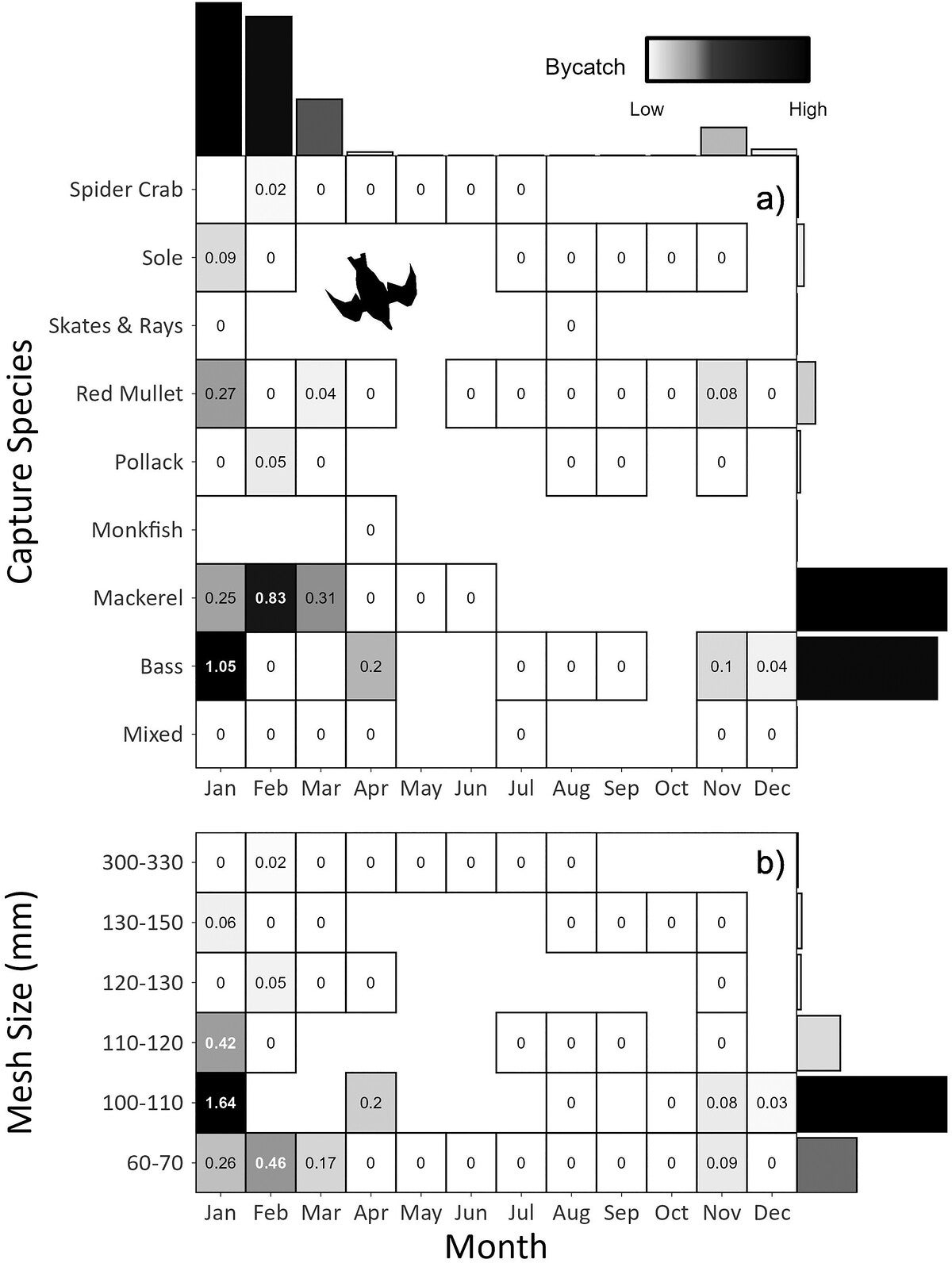
The highest average auk bycatch rates occurred in January and February. Together, those months accounted for 120 of the 138 guillemots and razorbills recorded. The concentration suggests that mitigation need not depend solely on uniform deployment throughout the year.
Elevated rates also occurred when crews targeted European sea bass and Atlantic mackerel. Nets with mesh sizes of 100–110 millimeters were associated with particularly high rates. These overlapping patterns point toward specific winter fishing activities where deterrents could prove especially useful.
Targeting those conditions could concentrate effort where risks are highest. It would also give fishermen a more focused deployment task. However, the seasonal pattern comes from this Cornish fishery and requires local evaluation before wider application.
Participants reported that both devices could fit routine operations after an initial learning period. Handling additional buoys along longer nets presented the greatest operational challenge. Fishermen also identified improvements involving lighter deployment systems, stronger kite materials and better mounting equipment.
The buoys were generally straightforward to handle and store. Kites performed less well in very light winds and became harder to manage in stronger winds. Reviewers excluded four sets involving damaged or malfunctioning kites from the modeling analysis.
Important uncertainties remain. The experiment did not specifically test wind speed, fishing depth, nighttime performance or whether birds become accustomed to the deterrents. A possible attraction of seals to the buoys also requires further testing.
“This technology means that fishing can continue while reducing the effects on seabirds,” said Fishtek Marine fisheries scientist Tom Hooper. The next challenge is refining deployment so that protection remains reliable and manageable under working conditions. The project received funding from Defra’s Fishing Industry Science Partnership programme and Schmidt Marine Technology Partners.
These resources examine the scale of seabird losses and why deterrent performance varies across fisheries and settings.
Looming-Eye Buoys temporarily reduce the number of fish-eating seabirds in pound nets: Examines the duration and limits of eye-pattern deterrence in a different fishing system. (Royal Society Open Science, 2026)
Seabird bycatch in European waters: Reviews mortality estimates across fishing gears and identifies major gaps in monitoring. (Animal Conservation, 2024)
Using a visual deterrent to reduce seabird interactions with gillnets: Tests a predator-shaped kite near a Portuguese gillnet fishing vessel. (Biological Conservation, 2023)
Looming-eyes buoys fail to reduce seabird bycatch in the Icelandic lumpfish fishery: depth-based fishing restrictions are an alternative: Shows why buoy success cannot be assumed across fisheries and explores an alternative approach. (Royal Society Open Science, 2023)
Buoys with looming eyes deter seaducks and could potentially reduce seabird bycatch in gillnets: Presents early testing of the buoy’s ability to deter vulnerable diving birds from an area. (Royal Society Open Science, 2021)
Research findings are available online in the journal Conservation Letters.
The original story “Floating scarecrows help keep diving seabirds out of fishing nets” is published in The Brighter Side of News.
Like these kind of feel good stories? Get The Brighter Side of News’ newsletter.
The post Floating scarecrows help keep diving seabirds out of fishing nets appeared first on The Brighter Side of News.


Leave a comment
You must be logged in to post a comment.