Some volcanic rocks carry hydrogen signatures that may trace back to Earth’s metallic core. Lavas from Baffin Island in the Canadian Arctic and Iceland contain unusually little deuterium, hydrogen’s heavier stable isotope. Explaining that imbalance could reveal whether the core has supplied material to the mantle over billions of years.
Work led by Wenzhong Wang at the University of Science and Technology of China tests a competing explanation. Published in Science Advances, the study examines whether crystallization of Earth’s ancient magma ocean could have created those distinctive signatures. Its simulations indicate that this process produced far too little separation between hydrogen isotopes.
The result strengthens the argument for selective transfer of hydrogen from the core into the surrounding rocky mantle. It does not directly demonstrate leakage or establish how quickly it occurs. Instead, the calculations constrain what an important alternative mechanism could have accomplished.
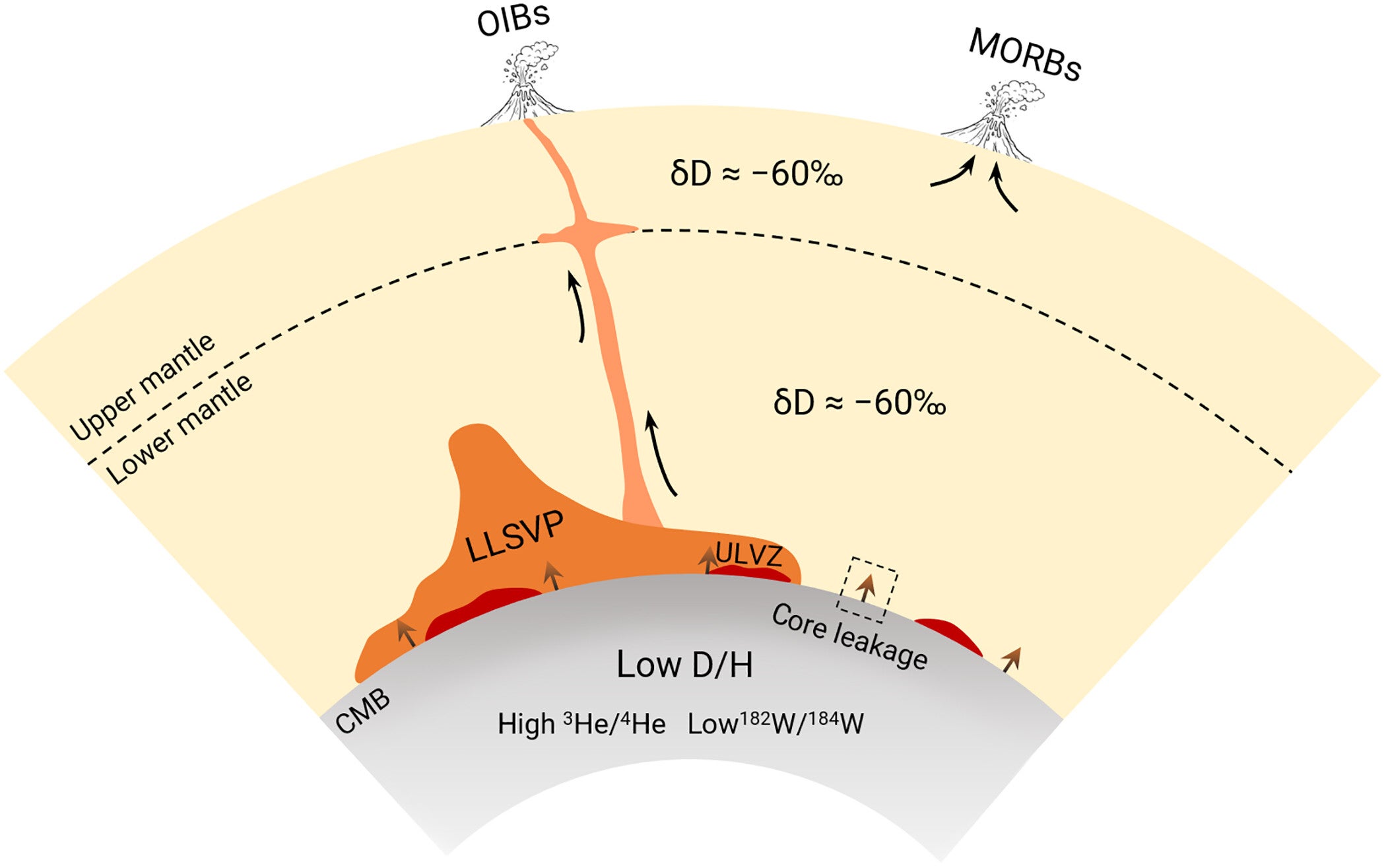
Ordinary hydrogen has one proton in its nucleus, while deuterium has a proton and a neutron. Both participate in similar chemical reactions, but their different masses affect how they distribute among materials. Scientists call that separation isotope fractionation, and use it to investigate the histories of rocks and water.
Hydrogen measurements are commonly expressed as delta-D values, comparing a sample’s deuterium-to-hydrogen ratio with a standard representing ocean water. Negative values indicate less deuterium relative to that reference. The unit, per mil, means parts per thousand, rather than percent.
Earlier measurements of Baffin Island and Icelandic lavas reported values as low as about minus 218 per mil. More recent work on Baffin Island melt inclusions found an average of minus 144, with an uncertainty of 24 per mil. Both differ substantially from typical modern upper-mantle estimates of roughly minus 80 to minus 60 per mil.
These differences raise a question about the source material carried upward by deep mantle plumes. Some interpretations invoke an ancient reservoir that preserved exceptionally light hydrogen from Earth’s beginnings. Another possibility is that the core later supplied light hydrogen to particular regions of the deep mantle.
Before comparing those explanations, the team needed to quantify what happened as Earth’s molten silicate layer solidified. Growing crystals can incorporate hydrogen differently from the melt around them. If they strongly favored one isotope, crystallization might have left a chemically distinctive reservoir behind.
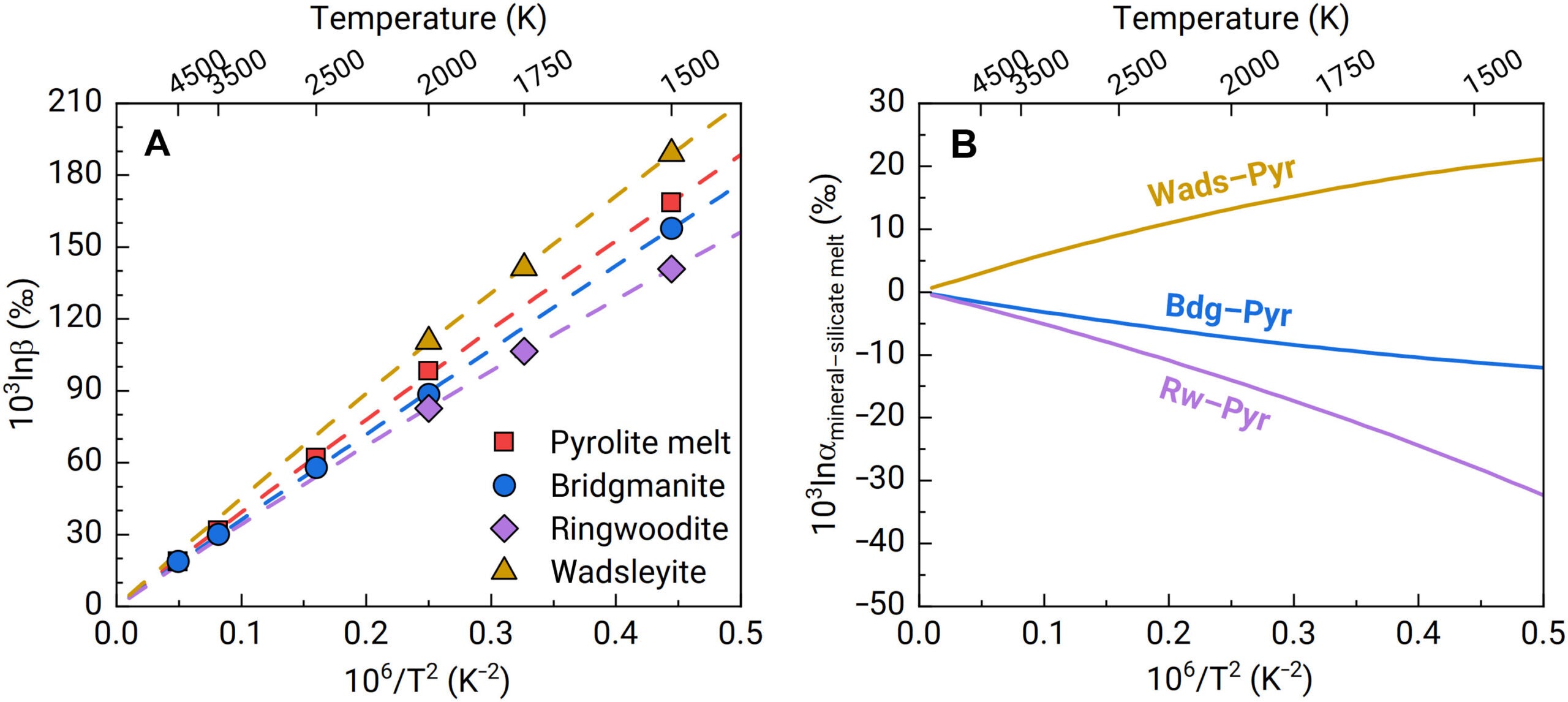
The calculations examined silicate melt and three important hydrogen-bearing mantle minerals: bridgmanite, ringwoodite, and wadsleyite. Hydrogen can enter their crystal structures even though these minerals are not underground pools of liquid water. Their ability to store it makes them relevant to the mantle’s hydrogen budget.
The team used machine learning to accelerate simulations based on quantum-mechanical calculations. A method called path-integral molecular dynamics accounted for quantum effects involving atomic nuclei. Those effects matter especially for hydrogen because the relative mass difference between its two stable isotopes is large.
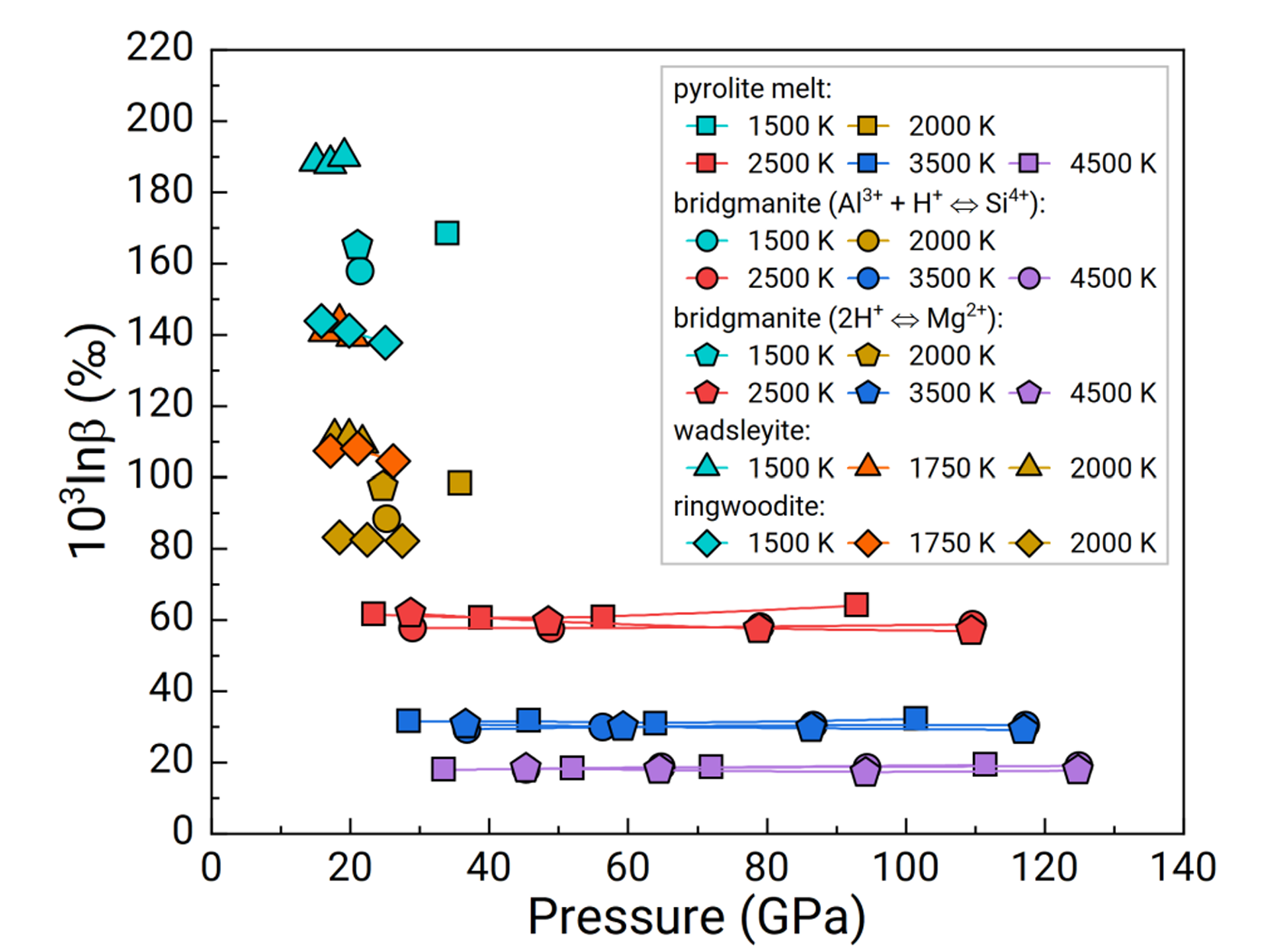
For bridgmanite and melt, the calculations covered temperatures from 2,500 to 4,500 kelvin. Ringwoodite and wadsleyite comparisons used 2,000 to 2,500 kelvin. The results supplied the isotope-separation estimates needed to model an evolving magma ocean.
The minerals did not all behave identically. Bridgmanite and ringwoodite incorporated relatively lighter hydrogen, leaving the remaining melt enriched in deuterium. Wadsleyite favored deuterium instead, producing an opposing effect during the crystallization sequence.
The researchers incorporated these differences into a model where solidification began within the mantle and advanced upward and downward. In the reference scenario, crystallization started 1,500 kilometres deep. The initial water content was 0.07% by weight, equivalent to approximately twice the mass of Earth’s present oceans.
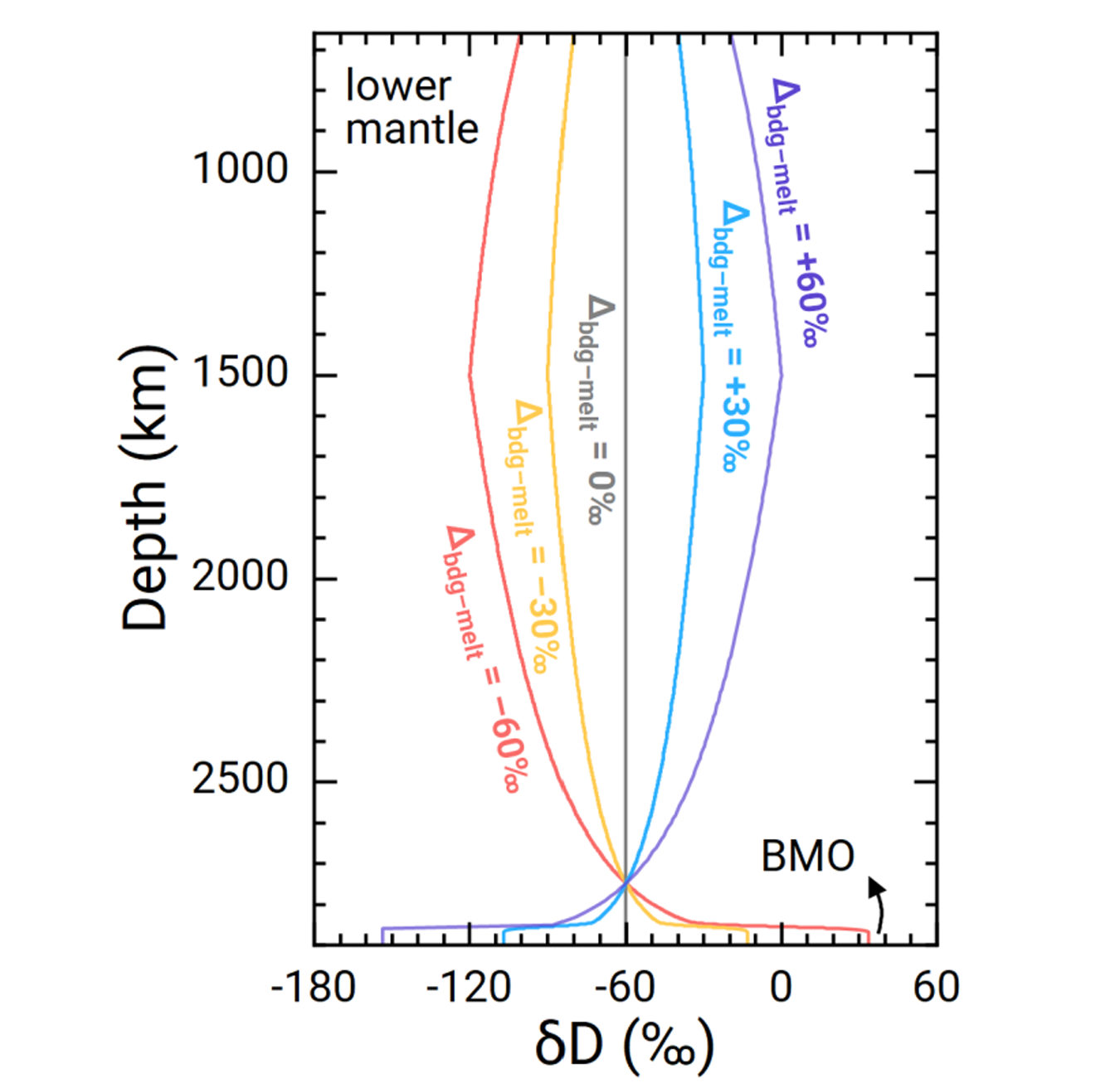
Despite that evolving mineral mixture, the reconstructed mantle remained remarkably uniform in hydrogen isotopes. The lower mantle ended only about three per mil lighter than the starting magma ocean. The remaining basal melt was about one per mil heavier, while the upper mantle retained essentially the initial composition.
Changing the starting water content, crystallization depth, and mineral water-storage parameters had little effect on the overall pattern. Altering the initial isotope ratio mainly shifted the whole mantle together. The model therefore struggled to create a strongly deuterium-depleted deep reservoir while leaving the upper mantle comparatively normal.
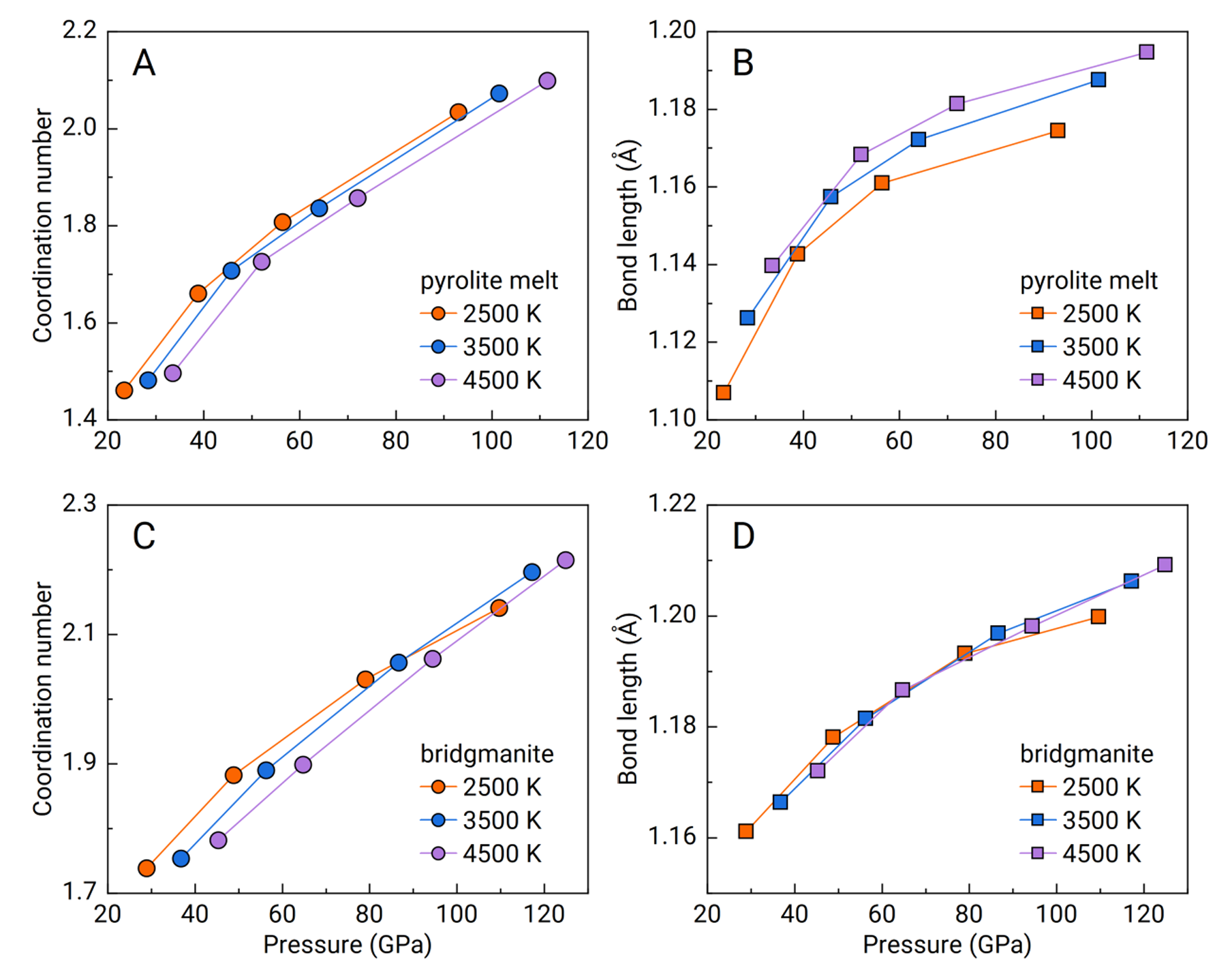
The weak separation also reflects hydrogen’s local bonding environment. In both molten rock and the modeled minerals, hydrogen bonds to oxygen. Increasing pressure changes those bonds in competing ways, so the calculated isotope behavior showed relatively little pressure dependence. This helped explain why extreme conditions did not automatically produce extreme isotope differences.
The crystallization model treated the magma ocean as a closed system, without exchange with the core or atmosphere. Newly formed crystals also separated from the melt without further isotope reequilibration. These assumptions define the calculation’s scope and distinguish it from a complete reconstruction of Earth’s evolution.
In reality, cooling magma released water into the atmosphere. The authors considered whether preferential loss of deuterium-rich vapor could change their conclusion. Their estimate suggested a mantle shift of no more than about 20 per mil if degassing supplied today’s oceans, assuming a mantle inventory of two to three ocean masses.
That loss would also affect the mantle broadly rather than selectively creating the required deep anomaly. Importantly, the simulations do not show that every primordial hydrogen signature must disappear. They suggest crystallization would preserve a preexisting signature widely, leaving the challenge of explaining why strongly depleted material remained concentrated at depth.
The distinction separates preservation from formation of a reservoir. Showing that an ancient signature could survive crystallization does not explain how it became confined to one region. That spatial contrast is central to interpreting the volcanic measurements.
Core formation offers a potential source of light hydrogen because separation between metal and silicate preferentially sends lighter hydrogen into metal. Later transfer could therefore change the isotope composition of nearby mantle material. Rising plumes might eventually transport those chemical signatures into volcanic sources.
Some relevant lavas also show unusually high helium-3-to-helium-4 ratios. The core may have preserved primordial helium, making the combined hydrogen and helium evidence important to the interpretation. Tungsten and ruthenium anomalies in related plume systems provide additional context, although they do not establish one universal transfer mechanism.
Simply mixing large amounts of core metal into mantle rock creates problems. The authors note that this should produce other chemical enrichments that are not observed in the relevant rocks. They instead discuss selective processes, including atomic diffusion or transport involving particular mineral phases.
These possibilities remain proposed mechanisms rather than observations of material crossing the boundary. A successful explanation must account for several elements, not hydrogen alone.
The next challenge is to determine which processes can move these components across the core-mantle boundary while reproducing the full chemical evidence. That requires explaining both the isotopes that reach volcanic rocks and the expected companions that remain absent. The hydrogen calculations narrow the possibilities without yet identifying the route.
These studies explore the isotope evidence behind competing explanations for unusual volcanic signatures.
Research findings are available online in the journal Science Advances.
The original story “Earth’s core may be leaking hydrogen into the mantle and its volcanic rocks” is published in The Brighter Side of News.
Like these kind of feel good stories? Get The Brighter Side of News’ newsletter.
The post Earth’s core may be leaking hydrogen into the mantle and its volcanic rocks appeared first on The Brighter Side of News.


Leave a comment
You must be logged in to post a comment.