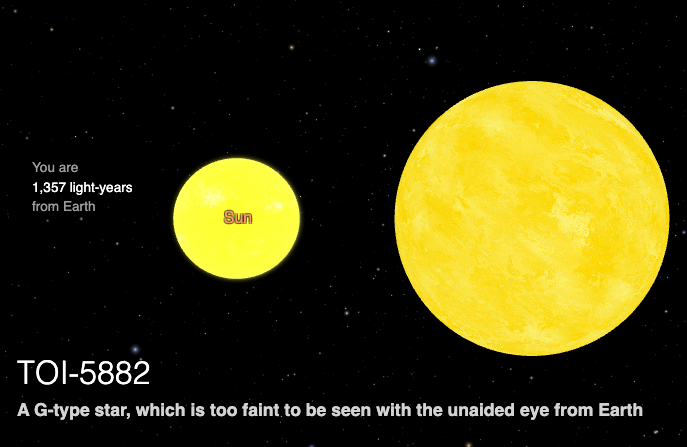
TOI-5882 looks, at first glance, like an ordinary sun-like star. However, its outer layers hold more lithium than astronomers would expect in a star at this stage of life. This chemical oddity now points to a dramatic possibility. Sometime in its recent past, the star likely swallowed a planet.
That star sits about 1,300 light-years away and is still only an early subgiant. This means it has begun to move beyond the main part of its life without yet swelling into a red giant. This matters because stars this age usually lose surface lithium over time. Their outer layers deepen and mix with hotter interior regions where lithium is destroyed. As a result, a strong lithium signal is not supposed to linger.
For Brooke Kotten of the University of Michigan, that made TOI-5882 an especially useful target. “You are what you eat, right?” said Kotten, lead author of the report in The Astrophysical Journal. “We know that there’s much more lithium in planetary material than there is in stars. So if a star eats a planet, it’s going to take on a bunch of lithium.”
Astronomers call the process engulfment, and it happens quickly. On cosmic timescales, a planet can disappear into a star in days or weeks. That leaves little chance of catching the act itself, so the work becomes something closer to forensic reconstruction.
“That’s what makes this field so exciting. You really are solving a mystery,” Kotten said. “We can’t just watch the crime happen, so we have to work with all the clues we’re given to figure out whodunit.”
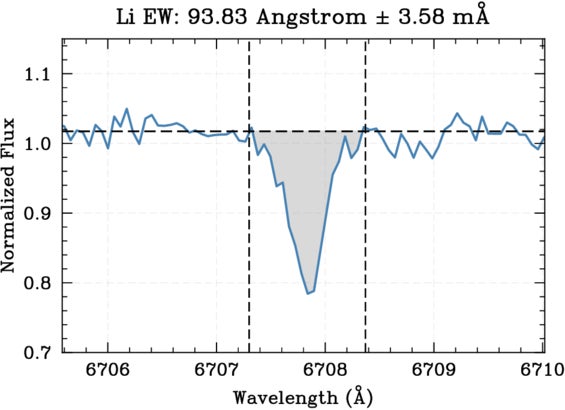
The most important clue here was lithium. TOI-5882 showed a lithium abundance of 2.49 ± 0.12 dex, along with a lithium equivalent width of 75.39 ± 3.58 milliangstroms after correcting for a nearby iron feature. On its own, that number means little to most readers. In context, it stands out sharply.
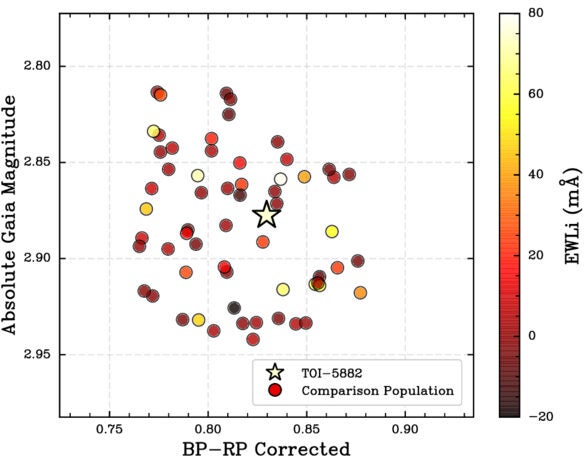
The team compared TOI-5882 with 61 similar subgiant stars drawn from the GALAH DR4 survey. These comparison stars were chosen to match the target as closely as possible in temperature, gravity, metallicity, color, and absolute brightness. They also screened out stars that might still be young and naturally lithium-rich.
Against that control group, TOI-5882 landed in the 98.4th percentile for lithium. Only one comparison star showed a stronger lithium signal. A tail-probability analysis put the odds of finding a star this lithium-rich in that sample at 1.6%.
“And it’s not like you have to cherry-pick the data to make it stand out. It’s robust,” said Melinda Soares-Furtado of the University of Wisconsin, a senior author on the study. “No matter how you slice it, TOI-5882 is so enriched in lithium it shows up as being at least in the 97th percentile.”
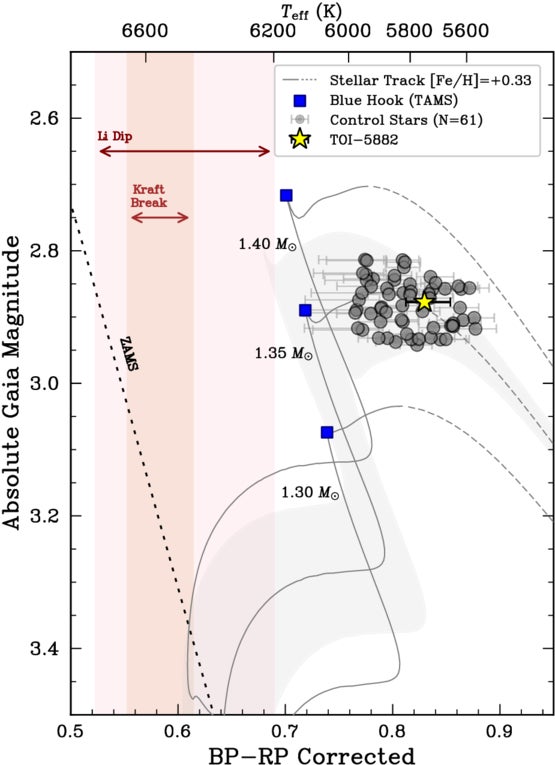
The case did not rest on lithium alone. TOI-5882 also occupies a narrow evolutionary window that earlier work had identified as unusually favorable for spotting engulfment. In this phase, the star’s convective outer zone is deep enough to shred incoming planetary material. However, it is not so deep and hot that the lithium signature is immediately erased.
Many stars are poor candidates for this kind of search. TOI-5882 was one of the rare exceptions.
The team also ruled out simpler explanations. Observations showed no convincing signs that the star is unusually young, which would have made a strong lithium signal less surprising. It also showed no infrared excess, no Hα emission, and no rapid rotation that might point to youth. Internal lithium production was also a poor fit. This is because the process most often invoked for that, the Cameron-Fowler mechanism, is expected to operate later in stellar evolution, not in an early subgiant like this one.
The Cameron-Fowler mechanism is an astrophysical process that explains how certain stars can produce and preserve lithium, even though lithium is usually destroyed at relatively low stellar temperatures. It was proposed by Alastair Cameron and William Fowler in 1971. The basic idea is that helium-3 inside a star can fuse with helium-4 to produce beryllium-7. This beryllium-7 is created in hot interior regions where nuclear reactions occur, but if it stayed there too long, it would be destroyed before it could become lithium.
The key step is rapid transport. The beryllium-7 must be carried quickly from the hot interior to cooler outer layers of the star. Once it reaches those cooler regions, it captures an electron and decays into lithium-7. Because the lithium is formed in a cooler zone, it can survive instead of being immediately burned. This mechanism is often invoked to explain lithium-rich red giants and other evolved stars whose surfaces contain more lithium than standard stellar evolution models would predict.
That left external enrichment, and planetary engulfment offered the cleanest explanation.
Seth Jacobson of Michigan State University, another senior author, compared the effect to a stadium filling with fans. “Lithium atoms delivered by planetary engulfment to a star are like sports fans arriving at a stadium,” he said. “There may already be a few early arriving fans present, representing the initial amount of lithium in the stellar atmosphere, but they are quickly outnumbered.”
TOI-5882 has another striking feature: a close brown dwarf companion. The object is more than 20 times the mass of Jupiter and follows a 7.1-day orbit. It sits in a mildly eccentric path around the star. The companion is not massive enough to ignite as a star. Yet, it may have been heavy enough to disrupt the orbits of other worlds in the system.
That possibility gives astronomers a plausible route for the missing planet’s final plunge. Massive companions on tight orbits can stir up inner planetary systems through gravitational perturbations and resonances. As a result, they sometimes send planets onto star-skimming paths that end in tidal inspiral and engulfment.
The researchers have not yet proven that this brown dwarf played that role, and Kotten said that idea will be tested in separate work. Still, the system’s architecture makes the scenario hard to ignore.
To estimate what kind of planet could explain the lithium excess, the team modeled the star’s convective zone and asked how much material would need to be mixed into it. Their answer depended heavily on what sort of planet was consumed.
If the engulfed body is treated unrealistically as having a protosolar composition, the required mass rises to about 5.6 Jupiter masses. But the authors argue that this is not a good assumption. This is because planets are generally enriched in heavy elements compared with stars.
Using more realistic compositions, they found a much smaller range. A rocky, terrestrial-like body could account for the signal with a mass near the super-Earth to Neptune range. A giant-planet-like composition would require more mass, but still within a plausible planetary regime. Overall, the team estimated that between 9 and 95 Earth masses of planetary material could explain the observed lithium enhancement.
“The fact that we can look at a star 1,300 light-years away and say with confidence, ‘This star has more lithium than you would expect,’ is a testament to both the precision of modern instrumentation and the hard interpretive work that goes into making sense of that signal,” Soares-Furtado said.
TOI-5882 offers a way to study planetary destruction long after the event itself has passed. By showing that a subgiant star can preserve a detectable lithium fingerprint, the work gives astronomers a practical method for identifying other likely engulfment cases in archival spectra and future surveys.
It also sharpens questions about how often planetary systems become unstable as stars age. Moreover, it raises the question whether massive companions such as brown dwarfs help drive those instabilities.
In the longer view, the study adds another piece to a much larger story about the fate of mature planetary systems, including our own, when stars begin to change.
Research findings are available online in The Astrophysical Journal.
The original story “Distant star TOI-5882 appears to have swallowed a planet” is published in The Brighter Side of News.
Like these kind of feel good stories? Get The Brighter Side of News’ newsletter.
The post Distant star TOI-5882 appears to have swallowed a planet appeared first on The Brighter Side of News.


Leave a comment
You must be logged in to post a comment.