Particle accelerators are usually associated with sprawling research facilities, massive magnets and long tunnels. A different approach uses laser-generated terahertz radiation to manipulate electrons inside a structure only millimeters across.
Researchers from the University of Manchester, Lancaster University and collaborating institutions demonstrated the technique using electrons already traveling at 99.99% of the speed of light. Their experiment accelerated relativistic electron bunches with charges as high as 60 picocoulombs, while also showing that terahertz fields can probe their structure on extraordinarily short time scales.
Published in Nature Photonics, the proof-of-principle experiment marked an important step toward compact accelerators driven by light rather than conventional radio-frequency technology. Since then, researchers have substantially increased the acceleration gradients and energy gains achievable with terahertz systems.
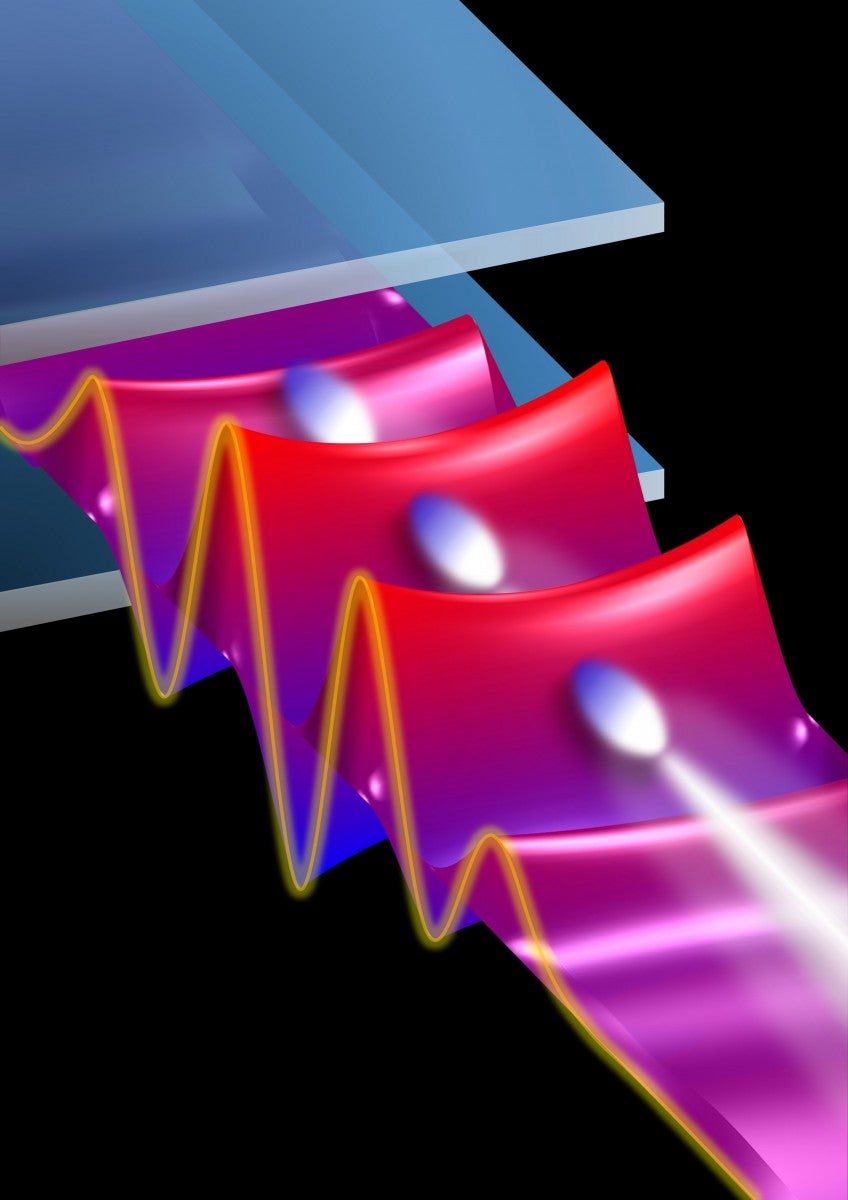
Conventional linear accelerators use oscillating radio-frequency electromagnetic fields to push charged particles to higher energies. The basic technology is powerful and mature, but the wavelengths involved contribute to the size of the equipment.
Terahertz radiation occupies the electromagnetic spectrum between microwaves and infrared light. Its wavelength is roughly a hundred times shorter than that of the radio-frequency fields commonly used in accelerators, allowing the structures interacting with electrons to become dramatically smaller.
The wavelength also provides another advantage. Terahertz oscillations occur on picosecond time scales, naturally matching extremely short electron bunches used in modern imaging and accelerator science.
Laser systems can generate these terahertz pulses with exquisite timing precision. That creates the possibility of using one laser system both to produce or synchronize an electron bunch and to manipulate it a fraction of a trillionth of a second later.
Getting terahertz radiation to push relativistic electrons presented an unusual problem.
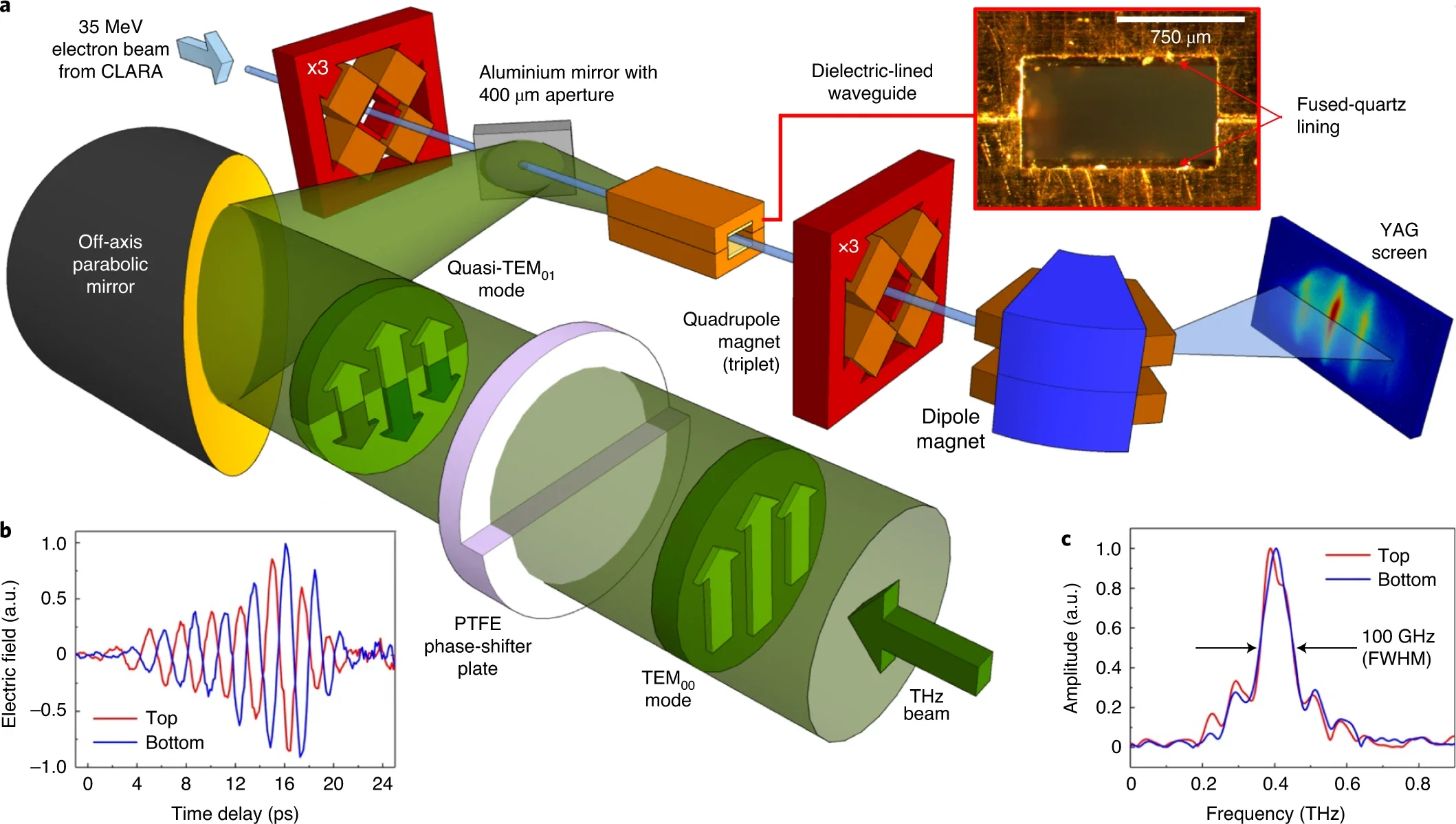
The researchers sent 35 MeV electron bunches from the Compact Linear Accelerator for Research and Applications, or CLARA, into a rectangular copper waveguide. The top and bottom of the channel were lined with fused quartz only 60 micrometers thick.
Electrons at that energy move at about 0.9999 times the speed of light. The terahertz field therefore had to travel through the structure at almost exactly the same phase velocity.
If the field moved faster or slower, the electrons would slip out of the accelerating portion of the wave. Some could then receive less energy or even encounter a field pushing in the opposite direction.
“The main challenge was matching the velocity of the accelerating THz field to the almost speed-of-light electron beam velocity,” lead author Morgan Hibberd said.
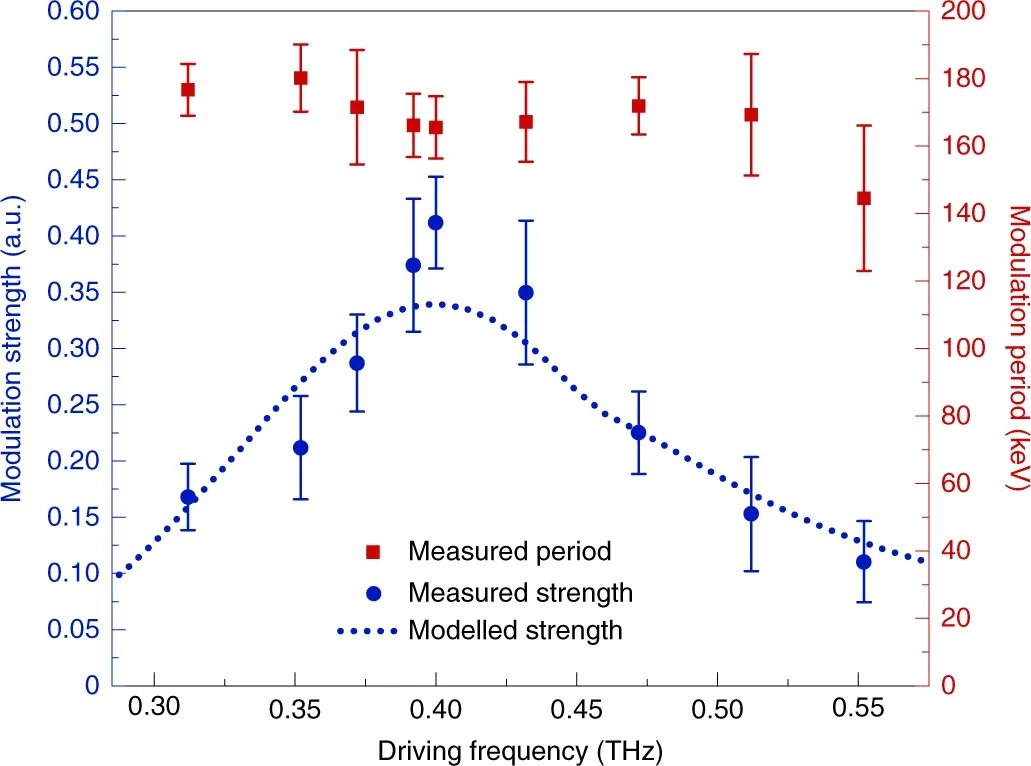
By carefully choosing the waveguide dimensions and quartz lining, the researchers slowed the terahertz wave to match the relativistic electrons at an operating frequency of 0.4 terahertz.
Matching phase velocity solved only part of the problem. The envelope containing the terahertz pulse traveled more slowly than its individual electromagnetic cycles, creating what physicists call group-velocity walk-off.
The electron bunch could therefore outrun the useful part of the pulse.
Hibberd and colleagues addressed this by generating narrowband terahertz radiation containing multiple cycles. Longer pulses allowed the electrons and terahertz field to remain together over an effective interaction distance of about 4.3 millimeters.
The experiment produced an average accelerating gradient of roughly 2 megavolts per meter. In one configuration, modeling of the measured energy modulation indicated a peak electron energy gain of about 8.8 kiloelectronvolts.
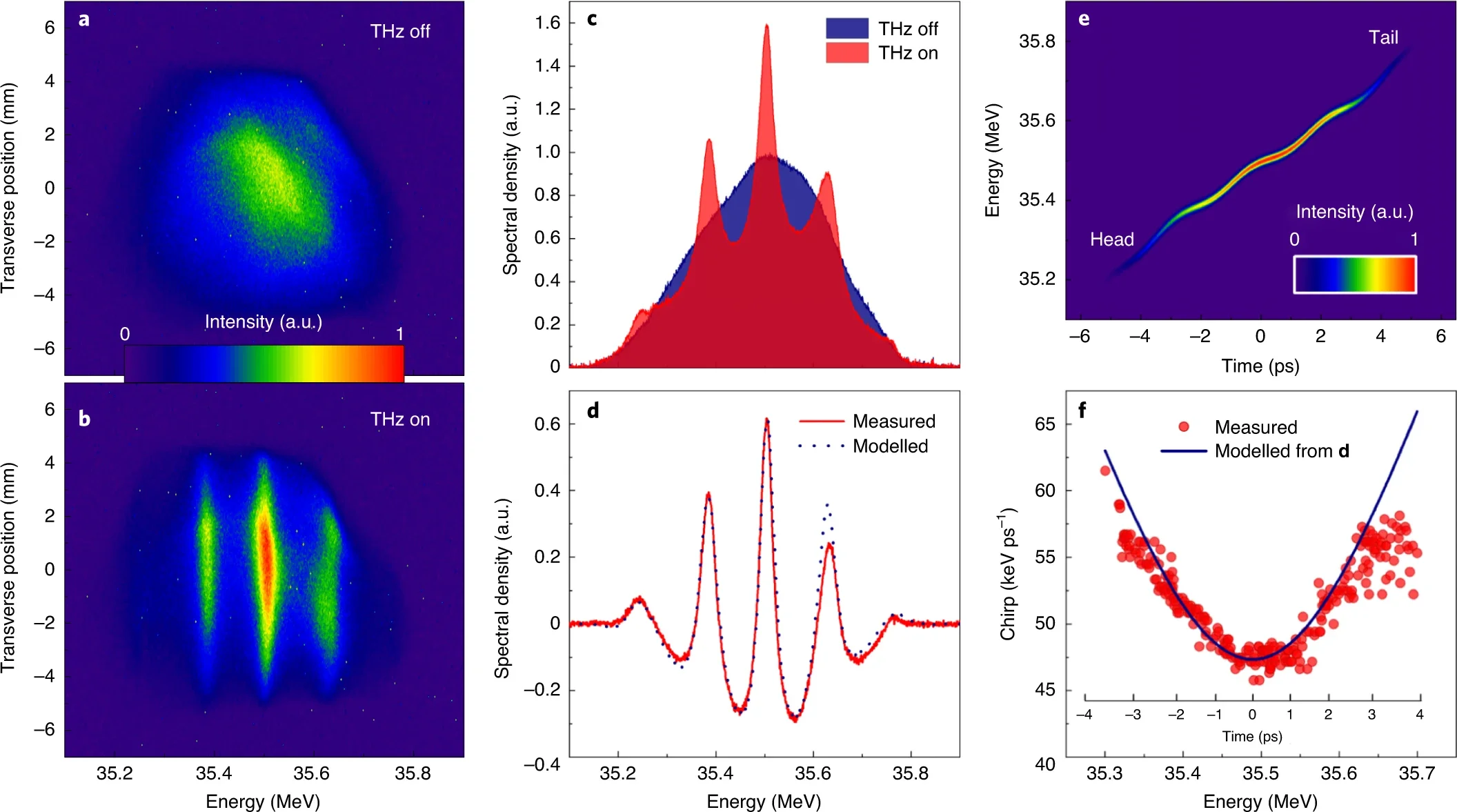
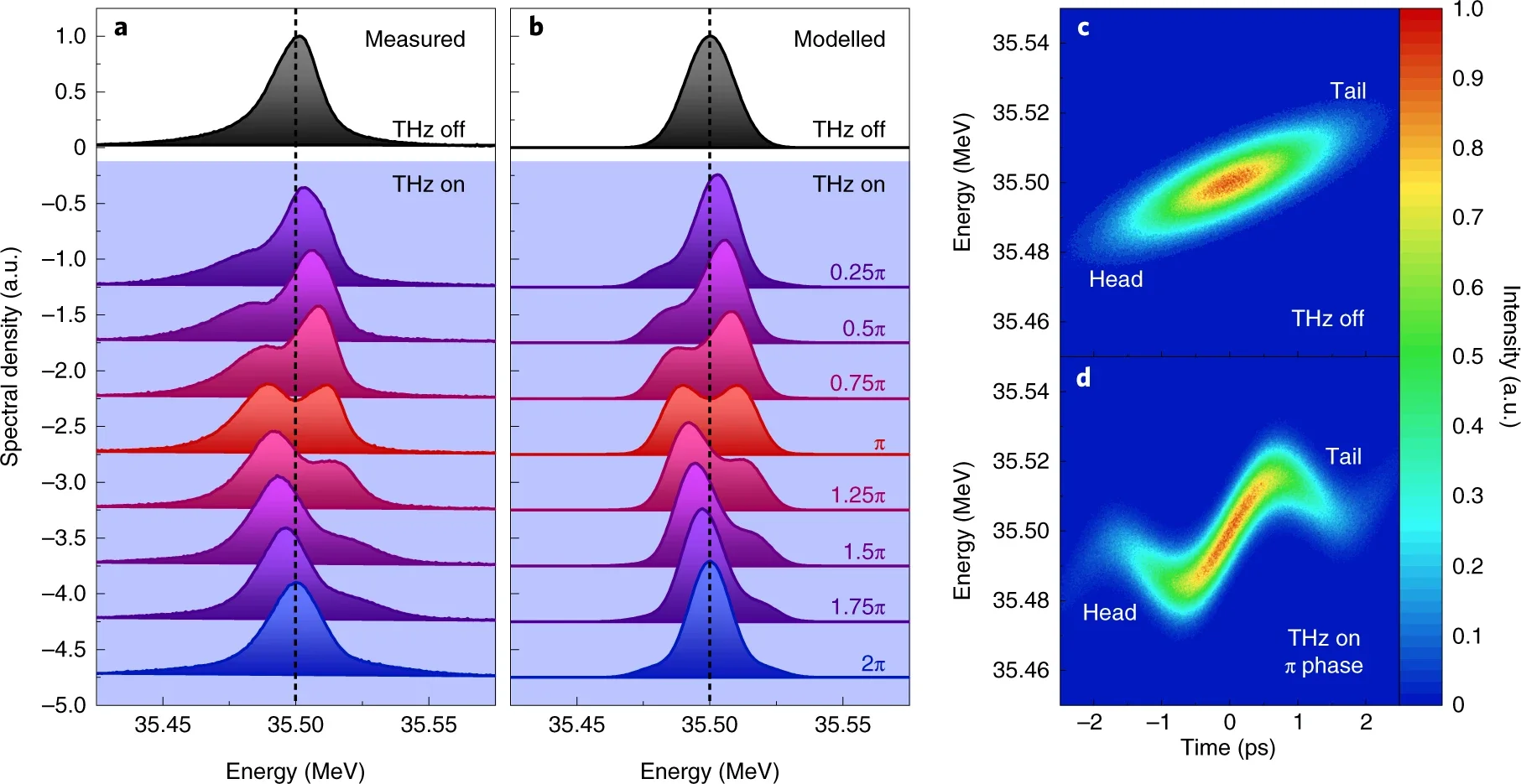
When the researchers shortened the electron bunch to roughly 2 picoseconds, comparable with one terahertz cycle, they could choose whether the bunch gained or lost energy simply by changing when it entered the field. The peak acceleration in those measurements reached about 10 kiloelectronvolts.
Acceleration was only one part of the demonstration. The terahertz field also acted as an exceptionally fast diagnostic tool.
A longer electron bunch experienced different portions of the oscillating field. Electrons arriving at slightly different times therefore received different energy changes, imprinting the bunch’s temporal structure onto its measured energy spectrum.
That allowed the researchers to reconstruct the relationship between time and energy inside the relativistic electron bunch. Such measurements normally require dedicated radio-frequency deflecting structures and additional beamline equipment.
Terahertz technology could eventually help scientists manipulate and diagnose electrons with femtosecond precision. One femtosecond is one quadrillionth of a second, short enough to follow atoms moving during chemical reactions or structural changes in materials.
That capability makes compact electron sources particularly interesting for ultrafast electron diffraction and next-generation X-ray generation.
The original demonstration used a modest 2 megavolts-per-meter gradient, but subsequent work has shown that substantially stronger terahertz acceleration is possible.
In 2021, another team demonstrated whole-bunch relativistic acceleration reaching an effective gradient of 85 megavolts per meter. Two terahertz stages produced an energy gain of 204 kiloelectronvolts.
A separate multistage experiment showed that nearly an entire relativistic bunch could be accelerated sequentially in two 30-millimeter dielectric waveguides while largely preserving its energy spread.
By 2023, researchers using tightly confined terahertz surface waves achieved an electron energy gain of 1.1 megaelectronvolts with an effective gradient reaching 210 megavolts per meter. More recent work has focused on tapered waveguides that continuously adjust the field velocity as slower electrons accelerate.
These advances do not mean kilometer-scale accelerators are about to disappear. Producing powerful terahertz pulses efficiently, preserving beam quality, synchronizing many acceleration stages and managing high particle charges remain substantial engineering challenges.
The long-term attraction is accessibility. Large accelerators can cost hundreds of millions or billions of dollars, restricting their most advanced capabilities to major laboratories.
Compact sources could eventually bring high-quality electron and X-ray beams into university laboratories, hospitals and industrial facilities. Potential applications include ultrafast imaging, materials characterization, radiation generation and specialized forms of cancer treatment.
Terahertz systems are particularly promising because they occupy a useful middle ground. Their wavelengths are short enough to support much smaller accelerator structures, yet long enough to accommodate significantly more charge than many optical-frequency accelerator concepts.
The 35 MeV CLARA experiment did not produce a pocket-sized replacement for a conventional accelerator. The incoming electrons still came from a large accelerator facility. What it demonstrated was the critical element that could eventually shrink part of that machinery: near-light-speed electrons can remain synchronized with laser-generated terahertz waves and gain energy inside a structure measured in millimeters.
These studies trace major advances made since the original relativistic terahertz acceleration experiment.
Terahertz-driven acceleration of subrelativistic electron beams using tapered rectangular dielectric-lined waveguides: Tapered waveguides were designed to continuously adjust phase velocity as lower-energy electrons accelerate, addressing one of the central synchronization problems in compact THz accelerators. (Physical Review Accelerators and Beams, 2024)
Megaelectronvolt electron acceleration driven by terahertz surface waves: Strongly confined terahertz surface waves produced a 1.1 MeV energy gain and effective acceleration gradients reaching 210 MV/m. (Nature Photonics, 2023)
Long range terahertz driven electron acceleration using phase shifters: Researchers developed a phase-shifting strategy to overcome dephasing and extend useful THz-electron interactions over greater distances. (Applied Physics Reviews, 2022)
Stable and Scalable Multistage Terahertz-Driven Particle Accelerator: Two sequential THz stages accelerated almost an entire relativistic electron bunch while largely maintaining beam quality, demonstrating a route toward scalable systems. (Physical Review Letters, 2021)
Cascaded high-gradient terahertz-driven acceleration of relativistic electron beams: Whole-bunch acceleration reached an effective gradient of 85 MV/m, while two stages produced a combined energy gain of 204 keV. (Nature Photonics, 2021)
Research findings are available online in the journal Nature Photonics.
The original story “Compact particle accelerator uses terahertz waves to accelerate electrons to 99.99% light speed” is published in The Brighter Side of News.
Like these kind of feel good stories? Get The Brighter Side of News’ newsletter.
The post Compact particle accelerator uses terahertz waves to accelerate electrons to 99.99% light speed appeared first on The Brighter Side of News.


Leave a comment
You must be logged in to post a comment.