A dead star’s atmosphere contains an unusual clue to a possible new beginning: heavy elements that may come from a planet formed after the star died. The white dwarf HS 0209+0832 appears to be collecting material unlike the rocky debris normally detected around these stellar remnants.
A University of Warwick-led team reports the finding in a study published in Nature Astronomy. Supported by the European Research Council, the researchers identify the system as a second-generation planet candidate. Their evidence combines chemical measurements, stellar atmosphere models and a repeating brightness signal.
Such a world would differ from planets that survive their host star’s transformation. Rather than forming alongside a young star, it would contain material expelled during stellar death. The proposed explanation remains an inference, although the researchers argue it best accounts for the observations.
“Second-generation planets are worlds that form out of the material a star casts off as it dies,” said first author Jamie Williams, a Warwick physics doctoral student. “They’re incredibly rare, and finding one around a white dwarf was completely unexpected.”
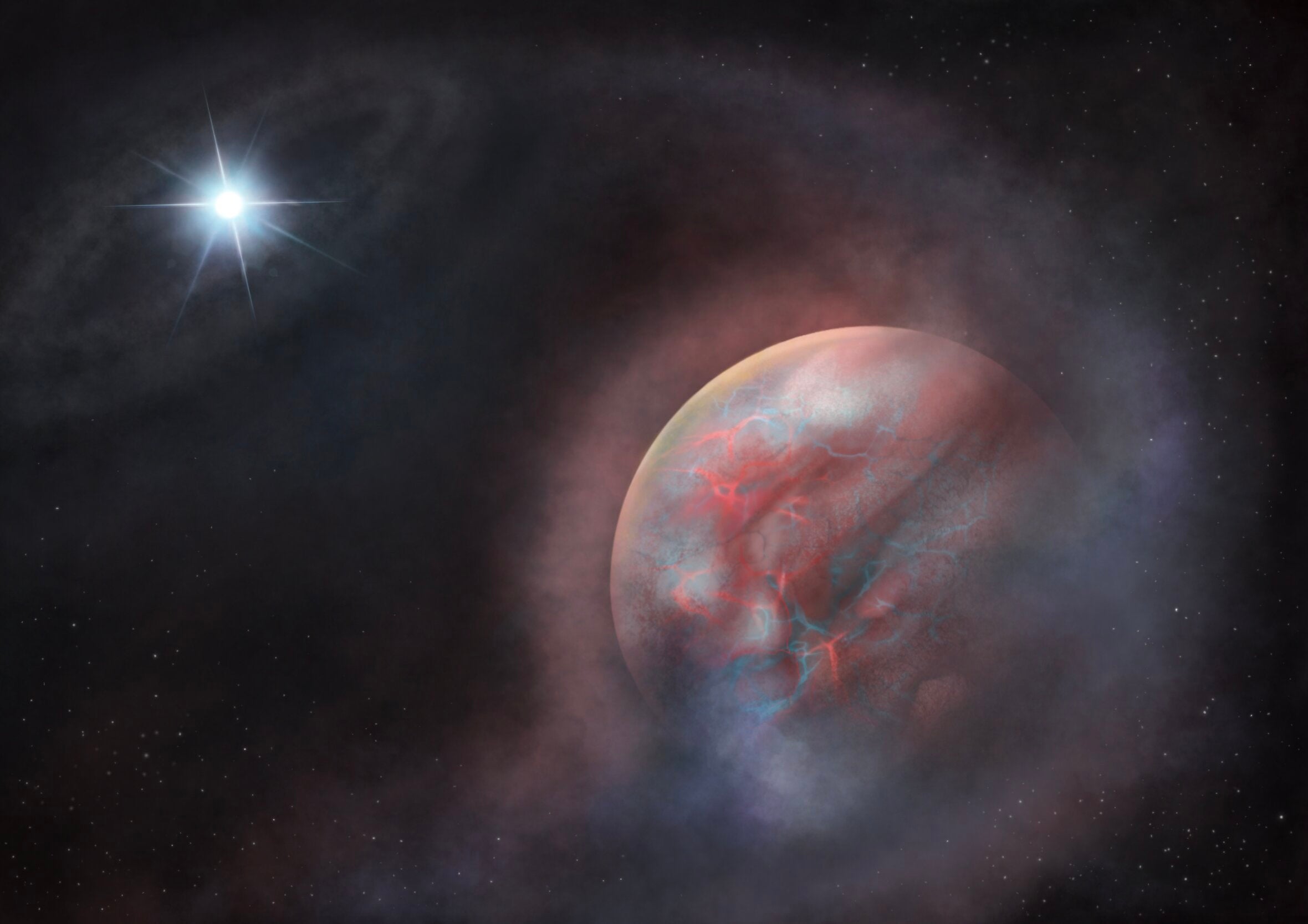
White dwarfs are the dense cores left after stars exhaust their fuel and shed their outer layers. Material from surrounding planetary systems can fall onto them, leaving detectable elements in their atmospheres. Those chemical traces commonly reveal rock-forming elements such as silicon and iron.
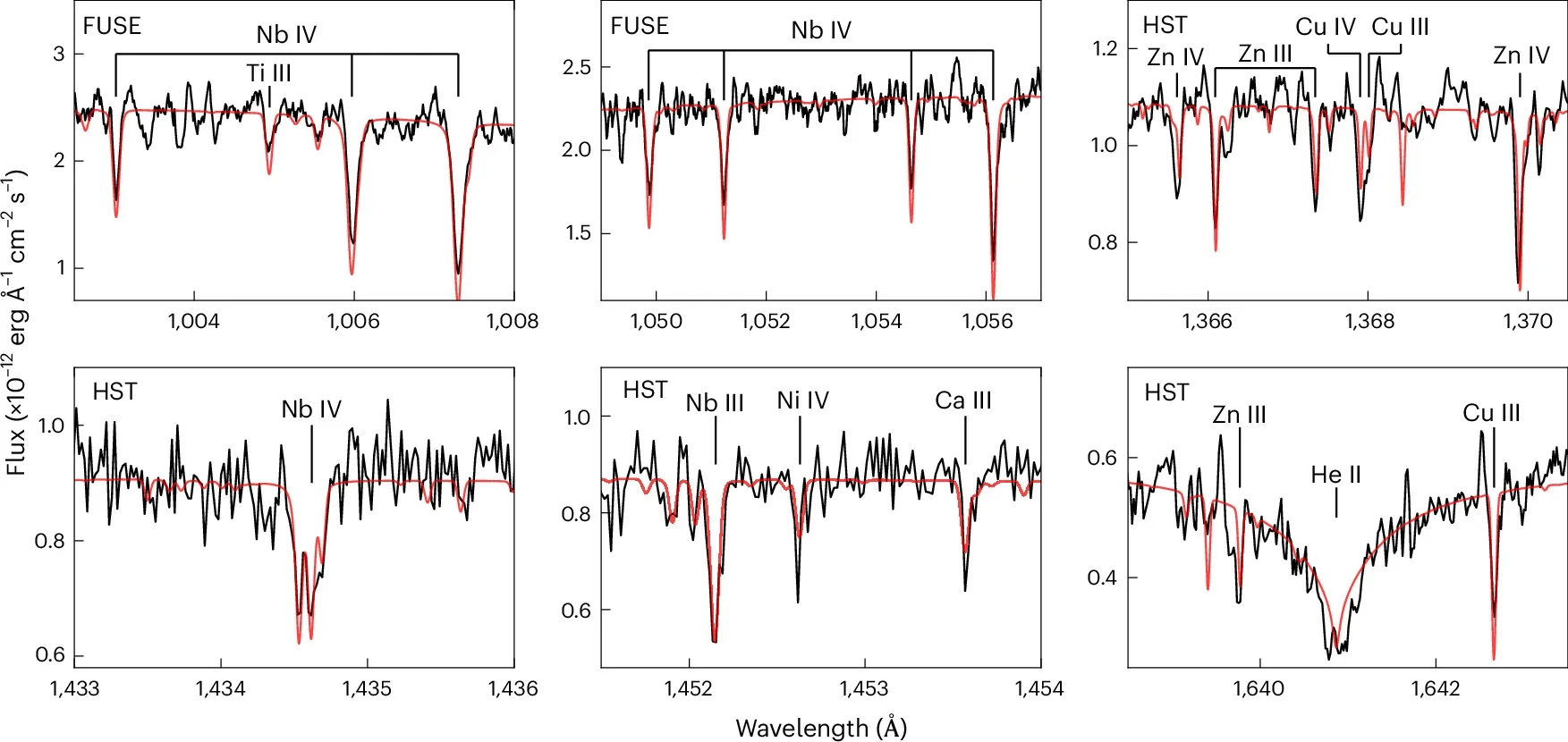
HS 0209+0832 presents a different pattern. Its atmosphere contains copper, zinc and niobium, with unusually strong enhancements compared with calcium. The niobium-to-calcium abundance exceeds the corresponding solar ratio by more than 1,000 times.
This is the first reported detection of niobium in a white dwarf. The researchers identified five spectral lines from doubly ionized niobium and 57 from triply ionized niobium. They found no comparable niobium signature in a comparison sample of 33 other metal-enriched white dwarfs.
The analysis drew on archival observations from the Hubble Space Telescope, the Far Ultraviolet Spectroscopic Explorer and the Very Large Telescope. Earlier ultraviolet observations had left roughly 100 spectral features unidentified. Recognizing copper and niobium helped explain those features and exposed the unusual composition.
The team measured nine metals and set upper limits for 15 other elements. Comparisons with meteorites and known examples of white dwarf pollution failed to identify an ordinary rocky source matching the pattern. Nickel was also unusually abundant relative to iron.
The heavy elements suggest material processed inside an aging star. During the asymptotic giant branch phase, stars can produce carbon and heavier elements before ejecting their outer layers. Slow neutron capture, known as the s-process, builds some of those heavy nuclei.
The researchers compared the observations with 138 models of material expelled by asymptotic giant branch stars. Those models offered a plausible source for the strong niobium enhancement and elevated copper, zinc and nickel. Carbon in the atmosphere provides another potential clue to this origin.
Reading that chemical record requires accounting for the white dwarf itself. At about 35,800 kelvin, its intense radiation can support some elements against gravity. Others sink, so their continued presence requires an external supply.
The researchers modeled these effects rather than assuming every measured atmospheric abundance directly represented incoming material. Their calculations indicate ongoing accretion at more than 445 million grams per second. That lower limit does not include all potentially supplied hydrogen and helium.
Helium offers another sign of continuing delivery. It should disappear from the visible atmosphere within months, yet it remains detectable. The observations therefore point to an active source rather than simply a chemical residue from the star’s earlier life.
The proposed planet would have formed in a disk containing the star’s expelled material. Creating that disk poses a problem: an isolated star generally sheds mass outward, rather than collecting it into an orbiting reservoir. A former companion could have helped retain material around the system.
In one scenario, interaction with a companion during the giant phase ejects material into a disk. A giant planet could then form from that reservoir. The researchers propose this history, but they have not established the presence or identity of the required companion.
The white dwarf’s cooling age is about five million years. Any formation and migration scenario must fit within that relatively short interval. A planet born farther away would need time to form and move into its present close orbit.
The paper also considers a different possibility: a surviving first-generation planetary core could have acquired a new atmosphere from the expelled material. That scenario would produce a world containing second-generation material without requiring the entire planet to form anew. The current evidence does not settle this distinction.
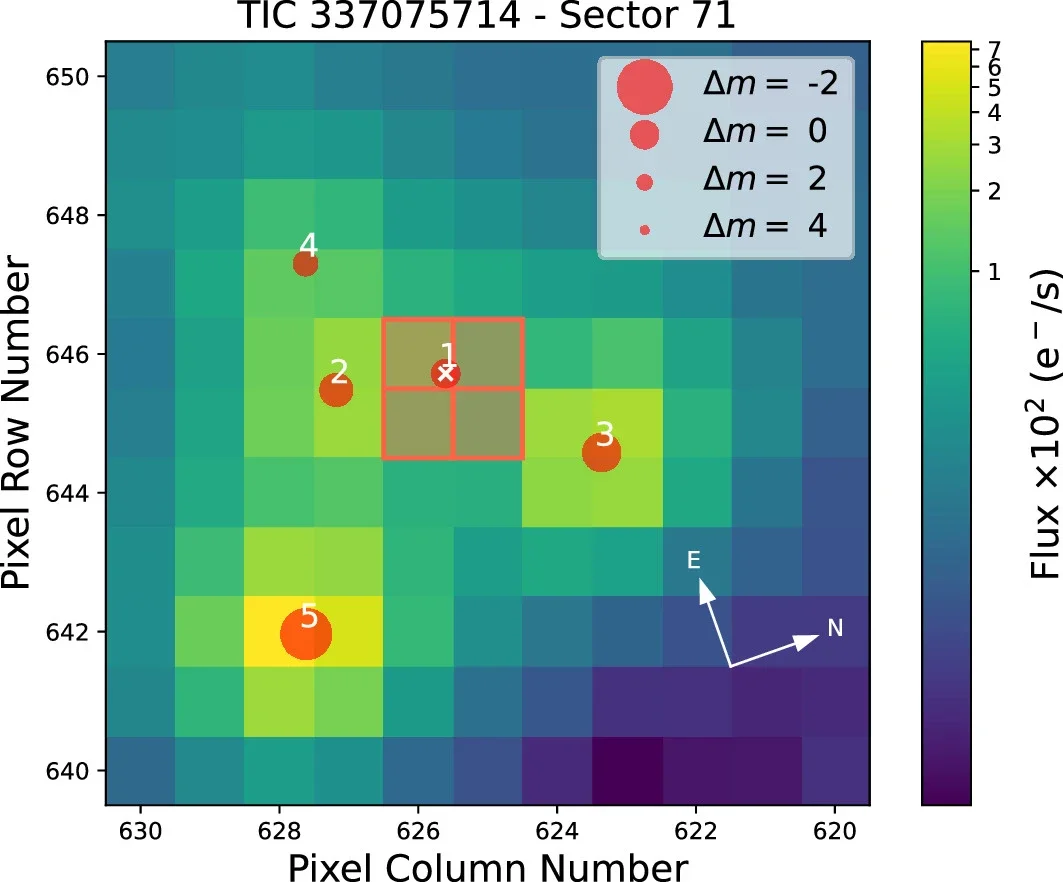
NASA’s Transiting Exoplanet Survey Satellite, or TESS, supplied another piece of evidence. Across four observing sectors, the system showed a faint, sinusoidal brightness variation repeating every 4.399 days. Its measured amplitude was about 0.12 percent.
That signal is consistent with a strongly irradiated, tidally locked giant planet. As it orbits, different portions of its illuminated atmosphere would face Earth, changing the observed brightness. The interpretation assumes a planet roughly Jupiter’s size; the observations do not directly measure that radius.
In this model, the planet orbits about 0.04 astronomical units from the white dwarf. Intense radiation drives atmospheric escape, and some escaping gas reaches the star. This could connect the brightness cycle with the unusual atmospheric chemistry.
The signal does not independently confirm a planet, and other explanations require consideration. The researchers also examined alternatives to the proposed material source, including direct accretion of stellar ejecta. Differences in the expected element patterns make those explanations less satisfactory in their analysis.
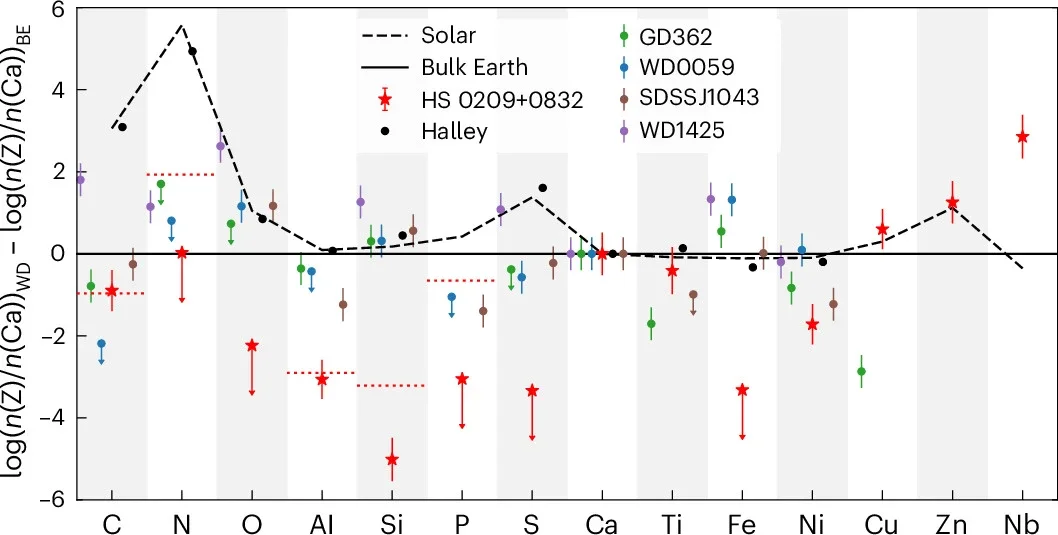
One unresolved issue involves strontium, which might be expected alongside niobium in material from an aging star. The observations did not detect it. Processing within a planet could potentially alter the element pattern, but detailed models of a second-generation planetary atmosphere are still needed. The chemical interpretation therefore remains a framework to test, with important aspects of the proposed history unresolved.
The study offers a candidate and a search strategy, rather than a completed account of its formation. Looking for carbon and s-process elements in other white dwarfs could uncover similar systems. Confirming their companions and explaining their chemistry would test whether stellar death can supply the ingredients for another generation of planets.
These resources explore planetary survival, atmospheric chemistry and possible planet formation after stellar evolution.
Accretion of a giant planet onto a white dwarf star: Examines evidence for a giant planet losing atmospheric material that accumulates around a white dwarf. (Nature, 2019)
A giant planet candidate transiting a white dwarf: Reports a close-orbiting giant planet candidate and considers how planets reach such orbits after stellar evolution. (Nature, 2020)
PEWDD: A database of white dwarfs enriched by exo-planetary material: Collects published chemical measurements used to investigate planetary debris falling onto white dwarfs. (Astronomy & Astrophysics, 2024)
Second-generation planet formation after tidal disruption from common envelope evolution: Models a possible route to new planets using disks produced through interactions between evolving stars and companions. (Publications of the Astronomical Society of Australia, 2025)
Aerosols and hydrocarbons in the atmosphere of a white dwarf planet: Uses James Webb Space Telescope observations to investigate the atmosphere and heating history of WD 1856 b. (Nature, 2026)
Research findings are available online in the journal Nature Astronomy.
The original story “Astronomers discover a ‘phoenix planet’ reborn from the ashes of a dead star” is published in The Brighter Side of News.
Like these kind of feel good stories? Get The Brighter Side of News’ newsletter.
The post Astronomers discover a ‘phoenix planet’ reborn from the ashes of a dead star appeared first on The Brighter Side of News.


Leave a comment
You must be logged in to post a comment.