A small snake preserved in Brazilian sandstone carried a skull unusually well suited to life underground. Its dense, overlapping bones and distinctive internal anatomy suggest that burrowing snakes were already specialized during the age of dinosaurs.
Named Tametara mirim, the animal lived approximately 85 million to 75 million years ago. An international team led by Annie Hsiou at the University of São Paulo, Tiago Simões at Princeton University, and Nicolas Di-Poï at the University of Helsinki described it in Nature.
The fossil provides evidence of early snake ecological diversity, rather than settling their origin. Its anatomy differs sharply from that of another ancient snake, Dinilysia patagonica. Together, they show why one fossil species cannot stand in for the ancestral lifestyle of all snakes.
The research received support from FAPESP, São Paulo’s research funding agency.
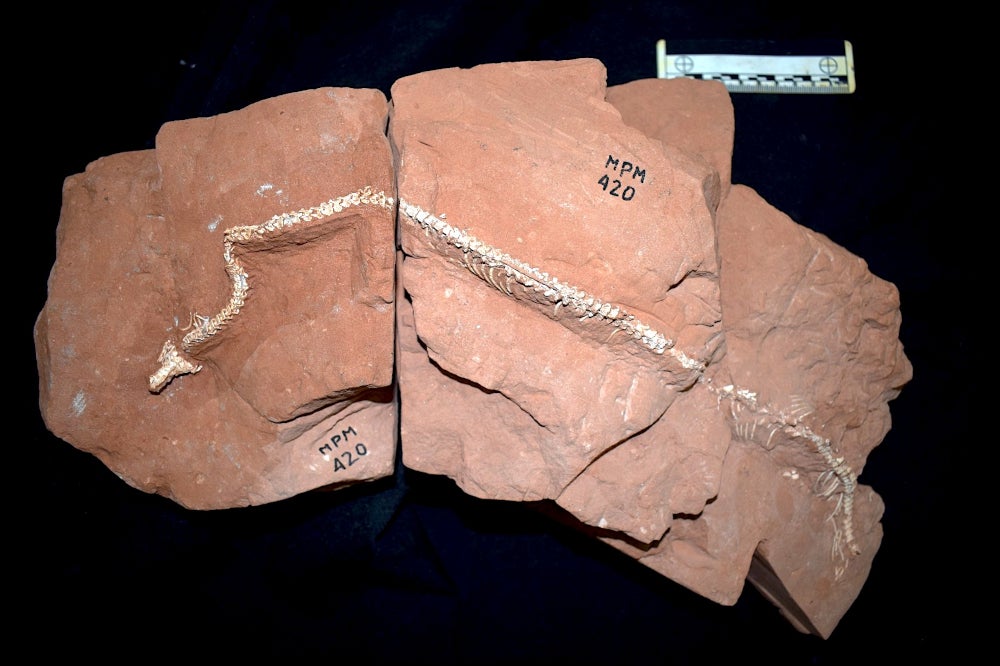
William Nava and Giovanna Paixão discovered the specimen in 2020 at a quarry in Presidente Prudente, western São Paulo state. Both were associated with the Marília Museum of Paleontology, which houses the fossil. The surrounding sandstone belongs to the Adamantina Formation of the Bauru Group.
That rock sequence is well known for dinosaur fossils. Its snake record has been much more limited, with previous Brazilian Cretaceous finds consisting of isolated vertebrae. The researchers identify Tametara as Brazil’s first reported articulated snake fossil, with bones still connected.
The specimen preserves the posterior half of the skull and approximately 103 vertebrae from the front portion of the body. Its preserved length is 419 millimeters, about 42 centimeters. Because the rear body is missing, that measurement should not be treated as the animal’s complete length.
The preserved skull measures 17.8 millimeters, with an estimated original length near 33 millimeters. Strong bone development and vertebral features indicate an adult. The species name combines a term meaning “adorned,” referring to its prominent skull crest, with “mirim,” meaning small.
High-resolution computed microtomography allowed the team to examine the skull without destroying it. Researchers separated individual structures digitally, producing 3D models of bones, cranial nerves, the inner ear and the internal skull cavity. Gabriela Sobral helped reconstruct these structures from the scans.
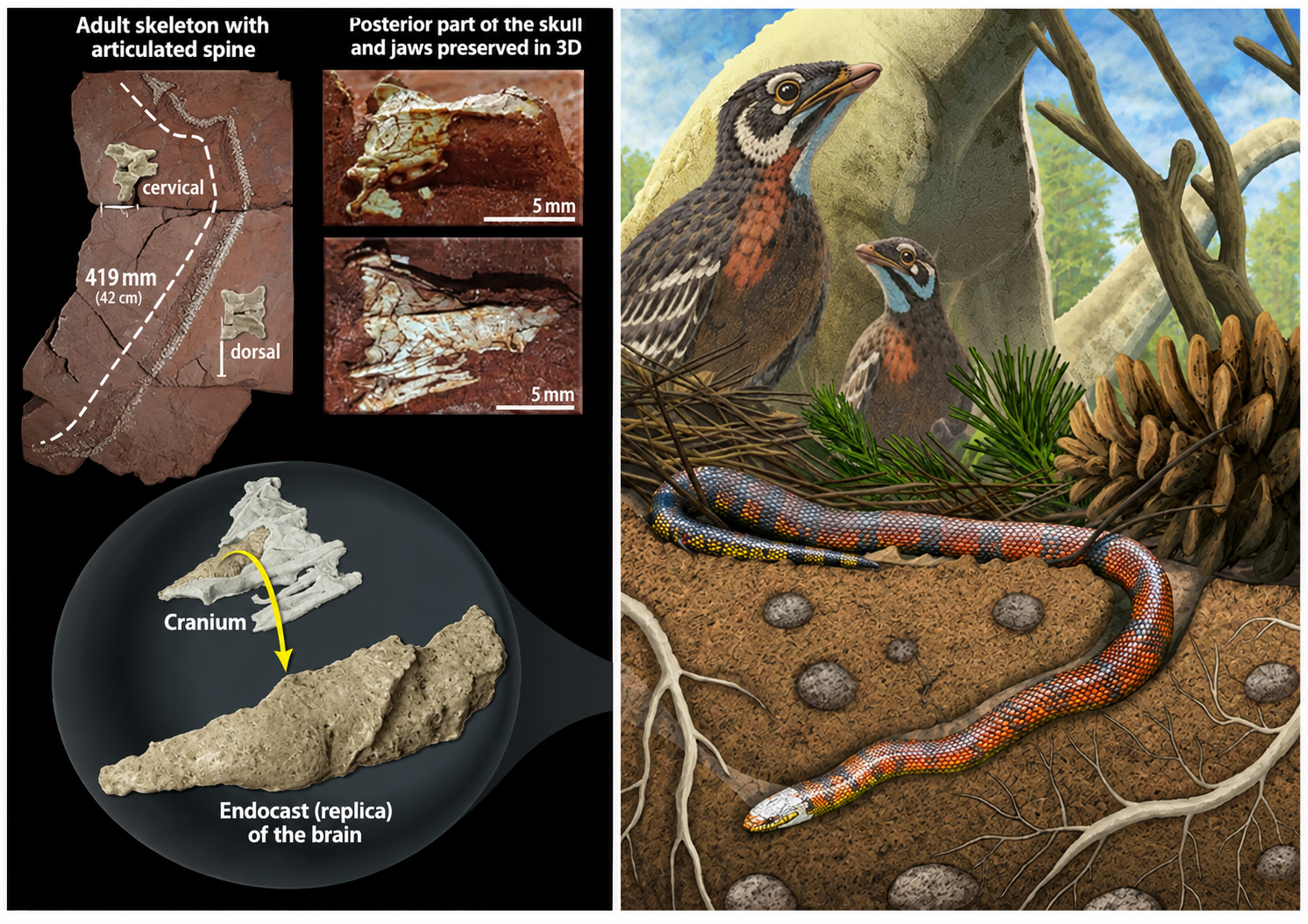
The resulting brain endocast is a model of internal spaces, not a fossilized brain. Those spaces housed neural tissue and other structures when the snake was alive. Their shapes can nevertheless provide clues about anatomy and sensory capabilities.
The correspondence between an endocast and the brain varies across regions. In snakes, the forebrain and olfactory bulbs generally match their enclosing spaces more closely than posterior regions. The quantitative comparisons therefore focused on the telencephalon, part of the forebrain.
This caution matters when interpreting how an extinct animal perceived its surroundings. A small region on an endocast can suggest reduced emphasis on a function. It cannot directly reveal behavior or measure the animal’s sensory performance.
Tametara’s skull roof contains compact bones with substantial overlap. Those features resemble conditions in living burrowing and partly burrowing reptiles. The researchers measured bone thickness, compactness, overlap and skull proportions to test that comparison quantitatively.
The inner ear supplies another line of evidence. It has an enlarged vestibular region and a simplified arrangement of semicircular canals. That combination is consistent with adaptations seen in burrowing snakes, although inner-ear shape alone has produced conflicting habitat interpretations in earlier research.
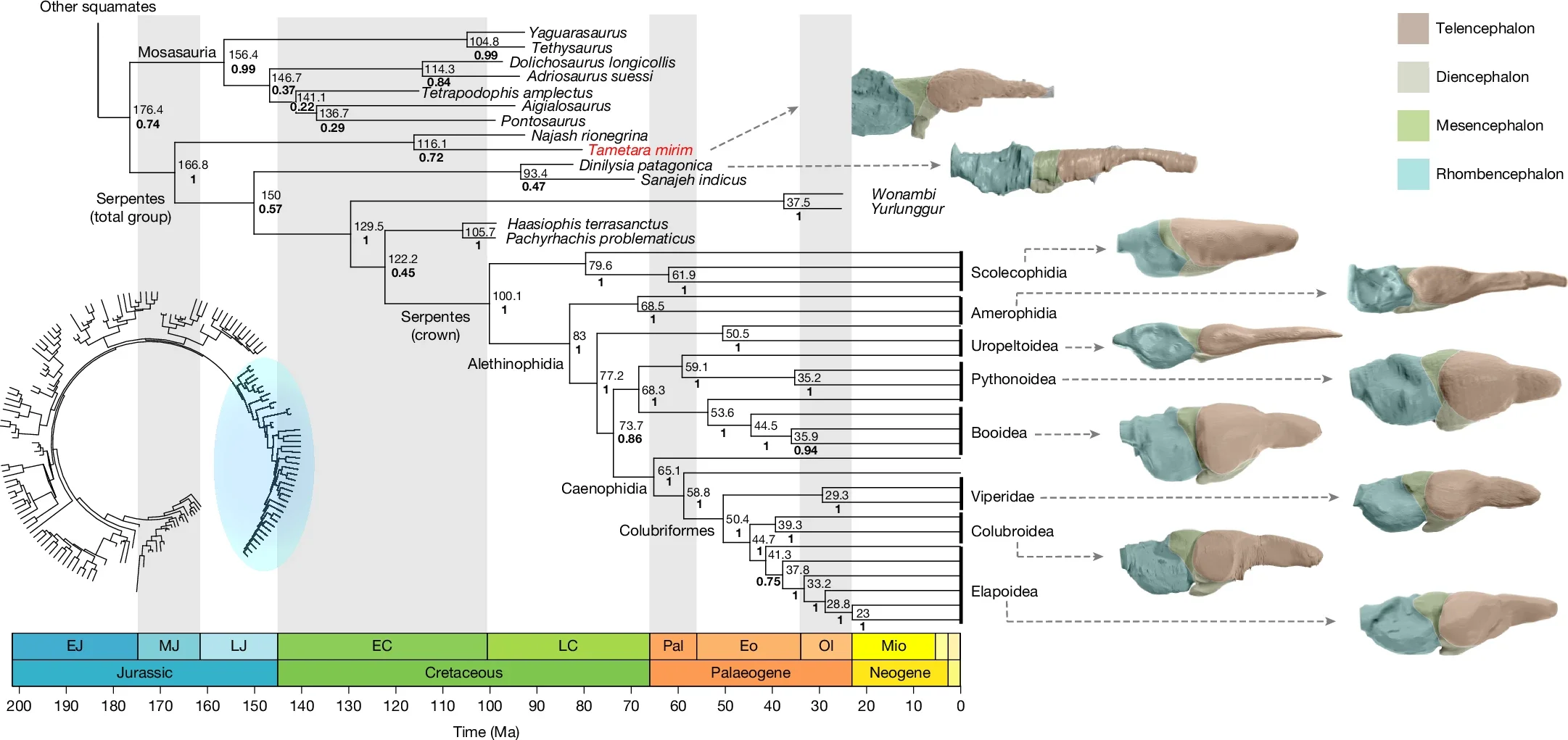
The endocast also shows short olfactory bulbs and only modestly expanded cerebral hemispheres. Its optic tectum, associated with visual processing, is poorly defined. Reduced development of that region occurs in reptiles living underground and in other conditions where vision has less prominence.
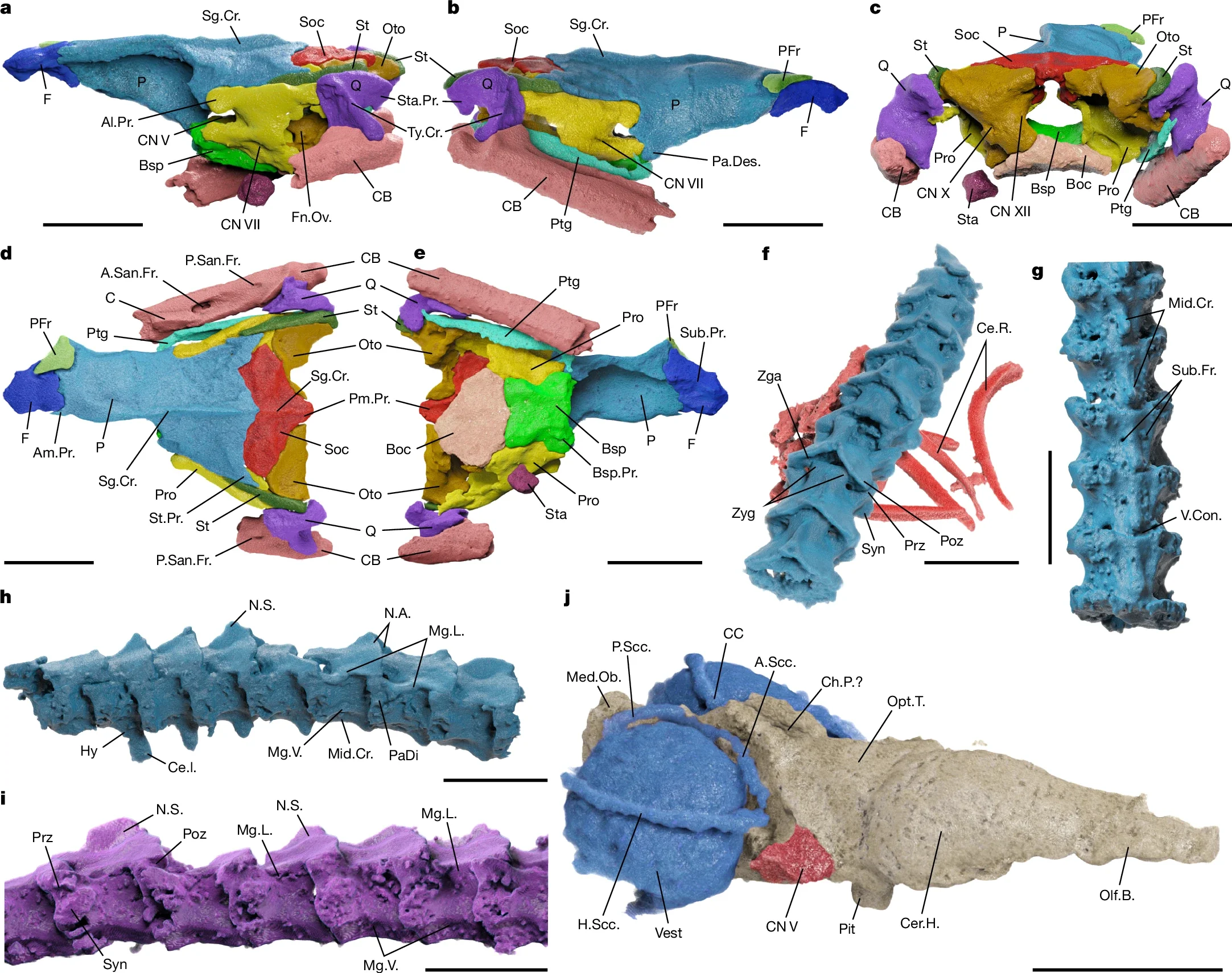
Not every feature fits the same ecological pattern. Tametara also had an elongated mid-hindbrain and a large pituitary region, traits more commonly encountered in surface-dwelling, aquatic or partly burrowing species. Different brain regions therefore appear to have followed different evolutionary paths.
The strongest evidence comes from the agreement between independent analyses. Forebrain shape and skull microstructure both place Tametara among burrowing forms. The inner-ear anatomy supports that interpretation without serving as its sole foundation.
The team reconstructed Dinilysia patagonica, an Argentine Cretaceous snake, for comparison. These two species are the only stem snakes with well-preserved braincases and publicly available scan data suitable for this analysis. Stem snakes belong to extinct branches outside the group containing all living snakes.
The forebrain comparison included 58 living reptile species and the two fossils. A separate skull-microstructure analysis covered 106 living species plus the fossils. These datasets allowed the researchers to evaluate anatomical similarities against known habitat preferences.
A statistical classification model assigned Tametara a 99.2% probability of belonging to the burrowing category. However, the model’s overall classification accuracy was 65%, and performance varied substantially among habitats. That probability is a result within the model, rather than direct observation of an ancient snake underground.
Dinilysia occupied a different region of anatomical variation, with unusually long, curved olfactory bulbs and narrow cerebral hemispheres. Its features favored a non-burrowing interpretation. The model leaned toward surface-dwelling life, but its forebrain shape did not clearly distinguish among alternative non-burrowing habitats.
The skull-bone comparison supported the same broad separation. Tametara fell within the burrowing snake cluster, while Dinilysia lay outside it. Their contrasting anatomy indicates that early snake lineages did not share one uniform ecological profile.
The study also tested Tametara’s evolutionary placement using 166 fossil and living species, 394 anatomical characters and genetic data from 11 loci. All analyses placed it among stem snakes. Most identified it as an early-diverging form alongside the Argentine snake Najash.
That position does not make Tametara a direct ancestor of modern snakes. Nor does its underground specialization establish the habitat in which snakes first emerged. The broader fossil record includes marine stem snakes as well as burrowing and non-burrowing forms.
Important parts of Tametara remain unknown. The region near the cloaca, where hind limbs would have occurred, was not preserved. Researchers therefore cannot determine whether this individual retained them.
The authors report fewer than ten articulated snake fossils from the entire Mesozoic, with only three previously known examples preserved in 3D. Better-preserved fossils from earlier periods, especially the Jurassic, remain essential. Tametara strengthens the evidence for early habitat diversification while leaving the original setting of snake evolution unresolved.
These studies explore ancient snake anatomy, sensory evolution and competing interpretations of ancestral habitats.
Reconstructing the origin and early evolution of the snake brain: Uses detailed brain reconstructions to investigate sensory and ecological changes during snake evolution. (Science Advances, 2023)
New skulls and skeletons of the Cretaceous legged snake Najash, and the evolution of the modern snake body plan: Examines well-preserved fossils that illuminate skull transformation and the persistence of hind limbs in early snakes. (Science Advances, 2019)
The ecological origins of snakes as revealed by skull evolution: Tests how skull development and shape inform different ecological stages in snake origins. (Nature Communications, 2018)
The morphology of the inner ear of squamate reptiles and its bearing on the origin of snakes: Investigates the relationship between inner-ear anatomy and habitat, including limits on interpreting ancient snakes. (Royal Society Open Science, 2017)
The oldest known snakes from the Middle Jurassic-Lower Cretaceous provide insights on snake evolution: Reports older fossils that extend the timeline relevant to questions about snake origins. (Nature Communications, 2015)
Research findings are available online in the journal Nature.
The original story “Ancient Brazilian snake fossil sheds new light on the origin of snakes” is published in The Brighter Side of News.
Like these kind of feel good stories? Get The Brighter Side of News’ newsletter.
The post Ancient Brazilian snake fossil sheds new light on the origin of snakes appeared first on The Brighter Side of News.


Leave a comment
You must be logged in to post a comment.