Only a small patch of faded pigment survives, preserving part of a hand against an Indonesian cave wall. Mineral deposits covering that stencil show it was already there at least 67,800 years ago, giving it the oldest reported minimum-age constraint for cave art worldwide.
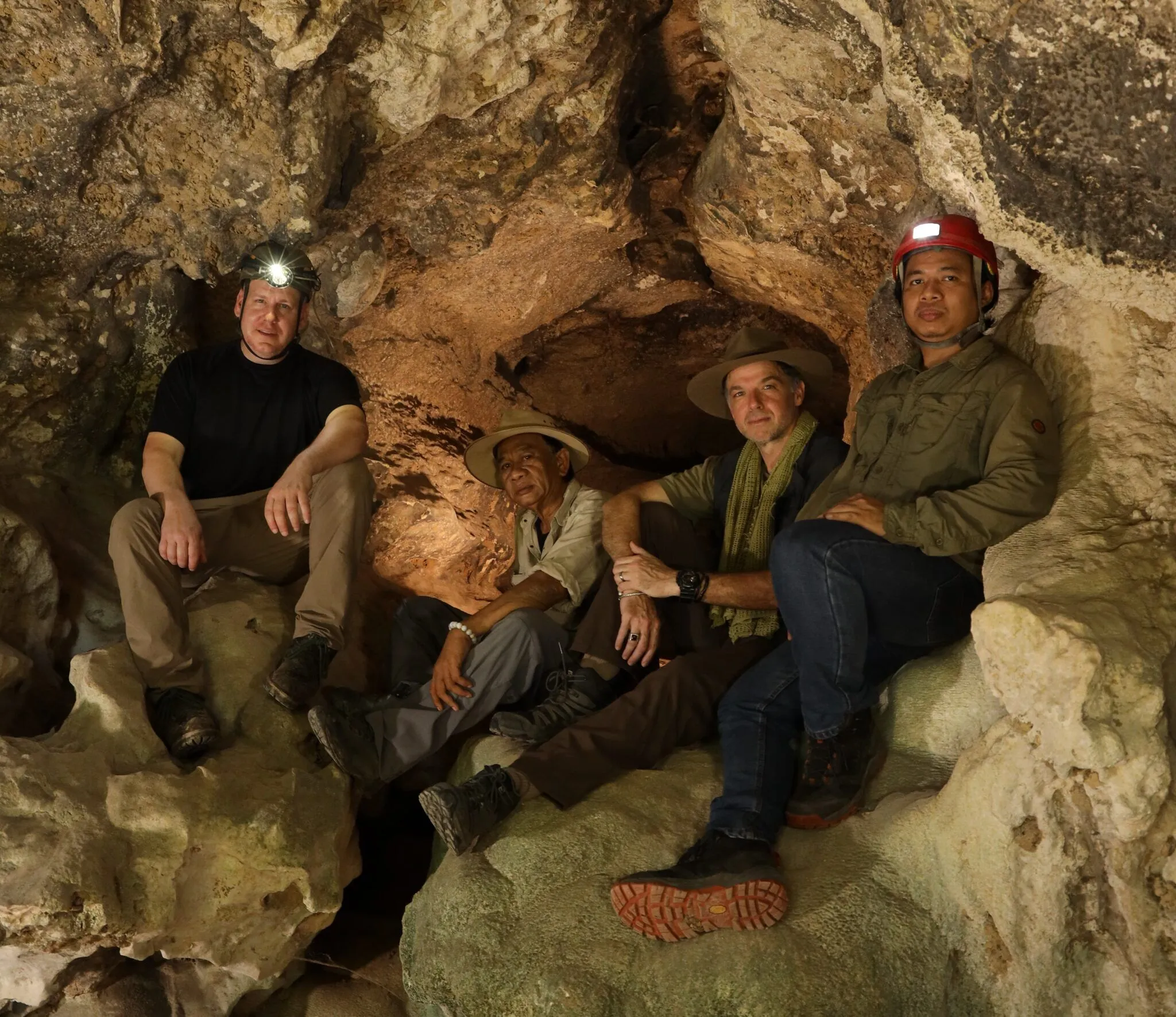
The archaeological study, published in Nature, examined paintings in southeastern Sulawesi and its satellite islands. An international team co-led by Griffith University, Indonesia’s National Research and Innovation Agency, known as BRIN, and Southern Cross University investigated the images.
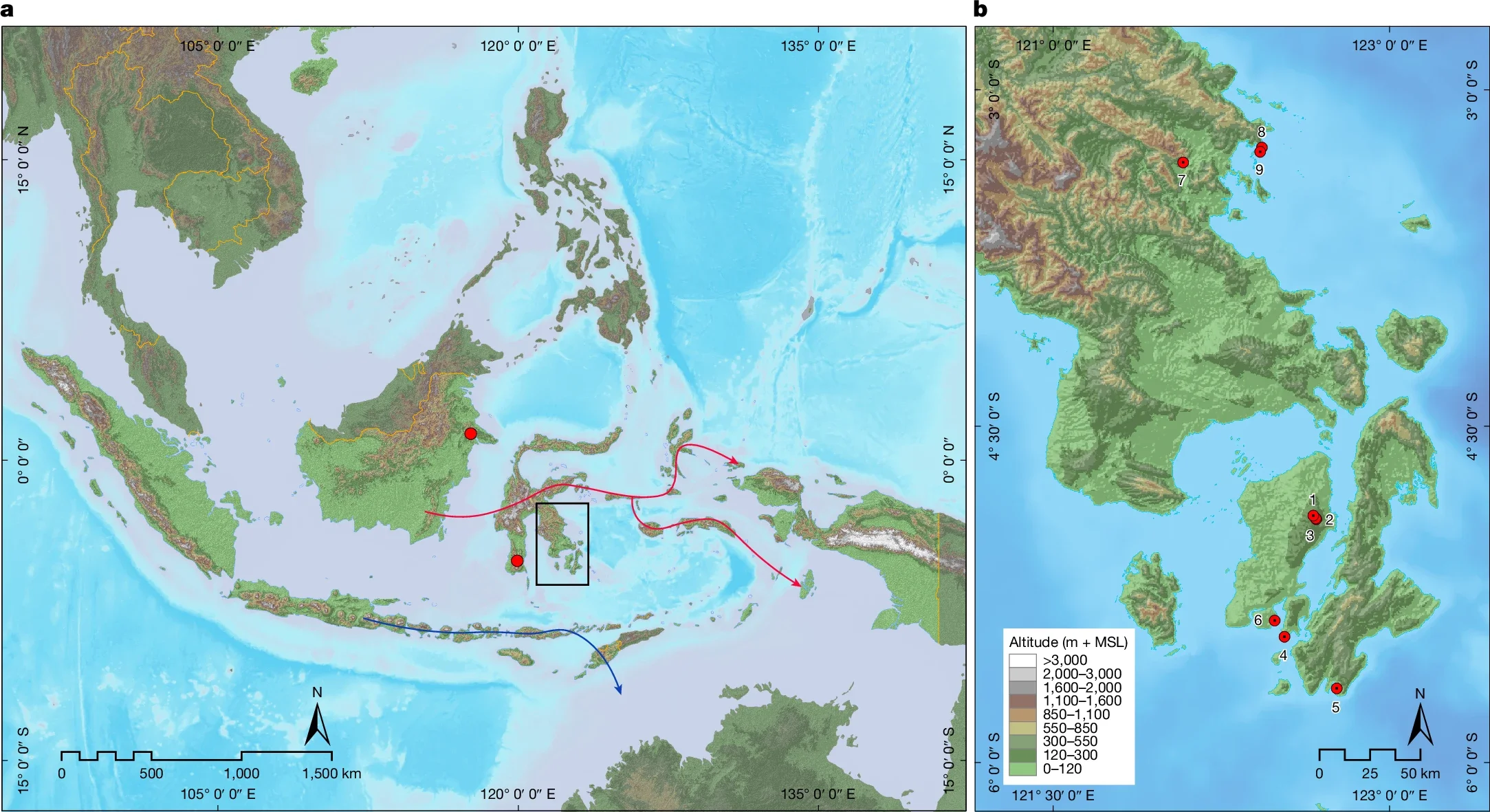
The oldest stencil comes from Liang Metanduno, a limestone cave on Muna Island. It adds evidence for an exceptionally long history of image-making in the region. The researchers also argue that its age strengthens the case for early human journeys toward Australia through northern Wallacea.
The dated stencil is poorly preserved. Its remaining pigment covers an area approximately 14 by 10 centimeters, showing portions of fingers and the adjoining palm. Ancient mineral formations partly cover the image.
One surviving fingertip appears deliberately narrowed. The researchers identify this as a distinctive hand-stencil form known so far only from Sulawesi. It gives the image a claw-like appearance, although the fragment cannot reveal the complete original design.
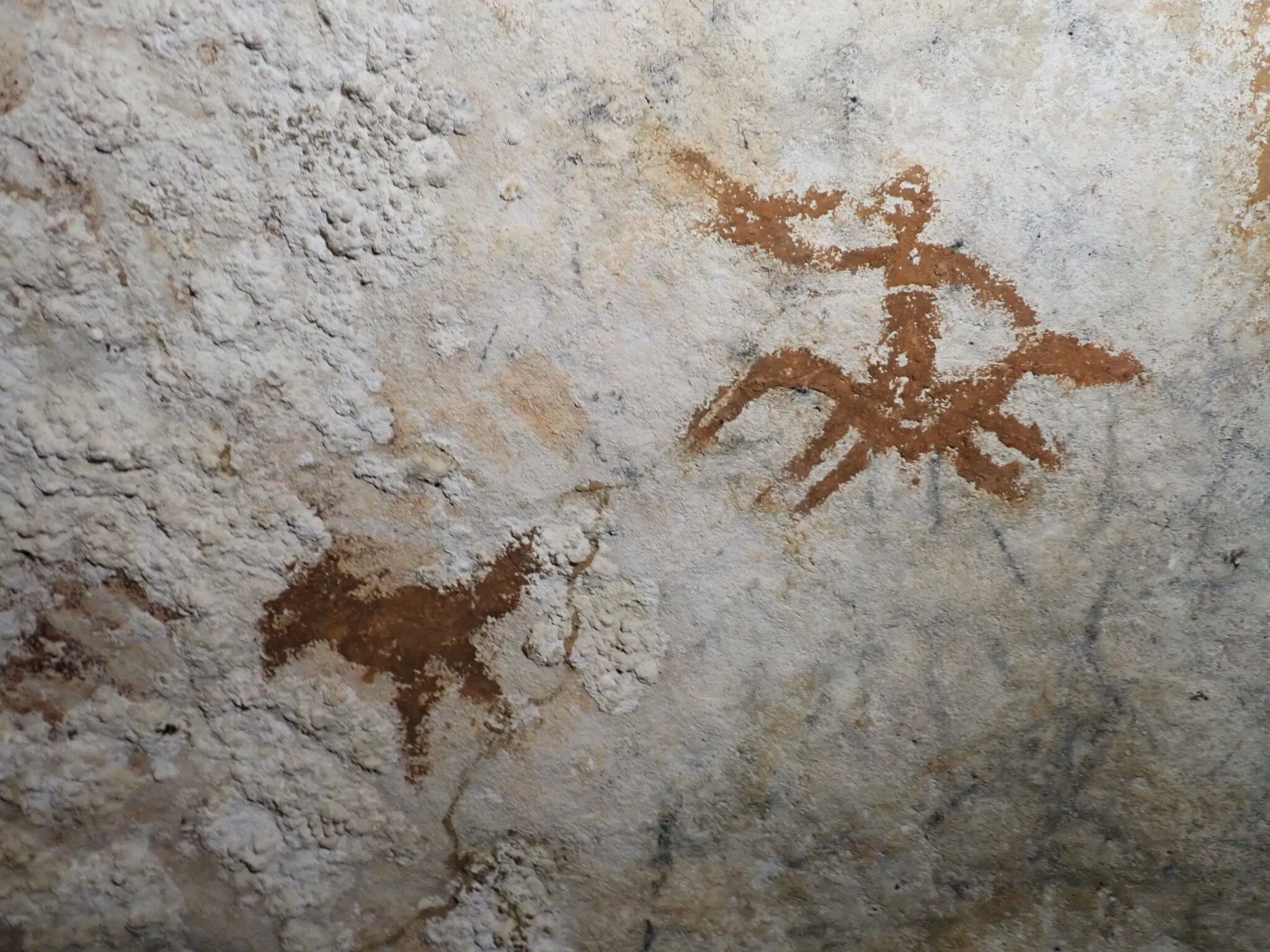
The team’s broader survey began in 2019 and documented 44 rock-art sites, including 14 newly recorded locations. Researchers dated 11 individual motifs across eight sites. These comprised seven hand stencils, two human figures and two geometric images.
Earlier dating work had concentrated on the Maros-Pangkep limestone landscape in southwestern Sulawesi. The new results extend the evidence for ancient painting into the island’s southeastern region. Six of the seven sampled hand stencils yielded minimum ages within the Pleistocene.
The team used laser-ablation uranium-series analysis to date calcium carbonate associated with the paintings. Where mineral growth covers pigment, the painting must predate that growth. Dating deposits beneath pigment can sometimes establish an upper age boundary as well.
The analysis maps uranium and thorium within the mineral layers. Their isotope ratios allow researchers to estimate when the carbonate formed, rather than when an artist applied pigment.
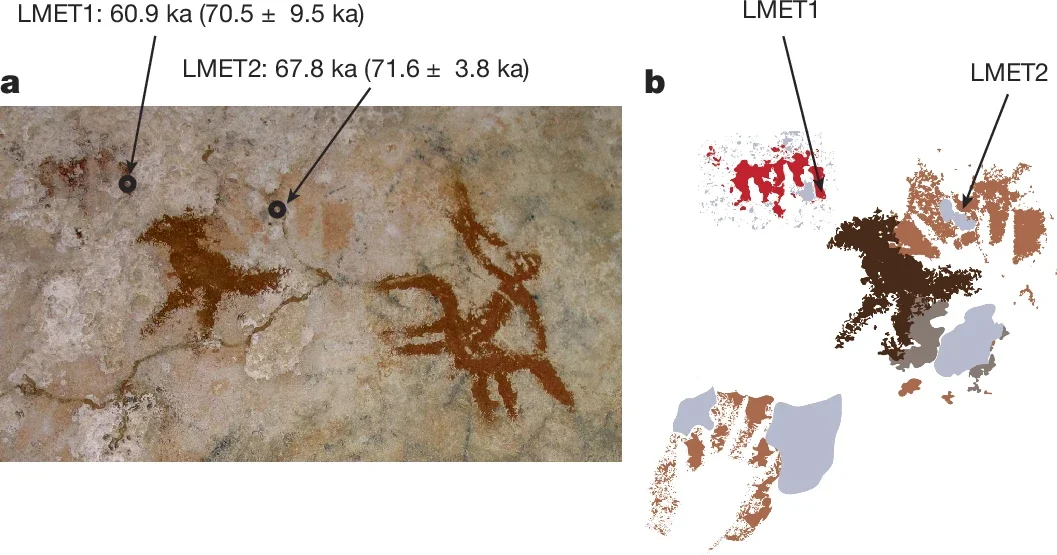
For the oldest stencil, the overlying calcite yielded an age of 71,600 years, with a reported uncertainty of 3,800 years. The researchers used the lower end of that estimate to establish a conservative minimum of 67,800 years. The painting itself could be older.
This distinction matters when comparing artworks. A higher minimum age does not, by itself, prove that one painting was made before another. It shows that the surviving evidence places a stronger lower boundary on its age.
The Muna minimum exceeds the 51,200-year minimum reported for a Sulawesi narrative painting in 2024 by 16,600 years. It also exceeds the published 66,700-year minimum for a hand stencil at Maltravieso in Spain by 1,100 years. The Spanish stencil’s dating and attribution to Neanderthals have been debated.
Uranium movement within mineral deposits can make calculated ages appear too old. To address that risk, the team avoided porous samples and examined multiple regions within deposits. The resulting ages followed the expected sequence or agreed within uncertainty, supporting the integrity of the samples.
A second mineral sample came from another stencil only 11 centimeters away on the same panel. It contained two pigment layers separated by calcium carbonate. Their different positions and dates revealed more than one episode of painting.
The older pigment had a minimum age of 60,900 years. The younger layer fell between a minimum of 21,500 years and a maximum of 32,800 years. Together, the layers indicate painting episodes separated by at least 35,000 years.
That does not establish uninterrupted use of the cave throughout the interval. Nor can the older pigment’s original subject be identified confidently. It may belong to an earlier stencil, residual spray from the oldest stencil, or another image now obscured.
Other caves showed that hand stencils continued to be made in the wider region around 20,000 years ago. Liang Metanduno also contains fresher-looking paintings over older surfaces and images. Their subjects include a bird interpreted as probably a chicken, suggesting much later artistic activity.
The narrowed fingertip offers evidence of deliberate modification, but its production method remains uncertain. Additional pigment could have reduced the negative outline. Alternatively, movement of the hand during pigment application could have produced the narrowing.
Adam Brumm, an archaeologist at Griffith’s Australian Research Centre for Human Evolution, considers the symbolism open to speculation. He suggests it could relate to connections between humans and animals. Other early Sulawesi art includes figures interpreted as combining human and animal characteristics.
That comparison does not establish what this particular hand meant. The stencil preserves a visual choice without an explanation from its maker. Its significance must therefore be separated from the measurable evidence of age and form.
The team attributes the Muna art to Homo sapiens, citing its technical and stylistic complexity and known regional arrival times. However, the paper acknowledges that no available method directly identifies the artist’s species. Earlier hominins occupied Sulawesi, and possible overlap with modern humans remains unclear.
Sulawesi lies in Wallacea, the island zone between continental Southeast Asia and the former landmass of Sahul. During the Pleistocene, Sahul encompassed Australia, Tasmania and New Guinea. Reaching it required maritime journeys through the intervening islands.
Researchers have proposed two main migration corridors. A northern route passed through Sulawesi and the Spice Islands toward New Guinea. A southern route approached the Australian mainland through Timor or nearby islands.
The timing is also debated. A shorter chronology places initial settlement around 50,000 years ago, while a longer chronology places arrival at least 65,000 years ago. The Muna stencil provides early archaeological evidence along the proposed northern corridor.
“This discovery strongly supports the idea that the ancestors of the First Australians were in Sahul by 65,000 years ago,” said BRIN rock-art specialist Adhi Agus Oktaviana. The team interprets the artists as likely belonging to a broader population that later reached Australia.
The painting does not directly date arrival in Sahul or demonstrate ancestry. It establishes ancient image-making at a location relevant to the migration debate. Its age and position give researchers a firmer basis for investigating other islands between Sulawesi and western New Guinea.
These studies explore early Indonesian imagery, regional human occupation and evidence for the first settlement of Sahul.
Narrative cave art in Indonesia by 51,200 years ago: Reports the earlier Sulawesi narrative painting and the laser-ablation dating approach used to investigate mineral growth over art. (Nature, 2024)
Hominins on Sulawesi during the Early Pleistocene: Documents much earlier stone tools on Sulawesi, providing context for questions about which human groups occupied the island. (Nature, 2025)
Early presence of Homo sapiens in Southeast Asia by 86–68 kyr at Tam Pà Ling, Northern Laos: Presents fossil and dating evidence for early modern humans in mainland Southeast Asia. (Nature Communications, 2023)
Human occupation of northern Australia by 65,000 years ago: Reports archaeological evidence at Madjedbebe central to debates over the timing of Australia’s first human settlement. (Nature, 2017)
Least-cost pathway models indicate northern human dispersal from Sunda to Sahul: Models possible island-crossing routes and identifies northern Wallacea as a promising area for archaeological investigation. (Journal of Human Evolution, 2018)
Research findings are available online in the journal Nature.
The original story “67,800 year-old cave wall hand stencil offers clues to Australia’s first settlement” is published in The Brighter Side of News.
Like these kind of feel good stories? Get The Brighter Side of News’ newsletter.
The post 67,800 year-old cave wall hand stencil offers clues to Australia’s first settlement appeared first on The Brighter Side of News.


Leave a comment
You must be logged in to post a comment.