Electronic skin may one day let robots, prosthetic limbs and wearable devices feel the world with care. A new study from Hanyang University in South Korea brings that future closer with a compact sensor that can detect touch, pressure and nearby objects.
The research team, led by Associate Professor Jaekyun Kim from the Department of Photonics and Nanoelectronics, developed a vertically integrated dual-gate tribotronic transistor. The device uses tiny electrical signals from touch and converts them into a tunable response.
Modern wearable devices and flexible electronics need sensors that are small, efficient and sensitive. Electronic skin systems also need many sensing pixels packed close together.
Triboelectric nanogenerators, often called TENGs, have gained attention for this reason. They turn mechanical contact, pressure or motion into electrical signals through charge movement.
This broad effect is familiar from static electricity. When two surfaces touch and separate, electrical charges can build up.
In tribotronic devices, those charges can control a transistor. That creates a sensor that responds to touch without needing a bulky power system.
Conventional tribotronic sensors face major limits. Many have sensitivity that cannot be tuned after fabrication.
That makes it hard for one sensor to adapt to different pressure ranges. A light touch and a firm press may require different response settings.
Large-area integration also remains difficult. Electronic skin needs many pixels, each small enough to produce clear touch maps.
Older device structures can take up too much space. That limits how densely sensors can fit across a surface.
“Our vertical dual-gate architecture not only offers gate-tunable amplification of the triboelectronic responses, but also minimizes pixel footprint, enabling high-density, large-area integration,” Kim said.
The new device stacks its main parts vertically. A soft polydimethylsiloxane, or PDMS, layer sits on top and acts as the triboelectric sensing layer.
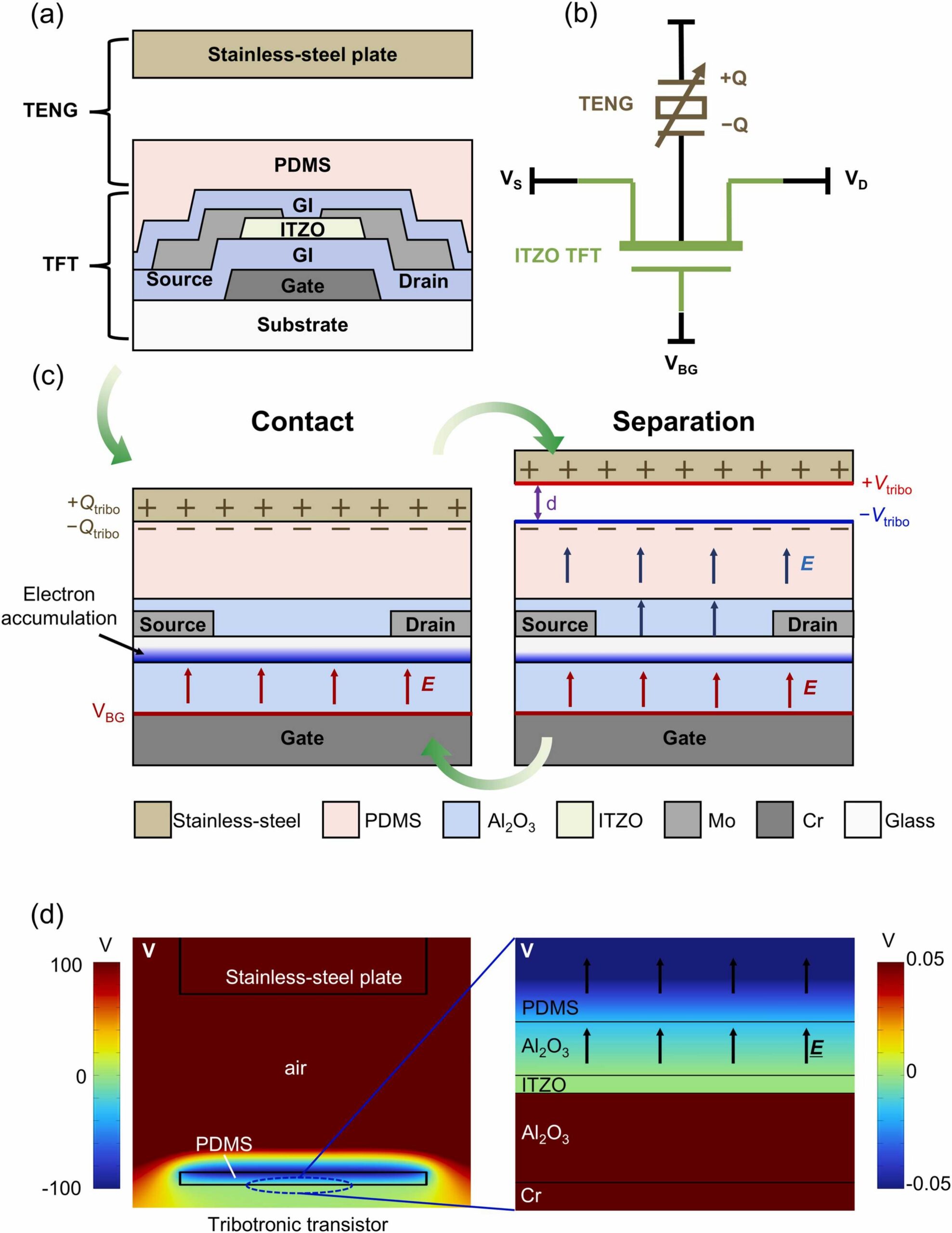
Below that is a dedicated top-gate insulator. Under the insulator is an indium-tin-zinc-oxide thin-film transistor, known as an ITZO TFT.
The PDMS layer acts as a top gate that responds to touch. The ITZO transistor has a bottom gate that controls the baseline current.
Together, these gates give the device two forms of control. Mechanical contact creates the sensing signal, while the bottom gate adjusts sensitivity.
This structure also reduces the pixel footprint. Smaller pixels can create sharper pressure maps across a larger electronic skin sheet.
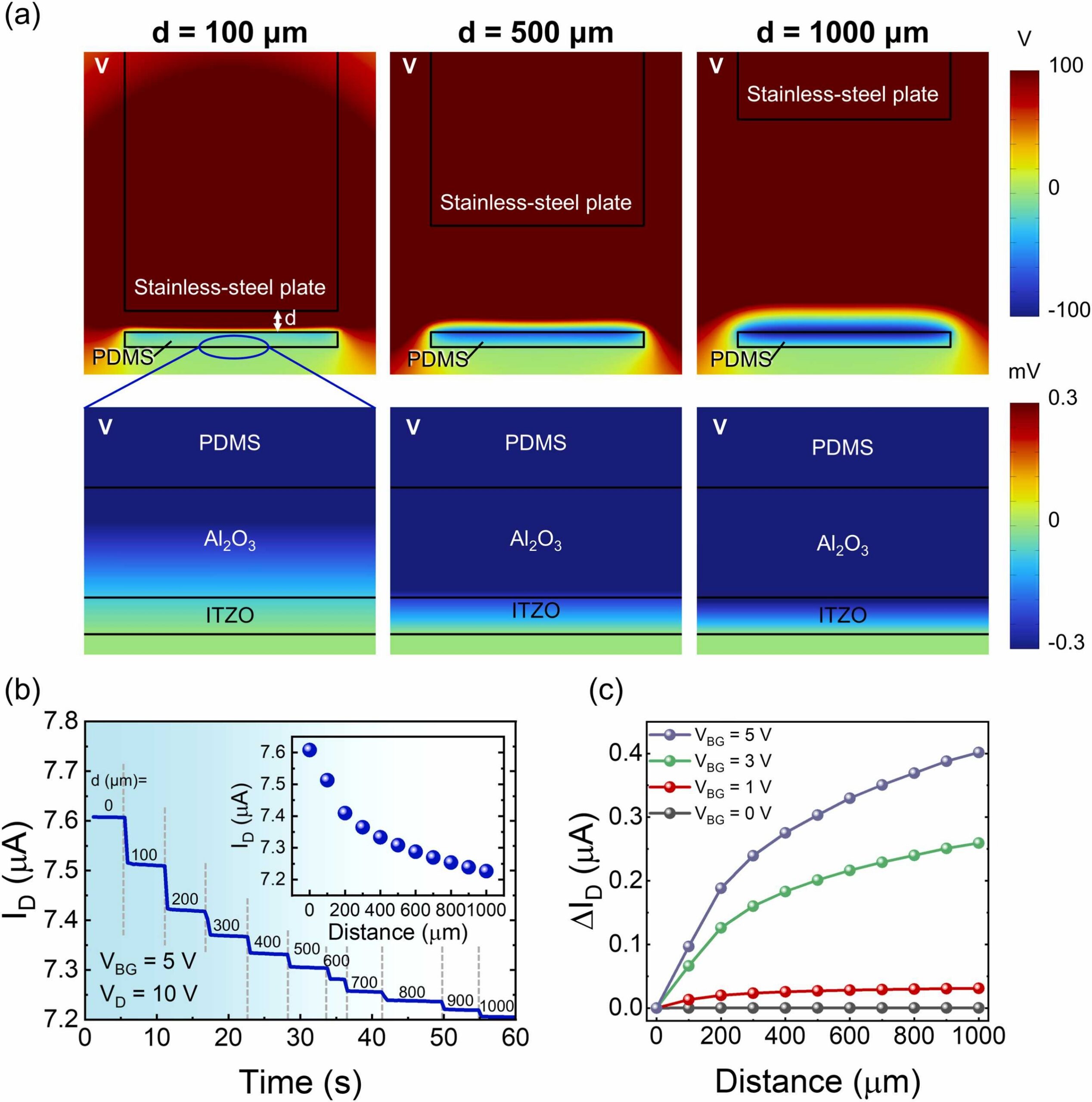
To operate, the device first goes through a charging step. A stainless-steel plate touches the PDMS surface.
This contact creates triboelectric charges at the interface. When the plate separates from the PDMS, those charges create a triboelectric potential.
That potential acts like a top-gate voltage. It suppresses current flow through the ITZO transistor.
When the charged plate or another object moves toward the PDMS again, the triboelectric potential decreases. The transistor current then begins to recover.
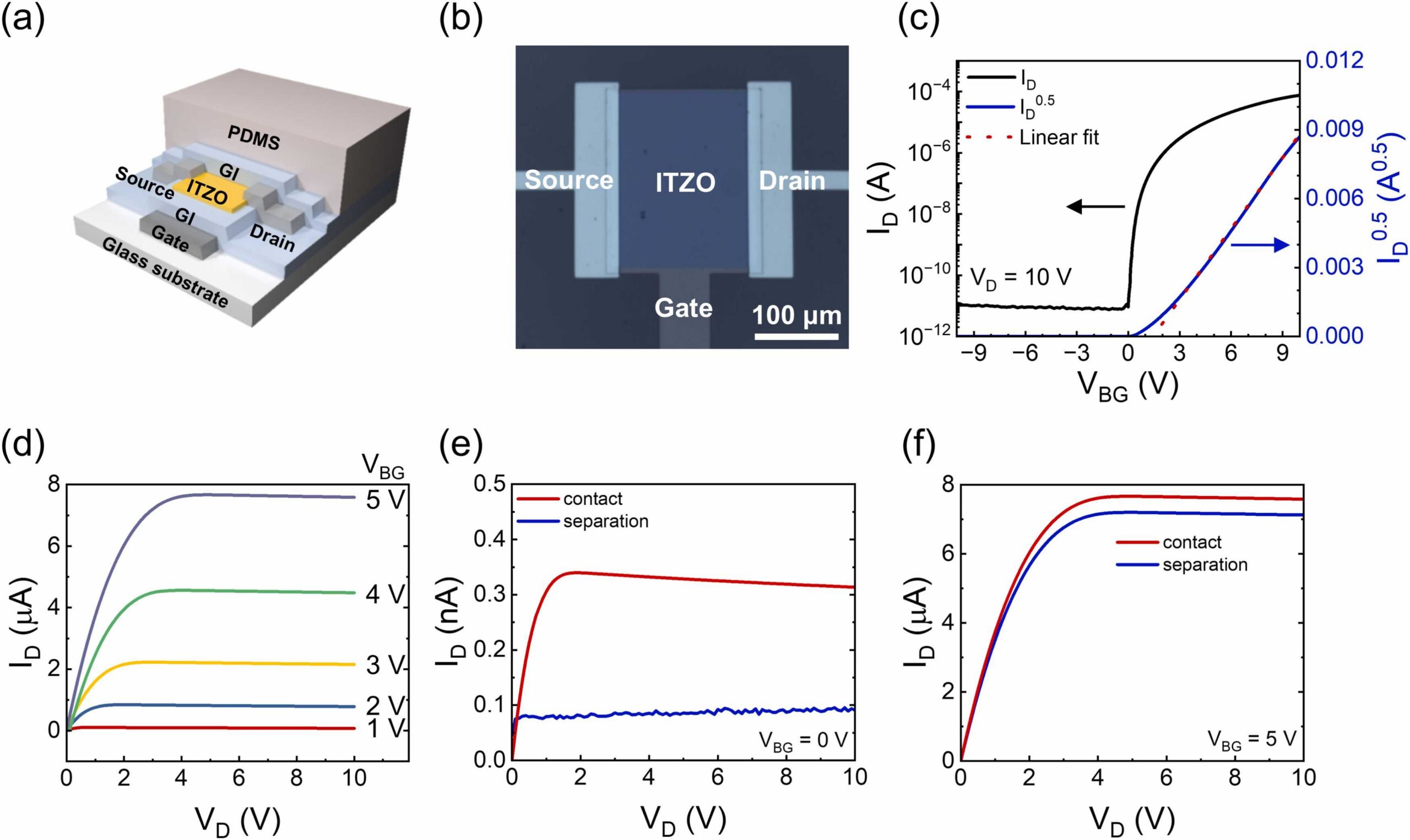
That current change becomes the sensor’s response. It tells the device whether something touched it or came nearby.
The bottom gate sets the transistor’s baseline current. By changing that voltage, researchers can tune how strongly the device responds.
The team found that sensitivity increased as the bottom-gate voltage rose. This gives the sensor a programmable quality that many earlier designs lack.
The system can also switch its sensing function up or down. Under certain gate settings, the device becomes more responsive. Under others, its response can be reduced.
That matters for real-world electronic skin. A robot may need high sensitivity when handling soft tissue, food or glass. It may need a different range when gripping sturdier objects.
A tunable sensor can better match changing tasks.
The researchers also tested pressure. They found that stronger pressure produced a larger signal.
This happens because rough surfaces do not touch evenly at first. As pressure increases, more of the PDMS surface contacts the object.
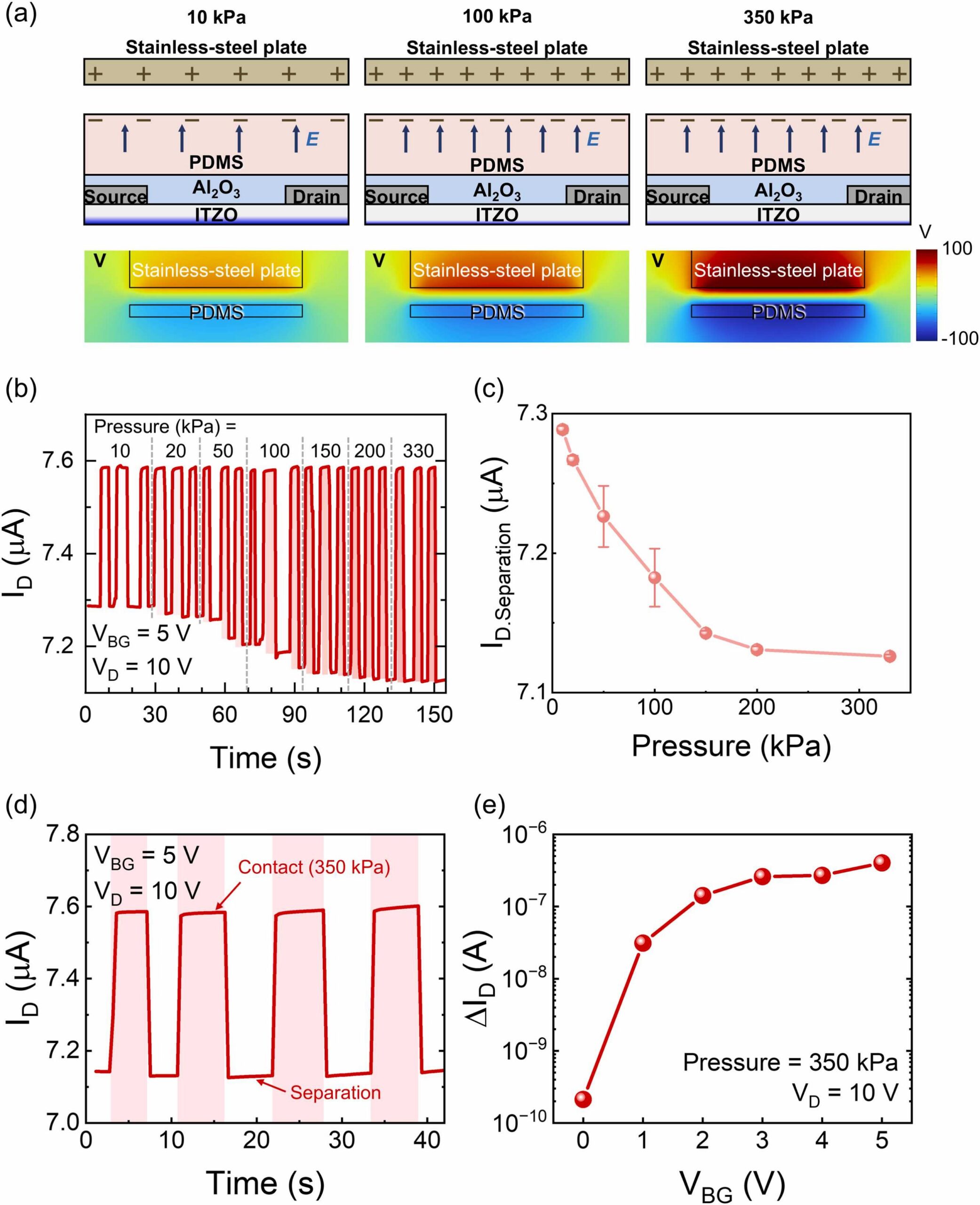
A larger contact area creates more triboelectric charge. That stronger charge leads to a stronger transistor response.
The device showed stable response and recovery times during repeated contact. Its response time was 127 milliseconds, and its recovery time was 212 milliseconds.
It also held up under repeated use. After 1,000 operating cycles, the device showed no noticeable performance loss.
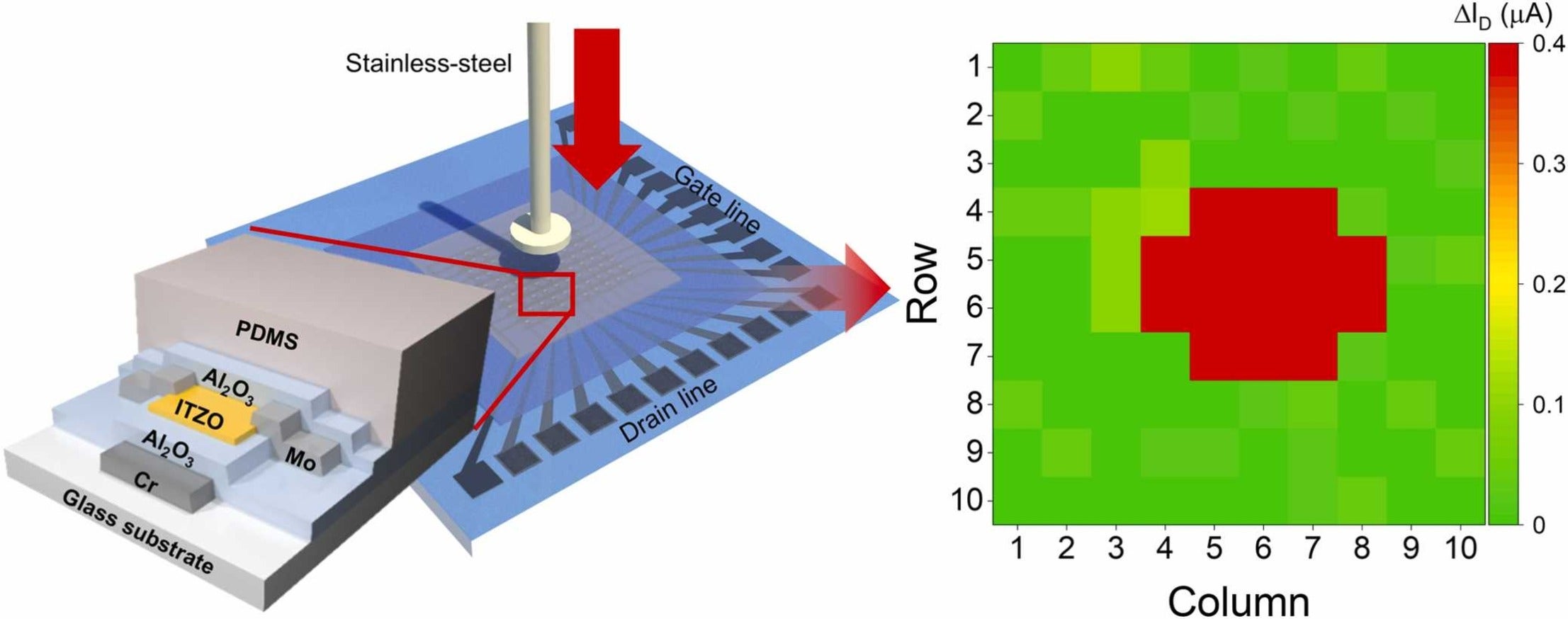
To show practical use, the team built a 10-by-10 transistor array. The array contained 100 sensing pixels.
After charging the sensing layer with a stainless-steel plate, researchers tested finger touches. The array produced pixel-level responses that mapped where contact occurred.
This is important for electronic skin because touch is spatial. A useful surface must know not only that contact happened, but where it happened.
The array also showed reliable proximity sensing. Using a stainless-steel probe, it detected nearby objects at distances up to 500 micrometers.
That means the device can sense before direct contact. For robots, that early warning could help prevent damage or unsafe interactions.
“Our research could contribute to the development of electronic skin systems that allow robots, prosthetic devices, and wearable electronics to perceive touch, pressure, and proximity more precisely,” Kim said. “This will lead to safer and more reliable human–machine interaction, with applications in healthcare robots, health monitoring and autonomous systems.”
The promise is easy to picture. A prosthetic hand could sense gentle pressure. A care robot could detect a human arm before bumping into it.
A wearable health patch could monitor small touches or mechanical changes. An autonomous system could feel its surroundings with more detail.
The study does not turn electronic skin into a finished product. But it gives engineers a scalable platform for sensitive, programmable touch arrays.
This research could help create electronic skin that is more precise, compact and adaptable. Robots and prosthetic devices need touch systems that can detect light pressure, firm contact and nearby objects. A tunable sensor array could help machines respond more safely to people and delicate materials.
The work may also support future wearable electronics. Devices used for health monitoring could benefit from thin, flexible sensors that detect pressure without heavy power demands. That could make long-term wearable sensing more practical.
For researchers, the vertical dual-gate design offers a path toward larger and denser sensor arrays. Because the architecture reduces pixel size and allows electrical tuning, future systems may achieve better touch maps across wide surfaces.
For humanity, the broader benefit is more natural interaction with machines. Robots that can feel more like human skin could become safer in hospitals, homes and workplaces. Prosthetic limbs could also become more responsive, giving users better control and confidence.
These resources explore proximity-sensitive electronic skin, triboelectric nanogenerators and the broader challenge of giving robots and wearable systems human-like tactile perception.
Proximity Sensing Electronic Skin: Principles, Characteristics, and Applications: Reviews flexible proximity sensors that can detect objects without physical contact, including triboelectric and dual-function approaches for human-machine interaction. (Advanced Science, 2024)
Recent Progress of Bioinspired Triboelectric Nanogenerators for Electronic Skins and Human–Machine Interaction: Examines how triboelectric devices inspired by biological systems can provide self-powered sensing for electronic skin and robotic interfaces. (Nanoenergy Advances, 2024)
Recent Advances in Self-Powered Electronic Skin Based on Triboelectric Nanogenerators: Reviews TENG-based electronic skins used for medical sensing, motion monitoring and tactile recognition while outlining remaining challenges for practical systems. (Energies, 2024)
Research findings are available online in the journal Nano Energy.
The original story “New electronic skin sensor detects touch, pressure and nearby objects” is published in The Brighter Side of News.
Like these kind of feel good stories? Get The Brighter Side of News’ newsletter.
The post New electronic skin sensor detects touch, pressure and nearby objects appeared first on The Brighter Side of News.


Leave a comment
You must be logged in to post a comment.